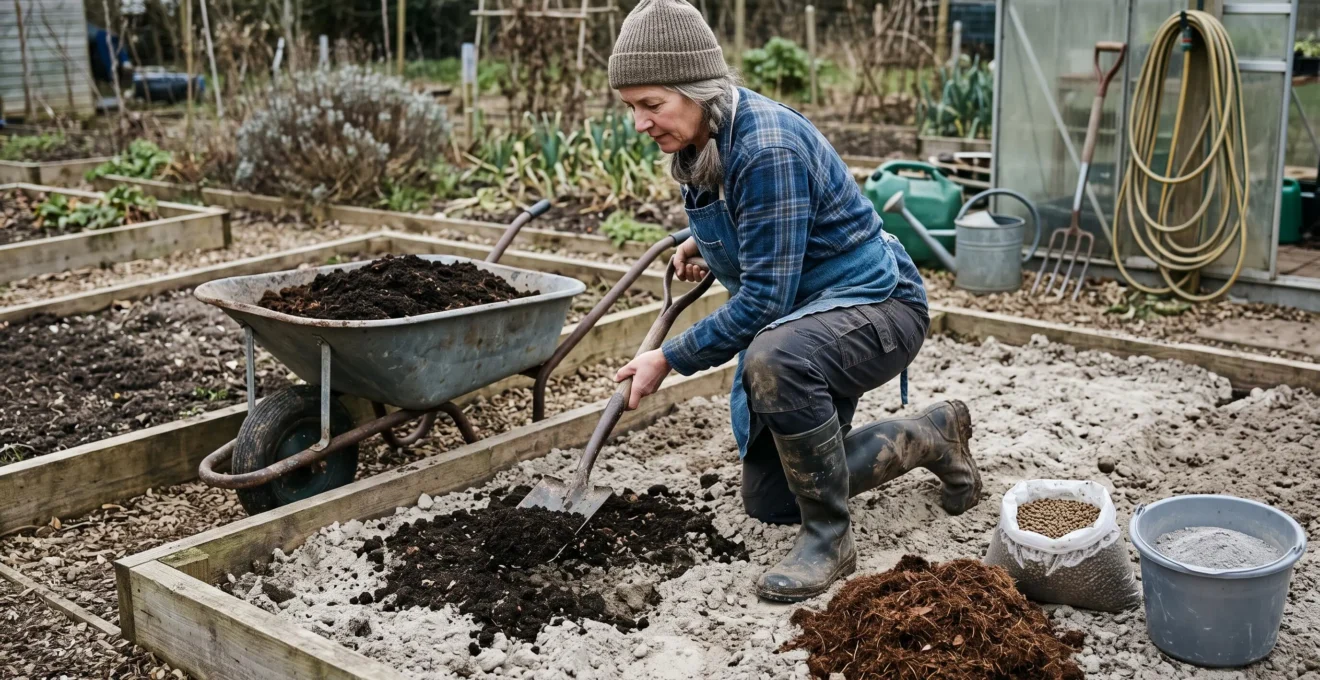
Blood meal and pelleted chicken manure are among the faster-acting organic soil amendments for nutrient-depleted gardens, particularly where nitrogen is limiting plant growth. Well-rotted manure provides broader nutritional and structural benefits, while garden compost, leaf mould and selected mineral amendments support fertility over longer periods.
Choosing the right material depends on what has been lost from the soil. A vegetable bed exhausted by successive harvests may require additional nitrogen, whereas compacted ground with poor drainage needs organic matter and improved biological activity. Adding fertiliser to the latter without addressing its physical condition may achieve little.
For gardeners restoring overworked soil without synthetic fertilisers, the most effective approach combines targeted nutrient replacement with gradual improvements in soil structure. A soil test helps distinguish genuine deficiencies from problems caused by unsuitable pH, restricted root growth or poor moisture management. The objective is not simply to supply more nutrients, but to make existing and newly added nutrients accessible to plants when they need them.
Choosing organic amendments for faster soil recovery
- Use blood meal or pelleted chicken manure to address confirmed nutrient shortages during active plant growth.
- Apply mature compost and leaf mould to rebuild soil structure, moisture retention and biological activity.
- Reserve lime and mineral amendments for soil conditions that justify their use.
- Match application rates and timing to crop requirements, rather than assuming natural materials are harmless in excess.
- Why Does Well-Rotted Manure Feed Plants Faster Than Leaf Mould Despite Both Being Organic?
- How to Use Rock Dust and Lime as Organic Soil Amendments for Long-Term Fertility Building?
- Bagged Organic Amendments vs Homemade Compost: Which Offers Better Value for Large Gardens?
- The Organic Amendment Mistake That Creates Toxicity Despite Being Natural and Chemical-Free
- When Should You Apply Organic Soil Amendments for Maximum Nutrient Uptake and Minimum Loss?
- Why Does the Brown-to-Green Ratio Control Whether Compost Becomes Rich Soil or Smelly Sludge?
- Blood Meal vs Bone Meal vs Pelleted Chicken Manure: Which Organic Fertilizer for Which Purpose?
- How Do Regenerative Gardening Methods Reverse Decades of Soil Degradation in Home Gardens?
Why Does Well-Rotted Manure Feed Plants Faster Than Leaf Mould Despite Both Being Organic?
Well-rotted manure generally supplies plant nutrients faster than leaf mould because it contains more readily available nitrogen and organic compounds that soil microorganisms can mineralise. Leaf mould consists largely of decomposed leaf material, making it more valuable for improving soil structure and moisture retention than for correcting an immediate nutrient deficiency.
The difference lies in how microorganisms process each material. During decomposition, bacteria and fungi convert organic nutrients into mineral forms that roots can absorb. Manure typically contains a greater proportion of nutrient-rich compounds, although its fertilising strength depends on the animal species, bedding material, storage conditions and degree of decomposition.
Leaf mould contains relatively stable organic matter. Its principal contribution is improving the physical environment around roots, particularly in sandy soils that dry rapidly or heavy soils that become compacted.
The distinction between feeding amendments and conditioning amendments provides a practical basis for choosing materials. Guidance from the University of Massachusetts Amherst classifies dried blood as a rapid nutrient source, whereas several mineral amendments release their nutrients much more gradually.
60–75%
The estimated proportion of organic nitrogen in dried blood that becomes available during the first growing season. This figure describes seasonal nutrient availability, not a guaranteed period for visible plant recovery.
Use relatively fast nutrient sources when actively growing plants have a confirmed deficiency. Choose leaf mould when the principal objective is improving moisture retention, aggregation or root development.
Manure must also be sufficiently decomposed. Mature material should be dark, friable and earthy-smelling, without strong ammonia odours or extensive recognisable bedding. Fresh manure can contain damaging concentrations of ammonium and soluble salts, while incompletely decomposed, straw-rich material may temporarily immobilise nitrogen. Appearance alone, however, cannot establish microbiological safety.
Once immediate nutritional requirements are understood, longer-term fertility building depends on whether soil chemistry and physical conditions allow roots to access those nutrients.
How to Use Rock Dust and Lime as Organic Soil Amendments for Long-Term Fertility Building?
Rock dust and garden lime support long-term soil fertility through different mechanisms. Suitable rock dusts can gradually release mineral nutrients, while lime reduces excessive soil acidity and supplies calcium or, depending on its composition, magnesium. Neither should be treated as a universal fertiliser or a rapid remedy for nitrogen deficiency.
Finely ground rock contains minerals that become available through weathering and biological processes. Release rates depend on mineral composition, particle size, soil chemistry and environmental conditions. Granite dust, for example, releases potassium very slowly, according to UMass Amherst’s organic fertilisation guidance.
Lime acts more directly on soil chemistry by neutralising acidity. This can improve nutrient availability in excessively acidic soil, but unnecessary liming can make iron and manganese less accessible to plants.
Testing soil pH before liming is therefore essential. A pH measurement should be interpreted alongside the requirements of the plants being grown and, where possible, a soil laboratory’s recommendations.
Excessive liming may produce interveinal chlorosis, where leaf tissue becomes yellow while veins remain green. This symptom warrants investigation rather than an automatic application of iron or additional fertiliser.
| Amendment | Primary purpose | When application is justified | Main limitation |
|---|---|---|---|
| Rock dust | Gradual mineral supplementation | Where its mineral composition matches an identified requirement | Nutrient release can be extremely slow |
| Calcitic garden lime | Acidity correction and calcium supply | When soil is too acidic for the intended crops | Excessive application raises pH unnecessarily |
| Dolomitic lime | Acidity correction and magnesium supply | When both acidity and magnesium status justify treatment | Unnecessary magnesium addition |
Mineral amendments can complement mature compost because an active soil ecosystem contributes to mineral weathering and nutrient cycling. However, adding compost does not guarantee that every rock dust will provide meaningful quantities of available nutrients.
Correcting those limitations selectively also reduces expenditure on materials that a garden does not need, an important consideration when restoring extensive planting areas.
Bagged Organic Amendments vs Homemade Compost: Which Offers Better Value for Large Gardens?
Homemade compost generally offers better material-cost value for large gardens when sufficient suitable waste, space and preparation time are available. Bagged organic amendments offer greater nutrient precision when they carry a reliable analysis. Combining bulk homemade compost with targeted purchased fertilisers often provides a more practical restoration strategy than relying exclusively on either option.
The comparison should account for nutrient reliability, total application volume and material quality. Homemade compost varies according to its ingredients and decomposition conditions. Bagged fertilisers with a declared nutrient analysis allow more precise nutrient selection, although purchased compost and soil conditioners do not necessarily provide equivalent guarantees.
Gardeners should distinguish between purchasing organic matter to improve the physical condition of soil and purchasing nutrients to correct a measured deficiency.
| Selection criterion | Bagged organic amendments | Homemade compost |
|---|---|---|
| Nutrient consistency | More predictable when supported by a declared analysis | Variable without laboratory testing |
| Bulk application | Purchase and transport costs increase with volume | Economical when suitable feedstocks are readily available |
| Preparation time | Generally ready for use as directed | Requires decomposition and curing |
| Contamination risk | Depends on feedstock sourcing and quality controls | Depends on the origin and management of collected materials |
| Best use | Targeted nutrient correction | General soil conditioning and organic matter replacement |
To assess a bagged amendment, examine its NPK declaration, source materials and recommended application rate. NPK identifies the principal nitrogen, phosphorus and potassium components, although phosphorus and potassium may be declared using oxide equivalents rather than elemental concentrations.
Also check whether the material contains carriers, fillers or other ingredients that dilute its nutrient concentration. A larger bag does not necessarily supply more useful nutrition than a smaller, concentrated product.
For bulk conditioning, compare the delivered cost per litre. For targeted feeding, compare the cost of treating the intended area at the recommended rate. These measures are more useful than comparing bag prices alone.
Where composting capacity is limited, prioritise the most structurally degraded beds for homemade compost and reserve purchased products for diagnosed nutrient shortages.
Whatever the financial advantages, neither purchased nor homemade materials represent good value if their application introduces excessive nutrients or persistent contaminants.
The Organic Amendment Mistake That Creates Toxicity Despite Being Natural and Chemical-Free
The most damaging organic amendment mistake is assuming that natural materials can be applied without considering their concentration, composition or origin. Excess manure, compost and animal-derived fertilisers can create nutrient imbalances, soluble salt accumulation and root damage. Contaminated organic matter can also introduce persistent herbicides that remain active after composting.
Repeated manure applications can raise soil phosphorus levels even when the gardener is primarily trying to supply nitrogen. Excessive phosphorus may interfere with the availability or uptake of certain micronutrients, while surplus nitrogen can contribute to nitrate accumulation in leafy vegetables.
Containers are particularly vulnerable to soluble salt accumulation because roots occupy a restricted volume of growing medium. Applying concentrated organic fertilisers repeatedly without considering previous applications can worsen this problem.
A separate hazard is persistent herbicide carryover. Aminopyralid and similar substances can remain active in manure originating from animals fed treated forage. Ordinary composting does not reliably eliminate these residues.
Beans, peas and tomatoes are sensitive indicator plants. Distorted shoots, cupped leaves and unusually restricted growth may suggest contamination, although these symptoms can also have other causes.
A controlled plant bioassay offers a practical screening method. The procedure described in NC State Extension‘s herbicide carryover guidance uses representative samples, untreated control plants and comparative observations over two to three weeks. Germination alone is insufficient to assess the material.
Five steps to screen manure or compost for herbicide contamination
- Collect material from different locations and depths within the pile, producing a representative combined sample.
- Prepare three to six test pots, approximately 10–13 cm across, containing equal parts sampled material and commercial fertilised potting mix.
- Prepare separate control pots containing only the same commercial potting mix, with clear labels distinguishing controls from samples.
- Sow three bean or pea seeds in each pot and maintain comparable growing conditions for two to three weeks.
- Compare shoot development and leaf shape against the controls, recording any visible abnormalities before deciding whether to use the material.
A satisfactory bioassay provides useful evidence but is not equivalent to laboratory residue analysis. Suspect material should be kept away from sensitive crops.
Raw poultry manure presents additional risks from concentrated nutrients and potentially harmful microorganisms. Use properly processed material rather than relying on an arbitrary ageing period. Commercial blood meal does not inherently require composting, but it must be applied at the recommended rate and kept away from direct contact with seeds and sensitive roots.
Once material quality and application rates are controlled, timing becomes the next important factor in preventing nutrient losses and unnecessary plant stress.
When Should You Apply Organic Soil Amendments for Maximum Nutrient Uptake and Minimum Loss?
Apply fast-releasing organic fertilisers shortly before or during active plant growth, when roots can absorb the nutrients supplied. Mature compost and leaf mould can be applied during autumn or spring for longer-term soil improvement. Mineral amendments require timing based on soil test results, material properties and the needs of the intended crops.
Organic nutrient release depends heavily on soil temperature, moisture and microbial activity. UMass Amherst notes that mineralisation generally accelerates as soil warms in late spring, while annual crops can have substantial nitrogen requirements three to four weeks after emergence or transplanting.
Applying nitrogen-rich material long before plants need it can therefore reduce its effectiveness. In wet conditions, nitrate may move below the active root zone through leaching. Surface-applied manure can also lose nitrogen through ammonia volatilisation, depending on its composition and environmental conditions.
Where appropriate, shallow incorporation of concentrated fertilisers reduces exposure at the surface. A suitable mulch can help regulate soil moisture and protect against erosion, but it cannot prevent all dissolved nutrient losses. Avoid applying nutrient-rich amendments immediately before heavy rainfall or onto waterlogged ground.
| Growing area | Preferred timing | Application approach |
|---|---|---|
| Established vegetable beds | Before planting and during active growth as required | Apply targeted nutrients according to crop demand and previous applications |
| New or depleted beds | Autumn or before the spring growing season | Build soil structure with mature organic matter and correct confirmed deficiencies |
| Established perennial borders | Before seasonal growth or during suitable mulching periods | Use surface-applied organic matter without disturbing established roots |
| Container gardens | Throughout active growth when additional feeding is needed | Use container-suitable products at their specified rates and intervals |
In the UK’s wetter autumn and winter conditions, reserve readily available nitrogen for periods when plants can use it. Stable organic matter can be more suitable for off-season conditioning, particularly when beds remain protected by mulch or vegetation.
Container feeding requires separate management. Frequent watering can remove soluble nutrients, but repeated fertiliser applications can also concentrate salts. Follow product-specific guidance rather than copying open-ground application rates.
Seasonal planning becomes more reliable when homemade compost is sufficiently mature, making the management of the compost pile an integral part of garden fertility.
Why Does the Brown-to-Green Ratio Control Whether Compost Becomes Rich Soil or Smelly Sludge?
The balance between carbon-rich browns and nitrogen-rich greens determines whether composting microorganisms have suitable nutrition, moisture and oxygen. Too many dry browns can slow decomposition, while excessive wet greens may restrict airflow and produce anaerobic conditions. A balanced mixture encourages aerobic decomposition and creates more stable organic matter for garden soil.
Browns include dry leaves, untreated cardboard and suitable woody materials. They provide carbon as an energy source for microorganisms and, particularly when coarse enough, help maintain air spaces within the pile. Greens include fresh grass clippings and vegetable scraps, which contribute nitrogen and moisture.
According to the EPA‘s home composting recommendations, a practical starting mixture contains two to three parts brown material to one part green material. This is a material-mixing guideline rather than an exact elemental carbon-to-nitrogen ratio.
The condition of an existing pile provides useful evidence about what needs correcting. Adding more ingredients without identifying the underlying problem can prolong decomposition.
| Observable problem | Likely explanation | Corrective action |
|---|---|---|
| Slimy material with an unpleasant smell | Excess moisture or restricted oxygen | Add dry browns and turn the pile to restore airflow |
| Dry, largely unchanged ingredients | Insufficient moisture | Add water gradually while turning the material |
| Moist pile showing little decomposition | Possible nitrogen shortage | Add suitable greens and mix thoroughly |
| Dark, crumbly material with an earthy smell | Advanced decomposition | Allow curing to finish before garden application |
3–5 months
The EPA’s estimated production time for finished compost in a well-maintained backyard pile. Cold weather, unsuitable moisture levels and slowly decomposing ingredients can extend this period.
United States Environmental Protection Agency, Composting At Home.
The EPA also recommends a curing period of at least four weeks after the pile stops reheating when mixed and recognisable food scraps have disappeared.
Mature compost provides more dependable soil-conditioning benefits than unfinished material. Its nutrient concentration remains variable, but completing decomposition reduces the likelihood of introducing unstable organic matter that competes with growing plants for available nitrogen.
Even well-prepared compost may not supply enough of a particular nutrient when plants need it urgently, which is where concentrated animal-derived fertilisers become useful.
Blood Meal vs Bone Meal vs Pelleted Chicken Manure: Which Organic Fertilizer for Which Purpose?
Blood meal is most appropriate for correcting confirmed nitrogen shortages, bone meal supplies phosphorus and calcium where soil conditions permit effective uptake, and pelleted chicken manure provides several major nutrients for broader feeding. The right choice depends on the deficient nutrient, existing soil fertility, plant requirements and the product’s declared composition.
The three materials differ substantially in nutritional concentration and release behaviour. Blood meal is relatively fast-acting, making it useful where an established nitrogen shortage is restricting leafy growth. Bone meal releases nutrients more gradually and should only be used where additional phosphorus or calcium is justified.
Chicken manure typically provides a wider range of macronutrients, although pellet formulations vary. The comparative guidance in the University of Saskatchewan‘s comparison of animal-based fertilizers identifies blood meal as a fast nutrient source and bone meal as a medium-release material, while chicken manure generally has medium-to-fast nutrient availability.
| Selection criterion | Blood meal | Bone meal | Pelleted chicken manure |
|---|---|---|---|
| Principal nutrients | Nitrogen | Phosphorus and calcium | Nitrogen, phosphorus and potassium |
| Typical release behaviour | Fast | Moderate, often gradual | Variable according to processing and formulation |
| Best application | Confirmed nitrogen deficiency | Identified phosphorus requirement | Broader nutrient supplementation |
| Main misuse | Excessive nitrogen application | Adding phosphorus to already phosphorus-rich soil | Repeated applications without accounting for accumulated nutrients |
| Important precaution | Keep concentrated material away from sensitive roots | Check soil pH and phosphorus status | Follow application rates and avoid concentrated deposits around stems |
Blood meal can attract animals and damage plants when overapplied. Yellowing older leaves may indicate nitrogen deficiency, but waterlogging, root damage and other stresses should be ruled out before treating the symptom.
Bone meal becomes a less suitable phosphorus source in alkaline soil because its phosphorus compounds are less readily available under those conditions. Applying additional phosphorus does not automatically improve flowering or root development when the soil already contains sufficient amounts.
Pelleted chicken manure is convenient for mixed vegetable gardens, but its broad nutrient profile does not make it universally balanced for every soil. Repeated use can supply more phosphorus than crops remove.
These concentrated amendments are most effective when used to fill identifiable nutritional gaps within a garden whose physical condition and biological processes are also being restored.
Key principles for lasting soil fertility
- Treat recurring nutrient deficiencies as a possible sign of restricted root activity or unsuitable soil chemistry, rather than automatically increasing fertiliser applications.
- Manage nutrient reserves and organic matter as separate but complementary aspects of soil restoration.
- Build a fertility strategy around continuous soil protection and biological nutrient cycling so that corrective amendments become supplementary rather than routine inputs.
How Do Regenerative Gardening Methods Reverse Decades of Soil Degradation in Home Gardens?
Regenerative gardening restores degraded soil by reducing unnecessary disturbance, maintaining protective ground cover, increasing plant diversity and supplying organic matter to soil organisms. These practices help rebuild aggregation, improve water movement and support nutrient cycling. Recovery is gradual, and its speed depends on the extent of previous degradation and ongoing management.
Repeated cultivation, bare soil exposure and intensive cropping can weaken soil structure and reduce the organic resources available to soil organisms. Adding fertilisers may temporarily improve plant growth without addressing these underlying problems.
A regenerative approach makes biological nutrient cycling a central part of fertility management. Mature compost supplies decomposed organic matter, leaf mould protects moisture-sensitive soil, and living roots contribute organic compounds that support microorganisms. Concentrated organic fertilisers remain useful when specific nutrient shortages persist.
Begin by identifying visible signs of degradation. Each symptom should guide a management response, although further investigation may be necessary when several problems occur together.
| Observable sign | Possible underlying problem | Recommended management response |
|---|---|---|
| Hard, compacted ground | Restricted pore space and root penetration | Avoid unnecessary cultivation and foot traffic; introduce mature organic matter |
| Surface crusting | Weak soil aggregation and exposure to rainfall | Maintain protective organic mulch or suitable living cover |
| Water running off planting beds | Poor infiltration or surface compaction | Protect the surface, improve organic matter levels and investigate drainage |
| Few visible earthworms | Potentially unsuitable moisture, pH or organic matter conditions | Maintain organic residues and investigate environmental limitations |
| Repeated poor crop performance | Nutrient imbalance, restricted roots or unsuitable soil chemistry | Test the soil and apply targeted corrections while restoring growing conditions |
In the first growing season, improved surface protection and moisture management may make soil easier to maintain. Changes in workability and infiltration can become apparent before substantial increases in soil organic matter are measurable.
Rebuilding stable soil structure and organic matter reserves generally requires sustained management over multiple growing seasons. Severely compacted or chemically imbalanced soils may need additional corrective measures. No universal recovery period can be guaranteed.
Progress is best assessed through repeatable observations: how readily water infiltrates, whether roots penetrate the soil, how the surface responds to rainfall and whether laboratory nutrient measurements become more consistent over time.
Start with the most depleted planting bed. Record its current condition, obtain a soil test, identify the principal limitation and choose an amendment that addresses it. Combine that targeted treatment with protective ground cover and minimal unnecessary disturbance, then reassess soil condition and plant performance during the following growing season.
How can you tell whether depleted soil needs fertiliser or more organic matter?
A soil nutrient test helps identify chemical deficiencies, while observations of compaction, drainage and moisture retention help assess physical condition. Soil with adequate nutrient reserves but poor root penetration may benefit more from structural improvement than additional fertiliser. Both treatments may be necessary where nutritional and physical limitations occur together.
Can organic soil amendments be applied without digging?
Yes. Mature compost and leaf mould can be spread over established beds, allowing soil organisms and natural processes to incorporate organic matter gradually. Concentrated fertilisers and mineral amendments may require shallow incorporation or another specific application method. Follow the instructions appropriate to the material without unnecessarily disturbing established roots.
Why have plants not recovered after applying an organic fertiliser?
Cold soil, insufficient moisture, waterlogging, unsuitable pH and restricted root growth can all limit nutrient availability or uptake. The original diagnosis may also have been incorrect. Check these conditions before repeating an application, particularly because organic nutrient sources release their nutrients at different rates and do not guarantee immediate visible recovery.
Are organic soil amendments suitable for acid-loving plants?
Suitable organic amendments can benefit acid-loving plants, but their effects on soil pH must be considered. Leaf mould can provide useful soil-conditioning benefits, whereas lime should generally be avoided where the existing acidity suits the plants. Check the amendment’s composition and the growing medium’s pH before applying nutrient-rich or mineral materials.
Can homemade compost completely replace purchased organic fertilisers?
Homemade compost may meet the requirements of some gardens, particularly where existing soil fertility is adequate and crop nutrient demand is modest. However, its variable nutrient composition makes it difficult to guarantee that it will correct a specific deficiency. Targeted purchased fertilisers may remain useful when soil testing or crop requirements justify additional nutrients.