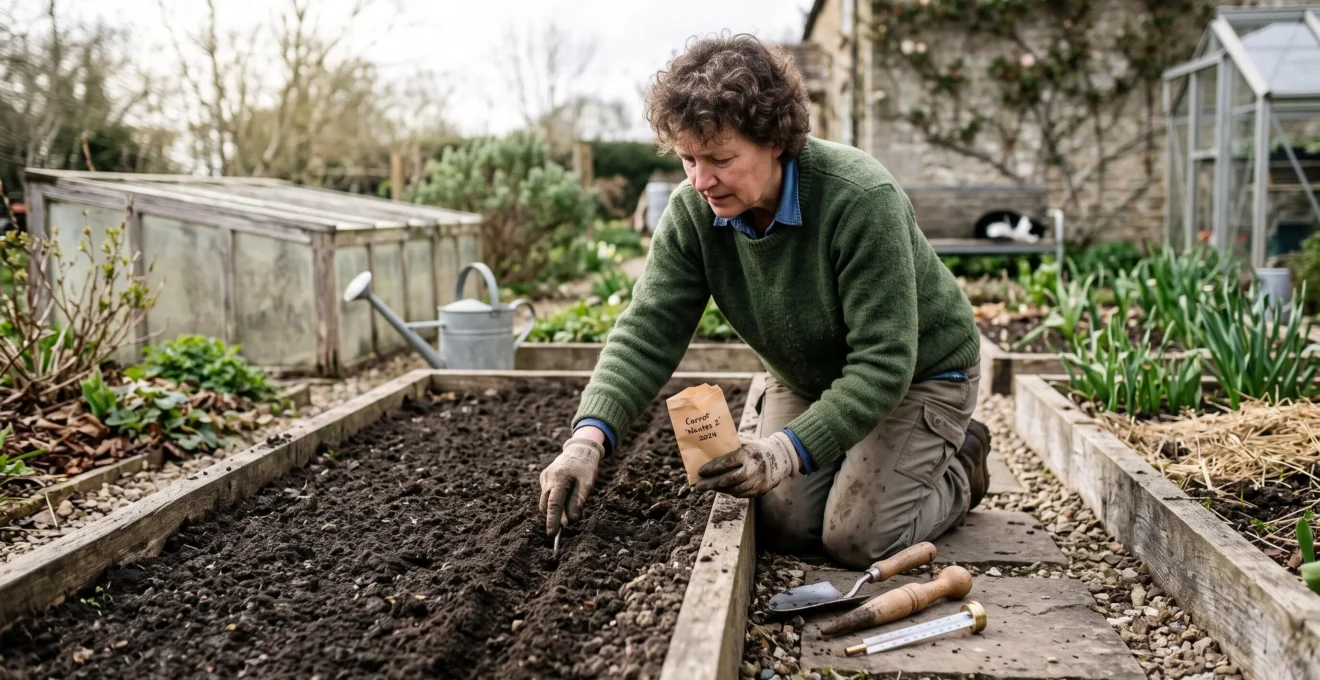
Accurate planting schedules improve germination rates and harvest yields by matching sowing and transplanting dates to the conditions each vegetable needs. Seeds establish more reliably when soil temperature, moisture and oxygen availability are suitable, while transplants develop stronger roots when planted after the relevant frost risk has passed. Although substantial improvements are possible in gardens where poor timing previously caused repeated failures, a 50% increase in germination or yield is not a universally established or guaranteed result.
The challenge for UK gardeners is that spring arrives at different speeds across the country. A sowing date suitable for sheltered gardens in Cornwall may expose seeds to prolonged cold and excessive moisture in Scotland. Even neighbouring gardens can have different planting windows because of drainage, elevation, shade and exposure.
A reliable vegetable planting calendar therefore combines regional growing seasons with observations from individual beds. Knowing when to prepare, when to sow and when to postpone a planting is more valuable than following a fixed timetable regardless of the weather.
What makes a UK planting schedule reliable?
- Use regional frost patterns to establish provisional sowing and transplanting windows, then adjust them to your garden’s microclimate.
- Check soil temperature and drainage before sowing rather than relying exclusively on calendar dates or daytime air temperatures.
- Choose autumn or spring planting according to crop biology, winter conditions and soil suitability.
- Record germination, transplant establishment and harvest performance to identify which timing adjustments genuinely improve productivity.
- Why Do Scottish Planting Schedules Differ from South-West England by Over a Month?
- How to Build a Custom Planting Schedule for Your Specific UK Postcode and Microclimate?
- Spring vs Autumn Planting: Which Season Delivers Better Results for Broad Beans and Garlic?
- The Soil Temperature Mistake That Kills Seeds Before They Germinate Despite Perfect Timing
- Should You Stick to Traditional Planting Schedules or Adapt Them for Changing UK Climates?
- Why Won’t Tomato Seeds Germinate Below 15°C While Lettuce Sprouts at 5°C?
- The Sowing Timing Mistake That Produces Weak Transplants from Premature February Starts
- Why Do Soil Temperatures Predict Germination Success More Accurately Than Calendar Dates?
Why Do Scottish Planting Schedules Differ from South-West England by Over a Month?
Scottish planting schedules can run more than a month behind those of South-West England because colder spring conditions, differences in daylight patterns and local maritime influences affect soil warming and frost exposure. South-western coastal gardens often benefit from relatively mild winters, while many Scottish gardens need longer before outdoor beds become suitable for reliable sowing.
The North Atlantic’s warming influence, associated with the Gulf Stream and North Atlantic Drift, moderates temperatures along Britain’s western coastline. However, latitude, altitude and exposure still create substantial regional differences. Scotland’s longer summer days can support vigorous growth once plants establish, but they do not compensate for insufficient warmth during early spring germination.
The following indicative planting windows illustrate how the same vegetables might be scheduled across three UK regions. They are practical starting points rather than verified regional frost forecasts or universal planting dates.
| Vegetable | South-West England | Midlands | Scotland |
|---|---|---|---|
| Early carrots | March, with protection where necessary | April | April–May |
| Spring-sown broad beans | February–March | March–April | March–April, later on exposed sites |
| First early potatoes | March | Late March–April | April–May |
These windows should be refined using local phenological indicators, meaning seasonal events that respond naturally to changing environmental conditions. Blossom appearing on nearby plum trees and the emergence of annual weeds can indicate advancing spring development, although neither independently proves that a vegetable bed is ready for sowing.
Copying a southern English schedule in a cold Scottish garden risks more than slow emergence. Seeds remaining in cold, saturated ground may deteriorate before establishing, leaving gaps that require resowing.
Regional guidance narrows the possibilities, but the conditions within an individual garden ultimately determine when planting should begin.
How to Build a Custom Planting Schedule for Your Specific UK Postcode and Microclimate?
Build a postcode-specific planting schedule by identifying typical local frost windows, calculating crop development times and adjusting provisional dates for your garden’s exposure, drainage and soil temperature. Combine nearby weather station records with direct observations from your vegetable beds. Over successive growing seasons, these records create a more reliable calendar than regional recommendations alone.
Start by consulting Met Office climate records and relevant RHS growing advice. Identify the typical period of the last spring frost and the first autumn frost using the nearest representative weather station. A postcode helps locate relevant observations, but it cannot provide a guaranteed frost-free date for an individual garden.
Work backwards from the intended transplanting date using the propagation period recommended for each crop. For direct-sown vegetables, calculate the expected harvest window using the variety’s stated maturity period. When planning late-season crops, allow additional flexibility for slower development as temperatures and daylight decline.
Next, assess the microclimate of each growing bed. South-facing walls can provide shelter and retain warmth, while low points in sloping gardens may collect cold air overnight. Urban gardens can benefit from heat retained by surrounding buildings, and coastal locations often experience moderated temperatures, although exposed coastal beds may suffer from strong winds.
A three-year growing log provides a practical foundation for refining planting decisions. Record observed frost dates, sowing dates, germination, transplant establishment and harvest quantities. Include unsuccessful sowings, since excluding failures would distort the apparent reliability of your schedule.
In sheltered beds, experiment with sowing one or two weeks earlier than your usual date. Use inexpensive trial quantities and retain sufficient seed for the conventional sowing window. Compare the results before adopting an earlier date permanently.
Five steps to create your personal vegetable planting calendar
- Identify representative local frost records and produce a reference sheet showing provisional spring and autumn frost windows.
- Collect maturity and propagation information from your seed packets and create a crop-by-crop schedule of provisional sowing, transplanting and harvesting dates.
- Inspect your growing area and draw a simple map identifying sheltered beds, shaded areas, frost pockets and poorly drained ground.
- Establish an experimental sowing beside a conventional sowing of the same variety and label both with their dates and growing conditions.
- Maintain a three-year observation log containing germination counts, frost incidents, harvest dates and comparable harvest weights.
Once your local growing windows are established, deciding whether particular vegetables should overwinter outdoors becomes a more manageable calculation.
Spring vs Autumn Planting: Which Season Delivers Better Results for Broad Beans and Garlic?
Autumn planting generally suits garlic and hardy broad beans grown in mild, free-draining gardens, while spring planting offers a safer alternative for broad beans in cold, exposed or waterlogged locations. Garlic usually benefits from winter cold exposure for bulb development, but suitable varieties and protected establishment methods allow gardeners to avoid unsuitable overwintering conditions.
Autumn-sown broad beans can establish before winter, taking advantage of available soil moisture and resuming growth as temperatures rise. However, prolonged dampness increases concerns about overwintering losses and diseases such as chocolate spot. Autumn planting is therefore a balance between potential harvest advantages and exposure to damaging conditions.
According to RHS advice on autumn and spring broad bean sowing, hardy varieties such as Aquadulce are suitable for November sowing. Where autumn conditions are excessively wet or windy, starting a fast-maturing cultivar such as Monica indoors during February can produce crops that mature at a similar time.
“there is hardly any difference in maturity times between these and autumn sown seeds.”
Garlic differs from broad beans because its development usually benefits from a period of cold exposure, associated with vernalisation and subsequent bulb formation. Autumn planting provides a convenient way to satisfy this requirement, but planting directly outdoors in autumn is not an absolute biological necessity.
As explained in the RHS garlic growing guide, gardeners with heavy soil that remains wet throughout winter can start cloves in modules before transplanting them outdoors in spring.
The most suitable planting season depends on the interaction between crop requirements, winter survival and ground conditions.
| Decision criterion | Autumn planting | Spring planting or transplanting |
|---|---|---|
| Overwintering survival | Depends on variety hardiness, shelter and winter severity. | Avoids prolonged exposure to unsuitable winter ground conditions. |
| Disease pressure | Prolonged wet conditions can favour disease development. | Reduces winter exposure but does not eliminate disease risk. |
| Harvest timing | Potentially earlier establishment and harvesting. | Early spring broad beans can approach autumn-sown maturity times. |
| Heavy or waterlogged soil | Generally less suitable without effective drainage. | Often preferable, including garlic started in modules. |
| Garlic cold exposure | Naturally provides a winter chilling period. | Requires attention to cultivar suitability and previous cold exposure. |
Regardless of the chosen season, successful establishment depends on the physical conditions surrounding the seed or clove, particularly soil temperature and moisture.
The Soil Temperature Mistake That Kills Seeds Before They Germinate Despite Perfect Timing
A vegetable seed can fail even when sown within its recommended calendar window. If the surrounding soil remains below the crop’s effective germination temperature, the seed may absorb moisture without developing rapidly enough to establish. Prolonged exposure to unfavourable conditions increases its vulnerability to decay, soil-borne pathogens and other causes of seed loss.
Germination begins with imbibition, the process through which a seed absorbs water. This activates metabolic processes that support embryo development. However, absorbing water does not guarantee successful germination, particularly when temperatures remain unsuitable or waterlogged soil restricts oxygen availability.
The common spring mistake is confusing warm afternoon air with warm soil. Several sunny days in February or March may make outdoor conditions feel suitable for gardening while the ground remains too cold for the intended crop.
Use a soil thermometer to assess conditions within the seed zone, typically around 2–5 cm for relevant direct-sown crops, adjusting the measurement to the actual sowing depth and the thermometer’s design. Take readings at a consistent mid-morning time over several days. This is a practical garden monitoring routine rather than a universal scientific measurement standard.
Organise vegetables into cool-season and warmth-demanding sowing groups to simplify planting decisions.
| Crop group | Examples | Suitable establishment conditions |
|---|---|---|
| Cool-season vegetables | Lettuce, spinach, peas and broad beans | Cool but workable, adequately aerated soil. |
| Warm-season vegetables | French beans and sweetcorn | Reliably warmed soil without prolonged cold conditions. |
| Warmth-demanding tender crops | Courgettes, peppers and cucumbers | Warm seed zones or controlled propagation under cover. |
When outdoor soil remains unsuitable, cloches or dark soil coverings can help encourage warming before sowing. Monitor the temperature beneath the covering rather than assuming that protection has achieved the necessary improvement. Alternatively, start transplant-tolerant vegetables in modules under appropriate conditions.
Recognising a false spring becomes increasingly important when historical planting dates no longer correspond consistently to prevailing weather conditions.
Should You Stick to Traditional Planting Schedules or Adapt Them for Changing UK Climates?
Traditional planting schedules remain useful as planning references, but UK gardeners should adapt them when repeated local observations demonstrate that growing conditions have changed. Warmer average temperatures do not automatically justify earlier sowing because rainfall, soil drainage, frost events and pest activity can offset the potential advantages of an extended growing season.
Historical gardening calendars reflect accumulated experience under particular climatic conditions. Their regional recommendations provide a valuable baseline, especially when combined with crop-specific advice. However, climate observations show that the environmental conditions underlying those recommendations are changing.
+0.51°C
The UK’s average temperature during 2016–2025 was 0.51°C higher than during the 1991–2020 climate reference period. This national increase does not establish an equivalent rise in spring soil temperatures or an earlier planting date for every garden.
Met Office, State of the UK Climate assessment, based on the 2025 report published on 15 July 2026.
Temperature is only part of the adjustment. The same Met Office assessment reports that October–March precipitation during 2016–2025 was 3% higher than during 1991–2020. Wetter ground can remain unsuitable for sowing despite comparatively mild air temperatures.
Changing rainfall patterns also make it important to prepare for dry spells during spring establishment. A seedbed that warms early but dries rapidly may require more attentive watering. Conversely, poorly drained beds may need longer before cultivation can begin. National climate figures alone cannot establish whether an individual garden is experiencing a trend towards drier springs.
Earlier growth also introduces biological risks. Mild winters may favour the survival of certain pests and pathogens, while plants encouraged into early development remain vulnerable to subsequent frost events. These effects depend on the organisms involved and local conditions.
The most dependable adjustment strategy is to retain traditional dates as a control while testing small sowings one or two weeks earlier. Compare emergence, plant health and usable harvests over two or three seasons before permanently advancing the schedule.
Any climate-responsive planting calendar must still respect the different biological temperature requirements of individual vegetables.
Why Won’t Tomato Seeds Germinate Below 15°C While Lettuce Sprouts at 5°C?
Tomato seeds require warmer germination conditions than lettuce because their physiological processes are adapted to different temperature ranges. However, 15°C is not an absolute minimum for tomato germination: some tomato seeds can germinate at lower temperatures, although establishment may be slower or less reliable. Lettuce can germinate successfully under substantially cooler conditions.
Temperature influences enzyme activity, respiration and the metabolic processes that supply energy for embryo growth. Each crop has a minimum, optimum and maximum germination temperature. Operating near the biological minimum is different from providing conditions that encourage rapid and consistent emergence.
Penn State Extension’s seed germination and seedling biology publication identifies a minimum germination temperature of approximately 10°C for tomatoes and 1.7°C for lettuce. Its listed optimum for tomato germination is approximately 29.4°C.
| Vegetable | Minimum germination temperature | Propagation implication |
|---|---|---|
| Lettuce | 1.7°C | Cool propagation conditions are possible; excessive heat can inhibit germination. |
| Spinach | 1.7°C | Can germinate in comparatively cool conditions. |
| Tomatoes | 10°C | Warmer propagation generally supports more reliable establishment. |
| Peppers | 15.6°C | Controlled warmth is particularly useful for early sowings. |
| Cucumbers and squash | 15.6°C | Avoid premature sowing into cold growing media. |
These figures come from the Penn State Extension temperature table and are converted from Fahrenheit. They represent indicative biological minima rather than recommended operating temperatures for every cultivar or seed lot.
Excessive warmth can also be counterproductive. The same publication lists an upper germination limit of approximately 29.4°C for lettuce, illustrating why heated propagation is not universally beneficial.
Separate cool-germinating crops such as lettuce, spinach, peas and broad beans from warm-germinating crops such as tomatoes, peppers, French beans and courgettes. Reserve heated propagators for crops that genuinely benefit from additional warmth, avoiding unnecessary energy consumption.
The distinction between germination temperature and growing-on temperature is equally important. Once tomatoes emerge, maintaining excessive warmth without sufficient light can encourage weak, elongated growth. Adjust the propagation environment after emergence rather than applying one temperature setting throughout seedling development.
Providing sufficient warmth to germinate a seed is only the first stage; the resulting seedling must also receive enough light to develop into a healthy transplant.
The Sowing Timing Mistake That Produces Weak Transplants from Premature February Starts
Starting tender vegetables too early in February can produce seedlings whose growth is driven by indoor warmth but constrained by limited natural light. The mismatch between temperature and light availability encourages stem elongation and weak development, particularly when tomatoes and other warmth-demanding vegetables are grown on inadequately lit windowsills.
Seedlings require light to support photosynthesis after emergence. A warm room may accelerate growth while short winter days and weak sunlight limit the energy available for producing sturdy stems, leaves and roots. Penn State Extension’s seedling biology guidance identifies inadequate light as a cause of elongated, fragile seedlings that may not achieve their productive potential.
The consequences can continue after propagation. Weak transplants may struggle to establish after potting on, suffer greater stress during hardening off and take longer to resume active growth outdoors. Under these circumstances, a later-sown seedling grown in better light can outperform an earlier start, although this outcome is not guaranteed.
Match the sowing date to your available propagation environment. Gardeners relying on natural windowsill light or an unheated greenhouse should delay tender crops until adequate light and warmth are available. Gardeners with thermostatically controlled propagation and suitable supplementary lighting have greater flexibility to begin earlier.
If seedlings have already become leggy, adjust the growing environment before discarding them. Increase their light exposure, reduce excessive warmth while remaining within crop-safe temperatures, and pot on when root development requires additional space. Avoid transplanting tender seedlings outdoors prematurely simply because they have become too tall for their original containers.
Healthy, compact growth and a suitable root system are better indicators of transplant readiness than age alone. Gradual hardening off should follow when outdoor conditions become appropriate.
The objective is to have vigorous seedlings ready when the outdoor growing environment becomes suitable, rather than producing the earliest possible seedlings regardless of their eventual planting conditions.
Key planting decisions to remember
- Distinguish biological germination limits from temperatures that support dependable emergence and healthy development.
- Evaluate the performance of an earlier sowing through established plants and usable harvests, not simply the date of first emergence.
- Keep alternative sowing dates and spare seed available so that unsuitable conditions do not force a premature planting decision.
Why Do Soil Temperatures Predict Germination Success More Accurately Than Calendar Dates?
Soil temperatures are more direct indicators of temperature-related germination suitability than calendar dates because they measure the conditions experienced by seeds. Calendar recommendations estimate when suitable conditions are likely to occur, whereas thermometer readings reveal whether the seedbed has actually warmed. Reliable germination also depends on moisture, oxygen availability and seed viability.
A date printed on a seed packet cannot account for a cold spring, prolonged rainfall, shaded growing beds or the thermal differences between individual gardens. Soil measurements allow gardeners to distinguish a theoretically suitable sowing window from conditions that genuinely support the intended crop.
For direct sowing, choose a thermometer suitable for measuring the relevant seed-zone depth. Take readings at approximately 10 am over three to five consecutive mornings, using the same location and measurement technique. Treat this schedule as a practical consistency method rather than a scientifically validated universal testing protocol.
Wait until readings remain within a suitable germination range for the intended vegetable, rather than responding to a single warm measurement or merely reaching its biological minimum. Where possible, consult the variety’s recommended propagation conditions and check whether colder weather is expected.
Measurement depth matters. Penn State Extension recommends inserting a soil thermometer approximately 7.6–10.2 cm into the ground for its general soil temperature assessment method. Shallower measurements may be useful when investigating the immediate environment of small, shallow-sown seeds, provided the instrument is designed for that purpose.
Temperature must also be assessed alongside consistent moisture and adequate soil aeration. Seeds need water to activate germination and oxygen to sustain respiration. Saturated or compacted soil can restrict oxygen availability even when temperatures are favourable.
The effectiveness of an improved planting schedule should ultimately be measured against previous results. Germination percentages and harvest weights require separate comparisons because more seedlings do not automatically produce proportionally greater yields.
Hypothetical example: measuring a 50% improvement in planting performance
Suppose two comparable sowings each contain 100 seeds of the same variety. The conventional calendar-based sowing produces 40 seedlings, while a sowing delayed until suitable soil conditions develop produces 60 seedlings. Germination increases from 40% to 60%, representing a relative improvement of 50%, or 20 percentage points.
If comparable growing areas subsequently produce 4 kg and 6 kg of usable vegetables respectively, the difference in harvest weight also represents a 50% increase. These figures illustrate how to calculate improvement; they are not experimental findings or a prediction of typical results.
Such comparisons become more meaningful when seed variety, growing area, sowing density, watering and other management practices remain comparable. Recording results across multiple seasons helps distinguish a useful timing adjustment from favourable weather or other influences.
Before your next sowing, select one vegetable that previously established poorly. Record its recommended planting window, monitor the soil, and compare a conventional sowing with a condition-based sowing. Track emergence and usable harvest weight to establish whether changing the timing delivers a measurable benefit in your own garden.
Can raised beds be planted earlier than conventional vegetable plots?
Raised beds can become workable earlier when their drainage and exposure encourage warming. However, their performance depends on construction, soil composition and location. Compare soil temperatures and moisture levels in raised and conventional beds before advancing sowing dates.
Should I adjust my planting schedule when growing vegetables in containers?
Yes. Containers can warm rapidly in sunlight but may also lose warmth quickly overnight and dry out faster than surrounding garden soil. Monitor the temperature and moisture of the growing medium itself, particularly when propagating tender vegetables outdoors.
How can I tell whether failed germination was caused by poor timing or old seeds?
Test a representative sample from the same seed packet under suitable controlled germination conditions. If the sample germinates successfully while outdoor sowings fail, environmental conditions or sowing practices deserve investigation. Poor results under both sets of conditions may indicate reduced seed viability, although other germination requirements should also be checked.
Does horticultural fleece allow vegetables to be planted before the last frost?
Horticultural fleece can provide protection against some cold conditions and may extend planting opportunities for suitable hardy crops. Its effectiveness depends on the material, installation, wind exposure and frost severity. It should not be treated as a guarantee of protection for frost-sensitive vegetables.
Can an accurate planting schedule guarantee a 50% increase in vegetable yields?
No. Accurate scheduling can reduce avoidable establishment failures and improve growing opportunities, but the evidence does not establish a universal 50% yield increase. Results depend on the original cause of poor performance, crop variety, soil fertility, water availability, plant spacing, pest pressure and subsequent weather. Measure comparable harvest weights to determine the actual improvement.