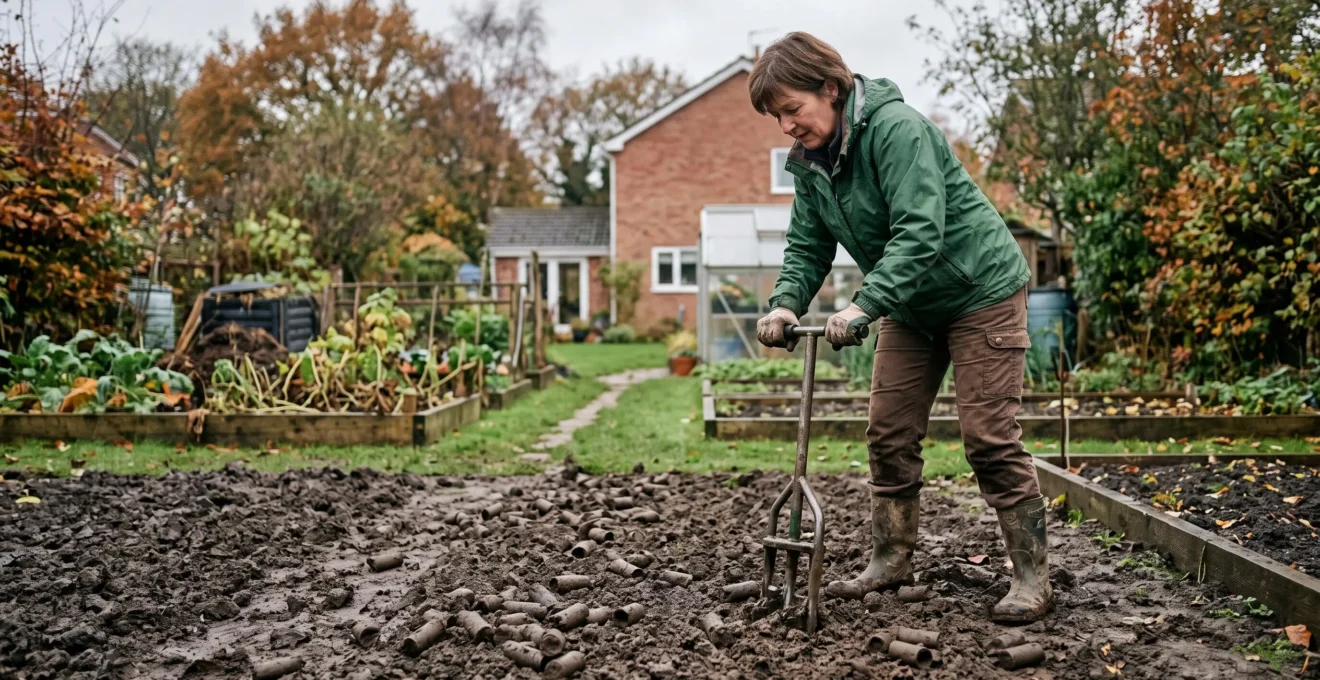
Soil aeration improves plant growth in heavy clay gardens by restoring the air-filled pores that supply oxygen to roots. When clay becomes compacted, roots struggle to respire, absorb nutrients and develop, even when water and fertiliser are readily available. Mechanical compaction relief addresses this physical restriction rather than attempting to compensate for it with additional feeding.
Research demonstrates substantial benefits from improving root-zone oxygen availability. A 2004 Australian study of aerated subsurface irrigation in heavy clay soils recorded a 25% increase in courgette fruit yield, a 29% increase in fruit number and a 24% increase in shoot weight under an oxygen-enrichment treatment.
However, these results concern oxygenated irrigation rather than mechanical garden aeration. They do not establish a universal 30% increase in plant growth rates.
For gardeners dealing with dense, poorly draining clay, the practical objective is to restore oxygen movement throughout the rooting zone while developing a soil structure that remains permeable between treatments.
Soil aeration in heavy clay: the essential principles
- Compacted clay restricts root respiration by reducing the connected air-filled pores through which oxygen travels.
- Hollow-tine aeration removes compacted soil rather than simply pushing it sideways, making it particularly suitable for heavy clay lawns.
- Mechanical loosening works best when clay is moist but friable, followed by organic matter management and protection against renewed compaction.
- Why Do Clay Soils Drown Roots in Winter Yet Crack Like Concrete in Summer?
- How Do Regenerative Gardening Methods Reverse Decades of Soil Degradation in Home Gardens?
- How to Transition from Traditional Digging to No-Dig Methods Without Yield Loss?
- Why Do Waterlogged-Looking Plants in Clay Soil Actually Suffer from Oxygen Starvation, Not Overwatering?
- Should You Aerate Soil with a Garden Fork or Invest in a Mechanical Spike Aerator?
- Core Aeration vs Spiking: Which Method Relieves Compaction for Longer in Heavy Soils?
- The Soil Aeration Mistake That Increases Compaction Instead of Relieving It
- When Should You Aerate Garden Soil for Roots to Quickly Exploit the New Air Spaces?
Why Do Clay Soils Drown Roots in Winter Yet Crack Like Concrete in Summer?
Clay soils become poorly aerated in winter because their fine particles retain water and leave limited connected pore space for oxygen movement. During summer, drying causes susceptible clay minerals to contract, producing cracks and hard soil blocks. These contrasting conditions can restrict root development throughout the year, particularly where repeated traffic has damaged the soil structure.
Clay particles resemble microscopic plates with extensive surfaces that attract and retain water. When these particles form stable aggregates, larger spaces between the aggregates allow drainage and gas exchange. Compaction reduces these spaces, leaving a greater proportion of fine pores that retain moisture.
During prolonged winter rainfall, water occupies the remaining air spaces. Oxygen movement becomes restricted before visible symptoms such as yellowing or wilting appear. In summer, the same soil may become mechanically resistant to root penetration as it dries.
According to the RHS advice on clay soils, soils containing more than 30% fine clay particles are classified as clay soils under its horticultural guidance.
Two simple observations can help identify clay-rich garden soil:
- Ribbon test: moisten a soil sample and press it between the thumb and forefinger. A cohesive ribbon that resists breaking suggests a substantial clay component.
- Jar sedimentation test: shake a soil sample with water in a transparent jar and allow the particles to settle. Coarser particles settle before finer material. Persistent cloudiness and a fine upper sediment layer may indicate clay, although this informal test cannot establish an accurate clay percentage.
Summer cracking can temporarily open pathways into the ground, but these fissures may narrow or close when the soil becomes wet again. Cracking alone does not demonstrate that the surrounding soil blocks contain sufficient air-filled pores.
Consistent root development depends on improving the internal structure of clay rather than relying on seasonal shrinkage to provide temporary aeration.
How Do Regenerative Gardening Methods Reverse Decades of Soil Degradation in Home Gardens?
Regenerative gardening improves degraded clay soil by combining mechanical compaction relief with organic matter additions, living roots and reduced disturbance. Mechanical intervention creates initial pathways for oxygen and root penetration, while biological activity gradually develops more stable soil aggregates. Recovery requires several growing seasons and depends on preventing the conditions that caused compaction originally.
Physical degradation and biological degradation are related but distinct. Physical degradation reduces the size and continuity of soil pores. Biological degradation weakens the processes through which roots, microorganisms and soil animals maintain those pores.
Adding compost supports biological recovery, but organic matter alone may not quickly overcome a severely compacted layer. Conversely, mechanically loosening clay without improving its biological condition can produce openings that subsequently collapse or become compressed again.
Stable soil aggregates provide the structural foundation for lasting aeration. Fungal hyphae help bind particles into aggregates, while earthworms create passages through the soil. Living roots contribute organic compounds and leave channels behind as older roots decompose.
The principles described in Penn State Extension’s soil quality information support a combined approach involving mechanical loosening, organic amendments, controlled traffic and plants capable of penetrating the soil.
A regenerative sequence for compacted garden beds therefore involves:
- Relieving verified compaction when soil moisture permits safe mechanical intervention.
- Applying mature compost to the surface to support soil organisms.
- Maintaining living roots through suitable crops, perennial plants or cover crops wherever seasonal conditions allow.
- Restricting foot traffic to permanent paths and reducing unnecessary cultivation.
Progress can be assessed using a simple soil probe. Record the depth at which resistance becomes pronounced in selected locations, then repeat the observations in subsequent years under comparable moisture conditions. Changes in root depth and aggregate appearance provide additional evidence of structural recovery.
Once biological processes begin maintaining these pathways, gardeners can progressively reduce cultivation and adopt a less disruptive approach to growing plants in clay.
How to Transition from Traditional Digging to No-Dig Methods Without Yield Loss?
Transitioning compacted clay beds to no-dig gardening involves correcting significant physical restrictions before relying on surface compost and biological activity to maintain aeration. A staged approach protects existing growing conditions while soil structure develops. Yield losses cannot be ruled out, but targeted loosening, permanent paths and careful crop management reduce avoidable risks during the transition.
Heavy clay often appears to require annual digging because its surface becomes hard and difficult to cultivate. However, digging when clay is excessively wet can shear existing aggregates and smear soil surfaces. The resulting dense layers may restrict oxygen movement and root penetration despite the apparently loose appearance of freshly turned soil.
Where a compacted rooting zone already exists, use a broadfork or garden fork to lift and fracture the soil gently without turning it over. This creates initial pathways while preserving more of the existing soil profile.
Apply mature compost at the surface and allow earthworms, roots and microorganisms to contribute progressively to structural improvement. Subsequent loosening should respond to observed restrictions rather than follow an automatic annual schedule.
The first growing season deserves particular attention because biological channels may not yet compensate for existing compaction. Begin with individual beds rather than converting the entire vegetable garden simultaneously.
Separate productive beds from permanent paths to prevent renewed compression. Where drainage remains inadequate, raised beds offer another way to establish a more favourable rooting environment, as recognised by RHS clay soil guidance.
Compare crop establishment, harvest performance and rooting depth between converted beds and those still managed conventionally. Differences should be interpreted alongside weather, crop choice and watering conditions rather than attributed automatically to the cultivation method.
Mechanical aeration and no-dig gardening are complementary when loosening serves as a temporary corrective measure. The need for further intervention should ultimately depend on whether roots receive sufficient oxygen and can penetrate the soil freely.
Why Do Waterlogged-Looking Plants in Clay Soil Actually Suffer from Oxygen Starvation, Not Overwatering?
Plants growing in saturated clay often wilt because water-filled pores restrict the oxygen supply required for root respiration. Excess water can therefore cause oxygen starvation rather than simply providing more moisture than the plant needs. Reducing irrigation helps when watering contributes to saturation, but persistent compaction and inadequate drainage require improvements to the root-zone environment.
Roots require oxygen to release usable energy through respiration. This energy supports nutrient uptake, cellular maintenance and the development of new root tissue. Oxygen travels much more readily through connected air-filled pores than through water-filled soil.
When saturation interrupts these pathways, roots may become unable to absorb sufficient water or nutrients despite being surrounded by both. Adding fertiliser cannot remove the underlying physical restriction.
25%
Increase in courgette fruit yield following an oxygen-enrichment treatment in a field experiment on saturated heavy clay soil in Queensland, Australia. The result demonstrates the importance of root-zone oxygen under those experimental conditions, not the expected benefit of mechanical garden aeration.
Bhattarai, Huber and Midmore, Annals of Applied Biology, 2004.
Several practical observations help distinguish possible oxygen deficiency from insufficient water availability.
| Observation | Possible oxygen starvation | Possible drought stress |
|---|---|---|
| Root-zone moisture | Persistently wet or saturated | Dry around active roots |
| Soil smell | Potentially sour or unpleasant | Generally lacks anaerobic odours |
| Root condition | Discoloured, soft or deteriorating roots | Dry or shrivelled roots |
| Surface condition | Standing water or possible algal growth | Dry, hardened or cracked ground |
| Appropriate initial response | Investigate drainage and compaction | Assess water availability and infiltration |
None of these symptoms independently proves oxygen starvation. Root diseases, nutrient deficiencies and unsuitable growing conditions can produce similar signs. Examine the soil beneath the surface before making substantial changes to watering or cultivation.
If rainfall or excessive irrigation keeps the root zone saturated, address the water supply and drainage first. Aerating clay while it remains waterlogged risks causing further structural damage.
Once persistent compaction has been identified and the soil has drained sufficiently, the next decision is how to restore connected pore space without damaging the surrounding clay.
Should You Aerate Soil with a Garden Fork or Invest in a Mechanical Spike Aerator?
A garden fork is generally suitable for small beds, isolated compacted patches and modest lawns, while mechanical spike aerators reduce labour across larger areas. However, both tools use solid tines that displace soil rather than remove it. In severely compacted clay lawns, a hollow-tine aerator is often the more appropriate investment or equipment hire option.
The choice depends on the area requiring treatment, the depth of compaction, the gardener’s physical capacity and the condition of the soil. A powered machine improves working efficiency but does not automatically provide a better form of decompaction.
| Criterion | Garden fork | Mechanical spike aerator | Hollow-tine aerator |
|---|---|---|---|
| Suitable area | Small beds and localised lawn patches | Larger lawn areas | Compacted clay lawns |
| Mechanical action | Penetrates and can gently lift soil | Displaces soil with solid tines | Extracts cylindrical soil plugs |
| Physical effort | High across extensive areas | Reduced manual effort with powered equipment | Depends on manual or powered operation |
| Spacing consistency | Dependent on the operator | Dependent on machine design and operation | Dependent on equipment and technique |
| Equipment commitment | Low if already owned | Purchase or hire | Manual purchase or equipment hire |
| Principal limitation | Labour and variable penetration | Potential compression around holes | Requires suitable soil moisture for effective extraction |
For lawn aeration using a garden fork, the RHS autumn lawn care recommendations advise spacing groups of holes approximately 10–15 cm apart and inserting the fork as deeply as practicable, preferably along the full length of its tines.
This spacing recommendation concerns lawns rather than established vegetable beds or perennial borders, where existing roots influence safe tool placement.
Solid tines push clay away from the insertion point. Wider tines or repeated insertions may intensify compression around the hole walls, particularly when the soil is plastic. A fork used to lift and fracture workable soil can provide a different effect from a machine that simply punches holes.
Before purchasing powered equipment, treat a representative compacted patch with an existing fork and compare it with an untreated area over a growing season. Observe drainage following comparable rainfall, soil resistance and plant establishment.
Where substantial clay compression remains the problem, changing from solid spikes to hollow tines may be more beneficial than increasing the power or frequency of the existing treatment.
Core Aeration vs Spiking: Which Method Relieves Compaction for Longer in Heavy Soils?
Core aeration generally provides a more substantial basis for lasting compaction relief in heavy clay lawns because hollow tines extract soil plugs and create additional open space. Spiking mainly displaces existing material, potentially compressing the surrounding soil. The persistence of either treatment depends on moisture conditions, traffic, soil structure and subsequent biological activity.
The fundamental difference is the volume of soil remaining within the treated area. A solid spike creates a hole without removing material. Unless the surrounding ground fractures or lifts, the displaced soil must occupy space beside or beneath the insertion point.
A hollow tine removes a cylindrical plug. The resulting opening creates a direct pathway through the treated layer, supporting oxygen movement, water redistribution and opportunities for root development.
In shrink-swell clay, solid-tine openings may narrow as the soil becomes wet. Repeated foot traffic can accelerate their closure. However, a specific lifespan for spiked holes cannot be established from the available evidence, and core aeration is also vulnerable to renewed compaction.
| Physical characteristic | Core aeration | Solid-tine spiking |
|---|---|---|
| Soil removal | Extracts material | Retains and displaces material |
| Additional open space | Created by plug removal | Dependent on displacement and fracturing |
| Hole-wall compression | Generally less inherent displacement | Greater potential for lateral compression |
| Long-term suitability for compacted clay lawns | Generally preferred | More dependent on soil condition and technique |
The RHS recommends hollow-tine aeration at intervals of three to four years for clay or waterlogged lawns. This is a maintenance recommendation, not a measured guarantee that individual aeration channels remain open for that period.
Aftercare determines structural persistence. For clay lawns, remove extracted plugs before applying a suitable lawn top-dressing, following RHS guidance. In other growing areas, extracted soil may be allowed to weather or crumble where this does not obstruct new openings.
Avoid treating sand or grit as a universal solution for heavy clay. The quantities required to alter clay texture substantially can make such amendments impractical. Lawn-specific top-dressing mixtures should not automatically be transferred to vegetable beds.
Protect freshly aerated ground from concentrated traffic and support aggregate development through appropriate organic matter management.
Even the better-suited tool can produce disappointing results when used under unsuitable moisture conditions. Preventing structural damage during treatment is therefore as important as selecting the aerator itself.
The Soil Aeration Mistake That Increases Compaction Instead of Relieving It
Aerating excessively wet clay is the principal mistake that can worsen soil structure instead of improving it. Wet clay deforms plastically under pressure, allowing aerator tines to smear and compress the walls of each opening. These glazed surfaces may restrict lateral oxygen movement and root penetration, undermining the intended benefit of mechanical aeration.
A freshly created hole can appear successful while concealing damage to the surrounding soil. When a tine passes through plastic clay, it can align and compress particles against the opening. The resulting smooth surface differs from the irregular, fractured surfaces produced when workable soil breaks apart.
This distinction explains why penetration depth alone is an insufficient measure of aeration quality. An opening should contribute to a connected network of pores rather than function as an isolated shaft surrounded by dense clay.
Rolling or repeatedly walking across freshly treated ground introduces another source of compression. Well-intentioned attempts to flatten an uneven surface may close some of the spaces that mechanical intervention has just created.
Use a soil moisture squeeze test before starting. Take a sample from the intended working depth rather than relying exclusively on the appearance of the soil surface. Clay that forms a sticky, easily moulded mass and produces smooth, shiny smears is likely to be too wet for effective mechanical loosening.
Clay naturally forms ribbons when sufficiently moist, so ribbon formation should be assessed alongside stickiness, surface sheen and the ability of a compressed sample to crumble. Workable clay should fracture under gentle pressure rather than remain a plastic mass.
Excessive aeration can also leave a superficially loose layer above an unresolved compacted horizon. Frequent shallow passes cannot correct a deeper restriction and may encourage roots to remain concentrated near the surface.
Five checks before aerating compacted clay soil
- Insert a soil probe at representative locations and record the approximate depth of pronounced resistance.
- Collect soil from the intended treatment depth, perform the squeeze test and confirm that the sample fractures rather than smears.
- Test the selected aerator on a small patch and inspect the openings for irregular fractured surfaces rather than smooth, glazed walls.
- Mark the treatment area and complete a systematic pass, checking that penetration reaches the accessible compacted layer without unnecessary repetition.
- Establish protected access paths and inspect the treated ground afterwards for fresh footprints, compressed tracks or collapsed openings.
One well-executed treatment under suitable conditions is preferable to repeated shallow interventions that fail to address the underlying restriction. Choosing the right seasonal window makes that outcome easier to achieve.
Key takeaways
- Assess moisture at the intended aeration depth because a dry-looking surface can conceal plastic clay underneath.
- Match the treatment depth to the identified restriction rather than relying on frequent superficial perforation.
- Coordinate mechanical loosening with upcoming root activity and arrange aftercare before opening the soil.
When Should You Aerate Garden Soil for Roots to Quickly Exploit the New Air Spaces?
The best time to aerate heavy clay garden soil is when it is moist enough for effective tine penetration, sufficiently friable to avoid smearing and approaching a period of active root growth. Spring and autumn commonly provide suitable opportunities in temperate gardens, but actual soil moisture and plant development should determine the treatment date.
In UK gardens, autumn frequently offers a useful combination of residual soil warmth, returning moisture and opportunities for root development. The Royal Horticultural Society identifies September and October as suitable months for autumn lawn maintenance, including aeration.
For clay vegetable beds, autumn loosening can also prepare the soil for subsequent growing seasons, provided rainfall has not made the ground excessively wet.
Spring provides an alternative window once winter saturation has subsided. Aerating suitable soil before planting gives developing roots access to newly opened pathways during establishment. However, working clay too early in a wet spring can create structural damage that persists into the growing season.
Summer intervention is less suitable when clay has hardened substantially. Tines may fail to reach the compacted layer, while excessive force can produce uneven fractures and unnecessary disturbance around established roots.
| Season | Suitable conditions | Principal consideration |
|---|---|---|
| Spring | Drained, friable soil before establishment or during active growth | Avoid residual winter saturation |
| Summer | Workable soil following suitable moisture recovery | Avoid hardened clay and unnecessary root disturbance |
| Autumn | Moist, workable ground with opportunities for continued root activity | Complete treatment before persistent saturation |
| Winter | Occasional relatively dry, unfrozen working conditions | Generally avoid saturated clay and periods of limited root activity |
Timing matters because newly opened pores are most valuable when roots can occupy them before structural settlement or renewed compression occurs. Active root development also contributes to the biological processes that help maintain soil structure.
Pair aeration with appropriate surface compost in garden beds or a suitable top-dressing on lawns. Keep heavy equipment, concentrated foot traffic and unnecessary cultivation away from the treated ground while the rooting environment develops.
The available research supports the importance of oxygen availability for plant performance, but it does not demonstrate that correctly timed mechanical aeration produces a predictable 30% growth-rate improvement. Evaluate success through healthier root development, improved establishment and measurable changes in soil resistance rather than a predetermined percentage.
Start by examining a poorly performing area of the garden, identifying the depth of compaction and testing soil moisture. Select the least disruptive tool capable of addressing the restriction, treat a representative area under suitable conditions and record its performance throughout the next growing season.
Can earthworms aerate heavily compacted clay without mechanical intervention?
Earthworms contribute to soil aeration by creating burrows and processing organic matter. However, severe compaction and prolonged oxygen deficiency can limit their activity. Targeted mechanical loosening may be necessary to improve the habitat before earthworm activity can contribute effectively to longer-term structural recovery.
Will adding fertiliser help plants growing in poorly aerated clay soil?
Fertiliser cannot replace the oxygen required for root respiration and nutrient uptake. Plants experiencing oxygen deficiency may struggle to use nutrients already present in the soil. Correct drainage and compaction problems first, then assess whether additional nutrients are necessary.
Can liquid soil aerators replace hollow-tine aeration?
Liquid products marketed as soil aerators should not automatically be considered equivalent to mechanical compaction relief. Improving water movement or soil wetting is different from removing compacted soil and creating additional pore space. Product-specific evidence is necessary before assuming that a liquid treatment can replace mechanical intervention in heavy clay.
Does aerating clay soil damage established plant roots?
Mechanical aeration can damage established roots when tines penetrate densely rooted areas. Around mature shrubs, trees and perennial plants, use targeted intervention and avoid forcing tools through substantial roots. Surface organic matter and traffic reduction may be preferable where mechanical loosening would cause excessive root disturbance.
How can gardeners tell whether soil aeration has improved plant growth?
Compare treated and untreated areas containing similar plants under comparable growing conditions. Record shoot development, crop yield where relevant, root penetration and soil resistance. Improved drainage and deeper rooting can support an assessment of structural recovery, but weather, nutrient availability and plant health must also be considered before attributing growth differences to aeration alone.