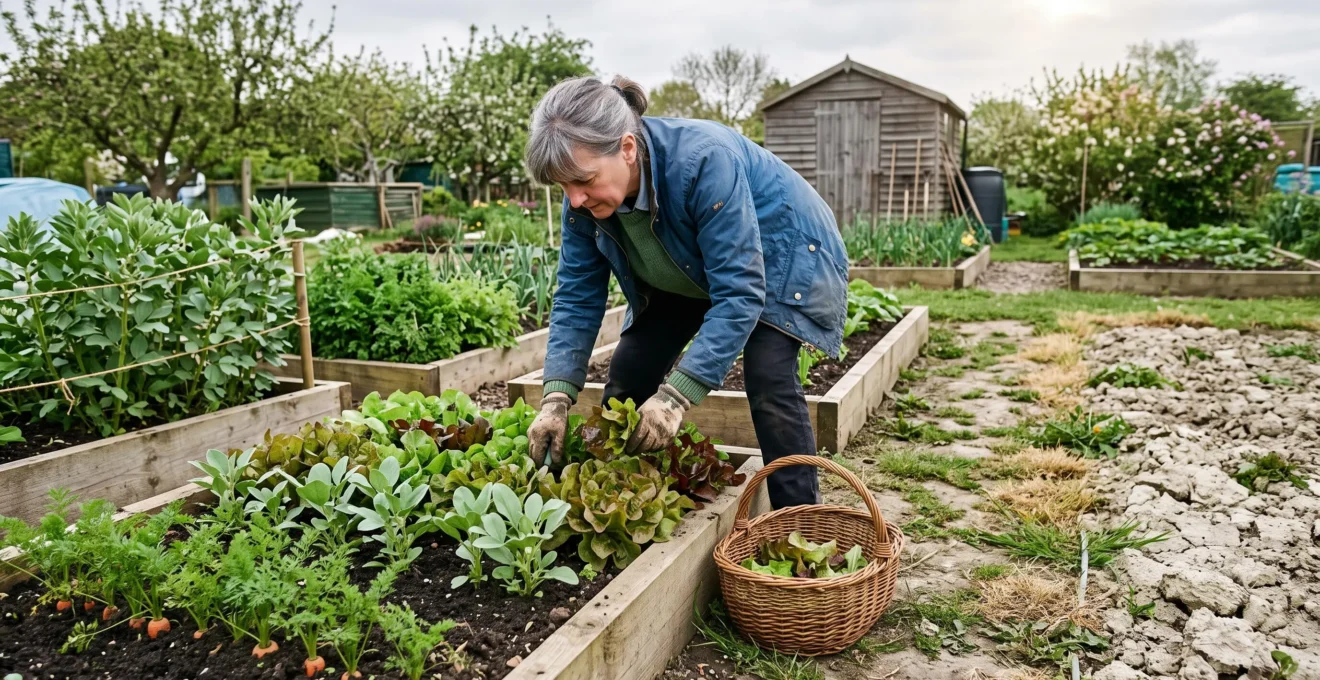
Heavy clay, compacted ground and unreliable drainage can make vegetable gardening frustrating before the first seed even germinates. Raised garden beds offer a practical alternative: create a fertile growing layer above the difficult native soil, improve access and concentrate soil management where vegetables actually grow.
Can this increase vegetable yields by 25%? It is possible under favourable conditions, particularly when the original ground severely restricts root growth, but 25% is not a scientifically established improvement for every raised bed. Crop choice, growing medium, irrigation and management all influence the result. Raised beds are a way to remove production constraints, not a guaranteed yield multiplier.
For UK gardeners facing heavy, wet ground, the greatest benefits often come from earlier soil warming, improved structure, more usable planting space and easier maintenance. Those advantages depend on getting the infrastructure right. Bed dimensions, construction materials, filling costs and long-term soil health determine whether the investment continues producing worthwhile harvests.
Raised garden beds: the essential decisions
- Yield potential: Raised beds can outperform difficult ground-level soil, but the proposed 25% improvement depends on the crop and growing conditions.
- Practical construction: Around 1.2 m wide is convenient for two-sided access; bed height and filling depth should reflect the underlying soil and accessibility needs.
- Long-term productivity: A suitable soil-compost blend, consistent moisture, annual organic mulching and sensible crop rotation matter more than bed height alone.
- Why Do Raised Garden Beds Allow Sowing 3-4 Weeks Earlier Than Ground-Level Soil?
- How Wide and Tall Should Raised Garden Beds Be for Easy Reach and Root Depth?
- Timber vs Metal vs Stone: Which Raised Bed Material Lasts Longest in Wet UK Climates?
- The Filling Mistake That Wastes £200+ Per Raised Bed on Unnecessary Premium Topsoil
- Should You Construct Raised Garden Beds in Autumn or Wait Until Spring Planting Time?
- How to Transition from Traditional Digging to No-Dig Methods Without Yield Loss?
- How to Design a Four-Bed Crop Rotation System for Year-Round UK Vegetable Production?
- Why Does Crop Rotation Reduce Vegetable Diseases by 75% Over Three-Year Cycles?
Why Do Raised Garden Beds Allow Sowing 3-4 Weeks Earlier Than Ground-Level Soil?
Raised garden beds can become suitable for spring sowing earlier than waterlogged ground-level soil because they drain more freely, receive solar warmth through exposed surfaces and contain a relatively loose growing medium. A three-to-four-week advantage is a possible seasonal outcome, not a dependable UK-wide rule. Actual timing depends on sunlight, soil composition, rainfall and local temperatures.
The first advantage is drainage. Heavy clay holds substantial moisture during winter, delaying spring cultivation. A raised bed with a suitable growing medium can shed excess water sooner, allowing its soil to become workable while surrounding ground remains sticky and saturated.
Its exposed sides also change how the growing medium responds to sunlight. Sun-facing walls can absorb and transfer warmth, although the effect depends on material, orientation and weather. Loose soil permits air and water movement and can warm more readily than saturated, compacted ground. That does not mean a raised bed generates heat internally or that its whole depth warms uniformly.
The RHS guidance on building a raised bed identifies increased spring soil temperature as a benefit for starting vegetables earlier. It does not establish a universal three-to-four-week advantage.
Earlier warming is not frost protection. A bed may be ready for cold-tolerant seeds while overnight air temperatures still threaten tender seedlings. Late spring frost remains possible in UK gardens, especially in exposed or frost-prone locations.
A soil thermometer provides a more useful decision than a fixed sowing date. Take readings around 10 cm below the surface, preferably at a consistent time of day, and compare them with the germination requirements of the chosen crop. Broad beans, peas, spinach, radishes and early carrots are useful candidates for the cooler part of the season, but their ideal sowing conditions differ.
For practical scheduling, measure both the raised bed and nearby ground-level soil over several days. Record the readings alongside soil moisture and weather conditions. This reveals whether an earlier sowing opportunity actually exists in that garden, rather than assuming the advertised advantage applies automatically.
Protect vulnerable plants with suitable horticultural fleece or cloches when frost is forecast. Avoid treating a warm afternoon reading as evidence that overnight conditions are safe.
There is also a seasonal trade-off: a bed that drains and warms quickly can lose moisture faster as spring progresses. Early sowing therefore requires an irrigation plan, particularly where the growing medium contains a high proportion of compost.
Once sowing conditions are understood, the next decision is how to size the bed so that its usable growing area remains accessible without compacting the soil.
How Wide and Tall Should Raised Garden Beds Be for Easy Reach and Root Depth?
A productive raised garden bed should be narrow enough to reach without stepping onto the growing medium and only as tall as the soil conditions, crops and gardener’s mobility require. Around 1.2 m width generally suits access from both sides, while a single-access bed should be narrower. Increasing height improves accessibility but adds cost, structural pressure and potential moisture loss.
Width is best determined by a simple physical test. Stand beside the proposed bed and measure how far you can comfortably reach while maintaining balance and avoiding strain. For access from both sides, combine the comfortable reach available from each edge. For a bed against a fence or wall, the full width must remain within reach from the accessible side.
For many adults, this suggests approximately 1.2 m for two-sided access and 60–75 cm for one-sided access. Individual reach takes priority over those examples, especially where bending or mobility is restricted.
The RHS recommends a convenient width of approximately 1.2 m for no-dig beds and advises that access paths between raised beds should be at least 45 cm wide, increasing to at least 1 m where wheelchair access is required. Paths must also suit the gardener’s actual turning and working needs.
Height needs a different calculation. A shallow raised bed may be enough where the existing soil is reasonably fertile and roots can continue into the ground below. Deeper construction becomes valuable where ground is compacted, poorly drained or difficult to access.
| Bed height | Best application | Important limitation |
|---|---|---|
| 15–30 cm | Salad crops, shallow improvements over usable soil and low-cost installations | Roots may need to penetrate the existing soil beneath |
| 30–45 cm | General vegetable production where a deeper improved growing layer is beneficial | Requires substantially more filling material |
| 40–60 cm | Some accessibility needs, difficult subsoil and situations requiring greater growing depth | Greater wall pressure, material cost and moisture-management demands |
Bed height does not necessarily equal maximum root depth. In an open-bottomed bed, roots can continue into suitable soil underneath. A gardener should check underlying compaction, drainage and obstructions before paying for a deeper structure. A simple hand examination of the native soil below the proposed bed can help identify whether roots are likely to encounter a restrictive layer.
Height also affects engineering. Wet soil exerts considerable outward pressure on retaining boards. Beds above roughly 40–45 cm deserve particular attention to board thickness, joint strength and bracing, although exact structural requirements depend on bed length, construction and materials.
For wheelchair users or people unable to kneel, comfortable working height, reach, path width and knee clearance may be more important than conventional vegetable-bed dimensions. The structure should be designed around the gardener rather than assuming one standard height provides accessibility.
A correctly sized bed makes harvesting and maintenance easier, but its long-term value also depends on whether the surrounding frame survives years of wet soil and British weather.
Timber vs Metal vs Stone: Which Raised Bed Material Lasts Longest in Wet UK Climates?
Stone and brick can offer the longest service life when properly constructed, while galvanised metal avoids the biological decay affecting timber. Timber remains attractive for affordability, ease of assembly and repair. No material has a universally established lifespan: durability depends on construction quality, drainage, corrosion protection, exposure and maintenance, so the best choice balances initial expenditure against expected years of use.
In wet UK gardens, the critical issue is not simply rainfall. Constant contact with damp soil creates demanding conditions for every material.
Untreated softwood, particularly inexpensive pine, is susceptible to decay where moisture remains trapped. Naturally more durable timber, including suitable oak or larch, may last longer but generally carries a higher purchase cost. Timber quality, sapwood content, detailing and ground contact can substantially alter the outcome.
Modern UK domestic preservative-treated timber differs from older arsenic-based treatments. Nevertheless, gardeners should confirm that a product is suitable for the intended garden use. An internal plastic membrane can separate soil from timber and reduce prolonged wet contact, provided drainage remains unobstructed. Old creosote-treated railway sleepers should not be repurposed for vegetable beds.
Galvanised steel does not rot, making it attractive for gardeners seeking a durable, relatively lightweight and potentially relocatable structure. Its vulnerable points are often exposed cut edges, damaged protective coatings, joints and fixings rather than the broad panels themselves.
Metal also conducts heat. Sun-exposed panels can warm quickly but may increase root-zone temperature near the edges during hot weather. The practical significance varies with panel design, colour, insulation, aspect and soil moisture.
Stone and brick provide a solid, permanent-looking solution, especially for long-established gardens. However, foundations, construction labour and material transport raise the installation burden. Poorly executed mortar joints and unsuitable porous materials can deteriorate through repeated wetting and freezing.
| Material | Relative cost and durability | Maintenance priority |
|---|---|---|
| Untreated softwood | Often low initial cost; relatively vulnerable to prolonged dampness | Inspect the soil-contact zone and replace decaying boards |
| Oak or larch | Higher initial cost; potential durability advantage depending on specification | Check joints, persistent moisture and damaged sections |
| Galvanised steel | Variable initial cost; resistant to timber-type decay | Inspect coatings, fasteners and corrosion-prone edges |
| Stone or brick | Typically high construction commitment; potentially very long service life | Maintain mortar, drainage and structural stability |
The decision should begin with how long the bed is expected to remain in position. A temporary growing area on a rented plot has different requirements from a permanent kitchen garden. Consider whether the bed may need moving, whether repairs can be undertaken easily and whether summer heat at the edges could become a concern.
Cost per useful growing year is more meaningful than purchase price alone. An inexpensive bed requiring repeated replacement may eventually cost more than a durable alternative, but paying for permanent masonry rarely makes sense when flexibility is essential.
Whichever material is selected, the largest avoidable expense may be the growing medium needed to fill the finished structure.
The Filling Mistake That Wastes £200+ Per Raised Bed on Unnecessary Premium Topsoil
Filling a deep raised bed entirely with expensive bagged premium soil can waste money when a suitable, tested bulk soil-compost mixture would serve the crops equally well. Savings of £200 or more are possible in some large-bed purchasing scenarios, but not guaranteed. The right strategy is to calculate the required volume, preserve adequate rooting depth and compare material costs before ordering.
The basic calculation is straightforward: length multiplied by width multiplied by fill depth gives the volume in cubic metres, provided all measurements use metres. This should be done before buying materials, not after the frame has been built.
Consider an explicitly hypothetical raised bed measuring 2.4 m long, 1.2 m wide and 0.5 m deep. It requires 1.44 cubic metres of material before allowing for settling or any reduction in fill depth. If only the upper 25 cm were purchased as a higher-grade mix, that portion would account for 0.72 cubic metres. The arithmetic demonstrates the potential purchasing difference, not proof that every bed can safely use an inferior lower layer.
The top 20–30 cm is important for seed establishment, nutrient availability and early root development, but it is not the entire root zone. Many vegetables extend roots considerably deeper. Filling the remaining volume with unsuitable debris, fresh timber waste or poorly decomposed organic material can create instability and nutrient problems rather than savings.
The safer approach for general vegetable growing is a reasonably consistent, free-draining blend of suitable topsoil and mature organic matter. Where a deep bed must be filled over usable existing ground, sound garden soil or verified bulk material may be an economical component of the lower fill.
Coarse woody material can be used in some specialised deep-bed systems, but it is not automatically a drainage solution. Large amounts of fresh wood may settle substantially as they decompose and can temporarily reduce available nitrogen near the decomposition zone. This approach is particularly unsuitable where maintaining dependable rooting depth, stable levels or a shallow accessible bed is the priority.
Bulk screened soil and mature compost may offer better value per cubic metre than numerous small bags. Ask suppliers about provenance, suitability for vegetable production and available quality testing. Manure and green-waste compost require particular care because persistent herbicide residues or other contamination may damage crops.
What a two-year raised-bed experiment found
Researchers Elizabeth A. Miernicki, Sarah Taylor Lovell and Sam E. Wortman compared direct-ground cultivation, compost-only raised beds and mixed soil-compost raised beds in an Illinois field experiment during 2015–2016.
Raised beds gave the highest yields for radish, kale and cilantro, while garlic and pepper showed smaller responses to the growing system. Compost-only beds also presented greater irrigation requirements. In the second experimental year, mixing soil with compost reduced irrigation demand by 32% compared with compost-only raised beds. These findings support paying attention to media composition rather than assuming more compost always means better performance. The results cannot be directly generalised to every UK garden.
The findings are documented in the scientific study on raised-bed vegetable production.
Expect some settling, especially where the mix contains a high proportion of degradable organic material. Allow for later topping-up with appropriate soil or compost, but avoid deliberately compressing the fill to prevent settlement. Excessive compaction undermines one of the main benefits of raised beds.
Five checks before ordering raised-bed filling material
- Measure the internal length, width and intended fill depth; record the required volume in cubic metres.
- Inspect the existing soil beneath the bed; note whether roots can penetrate it or whether drainage and compaction require attention.
- List the proposed growing-medium components and their intended depths; produce a written filling specification.
- Request comparable delivered quotations for suitable bulk and bagged materials; calculate a total cost for each option.
- Confirm material provenance and arrange for future settling and top-ups; record supplier details and the initial fill level.
Buying appropriate material is only part of the process. Construction timing affects whether the fill has time to settle and whether difficult clay ground can be prepared without unnecessary damage.
Should You Construct Raised Garden Beds in Autumn or Wait Until Spring Planting Time?
Autumn is often a useful time to construct raised beds because the growing area can settle before the main spring planting season and site preparation can be completed ahead of winter. Spring construction is also practical, particularly with ready-to-use, mature growing media. On heavy UK clay, the deciding factor is often ground condition rather than a particular month.
Building before winter provides an opportunity to establish the structure without competing with urgent spring sowing tasks. Mature compost and soil can begin integrating through biological activity, and changes in fill level become apparent before the main planting period.
However, an autumn-built bed containing a high proportion of raw organic material may still be unstable or insufficiently mature for early spring crops. Time alone does not guarantee that inappropriate filling materials become a suitable seedbed.
Winter rain presents another concern. Heavy clay can become too wet to work safely, and repeated walking or moving materials across saturated ground increases compaction. The RHS identifies late summer as a preferable construction opportunity where soil becomes heavily waterlogged during winter.
Materials may sometimes be easier to source outside the busiest spring gardening period, but availability and price advantages vary between suppliers. Neither should be treated as a guaranteed seasonal saving.
A spring build can work well when the site is accessible and the fill consists principally of suitable mineral soil and mature compost. Such material can generally be planted sooner than a fill dominated by undecomposed organic matter, provided structure, moisture and temperature are appropriate.
Before assembling the frame, deal with perennial weeds. Bindweed and couch grass can exploit the fertile growing medium and re-establish through the bed. Covering existing grass or annual weeds is different from eliminating persistent underground rhizomes.
A practical decision sequence is to inspect the footprint, identify persistent weeds, check drainage, choose the fill material and then decide when the site can be prepared without damaging the soil. For a clay garden that becomes inaccessible in winter, construction during suitable late-summer or early-autumn conditions may be considerably easier than waiting until the ground is saturated.
Once the structure is planted, productivity depends on soil care. Raised beds are particularly well suited to reducing cultivation disturbance, making a transition towards no-dig growing a logical next step.
How to Transition from Traditional Digging to No-Dig Methods Without Yield Loss?
Moving from regular digging to no-dig cultivation can preserve vegetable productivity when soil fertility, weed pressure, moisture and crop establishment are managed carefully. A newly filled raised bed already provides a relatively loose growing environment, making the transition straightforward. Existing compacted beds may need more attention, and no method can guarantee that yields will remain unchanged in every first season.
Traditional digging physically turns the soil and incorporates organic matter. No-dig management instead keeps disturbance to a minimum and applies suitable organic material to the surface. Earthworms and other soil organisms help redistribute nutrients and develop natural channels over time.
The RHS guidance on no-dig gardening recommends an establishment layer of approximately 10–15 cm of suitable organic mulch when creating a bed over grass or weeds. It also describes annual surface applications of around 5 cm as a typical maintenance approach.
These figures describe organic-matter applications in their particular contexts, not universal requirements for every raised bed. A bed already filled with fertile growing medium may not need a thick establishment layer, while a nutrient-poor site may require more careful preparation.
The practical transition begins with weed control. Persistent perennial weeds should be dealt with before the bed becomes difficult to access. Apply mature organic material as a surface mulch, avoid mixing it unnecessarily into the growing soil and plant through the prepared surface when conditions permit.
Water management remains important. Organic mulch can reduce surface evaporation, partly offsetting the faster drying associated with raised-bed structures. But a thick or coarse surface layer may complicate the direct sowing of small seeds, which need appropriate contact with a fine seedbed.
Concerns about yield loss should be evaluated through observable causes rather than assumptions about digging. Poor crop vigour may indicate insufficient nutrients, inadequate moisture, cold soil or persistent weeds. It does not automatically demonstrate that reduced soil disturbance has failed.
During the first growing season, inspect soil texture by hand, compare crop growth and record weed pressure. Where underlying soil is seriously compacted, demanding deep-rooted crops may struggle until the restriction is addressed. Starting with suitable leafy crops or transplants can make management easier while soil condition improves.
In the second season, use the previous year’s observations to refine compost applications and crop choices. Biological improvements may develop over time, but there is no dependable one-to-two-year deadline by which every compacted soil becomes fully restored.
Annual organic-matter management remains essential. No-dig does not mean no feeding, no weeding or no monitoring. The aim is to disturb a functioning soil system less often while maintaining the inputs needed for productive growth.
As soil structure stabilises, planting different crop families in a planned sequence becomes the next way to protect output and manage fertility without repeatedly rebuilding the beds.
How to Design a Four-Bed Crop Rotation System for Year-Round UK Vegetable Production?
A four-bed crop rotation divides growing space into manageable areas and moves vegetable families between them over successive years. The system can help organise fertility, reduce repeated exposure to crop-specific soil problems and keep planting continuous. For a small UK garden, the most useful plan combines crop-family records with seasonal sowing and harvesting, rather than insisting that every vegetable fits one rigid category.
Begin by identifying the main families. Brassicas include cabbage, kale and broccoli. Legumes include peas and broad beans. Alliums include onions, garlic and leeks. Potatoes and tomatoes belong to the same botanical family, Solanaceae, while courgettes and squash are cucurbits.
Those distinctions matter because crop rotation aims principally to avoid repeating susceptible hosts in the same ground. Root vegetables and alliums may share a practical growing area, but they are not the same botanical family. Similarly, tomatoes and courgettes can both require substantial feeding without sharing the same main family-specific disease risks.
A useful starting arrangement is shown below. It is a management framework, not a claim that every crop in a bed has identical nutrient requirements.
| Bed | Main crop group | Management focus |
|---|---|---|
| Bed A | Brassicas: cabbage, kale, broccoli | Maintain fertility and monitor brassica-specific soil diseases |
| Bed B | Legumes: peas, broad beans | Use suitable support and retain healthy roots where practical |
| Bed C | Roots and alliums: carrots, beetroot, onions, garlic | Avoid fresh manure immediately before sensitive root crops |
| Bed D | Potatoes and selected fruiting crops | Plan fertility and distinguish potatoes, tomatoes and cucurbits by family |
In subsequent years, move the principal crop groups between beds and record the specific species grown. A four-year sequence can provide a framework for increasing the interval before a family returns to the same place. However, mixed planting and overlapping harvests mean that a simple annual shift may not capture every previous crop.
Fertility should follow the needs of the next planting. Hungry crops benefit from suitable mature compost, while fresh manure immediately before some root crops can create undesirable growing conditions. Legumes contribute nitrogen through biological fixation, but the amount subsequently available to other crops depends on how their biomass and residues are managed.
Following legumes with brassicas may therefore be useful, but legumes do not automatically provide all the nitrogen required by a hungry brassica crop. Observe growth and soil condition rather than relying on rotation as a complete fertiliser replacement.
Year-round productivity also requires seasonal planning. Autumn-sown broad beans, suitable garlic varieties and overwintering onions can occupy space through winter. In spring and summer, successive sowings of salads, radishes and other quick crops can make use of gaps between larger plants.
Winter production should be understood realistically. Overwintering crops occupy growing space and establish ahead of spring; they do not necessarily provide continuous harvests throughout the coldest months.
For smaller plots, combining compatible crops or using an adapted rotation may be more productive than leaving substantial areas empty to preserve a textbook sequence. Keep a simple annual plan identifying each vegetable family and where it was grown. Photographing the plan each year produces an accessible history without requiring complicated software.
This planting history is also the foundation of soil-disease prevention. Rotation has real protective value, but its effectiveness depends heavily on which disease organisms are present and how long they remain viable.
Key takeaways before planning disease prevention
- Record the botanical families grown in each bed, including short-season and overwintering crops, rather than tracking only the main summer planting.
- Use the rotation plan to manage nutrition and repeated host exposure together; fertility benefits and disease prevention are related but distinct outcomes.
- Treat persistent soil diseases as exceptions to ordinary rotation schedules, because some pathogens remain viable long after their host crops have moved.
Why Does Crop Rotation Reduce Vegetable Diseases by 75% Over Three-Year Cycles?
Crop rotation can reduce certain vegetable diseases by interrupting the repeated cultivation of susceptible host plants in the same soil. However, a 75% reduction over three years is not a verified universal outcome. Effectiveness depends on the pathogen, the frequency of host crops, the initial infestation and how long the organism survives without a suitable host.
Many soil-borne pests and pathogens have preferred host plants. Repeatedly growing the same crop family can allow those organisms to accumulate when susceptible plants remain available. Moving a host crop elsewhere may interrupt reproduction and reduce future pressure.
This is particularly important in raised beds, where the soil is generally retained from year to year. Replacing the entire growing medium annually is expensive, disruptive and usually unnecessary. Crop planning can instead help preserve the usefulness of an established soil volume.
However, not all soil-borne problems respond equally to a three-year break. Clubroot, associated with brassicas, can persist in soil for many years. Onion white rot can also remain a problem long after onions or garlic have been removed. Potato cyst nematodes may survive for extended periods without potatoes.
These are reasons to distinguish ordinary preventive rotation from management of an established infestation. A routine three- or four-year rotation can be practical for general planning but may be inadequate where persistent pathogens are already present.
The RHS provides three-year and four-year vegetable rotation frameworks, and explains that rotation helps reduce the build-up of crop-specific pests and diseases. Its guidance does not establish a consistent 75% disease reduction, nor does it suggest that rotation eliminates every persistent pathogen.
Rotation also has limited influence over diseases whose spread does not depend primarily on repeated cultivation in the same soil. Airborne infections, including many forms of blight and powdery mildew, may arrive from surrounding plants or other sources. Moving crops between beds cannot reliably exclude these infections.
Contaminated tools, infected planting material and movement of affected soil can also compromise a planned rotation. Where disease is suspected, appropriate hygiene, resistant varieties and accurate diagnosis become important alongside crop placement.
In a four-bed system, the useful principle is to extend the interval between susceptible host crops wherever practical. If a persistent soil disease is confirmed, simply continuing the standard rotation may maintain the problem rather than resolve it. Crop-specific control advice and restrictions on host planting may be necessary.
Think of the claimed 75% figure as an illustration of the potential importance of prevention, not as a measurable target that every raised-bed gardener should expect. Meaningful disease reduction cannot be calculated without knowing what disease is being measured, the starting conditions and the comparison method.
More broadly, raised-bed productivity is cumulative. The frame provides access and containment; suitable fill creates a workable rooting environment; sensible irrigation supports crops through dry periods; no-dig management protects soil structure; and rotation helps limit avoidable disease pressure. None of these practices independently guarantees a specified percentage gain.
For the next growing season, choose one manageable area of difficult ground, assess its drainage and soil condition, build a bed within comfortable reach and record its costs, sowing dates and harvests. Comparing those results with an existing ground-level plot can reveal whether the raised-bed investment delivers a meaningful improvement in your own garden.
Can raised beds be built directly over heavy clay soil?
Yes. Open-bottomed raised beds can provide a more workable growing layer over heavy clay. However, the native soil still affects drainage and root penetration. Check for severe compaction or persistent waterlogging, and avoid assuming that a layer of gravel or wood underneath will automatically solve poor drainage.
Are raised beds safe for growing vegetables where the existing soil may be contaminated?
Raised beds may help separate crops from unsuitable native soil, but an ordinary open-bottomed structure does not guarantee protection from contaminants. If contamination is suspected, investigate the site and obtain appropriate soil testing or specialist advice before growing edible crops. Suitable barriers, drainage design and verified clean growing media may be necessary depending on the contaminant.
Do raised garden beds need more watering than vegetables grown in the ground?
They can, especially when elevated sides and a freely draining, compost-rich medium increase moisture loss. Requirements depend on bed depth, weather, crop demand and soil composition. A soil-compost blend, surface mulch and regular moisture checks can help manage irrigation more effectively than watering to a fixed timetable.
Can an existing lawn be converted into a productive no-dig raised bed?
Yes, provided persistent perennial weeds are managed and the new bed contains a suitable growing medium. No-dig establishment can involve smothering grass and applying appropriate organic material at the surface. The required preparation depends on the existing vegetation, the depth of the bed and how soon crops need to be planted.
How can a gardener measure whether raised beds actually improve vegetable yields?
Record the harvested weight of each crop and divide it by the productive planted area to compare yield per square metre. Grow comparable varieties under similar conditions where possible, and record watering, fertiliser use, planting dates and weather. Repeat comparisons across seasons because a single harvest can reflect factors unrelated to bed construction. Include materials and maintenance costs when judging the overall value.