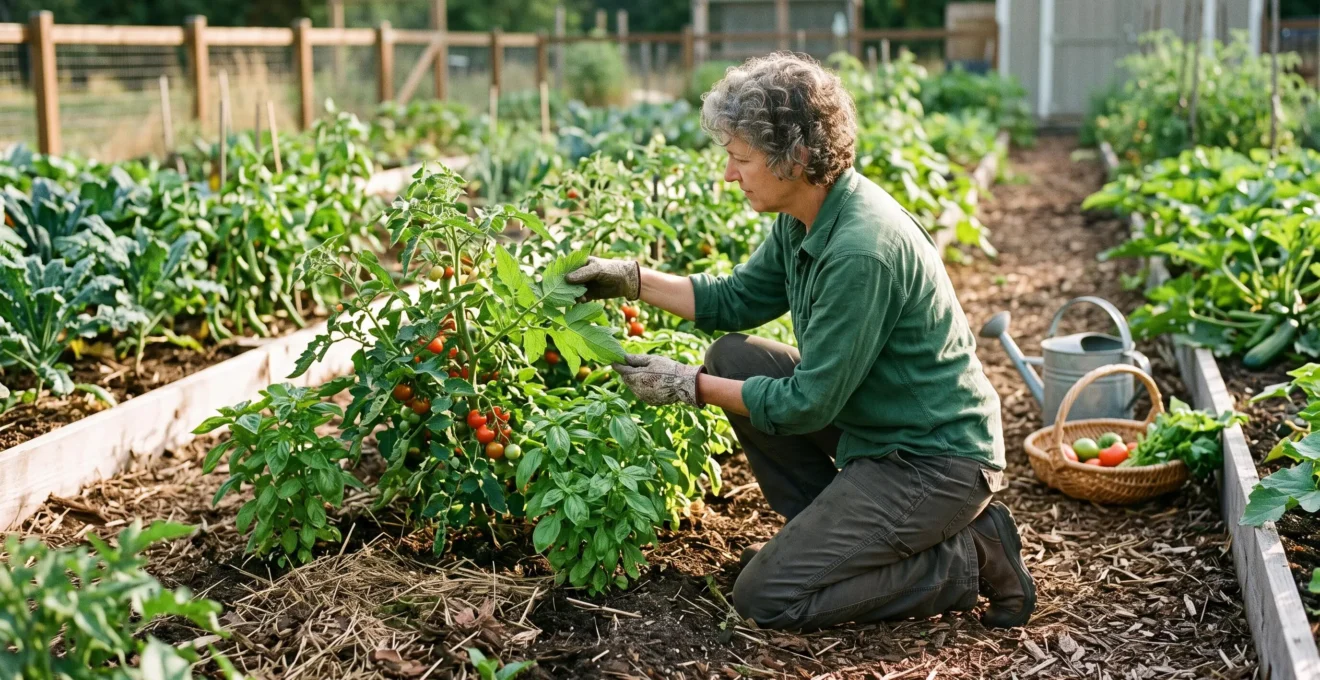
Companion planting can reduce vegetable pest damage by making crops harder to locate, diverting insects towards alternative plants and encouraging predators that feed on pests. The strategy works best when each plant has a defined purpose rather than simply appearing on a traditional list of friendly neighbours.
For UK gardeners, this means arranging tomatoes, brassicas, beans, herbs and flowers according to the pests they face, their growing requirements and the timing of insect activity. A flowering border may attract hoverflies, while an early trap crop can intercept flea beetles before they establish on young cabbages.
But can these partnerships really halve pest damage? A 2026 meta-analysis covering 316 studies found an average reduction in damage from invertebrate herbivores in plant mixtures compared with monocultures of 25.1 % in 2026. That supports the principle of plant diversity, not a guaranteed 50% reduction in every vegetable garden.
The practical objective is therefore measurable improvement without routine insecticide spraying: healthier crops, fewer damaging outbreaks and a garden that increasingly supports its own natural pest controllers.
Companion planting: the essentials
- Choose companions according to pest behaviour: scent interference, physical disruption, trap cropping or recruitment of natural enemies.
- Establish protective plants at the right time, manage trap crops and avoid competition for water, nutrients and light.
- Maintain flowers and undisturbed wildlife habitats so beneficial predators can suppress pests throughout the growing season.
- Why Do Tomatoes and Basil Genuinely Help Each Other While Some Pairings Are Just Myths?
- How to Use Nasturtiums and Mustard as Trap Crops to Protect Brassicas and Beans
- Marigolds vs Chives vs Garlic: Which Companion Plants Deter Which Vegetable Pests?
- The Companion Planting Mistake That Creates Competition Instead of Cooperation
- Should You Plant Companions Simultaneously or Establish Protectors Before Main Crops Arrive?
- Why Are Slow Worms, Ground Beetles, and Centipedes Your Garden’s Most Valuable Pest Controllers?
- Why Are Ladybirds, Lacewings, and Hoverfly Larvae Your Most Effective Aphid Controllers?
- How Does Maintaining Local Ecosystem Balance Reduce Garden Pest Problems Over Time?
Why Do Tomatoes and Basil Genuinely Help Each Other While Some Pairings Are Just Myths?
Tomatoes and basil can form a useful partnership because aromatic plants may interfere with insect host-finding, while mixed vegetation changes the visual signals pests use to locate crops. Research supports reductions in certain tomato pests, particularly thrips, under specific conditions. However, basil does not repel every insect, and traditional companion planting claims frequently exceed the available evidence.
Three practical mechanisms explain many of the better-supported pest-management benefits of companion planting:
- Chemical interference: volatile compounds released by neighbouring plants may mask or alter the odours insects associate with their preferred hosts.
- Physical and visual disruption: mixed foliage, different plant heights and contrasting leaf shapes can make a continuous crop harder for pests to recognise or move through.
- Beneficial insect recruitment: flowering companions provide nectar, pollen or shelter for insects whose offspring prey on crop pests.
These mechanisms provide a useful starting point for evaluating a proposed pairing. They are not an exhaustive account of plant interactions, and a plausible mechanism alone does not prove that a combination works.
The University of Minnesota Extension‘s research review of companion planting identifies studies in which basil and marigolds reduced thrips populations on tomatoes in field or greenhouse conditions. It also explains how plant odours, visual diversity and natural enemies can influence pest pressure.
The distinction between thrips and whiteflies matters. Evidence supporting basil against thrips does not establish that basil reliably prevents whitefly infestations. Research on French marigold volatiles and glasshouse whiteflies concerns a different companion plant and should not be transferred automatically to basil.
In a UK greenhouse, a gardener might place basil near tomatoes while inspecting leaf undersides for whiteflies and monitoring thrips damage. The basil provides a potential additional protective influence, not a substitute for ventilation, suitable growing conditions or regular observation.
Below ground, the partnership must remain compatible. Basil and tomatoes both require water and nutrients, so crowding them into the same limited compost volume can undermine growth even when their foliage interacts beneficially.
A reliable companion pairing begins with a specific pest, a credible mechanism and enough growing space for both plants. That reasoning becomes particularly important when one plant is intended to attract pests rather than discourage them.
How to Use Nasturtiums and Mustard as Trap Crops to Protect Brassicas and Beans
Nasturtiums and mustard can help protect selected vegetables by attracting or intercepting pests that would otherwise attack the main crop. This approach, called trap cropping, depends on choosing a genuinely attractive host, establishing it at the correct time and removing concentrated pests before they spread. Neither plant provides automatic protection for every brassica or bean pest.
A trap crop differs from an aromatic companion. Instead of making the main crop less attractive, it offers pests an alternative feeding or egg-laying site.
Mustard and other brassicas can be useful against flea beetles because these insects respond strongly to particular host plants. However, mustard is not consistently preferred over every cabbage or kale variety, and its effectiveness against cabbage aphids depends on the species and conditions involved.
Nasturtiums can participate in brassica companion systems, with research reporting reduced caterpillar damage in some combinations. Their reputation as aphid traps also makes them worth observing, but attraction varies by aphid species and nearby host plants.
For beans, the same principle applies only when the chosen trap is demonstrably attractive to the pest affecting those beans. Planting nasturtiums beside beans without identifying the pest is not a dependable trap-cropping strategy.
The University of Saskatchewan‘s pesticide-free trap cropping advice emphasises pest identification, suitable timing and active management of insects concentrated on trap plants.
Position matters. A trap strip along the edge of a brassica bed may intercept arriving insects, but placing a heavily infested plant directly against vulnerable seedlings can expose them to greater pressure. No universal separation distance works for every pest because crawling and flying insects move differently.
Monitoring determines whether a trap crop remains protective. Inspect both the trap and the vegetable crop regularly. If pest colonies expand, egg clusters accumulate or insects begin moving into the protected crop, remove the affected trap material and dispose of it appropriately rather than leaving it to reproduce unchecked.
For a small garden, removing heavily infested leaves or individual plants may be more manageable than maintaining a large sacrificial strip. The appropriate response depends on the pest and whether removing the trap will disperse insects onto neighbouring vegetables.
Planting the trap only after the main crop has been colonised defeats its interception purpose. The preferred host should normally become attractive before or during the period when pests first search for the protected vegetable.
Trap cropping is therefore a managed diversion rather than a passive planting trick. Once pest behaviour is understood, the next decision is whether a repellent or soil-active companion offers a better match.
Marigolds vs Chives vs Garlic: Which Companion Plants Deter Which Vegetable Pests?
Marigolds, chives and garlic influence garden pests through different mechanisms, so they should not be treated as interchangeable repellents. Certain French marigold varieties can suppress particular soil nematodes, while chives and garlic release sulphur-containing compounds that may interfere with some insects. Evidence for reliable pest control varies by plant, pest and growing conditions.
The first step is identifying the pest and the location of the damage. Distorted roots suggest a different problem from aphids clustering on young shoots or flea beetles producing small holes in brassica leaves.
The following comparison separates established uses from more tentative companion planting claims.
| Companion | Potential target and mechanism | Evidence and practical limits |
|---|---|---|
| French marigolds | Selected root-knot nematodes; effects associated with particular varieties and their root zones | Species-specific evidence exists, but scattered flowers do not protect an entire bed |
| Chives | Potential interference with host-finding by some sap-feeding insects through aromatic compounds | A plausible mechanism, not dependable control of aphids or other pests in every garden |
| Garlic | Sulphur-containing volatiles may influence certain insect behaviours | Effects depend on the pest and conditions; growing garlic nearby is not equivalent to applying a tested repellent |
The familiar claim that marigolds repel almost everything is misleading. Oklahoma State University Extension reports that certain varieties of Tagetes patula can suppress root-knot nematodes near their roots. It recommends more substantial planting or rotation for relevant nematode problems rather than relying on occasional marigolds between vegetables.
Oklahoma State University Extension reports that certain varieties of Tagetes patula can suppress root-knot nematodes near their roots. It recommends more substantial planting or rotation for relevant nematode problems rather than relying on occasional marigolds between vegetables.
Marigolds should therefore not be expected to prevent tomato caterpillars or leaf-feeding aphids simply because they are present. Some varieties may also attract spider mites, demonstrating that companion plants can introduce additional management considerations.
Timing also differs. A soil-related effect requires suitable roots to occupy the relevant area for long enough to influence the target organism. An airborne odour effect, where demonstrated, depends more directly on the companion being present when insects search for hosts.
Chives and garlic can still contribute to mixed vegetable beds, but a gardener should not assume that their scent alone will stop aphid reproduction. Flowering chives may also offer resources to visiting insects, providing a separate ecological benefit.
The strongest selection rule is straightforward: diagnose the pest before choosing the companion. A pairing without a relevant mechanism is unlikely to solve the observed problem.
Even a well-matched companion can fail if its growing requirements conflict with those of the vegetable it is meant to protect. Plant density and root competition are the next constraints to examine.
The Companion Planting Mistake That Creates Competition Instead of Cooperation
The most damaging companion planting mistake is adding protective plants without accounting for the space, water, nutrients and light already required by the main crop. Two species may interact beneficially with insects yet compete intensely through their roots or foliage. When competition reduces crop vigour, any pest-control advantage can disappear.
Consider a tomato grown in a restricted container. Adding several basil plants may increase aromatic foliage, but it also adds roots competing for the same limited compost moisture and nutrients. If watering and feeding remain unchanged, the tomato may grow less vigorously.
Competition is not always visible immediately. Early symptoms may include reduced growth, smaller leaves, uneven development or faster drying of the growing medium. These signs are not unique to overcrowding, so gardeners should also check irrigation, temperature and nutrient availability.
Root architecture offers a useful planning clue. Plants with contrasting rooting depths may sometimes exploit resources differently. However, shallow-rooted and deep-rooted labels are only approximations: actual root distribution depends on soil structure, moisture and growing conditions.
Above-ground compatibility requires similar attention. Tall companions can shade sun-loving vegetables, while dense foliage may reduce airflow around crops susceptible to fungal diseases.
Plant chemistry adds another complication. Some species release compounds that influence neighbouring growth, a phenomenon known as allelopathy. Its presence in laboratory or controlled conditions does not automatically establish a harmful effect in an ordinary vegetable bed.
Rather than increasing planting density indefinitely, treat the bed as a limited resource system. Companion plants redistribute ecological functions; they do not create unlimited capacity for additional roots and foliage.
Five checks before adding a companion plant
- Identify the pest: inspect affected leaves, stems or roots and record the visible damage in a garden note.
- Define the companion’s role: write down whether it is intended to disrupt pests, attract them or support predators.
- Check growing requirements: compare sunlight, water and nutrient needs, producing a simple compatibility note.
- Mark available space: sketch the bed and record the expected mature spread of both plants.
- Monitor the outcome: photograph crop growth and pest damage at regular intervals to create a before-and-after record.
A useful comparison is to maintain a similar crop elsewhere without the proposed companion, where space permits. Differences between beds are not proof of causation, but consistent observations can reveal whether the combination deserves repeating.
Once a pairing fits the available growing space, its success depends on another variable that companion planting charts rarely explain: when each species becomes established.
Should You Plant Companions Simultaneously or Establish Protectors Before Main Crops Arrive?
Companions should be established according to the protective mechanism they provide. Trap crops often need to become attractive before pests reach the main vegetable, while flowers intended to recruit beneficial insects should bloom before pest populations peak. Aromatic companions may sometimes be planted alongside crops, provided they develop sufficiently before the relevant pest activity.
Simultaneous planting is convenient, particularly in small UK gardens where vegetable beds are replanted throughout spring and summer. Yet convenience does not guarantee protection during the vulnerable establishment period.
For trap crops, timing is especially important. A mustard strip intended to intercept flea beetles must present suitable foliage when the insects begin locating brassica hosts. Sowing it after cabbage seedlings are already heavily attacked is unlikely to reverse the initial colonisation.
Flowers that support predators require a different sequence. Adult hoverflies need accessible floral resources, and their larvae require prey. Establishing flowering plants early can help attract adults before aphid populations expand, although weather and local insect populations influence the outcome.
Perennial flowering plants and permanent habitat features can be established in the previous growing season. Annual flowers may need earlier sowing or suitable young plants to provide blooms at the relevant time.
Aromatic herbs offer greater flexibility. Fast-growing basil can accompany tomato planting under suitable warm conditions, but newly planted basil may provide little foliage during the earliest period of pest activity.
Work backwards from the main crop’s planned planting date rather than following a universal companion sowing calendar. UK gardeners must also account for local frost risk, greenhouse conditions and seasonal differences between regions.
| Protection strategy | Preferred establishment stage | Main timing risk |
|---|---|---|
| Trap crops | Attractive to target pests before or as the main crop becomes vulnerable | Pests colonise the vegetable first |
| Aromatic companions | Sufficient foliage present during pest host-finding | Companion remains too small to influence pest behaviour |
| Beneficial insect flowers | Blooming before anticipated pest population peaks | Predators arrive after substantial damage |
| Permanent predator habitat | Maintained across seasons where practical | Overwintering refuges are repeatedly disturbed |
There is a trade-off. Early companions occupy space and may shade or compete with young vegetables. Their position and growth should therefore be managed so that earlier protection does not create a new source of crop stress.
Timing is not limited to plants. Many of the most useful pest controllers depend on permanent habitat that remains available long before vegetable seedlings enter the soil.
Why Are Slow Worms, Ground Beetles, and Centipedes Your Garden’s Most Valuable Pest Controllers?
Slow worms, ground beetles and centipedes help regulate pests that flowering plants alone cannot control. These ground-dwelling predators feed on different invertebrates, including slugs, small insects and larvae, often working beneath vegetation or after dark. Their value comes from complementing aerial predators, although their diets and effectiveness differ between species.
Gardeners often focus on ladybirds because they are visible on leaves. Yet many pests spend substantial portions of their lives at soil level, where ground predators can encounter them.
Ground beetles include species that hunt slugs, caterpillars and other invertebrates. Centipedes prey on small soil-dwelling animals, while slow worms, which are legless lizards rather than snakes, consume soft-bodied prey including slugs.
None of these animals should be regarded as a universal solution. Some predators eat a broad range of organisms, and their contribution depends on the species present, prey availability and habitat conditions.
Creating suitable shelter is generally more practical than attempting to introduce predators artificially. Useful features include:
- Undisturbed log piles with crevices and decaying wood.
- Stones and sheltered ground-level spaces that retain some moisture.
- Leaf litter and mulch where appropriate for the crop.
- Low vegetation providing cover between productive beds and wildlife refuges.
A refuge should remain reasonably stable through autumn and winter. Repeatedly removing all fallen leaves, turning every sheltered corner and clearing decaying material can destroy overwintering sites.
In the UK, slow worms are protected by law against intentional killing or injury. Garden maintenance should therefore avoid harming animals sheltering beneath logs, stones or compost materials. Refuge structures should be inspected carefully before disturbance.
Diverse planting supports these predators indirectly. Ground cover moderates exposed soil conditions, while mixed vegetation creates more sheltered routes between feeding and resting areas.
A practical design might retain one quiet habitat corner beside a vegetable plot, with ground-level cover extending towards the beds. This does not guarantee predator occupation, but it improves the availability of potential refuges.
Ground predators are particularly relevant to soil-level pest problems. Aphid colonies higher on vegetable plants require another group of natural enemies whose life cycles depend on both flowers and prey.
Why Are Ladybirds, Lacewings, and Hoverfly Larvae Your Most Effective Aphid Controllers?
Ladybirds, lacewings and hoverflies are valuable natural enemies of aphids because their larvae actively consume these sap-feeding insects. Adult ladybirds can also feed on aphids, while adult hoverflies primarily use floral resources. Supporting both adult reproduction and larval feeding creates more dependable biological control than simply attracting occasional visiting insects.
The important distinction is between what an adult insect needs and what its offspring need. A hoverfly visiting a flower may be feeding on nectar or pollen, while its larvae require suitable prey on nearby plants.
Many hoverfly species lay eggs close to aphid colonies, allowing newly hatched larvae to begin feeding without travelling far. Lacewing larvae are also predators, and several ladybird species consume aphids during both larval and adult stages.
Flowering companions can support these insects, particularly when blooms provide accessible nectar and pollen. Plants with relatively open flower structures, including certain umbellifers and composite flowers, can be useful for adult hoverflies.
In a UK vegetable garden, flowering coriander, dill or other suitable insectary plants may contribute to floral diversity. Their usefulness depends on flowering time, insect accessibility and the species already present locally.
Some aphids must remain available as prey. A small colony is not automatically a management failure. Removing every aphid immediately can also remove the feeding opportunity that encourages predators to remain and reproduce.
This does not mean allowing damaging colonies to expand unchecked. Monitor whether leaves are becoming distorted, growth is deteriorating or aphids are spreading faster than predators can respond.
Observe the whole plant before intervening. Ladybird larvae may resemble unfamiliar pests, while hoverfly larvae are less conspicuous than adults. Recognising beneficial immature insects helps avoid accidentally removing them.
Buying adult ladybirds for release is not necessarily an effective shortcut. Adults can disperse, and purchased insects may not establish resident populations. Encouraging locally occurring species through flowers, shelter and reduced insecticide use is a more sustainable starting strategy.
The relationship also changes through the season. Early flowering resources may support adults before major aphid outbreaks, while later flowers can maintain resources as crop growth and pest populations change.
These predators work best as part of a wider system. The final challenge is combining plant diversity, pest diversion and predator habitat without expecting every insect or every damaged leaf to disappear.
Key takeaways for a resilient vegetable garden
- Measure the success of companion planting through crop condition and changing pest damage, not the complete absence of insects.
- Combine host-finding disruption, managed trap crops and resident predators instead of relying on one companion species.
- Maintain protective habitats across growing seasons while adapting plant choices to the pests actually observed.
How Does Maintaining Local Ecosystem Balance Reduce Garden Pest Problems Over Time?
Maintaining local ecosystem balance can reduce recurring pest problems by combining diverse planting, selective pest diversion and natural predators. Companion plants may make crops harder to locate, trap crops can concentrate certain pests, and beneficial animals suppress populations that remain. The result depends on local conditions and consistent management rather than a guaranteed percentage reduction.
These three protective layers address different stages of pest activity. Mixed vegetation can interfere with initial host detection. Trap crops can divert selected insects during colonisation. Predators may then reduce pest populations after they become established.
The layers also have limitations. A trap crop may fail against the wrong pest, an aromatic companion may offer insufficient protection during an outbreak, and predator populations may respond too slowly to prevent early damage.
Broad-spectrum insecticides can disrupt this system by affecting beneficial insects alongside pests. Where natural enemies are reduced, pest populations may recover before predator populations rebuild, potentially increasing dependence on repeated interventions.
Maintaining a no-spray approach therefore involves observation and targeted cultural management rather than doing nothing. Removing heavily infested trap material, avoiding excessive crowding, maintaining healthy soil conditions and supporting predator habitat all contribute.
25.1%
Average reduction in damage caused by invertebrate herbivores in plant mixtures compared with monocultures, reported in a 2026 meta-analysis synthesising 2,315 observations from 316 studies. This is not a predicted reduction for an individual UK vegetable garden.
The same research synthesis reported an average reduction in invertebrate herbivore abundance of 21.6 %. These findings provide broader support for plant diversity, but the underlying studies span different plant communities and growing systems.
A 50% reduction is not a universal expectation. Some gardens may experience substantial improvements, while others see smaller effects or no clear benefit from a particular pairing. Initial pest pressure, surrounding vegetation, weather and management all influence outcomes.
Similarly, claims that ecosystem balance automatically reduces pest problems by 80% are not established by the supplied research. Numerical targets should be treated as outcomes to measure locally rather than promised results.
A simple monitoring system can make progress visible. Record pest sightings, the proportion of plants showing damage, predator activity and whether affected crops continue growing and producing satisfactorily.
Compare similar points in successive growing seasons, recognising that differences in weather or pest emergence may explain part of any change. Improvement can occur within a season, although maintaining habitat over several seasons may help develop a more stable community of beneficial organisms.
The objective is not a sterile garden. A few aphids, minor feeding marks and active predator populations may indicate a functioning ecological relationship, provided damage remains acceptable and crop productivity is maintained.
Choose one vegetable bed, identify its main pest problem and introduce a compatible companion or habitat improvement. Monitor the crop throughout the season, retain what demonstrably helps and adjust what does not. This turns companion planting into an adaptable, evidence-informed garden management practice rather than a collection of untested planting rules.
Can companion planting completely replace insecticide sprays?
Companion planting can form part of a spray-free pest-management strategy, particularly when combined with trap-crop monitoring, suitable growing conditions and protection of natural predators. It does not guarantee that every outbreak can be prevented. Some pest problems may still require physical removal, barriers or other targeted non-chemical measures.
Does companion planting work in containers and small UK gardens?
Yes, selected combinations can be grown in containers or compact beds when their water, light, nutrient and root-space requirements are compatible. Limited soil volume makes competition especially important. Separate pots positioned close together may offer a practical way to test a pairing without forcing both plants to share the same restricted root zone.
How can gardeners tell whether a companion plant is actually reducing pests?
Monitor the same crop regularly and record visible damage, pest numbers where practical, predator sightings and overall plant growth. Comparing similar plants with and without the companion may help reveal patterns. However, uncontrolled garden comparisons cannot establish causation because weather, soil conditions and pest exposure may differ.
Should flowering companion plants be removed after the vegetable harvest?
Not automatically. Healthy flowering plants may continue providing resources for beneficial insects, while permanent vegetation and undisturbed material can offer shelter. Remove plants when they harbour damaging pest populations, show significant disease or interfere with subsequent crops. Otherwise, retaining suitable habitat can support ecological continuity.
How long does it take for companion planting to improve pest control?
Some effects may occur during the first growing season when companions are established before relevant pest activity. Benefits associated with resident predators and permanent habitats may develop over successive seasons. There is no universal timetable: outcomes depend on the plants, pests, weather and surrounding ecosystem.