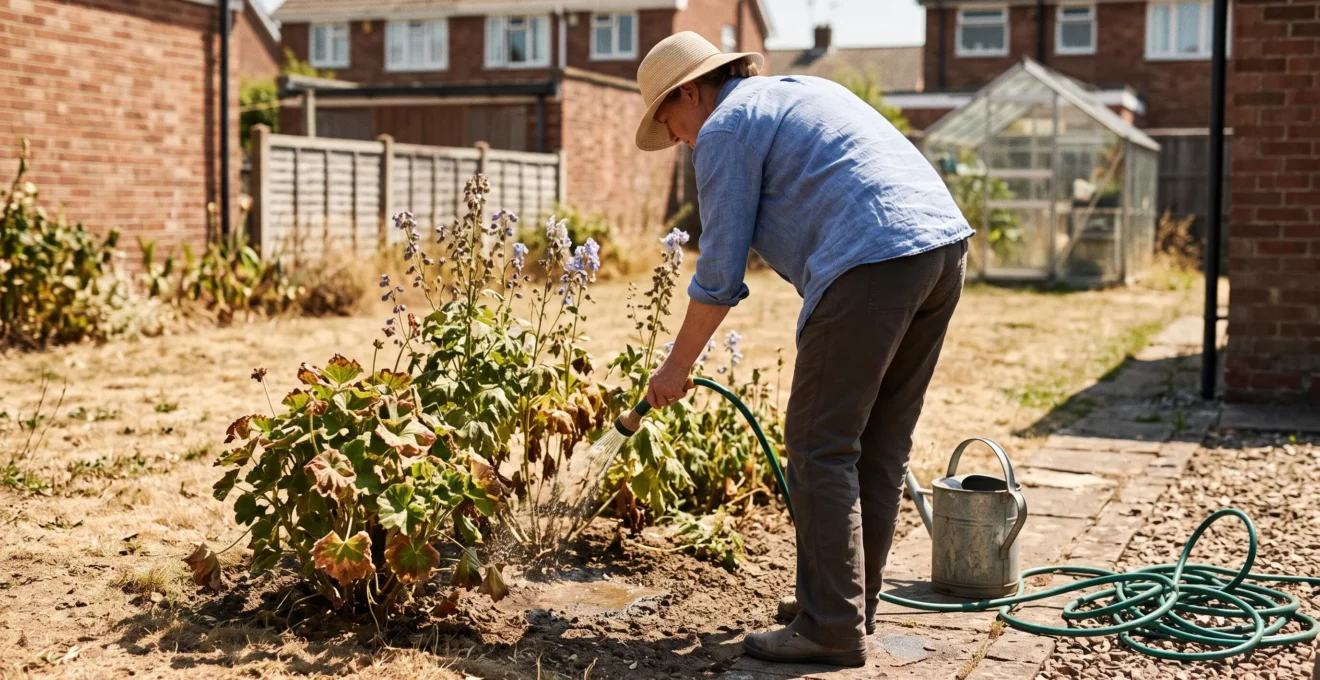
Protecting UK garden plants during heatwaves above 35 °C requires more than increasing the frequency of watering. Temporary shade, deep root-zone irrigation, moisture-retaining mulch and careful plant selection work together to reduce heat stress and preserve limited water supplies. The immediate priority is preventing irreversible damage rather than maintaining perfect-looking borders throughout the hottest days.
Traditional British gardens contain many plants adapted to relatively mild summers. When intense sunlight, hot winds and prolonged dry conditions occur together, even established perennials can struggle to regulate their temperature. Vegetable crops face additional problems, including failed pollination, premature flowering and reduced harvests.
Understanding whether a plant is suffering from dehydration, excessive leaf temperatures or oxygen-starved roots is essential before intervening. The wrong response can accelerate its decline. Preparing the garden before temperatures peak, protecting vulnerable specimens and adapting planting choices gradually can help preserve both ornamental borders and productive vegetable plots without exhausting available water.
Essential strategies for protecting garden plants in extreme heat
- Check moisture below the soil surface before watering wilted plants, particularly in clay borders where saturation can damage roots.
- Provide temporary, ventilated shade during peak afternoon heat, prioritising young plants and flowering vegetable crops.
- Water established borders deeply rather than repeatedly wetting the surface, and irrigate early in the morning whenever practical.
- Apply organic mulch to moist soil and gradually introduce plants suited to both summer drought and wet British winters.
- Why Do Classic British Border Plants Collapse During Heatwaves Despite Adequate Watering?
- How to Rig Emergency Shade Protection for Garden Plants During Heatwave Alerts?
- Heat-Tolerant Perennials vs Traditional UK Favourites: Which Will Survive Future Summers?
- The Watering Timing Mistake That Wastes 60% of Water During Summer Heatwaves
- When Should You Begin Heat-Preparation Measures to Protect Plants Before Heatwaves Strike?
- How Much Shade Should You Provide for Vegetables During 30°C+ Summer Temperatures?
- Why Do Waterlogged-Looking Plants in Clay Soil Actually Suffer from Oxygen Starvation Not Overwatering?
- How Can You Keep Gardens Productive When Summer Temperatures Exceed 30°C in UK Heatwaves?
Why Do Classic British Border Plants Collapse During Heatwaves Despite Adequate Watering?
Classic British border plants can collapse during heatwaves because their roots and internal water transport systems cannot always meet the demands of rapidly transpiring leaves. Plants respond by closing their stomata, reducing evaporative cooling. Consequently, foliage may wilt or suffer heat damage even when the surrounding soil contains adequate moisture.
This imbalance between water supply and demand creates hydraulic stress. Under sufficiently severe conditions, it can progress towards hydraulic failure, compromising the plant’s ability to transport water internally. However, temporary afternoon wilting does not necessarily indicate permanent damage.
Two forms of stress require different responses:
- Dehydration stress: water becomes unavailable faster than roots can absorb it, particularly in free-draining soils and restricted containers. Thorough irrigation may restore the plant’s water balance.
- Direct thermal damage: exposed leaves can become considerably hotter than the surrounding air. Excessive tissue temperatures can damage cellular structures and proteins, making additional watering alone insufficient.
Delphiniums, lupins and astilbes can struggle in exposed, intensely hot borders, although their vulnerability varies with root development, species and growing conditions. Hardy geraniums are particularly variable: some tolerate dry conditions considerably better than others. Large, soft leaves, limited root systems and a preference for cool, moist soil are useful warning signs when assessing unfamiliar plants.
According to Oregon State University’s guidance on plant heat stress, afternoon wilting followed by recovery during cooler conditions is consistent with heat stress. Persistent wilting requires closer investigation.
Push a finger beneath the soil surface near the affected plant. If the root zone feels dry and the foliage remains limp the following morning, inadequate moisture may be responsible. If the soil remains moist and the plant recovers overnight, temporary shading may be more valuable than further irrigation.
Once excessive leaf temperature becomes the principal problem, reducing direct solar exposure offers protection that watering alone cannot provide.
How to Rig Emergency Shade Protection for Garden Plants During Heatwave Alerts?
Emergency shade protection should intercept intense sunlight while allowing air to circulate freely around garden plants. Suspend shade netting, a lightweight sheet or a garden umbrella above vulnerable foliage during the hottest part of the day. Keep the sides open and remove or retract temporary covers when temperatures fall and sunlight becomes less intense.
Effective protection does not require a permanent structure. Bamboo canes, sturdy stakes, garden clips and existing supports can provide a temporary framework over individual plants or vegetable beds. The material should be selected according to the crop’s light requirements and the equipment already available.
The following materials offer different levels of protection, airflow and practical convenience.
| Material | Suitable applications | Practical limitations |
|---|---|---|
| 30% shade netting | Tomatoes, peppers and sun-loving vegetables | May provide insufficient protection for particularly sensitive foliage |
| 50% shade netting | Heat-sensitive vegetables, recent plantings and vulnerable containers | Can restrict productive sunlight if left in place continuously |
| Light-coloured bedsheet | Emergency protection using existing household materials | Variable light transmission and greater wind resistance |
| Garden umbrella | Individual specimens and grouped containers | Requires secure anchoring and occasional repositioning |
| Horticultural fleece | Brief, improvised protection when alternatives are unavailable | Can retain unwanted warmth; dedicated shade netting is preferable |
Position supports above the mature foliage and secure the material so that it cannot sag onto leaves. Maintaining an unobstructed air gap reduces heat accumulation and the risk of physical contact damage. Avoid enclosing the entire bed, as restricted ventilation can increase humidity and create conditions favourable to fungal disease.
Where materials are limited, protect recently planted specimens, shallow-rooted containers and flowering or fruiting vegetables first. Established shrubs and drought-adapted perennials can often remain uncovered unless they display persistent stress.
Retract covers during cooler periods to restore sunlight and pollinator access. Secure or remove improvised structures whenever wind conditions make them unstable.
Temporary protection buys valuable recovery time, but reducing the garden’s long-term dependence on emergency interventions also requires reconsidering which plants occupy its hottest positions.
Heat-Tolerant Perennials vs Traditional UK Favourites: Which Will Survive Future Summers?
Perennials adapted to sunny, seasonally dry environments are generally better candidates for increasingly hot British summers than plants requiring consistently cool, moist conditions. However, survival during heatwaves above 35°C also depends on establishment, soil drainage, cultivar characteristics and exposure. Drought tolerance alone cannot guarantee resistance to extreme temperatures or wet winters.
Rather than replacing an entire border, assess individual plants according to the characteristics that influence their ability to cope with prolonged heat.
| Assessment criterion | Potential resilience indicators | Potential vulnerability indicators |
|---|---|---|
| Root development | Established roots accessing a substantial soil volume | Restricted, shallow or recently disturbed roots |
| Leaf characteristics | Narrow, leathery, waxy or silver-grey foliage | Large, soft leaves associated with moisture-dependent growth |
| Natural growing conditions | Sunny habitats with seasonal drought | Cool woodland or consistently moist environments |
| Water requirements | Limited supplementary irrigation once established | Dependence on consistently moist soil |
| Winter suitability | Appropriate cold hardiness and tolerance of site drainage | Sensitivity to prolonged cold and saturated soil |
Lavender, suitable salvias, eryngiums, achillea and ornamental grasses such as Stipa offer potential alternatives for hot, free-draining positions. Miscanthus cultivars may also contribute to resilient planting schemes where their particular moisture requirements are satisfied.
These plants are not interchangeable. Lavender, for example, requires effective drainage, whereas some Miscanthus cultivars suit different soil conditions. Likewise, selected hardy geraniums can perform well in gardens experiencing alternating wet and dry periods.
The establishment period is especially important. Drought-tolerant plants may require regular irrigation during their first one or two summers while roots develop sufficiently to access available moisture.
The RHS guidance on plants for seasonally wet and dry soils emphasises the importance of choosing plants for contrasting seasonal conditions, including summer drought and winter saturation. A perennial that survives intense July sunshine may still fail in cold, poorly drained soil.
A gradual substitution strategy preserves the character of established gardens. Replace specimens that repeatedly fail in exposed locations with suitable alternatives, while retaining valued delphiniums, astilbes or other moisture-dependent favourites in cooler positions with suitable soil.
A well-adapted planting scheme reduces future irrigation demand, but its success still depends on how effectively water reaches developing and established roots.
The Watering Timing Mistake That Wastes 60% of Water During Summer Heatwaves
Watering during peak daytime heat can increase evaporation losses, particularly when irrigation is delivered through sprinklers or across exposed soil. Early morning is generally a more efficient watering window. However, the claim that midday watering wastes 60% of applied water is not a verified universal statistic and should not be treated as one.
Actual losses depend on wind, sunlight, soil moisture, irrigation equipment and the rate at which water enters the ground. Water directed slowly towards roots may remain effective even during hot weather, whereas fine sprinkler droplets are more exposed to evaporation and wind drift.
The more consequential mistake is often frequent, superficial watering. Repeatedly moistening the upper soil layer without reaching deeper roots leaves plants dependent on moisture close to the surface, where drying occurs rapidly.
For established borders, slower and more thorough irrigation encourages deeper root development where soil structure and plant characteristics permit it. Containers, seedlings and newly planted specimens require a different approach because their accessible soil volume is more limited.
15 cm
The recommended soil-moisture depth to check after watering garden borders. This practical benchmark helps establish whether irrigation has penetrated beyond the rapidly drying surface layer.
Check moisture penetration by carefully opening a small inspection hole beside the watered area after allowing the water to infiltrate. Avoid damaging significant roots. If the surface is damp but the soil beneath remains dry, adjust the application rate and watering duration before increasing frequency.
Morning irrigation replenishes available moisture before temperatures rise and allows accidentally wetted foliage to dry during the day. Nevertheless, a severely dehydrated plant should not be left without water until the following morning simply to follow an ideal schedule.
Direct irrigation towards the soil rather than the foliage, and avoid allowing water to accumulate around already saturated roots. There is insufficient evidence in the cited guidance to establish cold-water shock to surface roots as a general consequence of midday irrigation.
Effective watering becomes considerably easier when root systems, soil structure and moisture-retaining surfaces have already been prepared for prolonged dry weather.
When Should You Begin Heat-Preparation Measures to Protect Plants Before Heatwaves Strike?
Heatwave preparation should begin months before extreme summer temperatures arrive, with soil improvement, appropriate planting and root establishment undertaken during suitable autumn or spring conditions. Short-term measures should begin as soon as forecasts indicate severe heat, rather than waiting for visible plant damage or the hottest day of the event.
Long-term preparation creates resilience that cannot be improvised overnight. A recently planted perennial or a specimen accustomed to shallow irrigation cannot immediately develop a more extensive root system when a heatwave warning appears.
Autumn planting, where appropriate for the species and soil conditions, gives roots additional time to establish before summer. Spring provides an opportunity to assess drainage, replenish organic matter, organise container positions and prepare temporary shade equipment.
Apply organic mulch while the soil still contains moisture, preferably following rainfall or thorough irrigation. Covering an already parched border may slow subsequent evaporation but cannot replace missing soil moisture. Very dry mulching materials may also initially resist wetting, making it important to check that irrigation penetrates beneath them.
As temperatures rise, use Met Office forecasts and relevant severe-heat warnings as practical triggers for activating the garden’s protection plan. In England, UK Health Security Agency Heat-Health Alerts provide an additional indication of potentially disruptive hot conditions, although they are intended to protect human health rather than predict plant damage.
Five checks to complete before a forecast heatwave
- Inspect the weather forecast and identify the expected hottest days and afternoon periods, producing a written protection schedule.
- Check root-zone moisture in representative borders and containers, identifying which planting areas genuinely require irrigation.
- Water dry soil thoroughly and verify moisture penetration before applying or replenishing mulch, leaving a visibly protected soil surface.
- Install and test temporary shading over vulnerable plants, confirming that covers are secure and that air can circulate beneath them.
- Move portable containers into suitable sheltered positions and group the most vulnerable specimens where their moisture levels can be checked easily.
When a heatwave is imminent, avoid unnecessary root disturbance, major transplanting or ambitious border renovations. Concentrate instead on maintaining moisture availability and reducing excessive solar exposure.
With the basic protection system established, vegetable crops require more precise decisions about how much sunlight to intercept without compromising flowering, pollination or harvest quality.
How Much Shade Should You Provide for Vegetables During 30°C+ Summer Temperatures?
During summer temperatures above 30°C, approximately 30% shade cloth is a practical starting point for many fruiting vegetables, while more heat-sensitive crops such as lettuce may benefit from heavier shading. The appropriate level depends on crop type, sunlight intensity, local ventilation and whether protection is restricted to the hottest part of the day.
Shade percentages describe the nominal proportion of incoming light intercepted by the material. A 30% shade cloth provides filtered sunlight rather than darkness. It does not guarantee a corresponding reduction in air temperature, plant temperature or water consumption.
The University of Delaware’s vegetable heat-stress recommendations identify 30% shade cloth as a useful balance between light availability and cooling for most vegetables. The guidance also identifies 50–70% shade as an option for particularly heat-sensitive crops such as lettuce. These recommendations originate from US growing conditions and should be adjusted to the intensity and duration of British summer sunshine.
Use crop requirements to determine how much temporary protection is appropriate.
| Vegetable group | Suggested starting approach | Main objective |
|---|---|---|
| Tomatoes, peppers and aubergines | Approximately 30% shade during peak heat | Protect foliage and reproductive development while maintaining productive light levels |
| Flowering beans | Light, temporary overhead shade during intense sunshine | Reduce additional thermal stress during flowering and pod development |
| Lettuce | Consider 50% shade, increasing towards 70% during particularly severe conditions if necessary | Limit excessive exposure and heat-related quality deterioration |
| Spinach, chard and cool-season brassicas | Adjust temporary shade according to crop sensitivity and exposure | Protect vulnerable foliage without unnecessarily restricting growth |
Protecting flowers is particularly important because heat-related fruit-set failure can occur even when plants appear reasonably healthy. Tomatoes and beans may experience reproductive difficulties during prolonged hot conditions. Temporary shading can reduce one component of this stress, although it cannot guarantee successful pollination or overcome every effect of high ambient temperatures.
Excessive shading introduces a different problem. Continuous low-light conditions can encourage elongated growth, reduce productive capacity and contribute to disease where ventilation is restricted.
An adjustable cover offers greater flexibility than a permanent enclosure. Retract or remove it during cooler, cloudier periods and reassess plants as weather conditions change.
Shading reduces the demands placed on plants, but successful recovery still depends on roots functioning properly, particularly in gardens with heavy clay soil.
Why Do Waterlogged-Looking Plants in Clay Soil Actually Suffer from Oxygen Starvation Not Overwatering?
Plants growing in saturated clay soil often wilt because water displaces the air that roots need for normal respiration. Oxygen-starved roots become less effective at absorbing water and nutrients, producing symptoms resembling drought. Excessive watering can cause this condition, but poor drainage, compaction and prolonged rainfall can also be responsible.
The distinction matters because the visible symptoms do not identify the correct treatment. Adding more water to a wilted plant in saturated ground can worsen root-zone oxygen deficiency and prolong physiological stress.
Inspect the soil beneath the surface before irrigating. If it feels sticky, heavily saturated or releases water when gently compressed, postpone additional irrigation. A sour or stagnant smell may provide another indication of poorly aerated conditions, although its absence does not rule out root problems.
Heatwaves introduce an additional difficulty. Exposed clay can harden and develop deep cracks as it dries. Irrigation may then run through preferential channels without evenly moistening the surrounding root zone. A single border can contain persistently wet pockets alongside severely dehydrated areas.
Different soil conditions require different responses:
- Dry, hardened clay: gently loosen an unplanted section of the surface where practical, avoiding root damage, and apply water slowly in stages. Check whether the surrounding soil becomes moist rather than assuming water disappearing into cracks has reached the roots.
- Saturated, compacted clay: stop unnecessary irrigation, avoid disturbing or walking on wet beds and allow excess moisture to drain where possible.
- Unevenly wetted clay: inspect several points around affected plants and target genuinely dry areas rather than watering the whole border indiscriminately.
Structural improvement offers more lasting protection than repeated emergency interventions. The RHS recommends incorporating suitable organic matter before planting, avoiding damage to wet soil structure and considering raised beds or mound planting where drainage is problematic.
In established borders, gradual applications of organic matter can form part of a longer-term improvement strategy. Avoid aggressive digging or aeration around stressed roots during extreme heat, and do not assume that raised planting will eliminate every drainage problem.
Managing both drainage and moisture retention allows the garden to withstand alternating wet and dry conditions, creating a stronger foundation for maintaining productive crops throughout summer.
Key decisions for a more resilient, productive garden
- Distinguish plants requiring immediate protection from established specimens capable of tolerating temporary stress, directing limited resources where they matter most.
- Judge vegetable performance by flowering, fruit development and harvest quality as well as the appearance of foliage.
- Assess summer interventions alongside winter drainage and long-term root establishment before investing in permanent changes to the garden.
How Can You Keep Gardens Productive When Summer Temperatures Exceed 30°C in UK Heatwaves?
Keeping gardens productive during UK heatwaves above 30°C requires coordinated management of irrigation, shade, soil conditions and crop priorities. Maintain adequate moisture around active roots, protect sensitive flowering crops from excessive sunlight, ventilate covered growing spaces and accept that some heat-related losses may occur despite appropriate care.
Productivity depends on how these interventions work together. Shade reduces additional thermal stress, while healthy soil structure enables roots to access both oxygen and water. Appropriate plant selection limits unnecessary irrigation demand, leaving more resources available for vulnerable vegetables and recent plantings.
Containers and hanging baskets deserve particular attention because their limited compost volume can dry rapidly. Check them daily during extreme conditions and more frequently where exposure or container size warrants it. Grouping movable pots in sheltered positions can make moisture monitoring and targeted irrigation easier.
Greenhouses and polytunnels require effective ventilation before indoor temperatures become excessive. Open available vents and doors where practical, introduce suitable shading and consider damping down greenhouse paths when water availability, humidity and ventilation permit. Avoid creating persistently humid, stagnant conditions around foliage.
Regularly harvest crops that have reached usable maturity. Picking beans, courgettes and other continuously harvested vegetables can help maintain productive growth, although extreme temperatures may still interrupt flowering and fruit development.
During water scarcity, adopt a flexible irrigation priority hierarchy:
- Seedlings and recent plantings: protect specimens with limited root establishment and little access to deeper moisture.
- Flowering and fruiting vegetables: maintain suitable root-zone moisture during sensitive reproductive stages.
- Containers and hanging baskets: address rapid drying, promoting severely dehydrated specimens to immediate priority when necessary.
- Established ornamental borders: reserve supplementary irrigation for plants showing genuine moisture deficiency or persistent stress.
Some heat-related failures cannot be reversed through irrigation. Lettuce may bolt, beans may develop distorted pods, and tomatoes can split when moisture availability changes abruptly. Removing spent or damaged produce and adjusting protection for subsequent growth is often more useful than attempting to restore affected tissues.
Where water restrictions apply, check the conditions published by the relevant water supplier before selecting irrigation equipment or using mains water. Stored rainwater and permitted root-zone watering methods can help preserve essential plantings without assuming that every irrigation practice remains authorised.
Before the next period of extreme heat, walk through the garden and identify its most exposed planting areas, moisture-dependent crops and poorly drained borders. Prepare temporary covers, check available water supplies and establish which plants need protection first. These practical decisions can preserve valuable plants and productive growing space while supporting a gradual transition towards a garden better adapted to hotter British summers.
Should heat-scorched leaves be removed immediately?
Avoid extensive pruning while the plant is still experiencing extreme heat. Partially damaged foliage may retain functional green tissue and provide some protection to underlying leaves. Once temperatures moderate, assess recovery and remove clearly dead or diseased material where appropriate. Existing scorch damage will not disappear, but healthy new growth may develop if the roots and growing points remain viable.
Should garden plants be fertilised during a severe heatwave?
Avoid applying fertiliser simply because a plant appears heat-stressed. Fertiliser cannot correct excessive leaf temperatures, dehydration or oxygen-starved roots. Concentrated applications to dry soil may create additional stress. Maintain appropriate moisture and resume suitable feeding practices when growing conditions stabilise, taking account of the plant’s nutritional requirements and the product instructions.
Are dark-coloured plant pots a disadvantage during extreme summer temperatures?
Dark containers exposed to direct sunlight can absorb considerable solar energy, increasing temperatures around the root zone. Container material, size and exposure also influence heating. Moving vulnerable pots away from intense afternoon sunshine or shading their outer surfaces can help reduce additional thermal stress without unnecessarily depriving sun-loving foliage of light.
Can a garden lawn recover after turning brown during a heatwave?
Established grass may enter a period of reduced growth during prolonged dry weather and recover when moisture returns. Recovery is not guaranteed if the drought causes extensive damage to roots or growing points. During water shortages, prioritise vulnerable garden plants and productive crops rather than attempting to maintain a uniformly green lawn.
Should garden protection be removed as soon as a heatwave ends?
Remove temporary shade when intense sunlight and excessive temperatures have subsided, but continue checking soil moisture and plant recovery. Specimens that remain wilted or have substantial foliage damage may require further protection from strong exposure. Restore normal growing conditions according to the plant’s recovery and the forecast rather than automatically removing every protective measure at once.