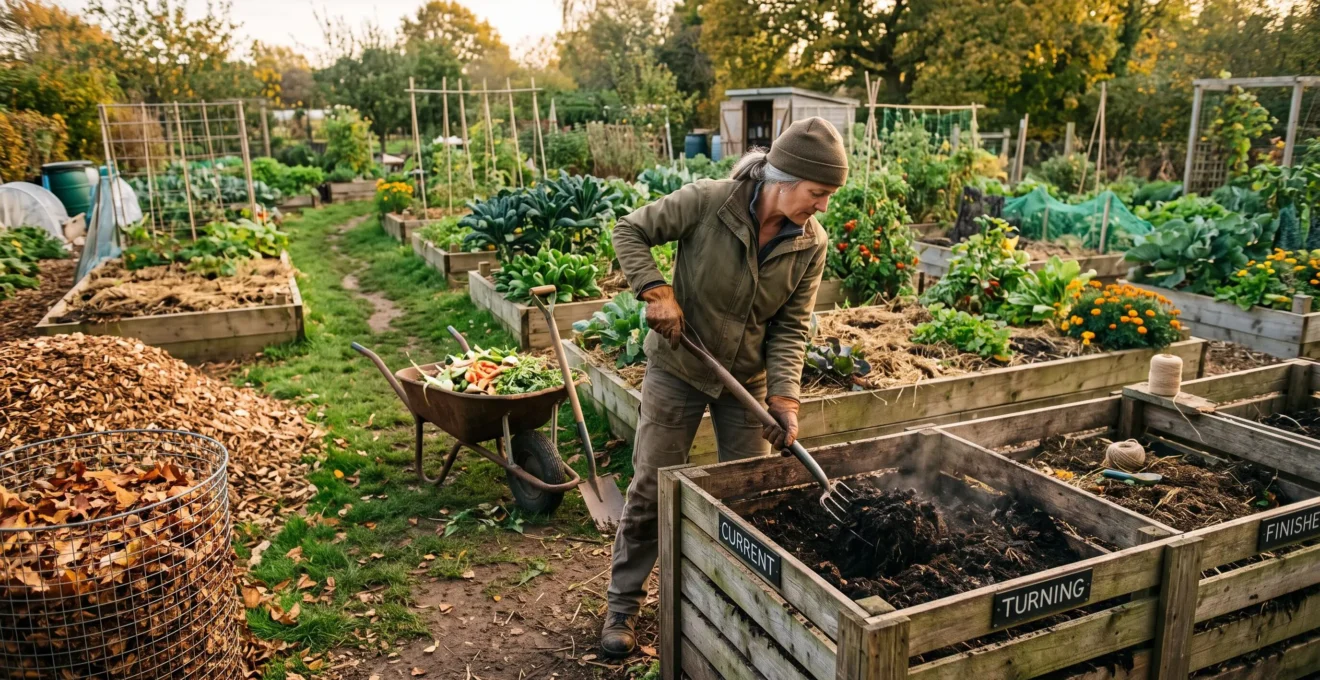
A self-sustaining garden is designed to keep nutrients, organic matter and useful resources circulating within its boundaries. Instead of repeatedly buying compost, fertiliser and soil conditioners, the gardener captures plant residues, kitchen scraps, fallen leaves and other suitable materials, then returns them to the soil through composting and mulching.
The principle is straightforward: every useful resource retained reduces the amount that must be replaced. Achieving this requires more than a compost heap. The garden needs sufficient organic material, suitable infrastructure, productive soil biology and planting choices that do not continually exhaust the available nutrient supply.
Complete independence is difficult because harvested food exports nutrients, decomposition can release nutrients into the environment, and some gardens require additional water or mineral inputs. Nevertheless, a well-designed closed-loop system can substantially reduce ongoing purchases while improving soil condition. For UK gardeners, the practical starting point is to measure what leaves the property, calculate what the growing beds need and build a recycling system around those flows.
Self-sustaining gardening: the essential principles
- Keep suitable garden residues and household organic materials on-site, converting them into compost and mulch rather than exporting potential fertility.
- Calculate compost demand from actual growing-bed area and application depth, then compare that requirement with the organic materials the garden produces.
- Combine composting infrastructure, perennial planting, water management and soil protection to reduce external inputs progressively rather than expecting immediate independence.
- Why Do Self-Sustaining Gardens Compost Everything On-Site Instead of Removing Organic Waste?
- How Much Compost Must You Generate Annually to Supply a 100m² Garden Without Buying Inputs?
- Backyard Chickens vs Compost-Only Systems: Which Closes the Nutrient Loop More Effectively?
- The Waste Export Habit That Breaks Self-Sustaining Cycles and Depletes Garden Fertility
- What Infrastructure Must Be in Place Before a Garden Can Achieve a Self-Sustaining Cycle?
- How to Build a Three-Bay Compost System for Year-Round Nutrient-Rich Production?
- Perennial Food Crops vs Annual Vegetables: Which Builds Soil Carbon Faster in UK Gardens?
- How Do Regenerative Gardening Methods Reverse Decades of Soil Degradation in Home Gardens?
Why Do Self-Sustaining Gardens Compost Everything On-Site Instead of Removing Organic Waste?
Self-sustaining gardens compost suitable organic waste on-site because every discarded leaf, grass clipping or vegetable residue contains nutrients and carbon that could support future soil fertility. Retaining these materials reduces the need to replace them with purchased products. Composting does not eliminate every nutrient loss, but it creates the recycling pathway on which a low-input garden depends.
A vegetable plant absorbs nitrogen, phosphorus, potassium and other elements from its growing environment. Some of those nutrients leave the garden when vegetables are harvested. Others remain in stems, roots, leaves and unused produce. Sending those residues away removes material that could otherwise be returned to the soil.
This distinguishes resource retention from conventional waste management. A tidy garden does not necessarily need empty borders and bags of organic material waiting for collection. It needs appropriate places for materials to decompose safely.
Begin with a simple input-and-output audit. Record the leaves, hedge trimmings, lawn clippings and suitable food scraps currently discarded. Alongside them, list purchased compost, manure, mulch and fertiliser. The comparison reveals which resources are leaving while similar materials are being brought back.
The EPA home composting recommendations explain how to combine nitrogen-rich materials with dry, carbon-rich ingredients while maintaining oxygen and moisture. The guidance suggests approximately two to three volumes of browns for each volume of greens as a practical starting point, rather than an exact chemical formula.
Appropriate containment also addresses concerns about odours and pests. Cover food scraps with dry leaves or other carbon-rich material, maintain airflow and avoid adding unsuitable food waste to ordinary open compost heaps. These measures make recycling more manageable without treating valuable organic matter as rubbish.
However, retaining everything indiscriminately is not the goal. Diseased plant material, persistent weed seeds and contaminated vegetation may introduce problems that a domestic heap cannot reliably eliminate. Removing these materials can protect the wider system.
Once the garden’s recoverable resources have been identified, the next question is whether they can produce enough compost to meet the growing beds’ annual requirements.
How Much Compost Must You Generate Annually to Supply a 100m² Garden Without Buying Inputs?
A 100m² garden does not have one universal annual compost requirement. The amount depends on the area actually cultivated, the depth applied and the growing method. For example, covering the full 100m² with a 5cm layer requires 5m³ of finished material. Producing that quantity at home requires considerably more raw material because compost shrinks during decomposition.
The starting calculation is:
Finished compost or mulch volume (m³) = growing-bed area (m²) × application depth (m).
The RHS advice on no-dig gardening recommends approximately 5cm of organic mulch annually for established no-dig beds. Newly established beds may need a substantially deeper initial layer.
The following examples illustrate how bed allocation changes annual material demand.
| Growing area treated | Application depth | Material required |
|---|---|---|
| 100m² | 2cm | 2m³ |
| 100m² | 5cm | 5m³ |
| 60m² | 5cm | 3m³ |
| 40m² | 5cm | 2m³ |
These are geometric examples, not universal application recommendations. A garden with permanent paths, established fruit bushes or perennial beds may need much less annual surface material than an intensively cultivated vegetable plot.
The second calculation concerns compost production. The EPA’s guidance indicates that mature compost can shrink to approximately one-third of its original volume. Under that illustrative assumption, producing 5m³ of finished compost could require around 15m³ of incoming material. Actual yields depend on the ingredients, moisture, decomposition and whether the intended mulch must be fully composted.
5m³
The calculated volume needed to cover 100m² with a uniform 5cm layer of finished compost or organic mulch. This is an application-volume example, not a guaranteed annual compost-production target for every garden.
Calculation based on the Royal Horticultural Society’s established no-dig mulching guidance.
To estimate available production, separate the main organic waste streams: vegetable kitchen scraps, lawn clippings, autumn leaves, shredded cardboard and spent crops. Measure their approximate volumes over representative periods rather than relying on household-size assumptions.
Carbon-rich materials deserve particular attention. A garden may produce abundant fresh grass in summer but insufficient dry leaves or woody material to balance it. Stockpiling autumn leaves helps overcome that seasonal mismatch.
A small household may not generate enough biomass to sustain 100m² of intensive vegetable production, especially during establishment. A realistic transition can involve an initial delivery of locally available wood chips, leaves or other suitable organic matter while planting more perennial crops and increasing internal mulch production.
Such materials are transitional imports, not proof of complete self-sufficiency. The long-term objective is to reduce dependence on them while monitoring whether soil fertility and crop performance remain adequate.
Once demand and potential supply are understood, livestock can be evaluated as one possible nutrient-processing component rather than an automatic improvement to the system.
Backyard Chickens vs Compost-Only Systems: Which Closes the Nutrient Loop More Effectively?
Compost-only systems are generally simpler to manage with minimal imported inputs, while backyard chickens can process selected organic materials and produce useful manure alongside eggs. Chickens do not create nutrients: their manure reflects what they consume, including purchased feed. The better choice depends on whether the household values eggs, has suitable space and can responsibly manage additional nutrient flows.
A compost heap transforms plant-based organic material into a soil amendment through microbial decomposition. It requires a suitable balance of ingredients, moisture and air, but no animal feed.
Chickens introduce another pathway. They consume appropriate feed and permitted scraps, convert part of that intake into eggs and body maintenance, and excrete nutrients in manure. Their bedding can then become a compost ingredient.
The important distinction is between nutrient conversion and nutrient independence. Purchased poultry feed brings additional nutrients onto the property. Eggs removed from the system also carry nutrients away. Manure production alone therefore does not demonstrate a closed nutrient balance.
Before adding chickens, compare the practical requirements.
| Decision factor | Compost-only system | Backyard chickens |
|---|---|---|
| Primary benefit | Recycles organic residues into soil amendment | Produces eggs and manure while processing suitable materials |
| External inputs | Potentially low after establishment | Feed and husbandry supplies usually required |
| Space requirements | Composting and storage area | Secure housing, outdoor space and manure management |
| Routine commitment | Periodic mixing, monitoring and harvesting | Daily animal care alongside compost management |
| Main constraints | Available feedstock and composting capacity | Animal welfare, biosecurity, local rules and manure handling |
| Best suited to | Gardeners primarily seeking soil fertility | Households seeking eggs and willing to maintain livestock |
A hybrid arrangement can work where chicken bedding and manure move into a dedicated compost batch. Some suitable garden surplus may be used as supplementary poultry feed, but this cannot replace a balanced diet. In the UK, restrictions on feeding kitchen waste to farmed animals, including backyard poultry, mean household kitchen scraps and cooked leftovers must not simply be fed to hens. Current applicable animal-health requirements should be checked before designing this part of the system.
Manure management also changes the design. Fresh poultry manure contains concentrated nutrients and may carry pathogens. Applying it directly around edible crops, particularly leaves eaten raw, introduces avoidable food-safety concerns.
The Oregon State University advice on composting chicken manure recommends managing manure and bedding in separate batches, with hot-composting temperatures around 130–160°F (approximately 54–71°C). Reaching a target temperature is not, by itself, proof that every pathogen has been eliminated. Appropriate management, adequate processing and maturity remain important.
Where manure production exceeds what the composting area can safely process and the garden can appropriately use, livestock may complicate rather than improve nutrient management.
For a gardener whose primary goal is reducing purchased soil inputs, compost-only production is often the more straightforward starting arrangement. Preventing unnecessary organic-material exports matters whichever system is chosen.
The Waste Export Habit That Breaks Self-Sustaining Cycles and Depletes Garden Fertility
The most damaging waste-management habit in a developing closed-loop garden is routinely removing usable organic material while purchasing replacements. Bagged autumn leaves, discarded grass clippings and cleared crop residues represent lost opportunities to recycle carbon and nutrients. Repeated exports increase dependence on outside materials, although selective removal remains appropriate when residues are diseased or contaminated.
Consider a household that sends lawn clippings for collection every week during active growth, removes leaves each autumn and buys bags of compost every spring. The material leaving the garden contains some of the same resources that purchased compost is intended to replenish.
The apparent convenience conceals a structural problem: organic matter is being managed as a disposal cost rather than a productive resource.
Common leaks include:
- Autumn leaves: bagging and removing them instead of producing leaf mould or storing them as compost browns.
- Lawn clippings: collecting and exporting them rather than leaving suitable short clippings on the lawn or adding manageable quantities to compost.
- Spent crops: discarding healthy residues that could be composted after harvest.
- Suitable plain cardboard: sending away a potential carbon-rich compost ingredient while needing additional browns.
- Usable animal bedding: disposing of suitable bedding instead of processing it safely with other organic materials.
These practices do not automatically cause measurable soil depletion in every garden. The consequences depend on replacement inputs, soil conditions and the nutrients removed. Nevertheless, sustained removal without equivalent replenishment can progressively weaken an organic-matter maintenance strategy.
Mineral fertiliser can address certain crop nutrient needs, but it does not directly replace every physical and biological contribution of organic matter, such as improved aggregation, moisture retention and habitat for soil organisms.
A useful response is to prioritise local recovery before purchasing manufactured or transported materials. UK green-waste collection services and community composting arrangements may provide opportunities to recover organic resources where permitted. Neighbours’ autumn leaves or suitable locally sourced arborist wood chips can support establishment, provided their quality and contamination risks are assessed.
These remain imports from beyond the garden boundary. Record them separately from materials produced on-site so that apparent independence does not disguise an ongoing external supply.
Exceptions are equally important. Seed heads from difficult weeds, suspect diseased plants and contaminated vegetation may be better managed outside an ordinary domestic composting cycle. The goal is to prevent avoidable losses without circulating problems.
Stopping unnecessary exports preserves resources, but those resources still need somewhere to go. Composting, storage and water infrastructure turn waste retention into a functioning production system.
What Infrastructure Must Be in Place Before a Garden Can Achieve a Self-Sustaining Cycle?
A self-sustaining garden needs composting capacity, a reserve of carbon-rich materials, reliable water management and protected storage for finished compost. These components must be sized to the garden’s actual organic waste production and seasonal demand. Without sufficient space, airflow or moisture control, retained materials can become difficult to manage rather than useful inputs.
The physical layout should follow the material flow. Fresh clippings, crop residues and kitchen scraps enter the composting area; dry leaves or suitable woody materials balance them; maturing material rests separately; and finished compost returns to the beds.
The RHS composting advice recommends choosing containers according to the quantity of waste available and the space at hand. Larger wooden bays can suit productive gardens, while adjacent containers allow different stages of decomposition to be kept separate.
Start by allowing room for at least two composting stages where space permits. A three-bay arrangement provides additional separation between fresh, maturing and finished material, but three bays are not essential for every household.
The second requirement is a year-round carbon reserve. Nitrogen-rich grass cuttings and vegetable scraps may arrive regularly, while dry leaves are concentrated in autumn. Without stored browns, heaps containing excessive wet greens can become compacted and oxygen-poor.
Store dry leaves in a ventilated enclosure, and protect suitable shredded cardboard or dry woody material from prolonged saturation. The reserve acts as a buffer when feedstock composition changes.
Water management is another design consideration. A heap that becomes too dry decomposes slowly; excessive saturation displaces oxygen. A sheltered location in partial shade, with suitable drainage and practical access to water, helps moderate these extremes.
Rainwater storage may reduce reliance on mains water, although storage capacity and rainfall patterns determine how much irrigation demand can actually be covered. Composting infrastructure alone cannot guarantee water independence.
Finally, provide a distinct area for finished compost so it does not become mixed with fresh additions. Convenient wheelbarrow access, simple turning tools and an identifiable destination for mature material complete the pathway back to the soil.
Five checks before starting a closed-loop garden
- Map organic material flows: create a written inventory showing which garden and household residues are retained, exported or purchased.
- Calculate compost demand: produce a bed-area worksheet recording each growing area’s size, intended mulch depth and resulting material volume.
- Allocate processing space: mark a garden layout showing at least two composting stages where practical, along with access for tools and moving material.
- Establish carbon and water reserves: identify a dry-material storage location and document how the compost will receive moisture during dry periods.
- Define the return pathway: prepare a seasonal schedule identifying where mature compost will be stored and which beds will receive it.
With the necessary components in place, a three-bay composting arrangement can make material movement easier to organise across the growing year.
How to Build a Three-Bay Compost System for Year-Round Nutrient-Rich Production?
A three-bay compost system separates fresh organic material, actively decomposing compost and finished compost into distinct working areas. Build adjoining bays with accessible fronts, adequate airflow and suitable drainage, then move batches through the stages as they decompose. This arrangement improves organisation and seasonal storage, but year-round availability still depends on material supply, temperature and curing time.
Choose the dimensions according to actual feedstock volumes rather than copying a fixed plan. The RHS notes that compost containers below approximately 1m³ are generally less efficient at retaining conditions suitable for active decomposition, although smaller systems remain usable.
For gardens with sufficient material and space, bays approaching or exceeding that capacity may be practical. The structure should still allow comfortable turning and unloading without requiring the gardener to reach awkwardly over high walls.
The three stages operate as follows:
- Bay one — receiving: combine fresh suitable greens and stored browns, maintain moisture and cover new food scraps appropriately.
- Bay two — decomposition and maturation: transfer a batch once appropriate, turning or aerating when conditions require it and avoiding further additions of fresh material to the ageing batch.
- Bay three — finished storage: hold mature compost until it can be applied to beds, keeping it separate from unfinished material.
Reclaimed pallets can provide an accessible framework with ventilation gaps, but their condition, provenance and stability need checking. Timber boards can offer greater control over enclosure and access, while mesh allows considerable airflow but may be less effective at retaining moisture. Material choice should reflect local availability, expected wear and maintenance needs rather than an assumed universal ranking.
Site the structure on a well-drained, sheltered surface where wheelbarrows can approach the working faces. Contact with soil can assist drainage and access for soil organisms, provided the location does not create unwanted runoff problems.
Managing the contents is more important than the number of compartments. A healthy active heap generally feels damp rather than waterlogged, contains enough coarse material for airflow and develops an earthy smell as decomposition progresses.
A strong unpleasant odour can indicate excess moisture, compaction or too much nitrogen-rich material. Mix in suitable dry browns and restore airflow. A dry heap that is not decomposing may require moisture. Slow activity can also result from insufficient material or low temperatures rather than an ingredient imbalance.
Where hot composting is intended, a compost thermometer can help track biological activity. The EPA describes well-managed heaps reaching approximately 130–160°F, or 54–71°C. Temperature alone should not be treated as a guarantee of complete sanitisation or maturity.
Finished compost should be stable, sufficiently decomposed and allowed to cure. The EPA describes at least four weeks of curing after active decomposition, while practical readiness depends on the material and conditions.
Seasonal management completes the design. In autumn, retain dry leaves for future mixing. During summer, combine abundant fresh growth with stored browns. In winter, expect slower decomposition and use the available bays for holding and protecting material rather than assuming uninterrupted rapid compost production.
Even an efficient compost system cannot compensate indefinitely for a planting design that demands more organic matter than the garden generates. Crop selection is therefore the next major design decision.
Perennial Food Crops vs Annual Vegetables: Which Builds Soil Carbon Faster in UK Gardens?
Perennial food crops often provide conditions favourable to soil-carbon retention because their roots remain established and their beds generally require less disturbance. Annual vegetables can also support soil organic matter when managed with compost, cover crops and minimal cultivation. Neither category has a guaranteed carbon-accumulation advantage under every condition; soil type, climate, residue management and cultivation practices determine the outcome.
Soil carbon enters the system through living roots, plant residues, organic amendments and biological activity. Its persistence depends on how much organic material enters the soil compared with how much is decomposed or lost.
Perennial crops maintain living root systems over successive years. Their permanent planting areas can reduce repeated digging, preserve soil cover and support more continuous biological activity.
Suitable options for UK gardens include asparagus, rhubarb, currants, other soft fruit and perennial herbs. These crops differ in their nutrient needs and productivity, but established plants often allow a more stable soil-management routine than frequently replanted annual beds.
Annual vegetables provide a different benefit: flexible crop rotation and the potential for substantial seasonal harvests from limited space. They can also require regular establishment, harvesting, soil preparation and organic-matter additions, depending on the method used.
The comparison is therefore not simply annual crops versus perennials. Management intensity and soil cover matter as much as plant lifespan. An undisturbed, mulched annual bed may retain soil carbon better than a poorly maintained perennial border with exposed, eroding soil.
For a hypothetical 100m² food garden, an allocation of 40m² to permanent perennial crops and 60m² to annual vegetables would create two different management zones. The exact split is a design choice, not a scientifically established optimum.
The perennial area could receive suitable leaves, chopped prunings and other garden-produced mulch as needed, while compost production is prioritised for the more demanding annual beds. Paths and growing areas should be measured separately when calculating material needs.
A mixed planting strategy also changes the timing of residue production. Pruned perennial material and fallen leaves can provide carbon-rich ingredients, while annual crop residues contribute seasonal inputs to the compost system.
There is no reliable universal figure for how quickly perennials increase soil carbon in a particular UK home garden. Sandy and clay soils, moisture levels, previous disturbance and organic-matter inputs all influence the result. Avoid treating any crop category as a substitute for observing actual soil condition.
The strongest low-input design is often a combination: permanent planting areas stabilise part of the system, annual beds supply flexible food production, and both contribute residues to the same nutrient-recycling infrastructure.
Key takeaways before restoring your soil
- Assess the condition of the existing soil before deciding whether extra compost, reduced compaction or improved drainage should come first.
- Judge progress through visible soil changes and continuing crop performance, not just the volume of organic material added.
- Connect plant residues, composting capacity and permanent soil cover into one repeating management cycle rather than treating them as separate gardening techniques.
How Do Regenerative Gardening Methods Reverse Decades of Soil Degradation in Home Gardens?
Regenerative gardening improves degraded soil by restoring organic-matter inputs, reducing unnecessary disturbance, maintaining living roots and protecting the surface with suitable mulch. These practices support soil structure, moisture regulation and biological activity over successive growing seasons. Recovery is gradual and depends on the original problem; severely compacted, contaminated or chemically deficient soils may require additional targeted intervention.
Degradation has several possible causes. Repeated cultivation can disrupt soil structure, inadequate organic-matter replacement can reduce biological resources, and traffic over wet soil can create persistent compaction. Bare surfaces are also vulnerable to erosion, crusting and moisture extremes.
The correct starting intervention depends on what is actually wrong. Applying compost without diagnosing severe compaction or drainage problems may not resolve the underlying limitation.
Three practical observations can help establish a baseline:
- Water infiltration: observe whether water enters the soil readily or remains pooled after a consistent test, taking account of recent weather and initial moisture.
- Earthworm activity: inspect comparable small soil samples at similar times and conditions to track changes in visible biological activity.
- Soil structure: examine whether a moist sample separates into stable crumbs or forms dense, compacted masses.
These observations are useful indicators, not complete diagnostic tests. Where poor crop growth suggests a nutrient imbalance or unsuitable pH, appropriate soil testing is more informative than appearance alone. Suspected contamination needs specific investigation rather than routine compost application.
Once the starting condition is understood, the regenerative sequence becomes easier to design. Protect existing soil from unnecessary disturbance, keep suitable organic material circulating, maintain surface cover and retain living roots wherever practical.
Compost returns part of the garden’s retained organic matter to growing beds. Mulches moderate surface conditions and contribute material as they decompose. Perennial plants and well-managed annual beds maintain productive root systems, while reduced cultivation helps preserve developing soil structure.
Improvements in earthworm activity, surface condition or soil workability may become noticeable within one or two growing seasons. That is a possible observation period, not a guaranteed recovery timetable. Long-term restoration depends on the initial condition and continuing management.
The complete closed-loop pathway can be understood as a repeating sequence:
- Plants capture energy and develop biomass using available water and nutrients.
- Harvested crops provide food while suitable unused residues remain available for recycling.
- Leaves, clippings and other suitable organic materials enter composting or mulching pathways.
- Finished compost and decomposing mulches support soil organic matter, structure and nutrient cycling.
- Healthy soil supports subsequent plant growth, producing new biomass that enters the cycle again.
This pathway is not perfectly sealed. Harvested crops export nutrients, some nutrients are lost through environmental processes, and other resources may need replenishment. A reliable low-input garden therefore monitors the balance rather than assuming that composting automatically replaces everything removed.
Its success is better measured by a declining need for purchased inputs alongside stable soil health and satisfactory harvests. If productivity or soil-test results indicate a genuine deficiency, responsible targeted replenishment is preferable to allowing the soil to become depleted in pursuit of an absolute independence claim.
For the next growing season, record the garden’s material imports and exports, establish a practical composting routine and monitor the same soil indicators over time. Use those observations to adjust planting, mulching and compost production until the garden depends less on purchased resources without sacrificing soil fertility.
Can a garden become completely self-sustaining without purchased fertiliser?
A garden can significantly reduce purchased fertiliser through composting, organic-matter retention and careful crop management. Complete independence is harder because food harvesting exports nutrients, and some are lost through natural processes. Soil testing and crop performance help determine whether recycling is sufficient or targeted nutrient replenishment remains necessary.
Can a small garden operate a closed-loop composting system?
Yes. A small garden can use compact compost containers, appropriate mulching and selective retention of plant residues. The main limitation is biomass availability. A small system may reduce purchases substantially without producing all the compost needed for intensive vegetable cultivation.
What should happen to excess grass clippings when the compost heap is full?
Suitable short clippings can be left on the lawn, while other clippings can be composted in manageable quantities with sufficient dry material. Avoid accumulating thick, wet layers that compact and develop unpleasant odours. When production repeatedly exceeds processing capacity, reassess storage, mowing practices and compost-bay sizing.
Does a three-bay compost system guarantee compost throughout winter?
No. Three bays help organise decomposition, curing and storage, but cold weather can slow microbial activity. Keeping a reserve of finished compost and stocking dry carbon-rich materials during autumn makes seasonal management easier. Available quantities still depend on feedstock supply, climate and processing time.
How can you tell whether your garden is becoming less dependent on external inputs?
Compare annual purchases of compost, mulch and fertiliser with the garden’s internal compost production, soil observations and harvest performance. A declining requirement for purchased materials, accompanied by stable fertility and satisfactory crops, is a stronger indicator than compost volume alone. Keep track of imported leaves, wood chips and other bulk materials so their contribution remains visible.