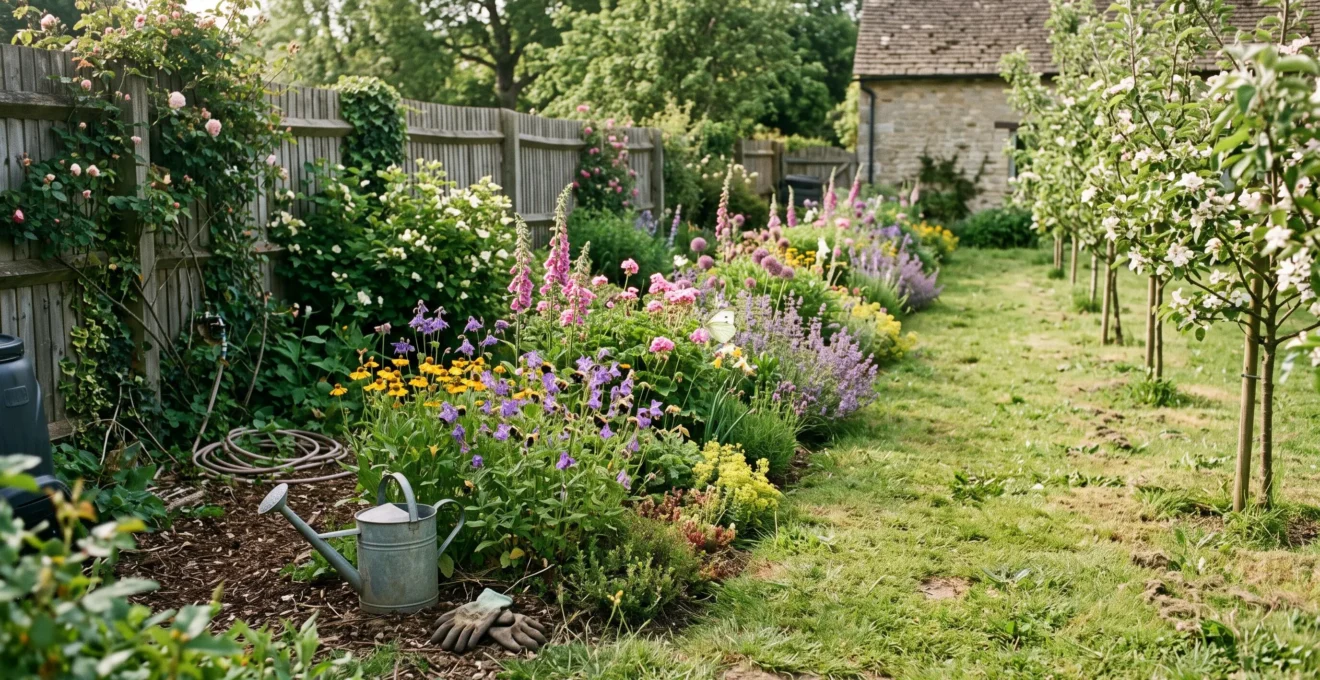
A pollinator corridor connects flowering plants, fruit trees and wildlife habitats into a network that bees, butterflies and other beneficial insects can use throughout the growing season. Instead of concentrating nectar in one attractive flowerbed, it places food and shelter along practical routes between the garden boundary and the crops that need pollinating.
Can this increase fruit yields by 40%? The scientific evidence requires an important distinction. A UK study of cider apple orchards found 40% more wild insect visits to apple blossoms where established flower strips were present, but fruit production did not increase significantly. More flower visitors do not automatically mean a proportionately larger harvest.
For a UK gardener, the practical opportunity is nevertheless substantial: improve access to compatible pollen, provide flowers from early spring into autumn, protect nesting habitats and encourage natural pest predators. The goal is a functioning wildlife network that supports fruit production while helping local insect populations.
Pollinator corridors: What matters most
- Connect existing habitats. Position flowering strips between garden boundaries, fruit trees and vegetable beds rather than creating isolated decorative patches.
- Maintain a seasonal nectar relay. Combine accessible flowers, shrubs and ground-level planting to provide overlapping resources from March through October.
- Measure pollination, not just insect numbers. A 40% increase in wild insect visits has been documented in UK apple orchards, but an equivalent increase in fruit yield is not established.
- Why Do Isolated Flower Patches Attract Fewer Pollinators Than Connected Planting Corridors?
- How to Plant Pollinator Corridors That Provide Nectar from March Through October?
- Native Wildflowers vs Garden Cultivars: Which Provide Better Nutrition for UK Pollinators?
- The Corridor Width Mistake That Leaves Pollinators Exposed to Predation and Disturbance
- When Should You Establish Pollinator Corridors to Support Overwintering and Early-Season Species?
- How to Create Bug Hotels, Log Piles, and Pond Edges That House Predatory Garden Wildlife?
- How to Use Nasturtiums and Mustard as Trap Crops to Protect Brassicas and Beans?
- How Does Maintaining Local Ecosystem Balance Reduce Garden Pest Problems by 80%?
Why Do Isolated Flower Patches Attract Fewer Pollinators Than Connected Planting Corridors?
Isolated flower patches can attract plenty of insects, but connected planting corridors may make food resources easier to locate and use across a garden. Their main advantage is the arrangement of flowering plants near crops and other habitats, rather than a guaranteed increase in visitor numbers. Whether continuous strips outperform separate patches depends on the surrounding landscape, flowering resources and pollinator species.
A bee moving through a typical garden may encounter several contrasting surfaces: a flowering border, closely mown lawn, paved patio, bare fence line and fruit tree. These features do not create identical conditions for feeding or sheltering. A planted route can provide successive opportunities to forage without relying on a single flowerbed.
However, a flowering lawn or patio gap is not necessarily an impassable barrier. Many bees routinely fly across open spaces, and pollinators can use resources in neighbouring gardens. Connectivity is a practical design principle, not proof that every insect follows a continuous planted line.
Foraging also involves an energy budget. In principle, widely separated nectar sources may increase travel costs, while closely spaced patches can reduce the distance between feeding opportunities. Yet garden-specific evidence does not establish how much energy continuous corridors save compared with isolated planting. Their benefit should therefore be evaluated through observed insect activity rather than assumed from appearance alone.
Fruit pollination adds another consideration: pollen must reach a receptive flower in a biologically useful form. Many apple and pear varieties depend on pollen from a compatible variety flowering at the same time. Increasing bee numbers is helpful only insofar as insect visits contribute to effective pollen transfer.
40% more wild insect visits
In a 2017 study involving eight cider apple orchards in Herefordshire, wild non-honeybee insects visited apple blossoms more frequently in orchards with established perennial flower strips. Fruit production did not increase significantly.
Lancaster University’s research on wildflower strips and apple orchard pollination
The study also associated wild insect richness and visits from Andrena bees with apple fruit set. Bumblebees frequently moved between orchard rows, illustrating why pollinator behaviour and movement between flowers can matter as much as the total number of insects present.
Before planting, map the movement already occurring in your garden:
- Choose a sunny, relatively calm afternoon when fruit trees or nearby flowers are in bloom.
- Draw the garden boundary, flowering patches, lawn, vegetable beds and fruit trees.
- Observe several fixed locations for equal periods and note where insects visit flowers or move between planted areas.
- Mark exposed gaps, rarely visited patches and promising connections between existing resources.
- Repeat the observations under similar conditions after the planting has established.
This provides a practical baseline, although differences in weather and seasonal flowering will still influence the results. An apparently quiet patch may simply contain plants that are not offering much nectar at the observation time.
The most useful starting point is not necessarily the longest possible corridor. It is the missing connection between an existing flowering resource and the crops that currently receive relatively few effective visits.
How to Plant Pollinator Corridors That Provide Nectar from March Through October?
A pollinator corridor can provide nectar from March through October by combining plants with overlapping flowering periods rather than relying on one large summer display. Start with early-flowering shrubs, follow with spring and summer perennials, and finish with late-season nectar sources. Arrange them along a route connecting fruit trees, vegetable beds and garden boundaries, while allowing for regional differences in flowering time.
The practical method is a nectar relay: as one group finishes flowering, another should already be opening. Spring-flowering fruit trees provide a valuable seasonal resource, but their blossom period is comparatively short. A garden designed only around apple blossom and summer lavender can leave significant gaps on either side.
Research described in RHS research on year-round nectar provision in urban gardens examined 59 residential gardens in Bristol between March and October 2019. Researchers recorded 636 flowering plant taxa. Trees, shrubs and climbers supplied approximately two-thirds of the estimated nectar in the surveyed gardens, emphasising the value of planting beyond low-growing flowers.
Use the following seasonal planting matrix as a starting point. The flowering windows are indicative for UK gardens and can shift with location, exposure, weather and cultivar.
| Flowering window | Potential nectar plants | Role in the corridor |
|---|---|---|
| March | Willow, lungwort, hellebores | Support early-active insects before most ornamental borders flower. |
| April–May | Apple blossom, flowering currants, columbine, Californian lilac | Overlap with fruit flowering and provide additional spring resources. |
| June–July | Lavender, bellflowers, cranesbills, honeysuckle | Maintain resources after the main spring blossom period. |
| August–October | Ivy, oregano, stonecrops, coneflowers, Verbena bonariensis | Help fill late-summer and autumn nectar gaps. |
Do not assume that a species will flower for its entire listed window. Record what actually opens in your garden, then identify weeks when few nectar-rich flowers are available.
Arrange plants in three complementary layers: flowering shrubs or suitable small trees for structure, herbaceous perennials for seasonal colour and accessible nectar, and lower-growing flowers around the corridor edges. This creates variation in shelter, flower presentation and available feeding resources. Different insects have different flower preferences and feeding structures, so flower diversity matters more than creating one uniform strip.
Consider the corridor’s position before buying plants. A flower-rich strip running along the farthest fence may support wildlife, but it will not necessarily improve pollinator activity around a poorly visited fruit tree. Connecting existing boundary vegetation with the fruit-growing area gives insects flowering resources near the crops where pollination matters.
Also examine flower structure. Some double-flowered bedding varieties have reduced or inaccessible reproductive structures, making them less useful to insects seeking pollen or nectar. As a quick nursery check, look for visible flower centres and watch whether insects can land and feed. This is a screening method, not a reliable measurement of nutritional quality.
Build your garden’s nectar-corridor planting plan
- Draw the route. Produce a sketch marking the garden boundary, existing flowers, fruit trees and vegetable beds, with a proposed connection between them.
- Audit the flowering calendar. Create a March-to-October chart showing which existing plants flower each month and where gaps remain.
- Choose complementary plants. Write a planting list covering early, middle and late flowering periods, including different plant heights.
- Check flower accessibility. Review the proposed varieties and mark those with open, accessible flowers, replacing unsuitable choices where appropriate.
- Record the baseline. Mark fixed observation points and note flower visits before planting so you can compare activity after establishment.
Once the seasonal sequence is planned, the next decision is which plants should form the corridor’s backbone and which ornamental varieties can usefully fill its gaps.
Native Wildflowers vs Garden Cultivars: Which Provide Better Nutrition for UK Pollinators?
Native wildflowers are particularly valuable for supporting pollinators associated with Britain’s native flora, while carefully selected garden cultivars can also provide accessible nectar and pollen. Neither category is automatically superior for every insect. A useful corridor combines suitable native habitat plants with productive ornamentals, judging each choice by flower structure, flowering season and the species it supports.
Native plants have longstanding ecological relationships with local insects. Some specialist bees depend heavily on pollen from particular plant groups, meaning that replacing native flowers with general-purpose ornamentals can remove resources they need. Butterflies also require appropriate larval host plants, which may differ from the flowers adults visit for nectar.
Generalist insects behave differently. Honeybees, many bumblebees and various hoverflies can exploit a broad range of suitable flowers. For fruit pollination, a corridor that provides early-season resources for these insects may be especially relevant, provided the insects subsequently visit compatible crop flowers.
This creates two overlapping but distinct objectives: supporting effective fruit pollination and conserving a diverse native insect community. A garden can pursue both, but selecting plants only because they attract large numbers of generalist bees may leave specialist species poorly served.
Use the following criteria when choosing between native plants and ornamental alternatives.
| Decision criterion | Native wildflowers and shrubs | Garden cultivars and non-native ornamentals |
|---|---|---|
| Specialist pollinator support | Often important where insects depend on particular native plant groups. | May offer limited support if the required host plants or pollen sources are absent. |
| Generalist nectar provision | Can supply accessible nectar and pollen across appropriate flowering periods. | Selected open-flowered varieties can provide useful additional resources. |
| Seasonal coverage | Useful for a locally adapted flowering sequence. | Can help fill periods when existing native planting provides little nectar. |
| Flower accessibility | Varies by species and flower shape. | Varies substantially; heavily doubled and closed flower forms deserve particular scrutiny. |
| Conservation role | Can contribute to local plant–insect relationships and other wildlife requirements. | Useful as complementary planting, but not necessarily a substitute for native habitat plants. |
A practical starting design might use willow and other suitable native shrubs for early resources, native flowering perennials within the main strip, and selected lavender, salvias or open-flowered asters where these complement the nectar calendar.
Lavender and ornamental perennials should not be selected solely on reputation. The actual flower form, local growing conditions and insect activity matter. Likewise, a native wildflower is not necessarily suitable for every garden soil, exposure or target pollinator.
Watch for three cultivar features when shopping: densely doubled petals that obscure feeding structures, varieties bred with little or no viable pollen, and unusually closed or altered flower forms that restrict access. A visible flower centre is a useful clue, but only one part of the assessment.
The RHS Plants for Pollinators listings can help narrow a planting shortlist. They should be treated as a practical filter rather than a guarantee of performance in every UK region. Local flowering records, suitable habitat and the insects already present provide more specific guidance.
For a small garden, an effective compromise is to establish native or locally suitable plants as the structural foundation, then use carefully chosen ornamentals to extend flowering when needed. Avoid relying entirely on one popular nectar plant, even if it attracts many bees in summer.
A diverse plant list only delivers its intended benefits when those flowers occupy a usable space. Corridor width and disturbance therefore deserve as much attention as botanical selection.
The Corridor Width Mistake That Leaves Pollinators Exposed to Predation and Disturbance
The main corridor-width mistake is creating a flower strip so narrow and exposed that it provides nectar but little shelter. A border beside a busy path may still attract feeding insects, yet offer limited protection from wind, mowing and repeated disturbance. There is no scientifically established universal minimum width for domestic pollinator corridors; usable space depends on the garden and its surroundings.
A row of flowers along a patio can be visually impressive, but it does not necessarily provide the same ecological functions as a broader planting containing shrubs, grasses, sheltered ground and less-disturbed vegetation.
Flowering resources and refuge are distinct habitat requirements. An insect may visit an exposed border to feed while using a different location for nesting or resting. A useful corridor should therefore be designed around what happens between flower visits, not simply how many flowers are visible.
Wind is especially relevant to exposed garden boundaries. Dense shrubs and mixed-height vegetation may create more sheltered conditions locally. Likewise, retaining some undisturbed ground and plant cover gives insects additional habitat options that a frequently trimmed flower border cannot provide.
Predation is another factor, but the relationship is complex. Spiders, birds and predatory insects are natural components of garden ecosystems, and some are themselves beneficial. There is insufficient evidence to claim that a particular narrow corridor width universally produces unacceptable predation or that adding a fixed amount of width eliminates this risk.
Instead of applying an invented measurement, test the design against the surrounding disturbance.
- Pathside planting: Can flowers and stems remain intact without being brushed, stepped on or repeatedly cut back?
- Lawn edges: Is there enough separation from mowing and strimming to protect the planted area?
- Boundary exposure: Can shrubs, climbing plants or other vegetation create sheltered sections where appropriate?
- Pets and play areas: Are quieter habitat areas available away from frequently used routes?
- Pinch points: Does the corridor narrow abruptly beside gates, bins or paved access routes?
A pinch point does not automatically sever insect movement; flying pollinators may cross it easily. However, it can reduce the amount of flowering or sheltered habitat available along the planned route. Where space is restricted, a substantial planting pocket on either side may be more valuable than forcing an extremely thin strip through the gap.
For a hypothetical terraced garden, consider a planted boundary bed interrupted by a narrow paved access path. Rather than obstructing access, the gardener could retain a flowering shrub on one side and establish a second nectar-rich planting pocket on the other. The insects may still fly across the path, while both pockets provide usable resources.
Width should also be considered alongside garden scale. A modest garden with diverse flowering shrubs and several relatively undisturbed habitats can offer valuable resources without resembling a landscape-scale wildlife corridor. Conversely, a large but intensively managed border may provide little nesting or overwintering habitat.
Walk the proposed route at different times of day. Identify where wind, shade, repeated movement or routine maintenance might undermine the intended habitat. Where a wider planted area is feasible, prioritise structural variety and a sheltered centre rather than simply increasing the number of identical flowers.
Creating a usable route is only the beginning. The planting must then survive establishment and remain hospitable when most pollinators are inactive.
When Should You Establish Pollinator Corridors to Support Overwintering and Early-Season Species?
Pollinator corridors are best established according to the planting material, local conditions and the flowering resources already present. Autumn is often suitable for establishing many hardy plants and sowing appropriate wildflower seed, while spring offers another planting opportunity. Winter habitat should be retained rather than cleared, and early-flowering species should be prioritised before the next fruit blossom season.
There is no single planting date suitable for every species or propagation method. The most reliable approach is to match the material to its establishment needs, then protect the developing habitat through its first winter and subsequent growing seasons.
| Planting material | Practical timing approach | Important consideration |
|---|---|---|
| Container-grown perennials and shrubs | Plant when soil conditions support establishment, commonly in spring or autumn. | Avoid planting into frozen, waterlogged or excessively dry soil. |
| Perennial plug plants | Use a suitable spring or autumn establishment window for the species. | Allow roots to develop before difficult weather and manage competition from weeds. |
| Bare-root shrubs and trees | Plant during the appropriate dormant-season window. | Check species requirements and avoid unsuitable soil conditions. |
| Wildflower seed | Use an autumn or spring sowing period appropriate to the seed mixture. | Prepare the seedbed and avoid assuming all species germinate on the same schedule. |
One of the most common planning errors is expecting a newly sown strip to provide a complete nectar supply immediately. Establishment, flowering and insect colonisation can take time. Some perennial species will contribute little in their first growing season, and the longer-term ecological benefits depend on successful growth and continued management.
Early-season provision deserves particular attention. Queen bumblebees emerging from winter dormancy and early solitary bees may become active while many ornamental borders remain bare. Willow and suitable early-flowering plants such as lungwort can help provide resources at this stage. Blackthorn may contribute spring blossom where space and growing conditions allow.
Position these plants near existing garden connections and fruit-growing areas. Their flowering periods should be checked locally rather than assumed from a national calendar, since spring conditions vary considerably across Britain.
Winter management is equally important. The RHS recommends retaining long grass, dead wood and some standing perennial vegetation, with perennial cutting delayed until early spring where appropriate. Hollow stems and retained foliage can shelter overwintering invertebrates.
Different insects overwinter in different places. Some solitary bees develop inside plant stems or suitable cavities; queen bumblebees may overwinter in protected ground-level locations. Leaving stems standing does not mean every bee overwinters inside stems, but retaining diverse, undisturbed habitat supports more life-cycle requirements than completely clearing the garden.
Where cutting is necessary, avoid removing every stem or all leaf litter at once. Retaining an undisturbed portion of the habitat can preserve shelter during the transition into spring.
Plan success over multiple seasons. In the establishment year, measure plant survival and flowering coverage. In later seasons, assess whether nectar gaps have narrowed, whether insects are using the plants and whether fruit-tree visits appear more consistent. Fruit yield should be interpreted cautiously because weather, pruning, compatible pollen and crop management also affect production.
A mature corridor provides food, but food alone cannot meet the full needs of every beneficial insect. Nesting spaces, deadwood and water complete the next part of the system.
How to Create Bug Hotels, Log Piles, and Pond Edges That House Predatory Garden Wildlife?
Functional wildlife habitat combines sheltered nesting cavities, undisturbed deadwood, suitable ground conditions and accessible water. A solitary bee hotel can provide nesting spaces for certain cavity-nesting bees, while log piles and vegetated pond edges support different wildlife communities. These features work best when integrated with flowering habitat, maintained according to their individual needs and kept free from unnecessary disturbance.
A pollinator corridor supplies food, but food is only one part of an insect’s life cycle. Bees also require places to reproduce; other insects may need suitable soil, decaying wood, foliage or standing vegetation. Providing a mix of habitats gives insects opportunities to complete more of their life cycles within or near a garden.
Importantly, nesting habitat does not guarantee permanent residency. Bees and other insects can still forage across neighbouring gardens, and nesting-site suitability differs between species.
Decorative bug hotels often combine unsuitable materials in elaborate structures without considering the insects expected to use them. A more practical approach is to create several modest, habitat-specific features.
For cavity-nesting solitary bees, use a solid, stable structure containing smooth, clean nesting holes or replaceable tubes. A range of appropriately sized openings can accommodate different species, but there is no single tube diameter suitable for all bees. Avoid rough, splintered interiors, damp loose filling and exposed cavities that allow rainwater to collect.
Position the nesting structure securely in a sheltered, sunny location, with openings protected from direct rain. Place it near suitable flowering resources rather than assuming it will be useful simply because it hangs somewhere in the garden.
Artificial nests need monitoring. Inspect for water damage, mould and deterioration, and use a maintenance or replacement approach appropriate to the nesting material and species. Reusable or removable components can make hygiene management easier. However, occupied tubes may contain developing bees across winter, so replacing or opening them indiscriminately can destroy the brood.
Annual inspection is sensible, but annual cleaning must not interrupt an occupied nesting cycle. A nesting box is a managed habitat, not an object that should be emptied automatically each autumn.
Log piles have a different function. Place untreated branches and logs in a relatively quiet location, allowing natural decay. Deadwood and the surrounding ground can provide shelter for numerous invertebrates and other garden animals. The aim is habitat continuity, not frequent rearrangement.
Pond edges contribute water and additional habitat diversity. A wildlife-friendly pond should include a gently sloping exit and vegetation around at least part of its edge. Shallow margins offer safer access for wildlife and may provide damp soil or mud used by certain nesting insects.
The RHS advice on wildlife habitats in gardens recommends features including deadwood, longer grass, flowering vegetation and accessible ponds. These support a range of wildlife needs rather than functioning exclusively as pollinator facilities.
To keep the habitat manageable, distinguish the maintenance requirements:
- Solitary bee nesting boxes: Inspect their condition, manage suitable replaceable components and protect occupied nests until emergence.
- Log piles: Leave most material undisturbed so decomposition and shelter conditions develop naturally.
- Vegetated pond margins: Preserve shallow access, suitable vegetation and safe exits while preventing excessive obstruction.
- Long grass and perennial stems: Retain some standing or undisturbed habitat across winter instead of clearing everything simultaneously.
Not every beneficial insect is a pollinator. Predatory beetles, spiders, hoverfly larvae and other natural enemies can also use garden vegetation and sheltered habitats. Maintaining diverse refuge areas supports these organisms, although their presence and pest-control effects vary between gardens.
Once the garden supplies both food and shelter, planting can also be arranged to influence where certain crop pests establish, creating opportunities for targeted monitoring and biological control.
How to Use Nasturtiums and Mustard as Trap Crops to Protect Brassicas and Beans?
Nasturtiums and mustard can be used as potential trap crops by placing them near vulnerable vegetables and inspecting them for pests. The intention is to concentrate certain insects on plants that can be monitored or managed more easily. This is not automatic pest protection: effectiveness depends on the pest species, crop, planting arrangement and timely intervention before populations spread.
A trap crop is a plant used to attract a target pest away from a more valuable crop, ideally making pest activity easier to detect and manage. Unlike ordinary companion planting, successful trap cropping requires evidence that the target pest favours the trap plant under the conditions in which it is grown.
Nasturtiums may attract certain aphids and can receive attention from cabbage white butterflies. Mustards may also be attractive to particular brassica-associated insects. However, attractiveness varies by plant and pest species, so neither should be treated as a universally effective barrier.
There is also an important distinction between crop families. Brassicas and beans do not share identical major pest communities. A trap-crop combination that attracts insects associated with cabbages may have little effect on aphids attacking beans. Identify the actual pest before selecting the sacrificial plants.
A practical layout is to position a monitored trap-crop strip between the main flowering corridor and the vulnerable vegetable bed, where space permits. The strip then has two possible functions: supplying additional flowering resources and concentrating suitable target pests at a predictable observation point.
The arrangement is a garden design strategy rather than a demonstrated guarantee that pests will stop at the first planted row.
In a hypothetical vegetable garden, a gardener could place nasturtiums along the edge of a brassica bed near a mixed flowering border. The gardener would inspect the nasturtium leaves and stems regularly, compare pest activity with the crop and intervene when pest populations threaten to spread. If the target insects ignore the nasturtiums, the strategy should be revised rather than presumed effective.
Monitoring is essential because an unmanaged trap crop can become a pest reservoir. Aphid populations may multiply on attractive plants, and caterpillars can develop if eggs are left undisturbed.
Use a repeatable routine:
- Identify the pest affecting the main crop rather than assuming every insect is harmful.
- Inspect the trap plants and an equivalent sample of crop plants at regular intervals.
- Record pest colonies, eggs or caterpillars, distinguishing them from beneficial insects.
- Look for natural enemies such as ladybird larvae, hoverfly larvae and signs of aphid parasitism.
- Remove or manage heavily infested plant parts when necessary, while avoiding the unnecessary destruction of predators and their habitat.
Hoverflies illustrate the biological connection between the flowering corridor and pest management. Many adult hoverflies visit flowers, while larvae of numerous species feed on aphids. Ladybird larvae also consume aphids. A modest pest population may support natural enemies, although tolerating an infestation is reasonable only while crop damage remains acceptable.
Removing every aphid immediately can deprive predators of food. Allowing colonies to multiply without limits can instead expose nearby vegetables to damage. The appropriate response depends on the trend in pest numbers, predator activity and crop condition.
Mustard requires additional caution near brassicas because related plants can share pests and diseases. A mustard trap crop should not be assumed to improve brassica health merely because it attracts insects.
The available evidence pack does not directly establish a particular protection rate for nasturtiums or mustard in domestic brassica or bean beds. Treat this as a monitored trial, keeping the crops under observation and assessing whether the arrangement genuinely reduces damaging pest activity.
The wider benefit emerges when flowering habitat, natural enemies and selective intervention work together. This leads to the final question: how much pest suppression can a balanced garden ecosystem realistically provide?
Key takeaways before assessing pest control
- A wildlife-friendly corridor needs flowering plants, shelter and seasonal continuity; no individual feature can replace the others.
- Beneficial insects need time and suitable habitat to establish, so predator activity should be monitored alongside pest populations.
- Judge success through observed crop condition and insect activity rather than assuming a fixed percentage improvement.
How Does Maintaining Local Ecosystem Balance Reduce Garden Pest Problems by 80%?
Maintaining ecological balance can reduce pest pressure by supporting predators and parasitoids before damaging insect populations expand. Flowering plants, sheltered habitat and reduced pesticide disruption may strengthen natural control, but an 80% reduction in garden pest problems is not an established universal outcome. Results depend on pest species, habitat maturity, weather, surrounding land use and management practices.
A garden ecosystem contains interacting populations rather than a simple division between helpful and harmful insects. Aphids, for example, feed on plants but also provide food for hoverfly larvae, ladybirds and other predators. Parasitoid insects can use pest populations as hosts, contributing another form of biological control.
Flowering resources may help sustain some adult natural enemies, while perennial vegetation, sheltered ground and undisturbed habitat provide additional resources or refuge. The potential advantage is temporal: beneficial insects may already be present when pest populations begin increasing.
However, predators do not necessarily prevent every outbreak. Their populations respond to prey availability and environmental conditions, and crop damage may occur before natural enemies become sufficiently abundant to suppress pests.
What a quantitative synthesis actually found
A 2020 quantitative synthesis published in Ecology Letters examined flower strips and hedgerows in agricultural landscapes. Its evidence included 18 studies reporting pest-control outcomes and 17 studies reporting pollination services.
Flower strips improved natural pest-control services in adjacent agricultural fields by an average of 16%. Pollination and crop-yield responses were more variable, with effects influenced by planting characteristics, establishment age and proximity. These agricultural findings do not establish an 80% reduction in domestic garden pests.
The quantitative synthesis of flower strips, pest control and crop yield also found that pollination services declined with increasing distance from floral plantings, while older, more diverse perennial strips were associated with better pollination outcomes.
This supports a practical design principle: keep beneficial habitat close to the crops, maintain it over time and avoid treating flower planting as a guaranteed intervention with a fixed result.
Three common gardening practices can undermine the intended balance.
- Broad-spectrum insecticide use: Applications may harm natural enemies as well as target pests, potentially disrupting biological control.
- Complete autumn clearance: Removing stems, deadwood, leaf litter and other refuge areas can eliminate habitat used by beneficial invertebrates.
- Reacting to every aphid immediately: Eliminating all prey can interrupt natural-enemy activity, although damaging infestations still require appropriate management.
Monitoring provides a more informative basis for decisions than a universal reduction target. Select a fixed group of representative plants, such as several brassicas, beans or fruit-tree shoots, and inspect the same plants each week during the growing season.
Record the number of visibly infested shoots or leaves, the presence of ladybirds and hoverfly larvae, and any recognisable parasitised aphids. Note visible crop damage and whether pest colonies are expanding or declining.
An aphid mummy, for example, is an altered aphid body that can indicate parasitoid development. Identifying these signs helps distinguish an insect population with active natural enemies from one that is expanding without obvious biological suppression.
Compare observations over successive weeks rather than interpreting one inspection as a definitive result. The same number of aphids can indicate different risks depending on crop condition, the rate of population growth and the insects feeding on them.
A simple garden record could include the following fields:
| Observation | What to record | Why it matters |
|---|---|---|
| Aphid activity | Number of infested leaves or shoots on the fixed plant sample | Shows whether the visible infestation is expanding or declining. |
| Predatory insects | Visible ladybirds and hoverfly larvae on the same plants | Indicates the presence of some natural enemies. |
| Parasitism | Recognisable aphid mummies | Provides an observable sign of parasitoid activity. |
| Plant damage | Changes in leaf condition, shoot growth or crop damage | Connects insect observations with actual gardening outcomes. |
| Garden conditions | Relevant changes in weather, flowering resources or management | Helps interpret changes that are not attributable solely to predators. |
These observations are not a laboratory measure of biological control, and predator sightings alone do not establish causation. They nevertheless help gardeners make more proportionate decisions and recognise when an intervention may be necessary.
Fruit yield requires a separate assessment. A healthy predator community can help manage some pests, but harvest size also depends on successful fertilisation, compatible varieties, fruit development, weather and plant health. Better pest control and better pollination are complementary goals, not interchangeable measurements.
Start with a garden map, one clear planting connection and a simple weekly observation record. Establish flowers for successive seasons, protect undisturbed habitat and monitor insect activity before and after changes. Over time, these observations offer a more useful measure of progress than any promised 40% yield increase or 80% reduction in pests.
Can a small urban garden support a useful pollinator corridor?
Yes. A small garden can provide flowering resources, nesting opportunities and shelter even without a long continuous planting strip. RHS-backed research in Bristol found that garden size was not significantly correlated with estimated nectar provision in the sampled gardens. Prioritise suitable plants, overlapping flowering periods and connections with neighbouring vegetation rather than garden size alone.
Will planting more flowers guarantee a larger apple harvest?
No. Flower planting may attract pollinating insects, but fruit production also depends on compatible pollen, successful fertilisation, weather and tree condition. The UK cider-orchard study recorded 40% more wild insect visits to apple blossoms where perennial flower strips were present, without finding a significant increase in fruit production.
Do pollinator corridors have to cross the entire garden?
No. Closely spaced flowering patches, boundary shrubs and planting pockets near fruit trees may provide useful resources where a fully continuous strip is impractical. Flying insects can cross lawns and paths. The aim is to improve access to food and habitat while maintaining the garden’s everyday functions, not to impose one rigid landscape pattern.
Should all dead stems and leaves be removed before spring?
Not necessarily. Standing stems, foliage, leaf litter and undisturbed ground can shelter overwintering invertebrates. Retain suitable habitat through winter and avoid clearing everything simultaneously. The timing of any necessary cutting should account for weather, plant growth and the possibility that insects are still occupying the material.
How can gardeners tell whether a pollinator corridor is working?
Track flowering coverage, insect visits and habitat use at fixed locations over successive seasons. For fruit crops, observe visits to blossoms and record harvest outcomes while noting weather and other growing conditions. For pest control, compare pest activity, visible predators and plant damage on the same sample of plants. These observations can reveal useful trends without attributing every change solely to the corridor.