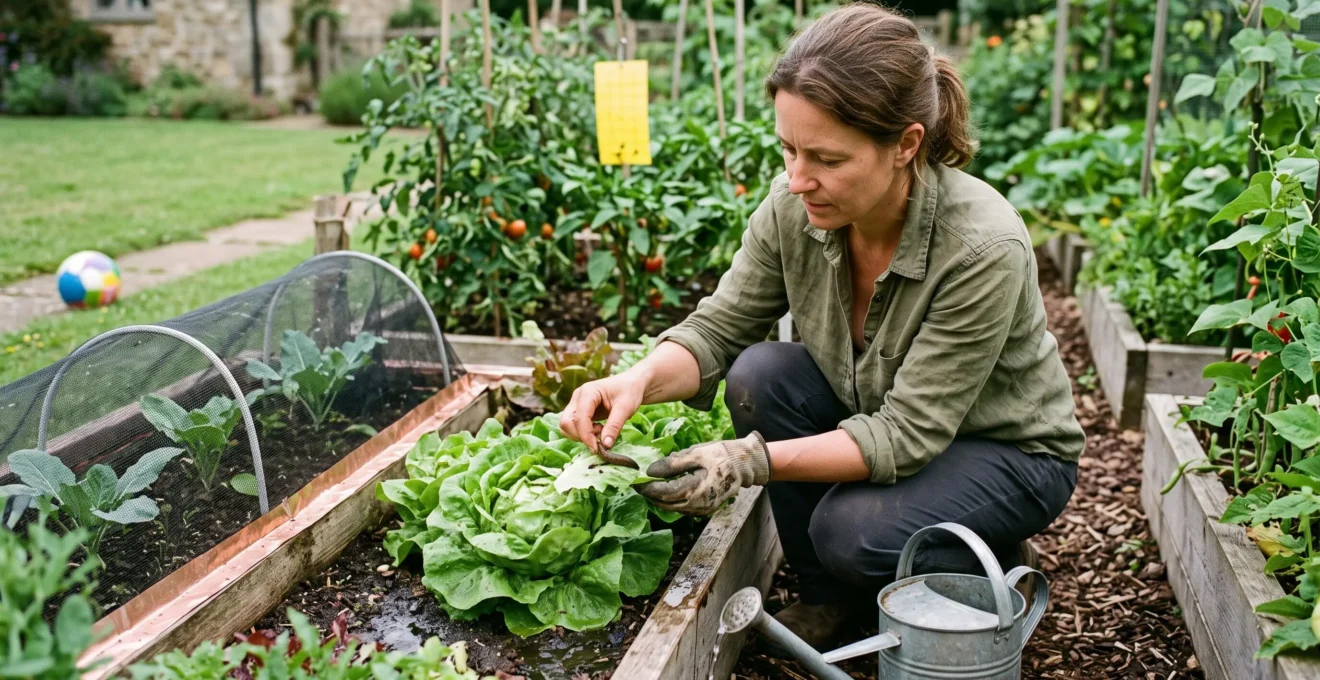
Reducing garden chemicals does not mean accepting ruined vegetables, slug-damaged seedlings or lawns overrun with weeds. It means controlling problems through prevention, physical protection and careful observation before considering a pesticide. This approach can reduce opportunities for children, pets and wildlife to encounter garden treatments without sacrificing effective pest management.
The essential change is from routine spraying to integrated pest management. Healthier growing conditions make plants less vulnerable, barriers interrupt predictable pest attacks, and regular inspections reveal when intervention is genuinely worthwhile. When these measures are insufficient, a carefully selected, authorised treatment may still have a limited role.
For UK households, the distinction between a natural ingredient and a safe gardening practice is especially important. Homemade mixtures can damage plants, organic insecticides can affect beneficial wildlife, and pesticide labels impose specific conditions that cannot be replaced by general safety advice. The most dependable low-chemical garden is therefore one that uses fewer treatments because its overall management works better.
Low-chemical pest management: the essentials
- Reduce avoidable exposure first by removing routine pesticide use from lawns, play areas and frequently accessed garden spaces.
- Combine healthy growing conditions, pest-specific barriers and regular inspections before considering sprays.
- Use only appropriately authorised treatments according to their labels; natural ingredients and homemade mixtures are not automatically safe.
- Why Are Slug Pellets and Lawn Weedkillers the Most Dangerous Garden Chemicals in Family Settings?
- How to Control Garden Pests Using Barriers, Traps, and Hand-Picking Before Resorting to Sprays?
- Organic-Approved Sprays vs Cultural Controls: Which Low-Chemical Strategy Works Best Long-Term?
- The Chemical Mixing Mistake That Creates Toxic Residues Beyond Individual Product Risks
- Should You Quit Garden Chemicals Immediately or Phase Them Out Over Multiple Growing Seasons?
- How to Make Effective Organic Pest Sprays from Garlic, Soap, and Neem Oil?
- Sticky Traps vs Visual Counts: Which Monitoring Method Gives Accurate Pest Population Data?
- Which Organic Gardening Techniques Deliver Results Equal to Conventional Chemical Methods?
Why Are Slug Pellets and Lawn Weedkillers the Most Dangerous Garden Chemicals in Family Settings?
Slug pellets and lawn weedkillers deserve particular attention in family gardens because their application locations can make contact more likely. Pellets sit on soil where children and pets explore, while lawn treatments cover grass used for play and recreation. Neither product category is automatically the most toxic: actual risk depends on the active ingredient, formulation, exposure and conditions of use.
Slug pellets create a distinctive exposure concern. Granules remain accessible at ground level, and certain formulations can be attractive to animals. A dog investigating treated soil may encounter pellets directly, whereas a spray applied to a restricted planting area presents a different contact pattern.
In Great Britain, the outdoor use of metaldehyde slug pellets was prohibited from April 2022 because of concerns about risks to birds and mammals. The UK government announcement on the outdoor metaldehyde ban identifies ferric phosphate products and changes to gardening practices as alternatives. This prohibition concerns metaldehyde outdoors in Great Britain, not every slug-control product or necessarily every other jurisdiction.
Lawn weedkillers raise a different practical question: how easily can a household prevent access to a treated surface? Selective herbicides may be applied across substantial areas, creating possible contact with treated grass through shoes, hands, paws and objects placed on the lawn. Spray drift can also extend beyond the intended area, while movement into soil or water depends on the particular substance and conditions.
These exposure pathways should not be confused with evidence that normal lawn contact necessarily causes chronic poisoning. Product-specific toxicology, residue persistence and actual exposure levels matter. Likewise, acute hazard warnings do not establish the consequences of repeated low-level contact without supporting evidence.
Before using either category, examine the household’s actual routine:
- Application location: Is the treatment near a lawn, sandpit, patio, vegetable bed or wildlife habitat?
- Who can access it: Could children, dogs, cats or other animals encounter treated plants or granules?
- Access restrictions: Can everyone realistically remain away for the period required by the product label?
- Possible contact surfaces: Could grass, soil, footwear, garden toys or animal paws transfer material elsewhere?
- Alternative controls: Could manual weeding, mulch, barriers or evening slug collection avoid the application?
Storage is important, but it only prevents access before use. It cannot replace correct application or compliance with restrictions on entering treated areas.
Once high-contact applications have been reduced, physical protection offers a practical way to keep pests under control without simply transferring chemical use to another part of the garden.
How to Control Garden Pests Using Barriers, Traps, and Hand-Picking Before Resorting to Sprays?
Barriers, traps and hand-picking work best when matched to a correctly identified pest and introduced before serious damage develops. Mesh can prevent flying insects from reaching crops, collars can protect seedlings, and manual removal can reduce visible pest numbers. Their limitations matter: no single physical method controls every pest, and some interventions become less useful once an infestation is established.
The first step is identification. Chewed brassica leaves may indicate caterpillars or slugs, but the appropriate response depends on which organism is present. Putting a slug barrier around plants suffering from aphids will not address the actual problem.
Different physical methods serve different purposes:
| Pest or problem | Physical control | Practical limitation |
|---|---|---|
| Slugs and snails | Night-time hand collection, suitable collars and copper or wool barriers | Barriers vary in effectiveness and cannot protect plants from pests already inside the protected area. |
| Cabbage white butterflies | Fine insect mesh over brassicas | Mesh must be installed before egg-laying and secured without gaps. |
| Carrot fly | Appropriate insect mesh or protective enclosures | Protection must coincide with susceptible growth periods and remain properly closed. |
| Cutworms | Collars around vulnerable young stems | Useful mainly for protecting individual seedlings. |
| Winter moth | Suitable sticky bands on susceptible trees | Timing and placement matter; bands can also trap non-target organisms. |
| Visible caterpillars and beetles | Inspection and hand removal | Less practical for large infestations or pests hidden inside plant tissues. |
Timing often matters more than the sophistication of the equipment. A mesh tunnel fitted before butterflies reach brassicas can prevent egg-laying. The same tunnel installed after caterpillars are established may enclose the problem instead.
The RHS guidance on managing pests without chemicals recommends vigilance, monitoring, mechanical removal and support for beneficial insects. It also recognises that pest populations fluctuate naturally and that minor cosmetic damage does not always require intervention.
Hand-picking is particularly useful for larger, accessible pests. Inspect vulnerable leaves, stems and soil surfaces, checking at times when the suspected pest is active. Aphid colonies may sometimes be dislodged with water, while concealed larvae or widespread sap-sucking infestations demand different methods.
A sensible escalation sequence is to identify the pest, inspect its distribution, introduce a targeted barrier or removal technique, and reassess the plants. If damage continues, investigate growing conditions and biological controls before considering a suitable treatment.
Physical controls become more reliable when the garden itself is less susceptible to outbreaks. That requires attention to spacing, plant selection, soil conditions and watering rather than relying entirely on interventions after pests appear.
Organic-Approved Sprays vs Cultural Controls: Which Low-Chemical Strategy Works Best Long-Term?
Cultural controls are generally the stronger long-term foundation because they reduce the conditions that favour recurring pest and disease problems. Organic-approved sprays can suppress some existing infestations, but usually provide no lasting protection against the underlying cause. For a low-chemical garden, the practical combination is prevention as routine maintenance and carefully justified treatment as an exception.
Cultural control means changing how plants are grown so that problems are less likely or less severe. Examples include choosing resistant varieties, rotating appropriate crops, leaving sufficient space between plants, managing soil moisture and avoiding irrigation practices that unnecessarily wet foliage.
Mulching can help suppress weeds and regulate soil moisture. Suitable plant spacing supports air movement, potentially reducing conditions favourable to some diseases. Resistant cultivars lower vulnerability to particular problems, although resistance is rarely universal.
These measures do not eliminate every pest. Their advantage is that they continue shaping growing conditions between outbreaks, whereas a contact spray generally acts on organisms exposed during treatment.
| Decision factor | Cultural controls | Organic-approved sprays |
|---|---|---|
| Primary purpose | Reduce vulnerability and prevent recurring problems | Control susceptible pests during an existing infestation |
| Timing | Planned before or during crop establishment | Applied when a specific pest problem justifies treatment |
| Recurring effort | Maintenance and seasonal planning | Potential repeat treatments within label restrictions |
| Impact on beneficial organisms | Can support beneficial wildlife when appropriately designed | May harm beneficial or non-target organisms |
| Main limitation | Cannot guarantee immediate suppression of a severe outbreak | Does not correct unsuitable growing conditions |
The distinction between organic approval and safety is crucial. Insecticidal soaps, botanical insecticides and naturally derived substances may still affect pollinators, predators or other organisms. Pyrethrins, for example, are natural-origin insecticides but remain toxic to susceptible insects.
The same caution applies to neem-based products: their legal status, formulation and safety conditions must be verified rather than assumed from the ingredient’s botanical origin.
A garden that needs repeated sprays against the same pest may have an unresolved problem. Overcrowded plants, unsuitable cultivars, poor monitoring or insufficient physical protection are all worth reviewing before repeating an intervention.
Over successive growing seasons, prevention may reduce recurring workload, although results depend on local conditions and there is no guaranteed annual improvement. Where a treatment remains necessary, it should be selected according to the identified pest, product authorisation and label instructions.
A prevention-first approach also reduces the temptation to combine several treatments. That matters because poorly planned mixtures or closely spaced applications can introduce hazards even when each ingredient appears relatively familiar.
The Chemical Mixing Mistake That Creates Toxic Residues Beyond Individual Product Risks
Combining garden treatments without verified compatibility can increase the risk of plant injury, unexpected exposure and ineffective control. This includes mixing pesticides together, adding fertilisers to sprays, or applying another product before the previous treatment’s relevant restrictions have been considered. However, interactions are product-specific: two treatments do not automatically create a more toxic residue simply because they are combined or used sequentially.
The clearest preventable mistake is preparing a tank mixture without explicit permission from the relevant product instructions. Ingredients may have different chemical properties, formulations and concentrations, creating the potential for incompatibility or damage to sensitive foliage.
For example, oil-based treatments and insecticidal soaps can both affect plant surfaces. Combining them, changing their concentrations or applying them too close together may increase phytotoxicity under certain conditions. The outcome depends on the products, crop, weather and application history.
Similarly, adding a herbicide to a liquid fertiliser is not automatically acceptable. A tank mixture that appears convenient can alter application characteristics or conflict with the instructions for either product.
The RHS guidance on understanding and avoiding chemical use advises against mixing pesticides unless the manufacturer’s instructions explicitly permit it. Its warning also covers combinations involving liquid fertilisers and foliar feeds.
Another overlooked concern is sequential treatment. Even when two products are never mixed in a container, applying them to the same foliage at different times may create problems if label intervals or compatibility conditions are ignored. This does not establish that every pair of residues produces a synergistic toxic effect; it establishes the importance of checking instructions before repeated applications.
Natural-origin preparations are not exempt. Homemade mixtures containing oils, soaps and aromatic plant extracts can have uncertain concentrations, making their effects difficult to predict. Increasing the number of ingredients is not a reliable way to improve control.
A practical safeguard is to maintain a treatment record containing the plant, pest, product, concentration specified by the label, application date and relevant restrictions. Keeping this information accessible makes accidental repeat treatments less likely.
Five checks before using another garden treatment
- Identify the pest and affected plants; record the diagnosis and location in a garden log.
- Check each product’s authorisation and permitted use; note the relevant label instructions.
- Review mixing permissions, application intervals and access restrictions; write down any incompatibilities or required waiting periods.
- Record every treatment’s product name, plant and application date; maintain a completed spray-history entry.
- Inspect the plants before considering a further application; document whether damage is increasing, stable or declining.
As a conservative household practice, avoid combining active treatments or layering different products without clear compatibility guidance. A single-product approach simplifies decisions but does not override any label directions or establish a universal safe interval.
Reducing unnecessary combinations is particularly useful during a transition away from routine pesticide use, when gardeners may be experimenting with unfamiliar alternatives.
Should You Quit Garden Chemicals Immediately or Phase Them Out Over Multiple Growing Seasons?
A phased transition is often practical, but high-exposure or unnecessary chemical applications can be stopped immediately. The priority is to protect frequently used family spaces while establishing dependable non-chemical methods for productive crops. An immediate ban on every treatment is not essential to low-chemical gardening; a transition should instead have clear actions, review points and an intention to reduce routine dependence.
The first growing season should prioritise locations where contact is difficult to control. Lawn treatments in play areas and accessible slug pellets deserve early review, particularly when children or pets use those spaces unpredictably.
Hand weeding, mulching and non-chemical lawn maintenance can replace many routine herbicide applications. In vegetable beds, protective mesh, collars and regular slug collection can be introduced before seedlings enter their most vulnerable stage.
A sudden shift to entirely new techniques may create practical difficulties. If physical barriers are installed too late or a susceptible crop is repeatedly damaged, the resulting frustration can make gardeners abandon the approach. Planned change allows each alternative to be evaluated without assuming that every chemical treatment has an equally effective immediate substitute.
Garden ecosystems also change through the seasons. Natural predator populations, pest pressure, soil conditions and weather can vary independently of pesticide use. A temporary pest increase is possible, but it should not automatically be attributed to a predictable ecological recovery period. There is no universally established timetable in which a garden must experience worsening pest damage before improving.
Instead, distinguish genuine crop losses from tolerable cosmetic damage and adjust the controls being used.
| Garden area | Recommended transition | Initial action |
|---|---|---|
| Children’s play lawn | Prioritise immediate reduction of routine chemical use | Replace routine weedkiller application with manual and cultural lawn care. |
| Pet-accessible beds | Prioritise immediate removal of avoidable exposure opportunities | Review accessible baits and introduce physical pest controls. |
| Vegetable beds | Begin prevention immediately; evaluate remaining treatment needs individually | Install mesh, monitor pests and select suitable cultivars. |
| Ornamental borders | Make changes according to plant vulnerability and actual damage | Accept minor cosmetic injury and strengthen preventive care. |
| Valuable specimen plants | Plan targeted management over successive seasons | Identify recurring problems and test appropriate alternatives before replacing established controls. |
During the second and subsequent seasons, review which interventions remained necessary. A reduction in spray frequency accompanied by acceptable crop quality is a meaningful practical outcome, even if occasional interventions are still required.
Any pesticide retained during transition must still be authorised for the intended use and applied strictly according to its label. A household’s decision to use less pesticide does not change product restrictions.
Replacing routine treatments becomes easier when gardeners understand the actual capabilities of alternatives, including the important difference between a registered botanical spray and an improvised homemade mixture.
How to Make Effective Organic Pest Sprays from Garlic, Soap, and Neem Oil?
Garlic, soap and neem are often promoted as ingredients for homemade pest sprays, but there is no universally validated recipe that makes these mixtures reliably effective and safe across garden plants. Soap-based products may control certain soft-bodied pests through direct contact, while garlic is more often discussed as a repellent. For UK gardeners, the dependable approach is to use an appropriately authorised product at its labelled dilution rather than inventing a stronger homemade mixture.
The three ingredients behave differently. Insecticidal soaps generally work by contacting susceptible pests directly. They are most relevant to exposed, soft-bodied organisms such as certain aphids, whiteflies and mites, although effectiveness depends on the product and pest.
A properly formulated insecticidal soap should not be confused with household washing-up liquid. Domestic detergents can contain additional ingredients that increase the risk of plant damage. Potassium salts of fatty acids may be used in specialist insecticidal formulations, but this does not establish a safe DIY concentration for every crop.
Neem-derived products are also formulation-dependent. Neem oil and azadirachtin-containing products should not be treated as interchangeable, and neither botanical origin nor availability online establishes approval for use as a pesticide in the UK.
Garlic preparations may have repellent effects under particular conditions, but a household garlic infusion is not a proven broad-spectrum insecticide. Its concentration, stability, effectiveness and effects on non-target organisms may be uncertain.
For that reason, there is no defensible single soap or neem dilution ratio per litre to recommend from the available evidence. A concentration appropriate for one authorised formulation cannot safely be transferred to another, and adding garlic does not create a validated combination.
Application conditions still matter when using a suitable labelled product. Contact treatments generally require coverage of the target pest, and hot or strongly sunny conditions may increase the risk of foliage injury with certain formulations. Rain or irrigation may affect the performance of some products. Follow the specific application restrictions rather than assuming an evening spray, a stronger dose or frequent reapplication will improve results.
The illustration shows familiar preparation ingredients, not a recommended mixing procedure. Combining neem oil, soap and garlic in one container cannot be assumed effective or compatible, and plant damage is possible. The safer alternative is to identify the pest, select an authorised treatment if necessary and measure precisely according to its own instructions.
Soft-bodied pests may be easier to address early, before colonies spread or shelter inside distorted foliage. Established infestations can require repeated assessment and additional non-chemical interventions, rather than progressively stronger spray mixtures.
In the UK, homemade plant remedies also require regulatory caution. A preparation made for personal use is not necessarily governed in precisely the same way as a commercial product sold with pesticidal claims, but homemade status does not establish safety, efficacy or unrestricted permission to supply it to others.
For most households, early pest detection and correctly selected controls offer a more reliable improvement than experimenting with concentrations. This makes monitoring the next essential part of the strategy.
Sticky Traps vs Visual Counts: Which Monitoring Method Gives Accurate Pest Population Data?
Sticky traps and visual counts provide different kinds of pest information rather than competing measurements of the same population. Sticky traps indicate activity among flying insects attracted to the trap, while visual inspection reveals pests and damage on the plants examined. Combining both methods gives a more useful management picture, although neither provides an automatically accurate estimate of every pest in the garden.
Sticky traps are useful for noticing changes in flying insect activity. A rise in captures may suggest that certain pests are becoming more active, but catches also depend on trap colour, placement, weather and the surrounding environment.
A yellow trap may collect whiteflies and other flying insects, including non-target organisms. Captures should therefore be interpreted as an indication of activity, not proof of economically important crop damage.
Visual counts offer more direct information about affected plants. Inspecting the undersides of leaves, young shoots and stems may reveal actual colonies or feeding damage that sticky traps miss. However, visual counts depend on how consistently plants and plant parts are selected, and very small or hidden pests may be overlooked.
A practical household monitoring routine can use the following illustrative method:
- Choose a fixed group of representative plants within each crop or planting area.
- Inspect the same plant parts, such as the upper and lower surfaces of selected leaves.
- Record observations at approximately the same time of day each week.
- Note the pest identified, number observed, extent of damage and presence of beneficial insects.
- Compare successive records and intervene when damage or pest activity reaches a level unacceptable for that particular crop.
This is a practical consistency protocol, not a scientifically validated sampling design. The suitable number of plants, inspection frequency and intervention threshold vary with pest species, crop value and local growing conditions.
For example, consider a hypothetical group of cabbage plants monitored weekly. If caterpillars appear on a few accessible leaves while new growth remains healthy, manual removal and continued inspection may be sufficient. If feeding damage spreads rapidly despite removal, mesh coverage, plant condition and additional controls need reassessment.
This example illustrates a decision process, not a universal numerical threshold. A small number of caterpillars on mature ornamental plants may be acceptable, while similar activity on vulnerable seedlings may justify earlier action.
A weekly record also tests whether cultural improvements are working. Fewer damaged leaves, stable pest activity and continued healthy growth provide more meaningful evidence of progress than simply counting how many sprays have been avoided.
Keep sticky-trap use proportionate. Traps that capture beneficial insects unnecessarily should not be deployed indiscriminately, particularly when visual observation already provides enough information for a decision.
Once monitoring is consistent, gardeners can evaluate the wider question: which non-chemical techniques actually deliver comparable plant health and productivity, and under what conditions?
Key takeaways for choosing effective organic techniques
- Compare outcomes that matter: plant survival, acceptable harvests, recurring labour and avoidable exposure, not just how quickly visible pests disappear.
- Judge preventive techniques across growing conditions and successive seasons, while recognising that results vary with pest pressure and management.
- Use monitoring to decide whether remaining damage is acceptable instead of treating every insect sighting as a failure.
Which Organic Gardening Techniques Deliver Results Equal to Conventional Chemical Methods?
Organic and non-chemical gardening techniques can provide effective prevention and acceptable crop protection, but they are not universally equivalent to conventional pesticides in speed, reliability or yield. Physical barriers, resistant varieties, mulching and sound cultural care can prevent many problems. During acute outbreaks, however, a suitable pesticide may act faster than alternatives, and the best method depends on the pest, crop and outcome being measured.
The word « equal » needs a clear benchmark. If success means immediate reduction of a severe susceptible insect infestation, an appropriately selected pesticide may produce a faster visible response than cultural changes. If success means maintaining healthy plants with fewer chemical applications and less disruption to beneficial wildlife, prevention-based management may be a stronger practical choice.
Several techniques deserve particular consideration:
- Mulching: Can suppress weeds, conserve soil moisture and reduce the need for routine herbicide use. Material selection and application matter because some mulches may also provide shelter for slugs.
- Crop rotation: Can help manage certain crop-specific pests, diseases and soil problems, although its usefulness depends on the organisms involved and the available growing space.
- Resistant varieties: Can reduce vulnerability to identified pests or diseases, making them particularly valuable when a recurring problem is already known.
- Natural predators: Hoverflies and other beneficial organisms can contribute to controlling pests such as aphids, although their impact varies with local conditions and seasonal population dynamics.
- Physical exclusion: Well-fitted insect mesh can prevent access by specific pests, especially when installed before vulnerable crops are attacked.
Other techniques deserve more cautious claims. Companion planting, for example, can be useful in some specific arrangements, but planting particular species together does not guarantee effective pest suppression. Claims of universal protection should be treated sceptically.
Comparisons must also account for time. Chemical interventions are often judged shortly after application, while cultural methods are judged over a growing season or through repeated cropping. A well-established prevention system should not be compared directly with a newly implemented one without recognising their different starting conditions.
Nevertheless, there is no evidence in the supplied guidance supporting a universal one-to-three-season timetable for organic methods to reach equivalence with conventional treatments. Improvements may occur sooner, take longer or remain limited under particular growing conditions.
The strongest practical strategy combines the techniques rather than expecting one to replace every pesticide. Resistant plants, appropriate watering, physical exclusion, manual removal and beneficial wildlife can work together to reduce the frequency and severity of problems.
Just as importantly, low-chemical gardening changes the definition of successful pest control. A few chewed leaves need not represent a failure when plants remain productive and damage is manageable. Tolerating limited pest presence can support a functioning garden ecosystem, provided vulnerable crops are still protected where necessary.
Start with one regularly affected crop or garden area. Identify its main pest, introduce a suitable preventive control, monitor the results and retain the method if it protects plant health acceptably. Repeating that process across the garden provides a realistic path towards fewer chemical applications without making productive gardening dependent on perfect pest elimination.
Are ferric phosphate slug pellets completely safe for children and pets?
No. Ferric phosphate products do not necessarily present the same wildlife risks as metaldehyde formulations, but that does not make every pellet formulation harmless. Check the product’s authorisation and label, follow application instructions, and prevent children and animals from accessing treatments where restrictions apply. Physical barriers and manual collection remain useful ways to avoid pellet application.
Can a garden remain productive without using any insecticide?
Yes, many gardens can produce worthwhile harvests using cultural care, resistant varieties, barriers, hand removal and beneficial organisms. Results depend on the crops and local pest pressure, so completely eliminating insecticides does not guarantee equal yields in every situation. Consistent monitoring helps identify when additional protection is needed.
How can I protect pollinators while managing aphids?
Start by checking whether aphids are causing significant harm and whether natural predators are already present. Small colonies may be manageable through hand removal or careful water dislodgement. Avoid unnecessary broad-spectrum insecticide applications and, if treatment is necessary, follow the product’s pollinator precautions and approved conditions of use.
Is homemade pesticide safer than a commercially formulated treatment?
Not necessarily. Homemade preparations can contain poorly controlled concentrations, may damage foliage and are not automatically tested for effects on beneficial organisms. A properly authorised commercial product provides specific instructions on approved uses, dilution and precautions. Non-chemical controls should still be considered before selecting either approach.
What should I do with unused or old garden pesticides?
Keep products in their original containers and secure them away from children and pets while arranging appropriate disposal. Check local council guidance for household hazardous waste and any relevant product instructions. Do not pour unwanted pesticides into drains, onto soil or into watercourses, and do not reuse pesticide containers for household purposes.