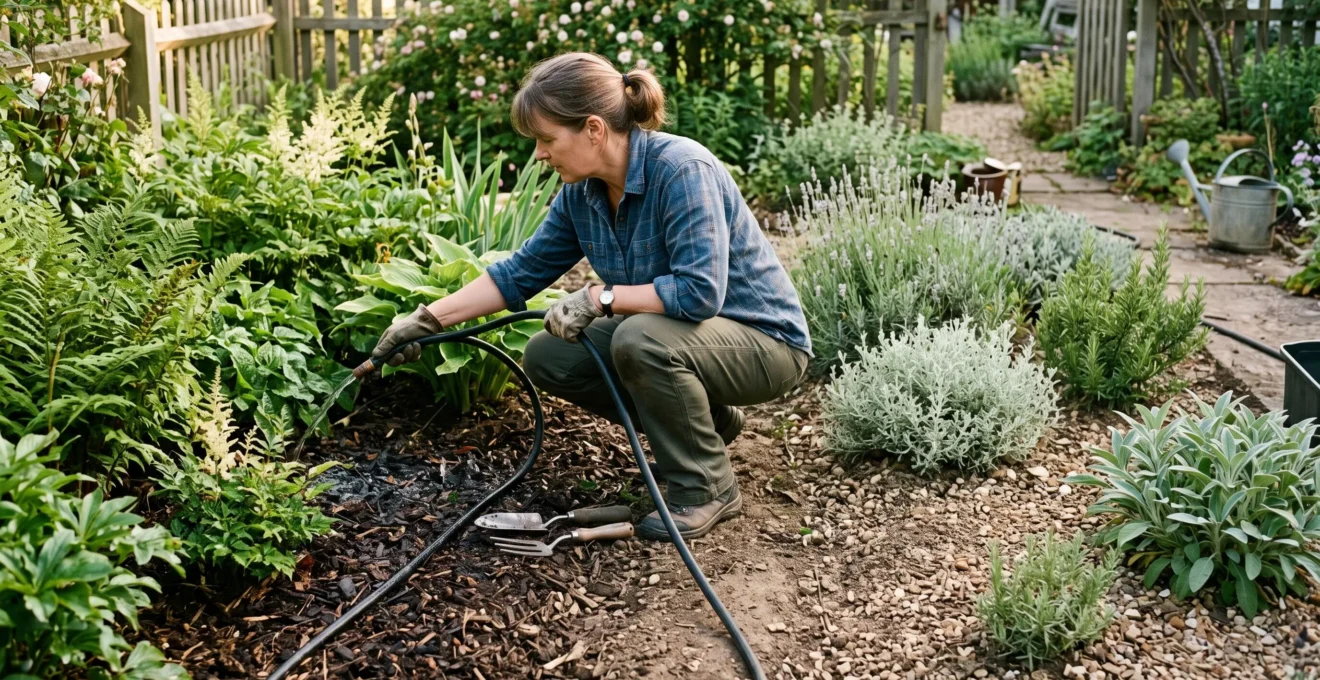
When lavender starts yellowing while the ferns beside it develop crispy fronds, the problem may not be how much water the garden receives. It may be that two plants with fundamentally different moisture requirements are sharing the same watering schedule.
Grouping plants with similar watering needs, known as hydrozoning, prevents this conflict. Instead of watering an entire border frequently enough to satisfy its thirstiest inhabitants, gardeners divide planting areas into high-, medium- and low-water zones. Each receives irrigation only when its particular soil and plants require it.
This approach can substantially reduce unnecessary watering while protecting roots from both drought and prolonged saturation. However, the frequently quoted 50% water-saving figure is not a verified universal result of hydrozoning alone. Actual savings depend on existing watering habits, rainfall, plant selection, drainage and irrigation equipment.
For UK gardens, where wet winters can be followed by surprisingly dry summers, the greatest benefit is often a healthier border that needs less corrective watering and fewer replacement plants.
Hydrozoning: the essentials for a water-efficient garden
- Group plants by their summer moisture needs, not simply by flower colour or appearance. Moisture-loving ferns and established lavender usually require different growing conditions.
- Separate irrigation into high-, medium- and low-water zones, checking soil moisture before watering rather than following one schedule for the entire border.
- Deep, appropriately spaced watering and healthy, well-drained soil help reduce both shallow rooting and waterlogging. A 50% saving is a possible target to investigate, not a guaranteed outcome.
- Why Do Moisture-Loving Ferns Fail When Planted Alongside Mediterranean Lavender?
- How to Design Garden Beds with Separate Irrigation Zones for High, Medium, and Low Water Users?
- Should You Prioritise Colour Harmony or Watering Compatibility When Designing Plant Combinations?
- The Watering Mistake That Rots the Roots of Drought-Tolerant Plants in Mixed Borders
- When Can You Reduce Watering for Drought-Tolerant Plants After Initial Planting?
- The Watering Frequency Mistake That Creates Shallow Roots and Drought-Vulnerable Plants
- The Summer Watering Timing Mistake That Wastes Water and Stresses Plants Further
- How Does Maintaining Ideal Soil Moisture Prevent Both Drought Stress and Root Rot Simultaneously?
Why Do Moisture-Loving Ferns Fail When Planted Alongside Mediterranean Lavender?
Moisture-loving woodland ferns and Mediterranean lavender often struggle together because their preferred growing conditions conflict. Ferns generally favour moisture-retentive, organic-rich soil and shade, whereas lavender thrives in sunshine and freely draining ground. Watering enough to support a thirsty fern can leave lavender roots excessively wet; withholding water to protect lavender may cause the fern to dry out.
Consider a typical mixed UK border with a woodland fern beside English lavender. The gardener notices browning fern tips during a dry spell and increases watering across the entire bed. The fern may recover, but the surrounding soil can remain wetter than lavender tolerates, particularly where heavy clay slows drainage.
Reducing irrigation produces the opposite problem: the lavender benefits from drier conditions while the fern may deteriorate. Neither plant is necessarily poorly maintained. The difficulty is that one watering regime cannot reliably satisfy two incompatible root environments.
The Royal Horticultural Society‘s RHS advice on growing lavender explains that lavender needs free-draining soil and that prolonged wet conditions can cause root rot. Established plants growing in the ground rarely need additional irrigation except during severe drought.
Most familiar woodland ferns prefer adequate moisture and organic-rich soil, although not permanently saturated conditions. Importantly, some fern species tolerate drier habitats. The particular species matters more than the general label ‘fern’.
Before assuming the problem is fertiliser deficiency or excessive sunlight, examine moisture at the roots. Push a finger into the soil or gently lift a small sample from beneath the surface. Compare the soil around each plant after watering and before the next scheduled irrigation.
If the lavender remains wet for long periods while the fern’s root area dries rapidly, the border has incompatible moisture conditions. Exposure and drainage may create additional differences even when the plants are only a short distance apart.
This pairing illustrates the central water-efficiency problem: applying enough water for the thirstiest plant can unnecessarily wet the surrounding low-water plants.
Separating these requirements into distinct growing areas is more dependable than repeatedly adjusting the watering schedule to rescue whichever plant is suffering.
How to Design Garden Beds with Separate Irrigation Zones for High, Medium, and Low Water Users?
Design a hydrozoned garden by classifying plants according to their established summer watering requirements, mapping the garden’s naturally wet and dry areas, and grouping compatible plants together. Give each high-, medium- and low-water zone an independently adjustable watering method. This prevents drought-tolerant plants from receiving irrigation intended for moisture-loving neighbours.
The EPA WaterSense landscaping recommendations support grouping plants with similar irrigation requirements into hydrozones. The agency explains that this reduces water use and helps protect vegetation from both insufficient and excessive watering.
The principle works in UK gardens, provided that planting and irrigation decisions reflect local rainfall, soil texture and seasonal conditions rather than copying a schedule designed for another climate.
Start with a simple classification:
| Zone | Typical plants | Watering approach |
|---|---|---|
| High-water | Moisture-loving woodland ferns, astilbes and hostas | Maintain appropriate moisture around the roots without saturating the soil. |
| Medium-water | Established ornamental plants with moderate moisture requirements | Water when examination of the root zone indicates that available moisture is becoming insufficient. |
| Low-water | Established lavender, santolina and suitable drought-adapted plants | Allow appropriate drying between watering sessions and avoid persistent wetness. |
These classifications are design starting points rather than fixed scientific categories. A recently planted lavender may need more frequent irrigation than an established specimen, and individual ornamental grasses or ferns can have markedly different requirements.
Next, map existing microclimates. Look for naturally damp hollows, north-facing walls, roof runoff, exposed windy positions and warmer areas beside south-facing masonry. Check soil texture and drainage rather than assuming the whole garden bed behaves identically.
Allocate moisture-loving plants to suitable damp or shaded positions and drought-adapted plants to sunny, freely draining sectors. Moderate-water species can form a visual transition between them, but they do not automatically prevent water from travelling through the soil.
True irrigation independence requires separate control of water delivery. This might mean individual drip lines connected to separate valves, independently operated soaker hoses or simply watering designated sectors by hand.
Where drip irrigation is installed, emitters should be selected and positioned to match the actual root distribution, soil infiltration and plant needs within each zone. Running identical emitters on one uninterrupted schedule defeats much of the purpose of hydrozoning. Emitter flow rates and spacing should be determined from site conditions, not an assumed universal setting for each category.
Existing borders can also be adapted without complete replanting. A hose can serve one marked sector at a time, separate soaker-hose loops can be opened independently, or valves can be added to a suitable drip manifold. Plants occupying fundamentally unsuitable soil may still need moving or containerising.
Five actions to create your first hydrozoned border
- Inventory the plants: label every established plant H, M or L according to its verified summer water needs. Deliverable: an annotated plant list.
- Map moisture conditions: identify sunny, shaded, poorly drained and fast-drying spots. Deliverable: a simple sketch of the border showing wet and dry areas.
- Draw the zones: group compatible plants and mark any specimens requiring relocation. Deliverable: a three-zone planting plan.
- Separate watering control: allocate a manual watering route, soaker-hose loop or independently adjustable irrigation line to each zone. Deliverable: a clearly labelled watering-zone layout.
- Test and record: check moisture at appropriate root depths before and after watering, then record which sectors actually required irrigation. Deliverable: a zone-by-zone moisture and watering log.
Where does the 50% figure fit? Consider an explicitly hypothetical comparison: a mixed border formerly receiving 100 litres might receive 50 litres after the low-water areas stop being irrigated unnecessarily. That represents a 50% reduction in this illustrative scenario, not an experimentally established outcome or a forecast for any particular garden.
Real savings must be measured against the previous watering practice. If the garden already receives little supplemental irrigation, the potential reduction may be modest. If an automatic system routinely overwaters drought-adapted beds, the opportunity may be considerably greater.
Once the watering zones are established, plant combinations can be chosen for visual effect without recreating the moisture conflicts the new layout was designed to prevent.
Should You Prioritise Colour Harmony or Watering Compatibility When Designing Plant Combinations?
Prioritise watering compatibility before colour harmony when designing a mixed garden border. Plants with similar root-zone moisture and drainage requirements can usually be arranged into attractive combinations through foliage, flower colour, height and texture. Conversely, a beautiful pairing with incompatible water requirements may demand constant intervention and waste water regardless of its appearance.
A useful design process has two stages: first shortlist plants that can thrive in the same light, soil and watering conditions; then select the most visually appealing combinations from that compatible group.
For a sunny, low-water border, lavender provides purple flowers and grey-green foliage. Santolina can contribute compact silver-toned structure, while suitable artemisia varieties and drought-adapted ornamental grasses create contrasting textures. Their individual drainage, hardiness and maintenance needs should still be checked before planting.
In a moisture-retentive shaded border, suitable ferns, hostas and astilbes can create combinations of layered green foliage, contrasting leaf shapes and seasonal flowers. Fern varieties may also contribute bronze, silver or other foliage tones.
These examples demonstrate that watering compatibility does not require visual monotony. A planting scheme can achieve considerable contrast without relying on plants from incompatible habitats.
The RHS guidance on growing garden ferns emphasises differences between fern species, including their tolerance of dry or wet conditions. This is especially relevant when choosing plants for specific garden microclimates.
What if the preferred colour combination genuinely requires incompatible plants? Containers can provide separate growing conditions while preserving the desired appearance. A potted lavender placed near a moisture-loving border, for example, can receive a different compost, drainage arrangement and watering schedule.
Recessed pots or suitable physical barriers may also help maintain different conditions, although they are not automatically watertight. Water can move through surrounding soil, containers may overheat or dry quickly, and enclosed planting spaces require closer monitoring.
Such arrangements introduce maintenance obligations rather than eliminating the original incompatibility. Drainage holes, container size and independent moisture checks remain essential.
Before buying a plant, ask two questions: how much supplemental water will it need during a typical summer once established, and does its root system require consistently moist or freely draining soil? If those answers conflict with its intended neighbours, choose another location or plant.
This approach also makes later troubleshooting easier: when plants share appropriate soil and irrigation conditions, unexpected decline is less likely to be caused by a fundamental watering mismatch.
The Watering Mistake That Rots the Roots of Drought-Tolerant Plants in Mixed Borders
The damaging mistake is watering an entire mixed border according to the needs of its thirstiest plants. Established drought-tolerant species may then remain in excessively wet soil, particularly where drainage is slow. Prolonged saturation reduces oxygen availability around roots and can encourage root-rotting organisms, even though neighbouring moisture-loving plants appear healthy.
This problem is common in mixed borders where the gardener increases irrigation after seeing one plant wilt without checking whether the surrounding soil is already wet.
Lavender is a useful warning species because it is adapted to well-drained conditions. When its roots remain excessively wet, the plant may deteriorate despite apparently generous care.
Symptoms that warrant investigation include:
- Lower leaves yellowing or losing vigour while the surrounding soil remains damp.
- Wilting that continues despite recent watering.
- Darkened, soft or decaying roots rather than a healthy firm root system.
- Persistent moisture around the plant’s crown, particularly in heavy soil.
These signs are not a definitive diagnosis. Yellow foliage and wilting can also have other causes, including damage, pests or unrelated root problems. The crucial distinction is whether the soil is dry or persistently saturated at the relevant depth.
In waterlogged soil, excess water fills spaces that would otherwise contain air. Roots require oxygen for normal function, so prolonged saturation can impair water uptake even while moisture is abundant.
This explains why a waterlogged plant can look deceptively thirsty. Adding more irrigation in response to wilting may intensify the underlying problem.
Water distribution also varies within the same border. Clay-rich patches may drain slowly, low spots may receive runoff, and organic mulch can retain surface moisture. A dry-looking area nearby does not prove that the lavender’s root zone is equally dry.
When excessive wetness is suspected, pause unnecessary irrigation around the affected plant and examine drainage. Pull mulch away from the immediate crown rather than piling it against stems, and check whether nearby watering systems are soaking the same soil.
If root rot is already advanced, correcting irrigation may not restore damaged roots. Severely affected plants may need replacement in a better-drained location. Lavender planted in heavy ground may benefit from a properly constructed raised bed or mound that allows water to drain away.
Separating irrigation is essential, but it may not be sufficient when water still moves laterally through saturated soil. Root-zone drainage and planting position must support the intended low-water regime.
Corrective watering must also account for plant age: a recently planted drought-tolerant specimen needs a different approach from one whose roots have already established in surrounding soil.
When Can You Reduce Watering for Drought-Tolerant Plants After Initial Planting?
Reduce watering for drought-tolerant plants gradually once their roots have established sufficiently to draw moisture from the surrounding soil. New growth, stable foliage between watering sessions and adequate moisture at root depth are useful indicators. A fixed number of weeks is less reliable because establishment depends on plant type, soil conditions, season and weather.
Drought tolerance describes how a plant performs once appropriately established. It does not mean that a freshly planted specimen can survive immediately without supplemental irrigation.
For example, newly planted lavender needs regular attention during its first summer, even though mature lavender growing in the ground usually requires little additional water. Its small initial root system cannot exploit the same soil volume as an established plant.
Too little water during this stage can leave roots inadequately developed and cause persistent stress. However, continuing frequent irrigation after the roots have established can unnecessarily maintain wet conditions around a species that prefers free-draining soil.
Watch for several indicators before extending the watering interval:
- The plant produces sustained, healthy new growth rather than deteriorating between watering sessions.
- Foliage remains reasonably stable during normal weather, without repeated severe wilting.
- Moisture checks show that water remains available at the developing root depth between irrigations.
- The plant has already tolerated gradually longer intervals without significant stress.
These are practical observations, not a laboratory test of root establishment. New planting may require continued irrigation during unusually hot or dry periods.
To reduce watering, check the soil before the next planned session and extend the interval only when moisture and plant condition justify doing so. Continue watering thoroughly enough to reach the active root area, allowing appropriate drainage between sessions.
Do not confuse reduced frequency with deliberately withholding essential water. Severe drought stress can damage newly establishing roots rather than encourage resilience.
Within a hydrozoned garden, temporary establishment watering can be delivered directly to individual new plants. Once those plants are established, the low-water sector can return to its normal reduced-irrigation approach without imposing the temporary schedule on every established neighbour.
Where several plants establish at different speeds, manage them individually rather than assuming that the entire zone becomes drought-tolerant on the same date.
After establishment, watering depth and frequency become especially important because shallow irrigation can undermine the drought resilience the planting scheme is intended to achieve.
The Watering Frequency Mistake That Creates Shallow Roots and Drought-Vulnerable Plants
Frequent, light watering can encourage shallow root development because it repeatedly moistens only the upper soil layers. These layers dry quickly during warm or windy weather, making plants more vulnerable between watering sessions. For many established garden shrubs and trees, deeper watering at appropriately longer intervals supports a more resilient root system.
The problem often begins with a well-intentioned habit: giving every garden bed a quick spray each evening. The surface looks damp, yet moisture may not penetrate far enough to reach the full active root zone.
Over time, where repeated shallow watering is the main moisture source, roots may become concentrated near the surface. When a hot spell arrives, that exposed zone dries rapidly, and plants can require increasingly frequent intervention.
University of Maryland Extension’s watering recommendations for trees and shrubs explain that deep, relatively infrequent irrigation encourages deeper roots, while frequent, light watering promotes shallow rooting. This advice must be adapted for different plant species, soil types and establishment stages.
The solution is not simply to pour more water into every border. Water should penetrate the appropriate rooting depth without generating persistent saturation or avoidable runoff.
For established plants suited to less frequent irrigation, apply water slowly around the root area and check its penetration before repeating the process. A soaker hose or drip line can make this easier than a short blast from an overhead sprinkler.
A useful diagnostic technique for established shrubs is to examine soil around 15 cm below the surface. Gently dig into the soil after watering and assess whether moisture has reached that depth. This is a practical reference point for many woody plants, not a universal target for every perennial or seedling.
Allow several hours for water to move into the soil before checking multiple points. If the surface is damp but soil at the intended root depth remains dry, the previous watering probably failed to penetrate sufficiently.
Adjust application duration, delivery rate or distribution rather than automatically increasing the number of watering sessions. If water runs off before soaking in, slower or divided applications may be more suitable.
Soil texture changes the result. Sandy ground generally allows water to move through quickly, while clay retains moisture longer and drains more slowly. Neither should be managed using an identical watering duration without inspection.
Hydrozoning becomes more effective when plants are watered according to their actual root development. An established drought-adapted shrub with a sufficiently developed root system may tolerate longer intervals, whereas a newly planted specimen or a naturally shallow-rooted species may require more frequent checks.
Once watering depth is appropriate, choosing when to irrigate can reduce additional losses, particularly during hot summer conditions.
The Summer Watering Timing Mistake That Wastes Water and Stresses Plants Further
Watering during the hottest part of a summer day can waste water through increased evaporation, particularly when using sprinklers or other methods that wet foliage and exposed soil. Early morning is generally the preferable irrigation window because temperatures are cooler, water can reach the roots before daytime heat, and leaves have an opportunity to dry.
During hot weather, part of the water delivered by an overhead sprinkler may evaporate before it is used by the plants. Wind can also displace droplets away from the intended rooting area, creating uneven watering.
The University of Maryland Extension guidance cited earlier indicates that watering during hot daytime conditions can increase evaporation losses by as much as 40%. That figure concerns potential evaporation associated with watering conditions, not the amount saved specifically by hydrozoning or a guaranteed saving from switching irrigation times.
Early morning watering is generally the better default for UK garden borders during summer. Cooler conditions reduce evaporation pressure, and foliage that becomes wet can usually dry during the day.
Evening watering may be practical when morning irrigation is impossible, especially when applying water directly to the soil. However, overhead watering late in the day can leave susceptible foliage wet overnight, increasing the risk of certain fungal diseases.
The method matters as much as the hour. A drip line or carefully directed hose delivers water to the soil with less unnecessary foliage wetting than an overhead sprinkler. Moisture should reach the root area without creating runoff.
A common misconception is that ordinary water droplets necessarily magnify sunlight enough to burn leaves. That is not an established general explanation for summer watering problems. Evaporation, water distribution and prolonged foliage wetness are more dependable considerations.
Separate hydrozones allow irrigation to be scheduled according to actual need. A high-water sector may require attention during a warm spell while an established lavender border remains sufficiently supplied by rainfall and stored soil moisture.
This avoids running one long automatic watering cycle simply because a portion of the garden needs additional moisture. Independent valves also make it easier to pause irrigation in zones that have already received adequate rain.
There are exceptions to general timing advice. Containers have limited rooting volume and can dry faster than plants in open ground. Borders against sun-exposed south-facing walls may also become warmer and lose moisture more quickly.
On exceptionally hot days, inspect these areas again rather than assuming that one morning watering session will always be sufficient. A plant experiencing genuine water stress should receive appropriate water when needed, not be left struggling solely to comply with a preferred watering time.
Timing alone cannot correct a poorly drained or excessively dry root environment. The final requirement is to maintain suitable moisture in each zone without depriving roots of the air they need.
Key takeaways before setting your watering schedule
- Measure conditions, not just frequency: a damp soil surface does not establish whether sufficient moisture has reached the active roots.
- Protect root aeration: reducing drought stress must not mean keeping every soil pore permanently filled with water.
- Define success by zone: the correct moisture level for a moisture-loving planting area can be excessive for an established drought-tolerant border.
How Does Maintaining Ideal Soil Moisture Prevent Both Drought Stress and Root Rot Simultaneously?
Maintaining appropriate soil moisture prevents drought stress and reduces root-rot risk by balancing two essential root requirements: available water and oxygen. When soil becomes too dry, roots struggle to absorb sufficient moisture; when it remains saturated, air-filled spaces disappear and root function deteriorates. Hydrozoning helps each plant group stay within its own suitable moisture range.
There is no single ideal moisture reading for an entire garden. A woodland planting area may perform best when its soil retains appreciable moisture, while established lavender generally benefits from a freer-draining environment that dries appropriately between periods of rain or irrigation.
Both conditions can be healthy when matched to the correct plant. Problems emerge when the same moisture target is imposed across incompatible species.
Think of soil moisture as a usable band rather than a fixed number. Below the appropriate range, water becomes increasingly difficult for roots to access. Above it, excessive saturation limits oxygen movement and can favour organisms associated with root decay.
Healthy soil structure makes this balance easier to maintain. Pore spaces allow water to enter, drain and remain available while still providing air for root respiration.
Organic matter can improve soil structure and, when appropriately incorporated, support moisture retention in sandy soil or improve the workability and drainage characteristics of some heavier soils. Garden compost and leafmould are useful in planting areas suited to moisture-retentive conditions.
However, soil improvement must respect the plants being grown. Adding substantial quantities of moisture-retentive material around lavender is not automatically beneficial, particularly where drainage is already poor. In such circumstances, a raised planting position and suitable free-draining soil may be more appropriate.
Mulch can reduce evaporation and moderate soil conditions, but it should not be packed against vulnerable stems or crowns. The goal is to retain appropriate moisture, not create prolonged wetness against plant tissue.
To monitor each hydrozone, examine moisture at the depth where its plants are actively rooting. Use a finger or small trowel where practical, and compare the soil’s feel and condition before watering.
An inexpensive moisture meter may provide supplementary readings, although measurements depend on the device and soil conditions. Compare readings with direct soil observations rather than interpreting one numerical value as universally ideal.
For a high-water zone, the objective may be consistently moist but aerated soil. For a medium-water zone, allow appropriate drying before irrigation. For an established low-water zone, avoid watering until conditions indicate that the plants genuinely require additional moisture.
These targets should be adjusted for rainfall, season, soil texture, plant species and establishment status. UK gardeners may need little irrigation during rainy periods but more frequent inspections when prolonged dry weather follows.
The water-saving mechanism is straightforward: if the high-water plants need irrigation but the low-water plants still have adequate moisture, only the high-water zone receives water. This avoids applying an unnecessary volume across the entire bed.
Whether that translates to a 10%, 30% or 50% reduction cannot be established without measuring the garden’s previous and revised water consumption. The provided guidance supports hydrozoning as a water-efficiency practice but does not demonstrate a universal 50% saving from grouping plants alone.
For a meaningful comparison, record watering duration or measured water use separately for each zone, alongside rainfall and relevant changes in planting or irrigation equipment. Compare similar weather periods and avoid attributing every reduction to hydrozoning when other conditions have changed.
Choose one mixed border this week, identify its most drought-sensitive and most waterlogging-sensitive plants, and check soil moisture around both before the next watering session. That simple comparison can reveal where irrigation is unnecessary, where drainage needs attention and which plants would benefit from a separate zone.
Can hydrozoning reduce garden water consumption by exactly 50%?
Hydrozoning can reduce unnecessary irrigation by allowing each plant group to receive only the water it needs. However, the sources provided do not verify a universal 50% saving. The actual reduction depends on the original watering system, rainfall, soil, plant mix and irrigation practices. Measuring water use before and after reorganising the zones is the most reliable way to assess the result in a particular garden.
Can high-water and low-water plants remain in the same raised bed?
They can sometimes occupy different sectors of a large raised bed if irrigation is independently controlled and their root environments provide suitable drainage. However, water can still move between adjacent areas through the soil. Where moisture requirements are fundamentally incompatible, separate containers or planting beds may provide more reliable conditions.
Do UK gardens need automatic irrigation to benefit from hydrozoning?
No. Hydrozoning describes how plants are grouped and watered, not the equipment used. Gardeners can divide a border into watering sectors and use a hose or watering can selectively. Automatic valves and drip lines may improve convenience and control, but independent manual watering can follow the same principles.
Should plants still be watered after rainfall?
Not automatically. Rainfall can reduce or eliminate the need for supplemental irrigation, but its effectiveness depends on the quantity received, soil conditions and root depth. Check moisture in the relevant root zone before watering. Containers, newly planted specimens and sheltered areas may need separate assessment because they do not always receive or retain rainfall in the same way as open borders.
Does mulching eliminate the need for separate watering zones?
No. Mulch can reduce soil evaporation and help moderate moisture fluctuations, but it cannot make fundamentally incompatible plants require the same amount of water. Different hydrozones may also benefit from different surface treatments. Keep mulch away from susceptible crowns and stems, and continue checking moisture beneath it.