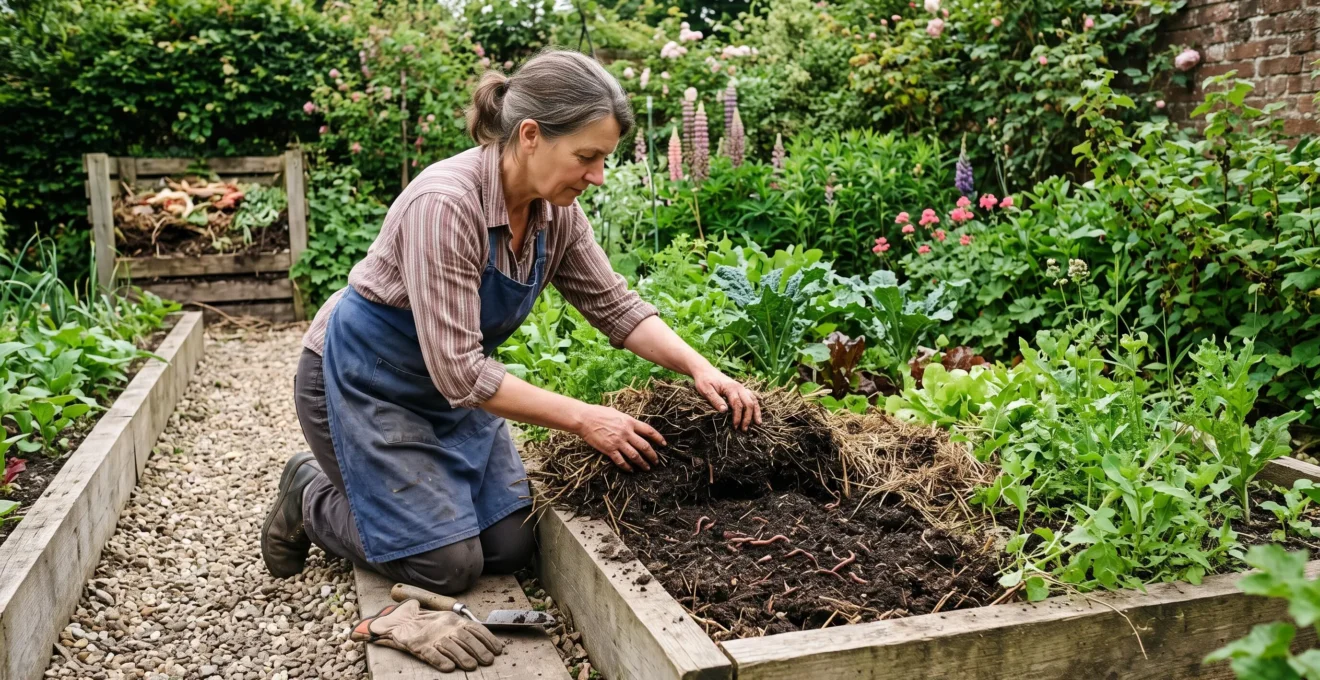
Decades of digging, exposed soil, heavy foot traffic and reliance on purchased fertilisers can leave a home garden struggling to absorb rain, support earthworms or grow vigorous crops without constant intervention. Regenerative gardening tackles these underlying problems rather than simply replacing one gardening product with another.
The approach combines minimal soil disturbance, continuous organic cover, living roots, diverse planting and the recycling of garden residues. Together, these practices create conditions in which soil organisms can rebuild aggregates, improve nutrient cycling and gradually restore damaged structure.
For a UK gardener, this does not require converting every vegetable bed into a wilderness or abandoning productive annual crops. It means diagnosing what has deteriorated, correcting genuine physical constraints and allowing biological processes to take over more of the work.
Recovery is gradual and depends on drainage, soil texture, existing compaction and management history. The most useful measure of progress is not how much compost has been applied, but whether the soil becomes increasingly capable of supporting healthy plants with fewer corrective interventions.
Regenerative gardening: the essentials
- Restore soil function by reducing disturbance, preventing bare ground and encouraging living roots and soil organisms.
- Diagnose compaction, drainage and persistent weeds before introducing no-dig beds or additional organic materials.
- Build a circular garden system that recycles plant residues, combines perennials with annual crops and progressively reduces purchased inputs.
- Why Does Regenerative Gardening Go Beyond Sustainability to Actively Improve Ecosystem Health?
- How to Transition from Traditional Digging to No-Dig Methods Without Yield Loss?
- Perennial Food Crops vs Annual Vegetables: Which Builds Soil Carbon Faster in UK Gardens?
- The « Harmless » Garden Product That Disrupts Soil Regeneration Despite Organic Certification
- In What Order Should You Implement Regenerative Practices to Restore Degraded Garden Soil?
- Why Do Self-Sustaining Gardens Compost Everything On-Site Instead of Removing Organic Waste?
- Core Aeration vs Spiking: Which Method Relieves Compaction for Longer in Heavy UK Soils?
- How Can You Create a Self-Sustaining Cycle That Eliminates the Need for External Inputs?
Why Does Regenerative Gardening Go Beyond Sustainability to Actively Improve Ecosystem Health?
Regenerative gardening goes beyond sustainability because it aims to improve the ecological condition of a garden rather than merely maintain its current state. By rebuilding soil structure, encouraging biological diversity and restoring nutrient cycling, it addresses damage accumulated through years of disturbance. Its success is measured through improving soil function, not simply by reducing harmful inputs.
Three related approaches have different objectives:
- Sustainable gardening seeks to maintain productivity and limit further environmental damage.
- Restorative gardening seeks to repair existing problems such as erosion, depleted organic matter or damaged soil structure.
- Regenerative gardening seeks to establish improving biological processes that help the garden become more resilient over time.
A compacted vegetable bed may remain productive through annual cultivation, fertiliser applications and frequent watering. Yet this does not necessarily mean its underlying condition is improving. Regeneration asks whether the soil is becoming better able to support plant growth through its own biological and physical functions.
The soil food web is central to that transformation. Plant roots release carbon-rich compounds that support microorganisms. Bacteria and fungi participate in decomposition and nutrient transformations, while mycorrhizal fungi can extend plants’ access to soil resources. Earthworms and other organisms help mix organic residues and create channels through which air, water and roots can move.
Microbial compounds, fungal hyphae and biological activity contribute to soil aggregation. As stable aggregates develop, improved pore structure can support root growth and water movement, creating conditions for further biological activity.
The balance between bacterial and fungal communities can also change with vegetation and disturbance. However, a higher fungal-to-bacterial ratio is not a universal definition of healthy soil: different plant communities support different microbial conditions.
Gardeners can look for changes in several observable indicators rather than relying on the appearance or certification of purchased amendments.
| Indicator | Soil requiring continued intervention | Signs of improving function |
|---|---|---|
| Earthworm activity | Few worms observed in comparable soil checks | Increasing activity under similar sampling conditions |
| Water infiltration | Persistent surface pooling or runoff | Improving absorption without prolonged waterlogging |
| Soil aggregates | Dense blocks, crusting or weak crumb structure | More stable, porous aggregates |
| Living roots | Long periods of exposed, unplanted ground | More months with growing roots |
| Soil management | Repeated cultivation to address recurring problems | Less disturbance needed to maintain workable soil |
These indicators should be compared in the same locations, season and moisture conditions. A single earthworm count or infiltration test cannot establish a complete diagnosis of soil health.
Once improvement becomes the objective, the next question is which routine practices prevent soil structure from recovering. Repeated digging is often an appropriate place to begin that assessment.
How to Transition from Traditional Digging to No-Dig Methods Without Yield Loss?
Transitioning to no-dig gardening without unnecessary yield losses requires preparation rather than abruptly abandoning cultivation. Remove persistent weeds, assess drainage, apply suitable organic matter to the surface and maintain productive planting during the changeover. Choose crops that suit the existing soil conditions while biological structure improves, and recognise that yields cannot be guaranteed during the transition.
Traditional digging can temporarily create loose soil by breaking apart compacted material. However, repeated cultivation also interrupts fungal networks, damages existing aggregates and disturbs natural drainage channels. Once the loosened soil settles, it may compact again, encouraging another cycle of digging.
The RHS guidance on no-dig gardening explains how surface mulching and reduced cultivation help protect soil organisms and structure.
For suitable, adequately drained beds, the RHS describes establishing no-dig areas with approximately 10–15 cm of organic material. Newly prepared beds intended for immediate planting need a sufficiently well-rotted growing layer, while established beds can receive approximately 5 cm of organic mulch annually. These are gardening recommendations, not fixed requirements for every soil or crop.
A phased transition protects the existing harvest.
- Before conversion: assess drainage and remove established perennial weeds, including persistent roots and rhizomes.
- During the first growing season: apply suitable surface organic matter and favour transplants, leafy crops and other vegetables that can establish in the available growing layer.
- During the following season: continue controlling emerging weeds, monitor root development and introduce additional crops as the bed becomes more workable.
- In subsequent seasons: maintain soil cover and diversify planting while reducing cultivation wherever conditions permit.
Crop selection should remain flexible. Deep-rooted vegetables are not inherently incompatible with new no-dig beds, but dense subsoil, stones or insufficient growing depth may make them more challenging initially.
The greatest practical obstacle during the first two growing seasons is often persistent weed regrowth. Bindweed, docks and couch grass can survive beneath organic mulch through established roots or underground stems. Surface covering may suppress seedlings without eliminating these plants.
Where weed pressure is severe, repeated removal or a longer preparation period may be necessary. Cardboard can help suppress some existing vegetation, but it should not be treated as a guaranteed solution for deep-rooted perennial weeds.
Protect productivity by retaining established growing areas while converting manageable sections, and compare harvest performance between beds rather than assuming that the new system will immediately outperform traditional cultivation.
Reduced disturbance protects the soil environment, but the roots growing through that environment determine how biological activity develops. This makes crop longevity and planting diversity the next important decisions.
Perennial Food Crops vs Annual Vegetables: Which Builds Soil Carbon Faster in UK Gardens?
Perennial crops often offer stronger long-term opportunities for soil carbon accumulation because their established root systems remain active across multiple growing seasons and require less replanting disturbance. However, the rate of accumulation depends on species, soil texture, climate and management. UK gardeners should combine perennial planting with well-managed annual beds rather than assume one system always stores more carbon.
Soil carbon originates partly from plant material entering the soil through root growth, root turnover, biological compounds and decomposing residues. Perennial vegetation can maintain these contributions over many years without repeatedly removing the entire crop.
Woody plants and some deep-rooted perennials also supply organic material below the surface. Carbon deposited at depth may experience different decomposition conditions from material remaining close to the surface, although deeper placement does not automatically guarantee permanent storage.
Annual vegetables generally require recurring establishment and may leave periods without living roots. Yet a productive no-dig annual bed with cover crops, retained residues and carefully managed compost can also support carbon inputs and soil structure.
20%
Average increase in soil organic carbon stocks in the upper 30 cm over 20 years following conversion from annual to perennial crops in a global agricultural dataset. This is not a predicted result for UK home gardens.
The scientific study on soil organic carbon under perennial crops, published in Global Change Biology in 2020.
The same research reported substantial variation in carbon changes and identified environmental and soil characteristics that influenced the results. Its findings concern agricultural cropping systems, including grasses and woody crops, rather than direct comparisons of asparagus, rhubarb and vegetables in domestic gardens.
A mixed garden can use perennial crops where their long residence and limited disturbance provide practical advantages, while retaining annual vegetables where seasonal productivity, crop rotation and dietary variety matter most.
| Garden area | Suitable planting approach | Regenerative consideration |
|---|---|---|
| Permanent sunny border | Asparagus or rhubarb where conditions suit | Long-lived roots and reduced replanting disturbance |
| Garden boundary | Soft fruit bushes | Persistent roots, seasonal leaf litter and ground cover opportunities |
| Larger permanent planting area | Appropriately sized fruit or nut trees | Long-term root development and organic residues |
| Productive vegetable beds | Annual vegetables with surface compost and cover crops | Food production alongside reduced disturbance and improved root coverage |
| Paths and unused spaces | Suitable low-growing vegetation | Reduced exposure and erosion where traffic and access permit |
Instead of estimating carbon storage from crop type alone, gardeners can track months of living root coverage per square metre. For each bed, record the months during which actively growing plants occupy the soil, including perennial crops and seasonal cover plants.
This provides a practical management indicator, not a direct measurement of soil carbon. Carbon stocks require appropriate soil sampling and laboratory analysis, with attention to soil depth and bulk density.
More permanent vegetation supports the broader regenerative strategy, but planting choices alone cannot protect soil biology from every intervention. Products applied to control pests and disease deserve similar scrutiny.
The « Harmless » Garden Product That Disrupts Soil Regeneration Despite Organic Certification
An organically approved plant protection product is not automatically harmless to every soil organism. Copper-based fungicides and some broad-spectrum pest-control products deserve particular scrutiny because their effects can extend beyond the intended target. Repeated or unnecessary application may conflict with regenerative objectives, although actual impacts depend on formulation, exposure, soil conditions and frequency of use.
Organic input approval establishes whether a product meets specified standards and conditions. It does not independently demonstrate that the product improves soil structure, microbial diversity or long-term ecosystem function.
The Soil Association‘s approved and verified inputs directory covers categories including fertilisers, composts, microorganisms and plant protection products.
Its documentation distinguishes approval or verification against applicable standards from an assessment of whether a product is suitable or effective in a particular situation. Listed plant protection products are subject to restrictions, including the requirement for an established crop threat when preventative practices are insufficient.
These agricultural certification arrangements should not be confused with universal approval of products marketed to domestic gardeners. OMRI-type listings similarly relate to specified input standards and permitted uses, rather than guaranteeing a regenerative soil outcome.
Copper-based fungicides illustrate the distinction. Copper has antifungal properties, but its activity is not necessarily restricted to the organism causing a particular plant disease. Copper can accumulate in soil under repeated applications, and excessive exposure can be harmful to sensitive organisms.
Nevertheless, certification status alone does not prove that an approved product will damage mycorrhizal networks in a particular garden. The outcome depends on the actual active ingredient, concentration, exposure and environmental context.
Broad-spectrum pesticide use raises a related concern: controlling one problem can expose beneficial organisms to the same intervention. Depending on the product and application, this may affect organisms that contribute to decomposition, natural pest control or nutrient cycling.
A regenerative approach therefore assesses the whole ecological cost of treatment, not simply whether an input is described as natural or organic.
Before applying a product, follow a consistent decision process:
- Identify the pest or disease accurately and determine whether intervention is necessary.
- Read the active ingredients, approved uses and mode of action rather than relying on front-label claims.
- Check whether the treatment is target-specific or has broader biological effects.
- Consider sanitation, physical removal, resistant varieties, habitat management or suitable biological controls.
- If treatment remains necessary, use only products authorised for the intended domestic use and follow their label restrictions.
This approach does not imply that all pesticides should be rejected regardless of circumstances. A carefully chosen intervention may sometimes prevent greater crop damage or disease spread.
The broader principle is to address causes before symptoms. That principle also determines the order in which soil restoration practices should be introduced.
In What Order Should You Implement Regenerative Practices to Restore Degraded Garden Soil?
Regenerative soil restoration should begin with diagnosis, followed by eliminating damaging practices, addressing serious drainage or compaction problems, protecting the surface and rebuilding biological activity. Reducing purchased inputs comes later, once soil function has demonstrably improved. This sequence prevents compost, mulch or biological amendments from being used as substitutes for correcting the conditions that caused degradation.
Before applying anything, examine how the soil behaves. A vegetable bed that becomes hard during dry weather may have different problems from one that remains waterlogged after rain. Likewise, a shallow compacted surface layer requires different treatment from a dense layer deeper in the profile.
Useful initial observations include:
- How readily a probe or screwdriver enters soil at different depths under comparable moisture conditions.
- Whether rain infiltrates or remains pooled at the surface.
- Whether soil breaks into porous crumbs or dense, smooth-sided blocks.
- Where roots stop, bend sideways or struggle to penetrate.
- Which perennial weeds are established and how they spread.
The Agriculture and Horticulture Development Board’s Visual Evaluation of Soil Structure (VESS) guidance provides a more structured approach to examining aggregate shape, porosity and rooting. Its scoring system identifies good structure at scores 1–2, moderate structure at 3 and poor structure at 4–5.
Those scores originate from agricultural soil assessment and should not be treated as universally validated thresholds for every garden. Moisture conditions also affect how reliably soil can be examined.
Once the main constraints are understood, apply the following order of operations.
- Stop ongoing degradation. Reduce unnecessary cultivation, avoid walking on growing beds, prevent prolonged bare soil and reconsider routine chemical inputs.
- Correct severe physical limitations. Investigate persistent waterlogging and identify whether targeted compaction relief, drainage improvements or changes in access are required.
- Protect exposed soil. Introduce suitable organic mulch, compost or living cover without burying plants or creating excessively wet conditions.
- Support biological recovery. Maintain plant diversity, increase periods of living root growth and recycle healthy organic residues.
- Reduce external dependence. Review purchased amendments and fertilisers as evidence of improved soil function accumulates.
Applying thick organic mulch over persistently saturated, poorly aerated soil without addressing its underlying drainage problems may maintain unfavourable wet conditions. Surface cover should therefore be matched to the actual soil state rather than applied automatically.
Five actions to establish your soil restoration baseline
- Map the garden’s soil conditions: mark compacted, waterlogged and exposed areas on a simple bed plan.
- Record soil structure: examine a small soil sample and note aggregate shape, rooting and any visibly dense layers.
- Identify persistent weeds: produce a short list showing where bindweed, docks, couch grass or other recurring weeds are established.
- Choose the first corrective intervention: write one practical action for each affected bed, with the reason it takes priority.
- Create a monitoring record: save dated photographs and observations of structure, infiltration and living plant cover for future comparison.
The most common sequencing mistake is purchasing compost, specialist amendments or microbial inoculants before identifying why the soil has deteriorated. If heavy traffic, poor drainage or destructive cultivation continues, additional materials cannot reliably resolve those pressures.
Once the main physical limitations are addressed, organic residues become an important resource for feeding soil organisms. Retaining more of those materials within the garden can reduce the need to replace exported nutrients.
Why Do Self-Sustaining Gardens Compost Everything On-Site Instead of Removing Organic Waste?
Self-sustaining gardens retain and recycle suitable organic residues because removing leaves, grass clippings and plant material also removes carbon and nutrients from the garden system. Composting, mulching and leaving healthy roots in place return some of these resources to the soil. However, diseased material, invasive weeds and certain contaminated residues may require separate handling or removal.
Every harvest exports nutrients contained in the edible crop. Removing additional vegetation unnecessarily increases that export. If a garden continually sends its leaves, stems and clippings elsewhere, maintaining fertility may require greater reliance on imported compost, fertiliser or mulch.
On-site recycling closes part of this nutrient loop. Soil organisms break down plant residues, transforming organic material and releasing some nutrients into forms that plants can use. Other nutrients remain temporarily bound in organic matter or microbial biomass and become available as biological processes continue.
Recycling does not manufacture nutrients. It conserves and redistributes resources already present in the garden, while plant uptake, harvested produce and environmental losses mean that perfect nutrient closure is generally impossible.
Different residues suit different recycling methods.
| Material | Suitable approach | Practical consideration |
|---|---|---|
| Healthy soft stems and leaves | Chop-and-drop mulching | Spread modestly rather than forming dense, wet layers |
| Healthy roots after harvesting | Leave roots in the ground | Allow gradual decomposition without disturbing the surrounding soil |
| Autumn leaves | Leaf mould or surface mulch | Collect where necessary and allow decomposition in a suitable area |
| Suitable vegetable scraps and garden trimmings | Managed compost heap or bin | Balance wetter and drier materials while maintaining appropriate aeration |
| Suitable soft plant residues | In-situ composting | Use manageable quantities and avoid creating anaerobic pockets |
Leaf mould is particularly useful where autumn leaves are abundant. Decomposing leaves can become a valuable soil-conditioning material, while retaining them in appropriate areas reduces the need to transport organic matter off-site.
Leaving healthy roots undisturbed also avoids unnecessary cultivation. Their gradual decomposition can contribute organic material within existing root channels.
However, the instruction to compost everything should never be interpreted literally. Persistent weed propagules, invasive plant material, certain diseased residues and contaminated waste can create problems if returned through an inadequately managed composting process.
Some pathogens survive unsuitable composting conditions, and ordinary domestic compost heaps cannot be assumed to reach the temperature or maintain the conditions required to neutralise every risk.
A practical decision rule is to retain material when it is suitable for the chosen process and unlikely to reintroduce a significant problem. Where that cannot be established, follow appropriate local disposal guidance rather than automatically adding it to a garden heap.
Organic matter recycling supports long-term soil structure, but it cannot always overcome an existing physical barrier. Where heavy soil is severely compacted, a carefully selected mechanical intervention may still be justified.
Core Aeration vs Spiking: Which Method Relieves Compaction for Longer in Heavy UK Soils?
Core aeration generally provides more direct relief from compacted surface soil than solid-tine spiking because hollow tines remove actual soil plugs instead of simply displacing material sideways. In heavy clay, spiking can compress or smear the surrounding soil when conditions are too wet. Neither method is a permanent solution unless the practices causing compaction also change.
Compaction reduces pore space, making it harder for water, air and roots to move through the soil. This is particularly troublesome where heavy clay is repeatedly walked on or worked when wet.
Solid-tine spiking creates holes by pushing soil aside. The resulting openings may improve short-term access for air or water under suitable conditions, but the surrounding soil is displaced rather than removed. In susceptible wet clay, that displacement can produce dense or smeared hole walls.
Hollow-tine core aeration removes cylindrical plugs. This provides immediate space without requiring the same degree of sideways soil displacement, making it a useful option for some compacted lawns and accessible soil surfaces.
However, the persistence of the benefit depends on soil condition, tine dimensions, aeration depth and subsequent traffic. Core aeration should not be presented as universally effective or permanently corrective.
A screwdriver or soil probe can provide a preliminary indication of resistance. Test several locations when the soil is moist but not saturated, and look for consistent resistance at similar depths. Stones, roots and naturally dense layers can also affect penetration, so the probe is a screening tool rather than a definitive compaction measurement.
Tool selection should reflect the location and depth of the compacted layer. Shallow lawn aeration cannot reliably correct a deeper restrictive horizon beyond the tool’s reach. Similarly, a compacted vegetable bed may require investigation before any intervention, particularly where drainage problems extend into the subsoil.
Use the following conditions to guide the decision:
- Moist, workable soil with confirmed shallow compaction: consider targeted hollow-tine aeration where the tool can reach the affected layer.
- Waterlogged clay: postpone mechanical aeration, which may smear and damage wet soil.
- Very dry, hard soil: avoid forcing tools into resistant ground without assessing whether moisture conditions are distorting the diagnosis.
- Deep or persistent compaction: assess the restriction and its cause rather than assuming repeated shallow aeration will resolve it.
- Healthy soil without a demonstrated restriction: avoid unnecessary mechanical treatment.
Regenerative gardening treats mechanical aeration as a corrective measure, not a recurring dependency. Deep-rooted vegetation can contribute biological channels, while mulch, reduced cultivation and controlled foot traffic help protect the resulting structure.
For growing beds, permanent paths are particularly useful because they concentrate traffic away from soil intended to support crops. Maintaining vegetation and organic cover between corrective interventions helps biological processes contribute to long-term resilience.
Once compaction no longer demands repeated correction, the garden can move towards a more self-supporting system in which plant growth, decomposition and nutrient reuse increasingly reinforce one another.
Key takeaways before building a closed-loop garden
- Correct the causes of degraded soil before expecting biological processes to maintain improvements independently.
- Keep suitable organic residues and living roots within the system to conserve resources and reduce dependence on imported materials.
- Measure declining intervention needs alongside plant performance, rather than treating zero purchases as the immediate definition of success.
How Can You Create a Self-Sustaining Cycle That Eliminates the Need for External Inputs?
A self-sustaining garden develops by linking plant growth, soil organisms, residue recycling and future planting into a continuous cycle. Living roots support soil biology, decomposers transform organic residues, and retained nutrients help support subsequent crops. Purchased inputs can often decline as these processes improve, but complete independence is rarely realistic, particularly where food harvests export nutrients.
The central mechanism is a series of connected exchanges. Plants capture energy through photosynthesis and allocate some of the resulting carbon compounds below ground. Roots and organic residues provide resources for soil organisms, which contribute to decomposition and nutrient availability.
Healthy soil structure supports further rooting, water movement and biological activity. Crops are harvested, suitable residues return to compost or mulch, and seeds from appropriate plants can be saved for future growing seasons.
Conventional garden management often interrupts this cycle by removing organic matter, leaving soil uncovered or repeatedly disturbing biological networks. Replacing those losses with purchased fertilisers or compost can maintain production without necessarily correcting the underlying dependency.
The regenerative objective is to keep useful resources cycling for longer. This requires a practical reduction strategy rather than withdrawing every purchased material at once.
| External input | Potential on-site replacement | When reduction becomes reasonable |
|---|---|---|
| Purchased mulch | Suitable leaves, plant residues and locally produced organic cover | When sufficient clean material is available without leaving other areas exposed |
| Purchased compost | Composted garden residues and suitable household organic waste | When compost production and soil conditions meet the garden’s needs |
| Routine pest-control products | Prevention, monitoring, physical control and beneficial organism habitat | When pest and disease pressure can be managed adequately |
| Purchased seeds | Seed saving from suitable open-pollinated crops | When viable, healthy seed can be collected, stored and propagated successfully |
| Purchased fertiliser | Improved nutrient recycling and appropriate soil management | When crop performance and soil assessment indicate that additional nutrients are unnecessary |
This order is indicative rather than universal. A garden producing abundant clean leaves might replace purchased mulch first, while another may reduce pest treatments through improved plant health before producing enough compost for its growing areas.
Seed saving also has limitations. Hybrid varieties may not reproduce their parent characteristics reliably, and some crops require attention to pollination, isolation, seed health and storage.
Likewise, reducing fertiliser should not mean ignoring nutrient depletion. Nutrients leave the system in harvested fruit and vegetables, while others may be lost through leaching or other processes. Biological recycling improves nutrient availability and conservation but cannot replace elements that have been permanently exported.
Some external dependencies are therefore entirely compatible with regenerative management. Supplementary water may remain necessary during drought, particularly for newly established plants or demanding food crops. Suitable seed-starting materials, initial establishment compost or amendments based on identified deficiencies may also remain justified.
A useful way to track progress is to maintain an annual record of purchased compost, fertiliser, mulch, seeds, pest treatments and irrigation requirements alongside harvest quality, soil observations and weather conditions.
A declining input curve is meaningful only if soil condition and garden productivity remain acceptable. Reduced purchases accompanied by nutrient deficiency, deteriorating crops or prolonged water stress would not demonstrate successful regeneration.
Over time, a functioning garden may need fewer routine corrections because surface cover, root growth, organic matter cycling and careful traffic management protect the conditions that plants depend on.
Begin with one manageable bed: record its structure and current inputs, reduce unnecessary disturbance, retain suitable organic residues and keep living roots present where practical. Review the same indicators across subsequent growing seasons before extending the approach to the rest of the garden.
How long does regenerative gardening take to improve degraded soil?
There is no reliable universal recovery period. Changes in surface cover, worm activity or soil workability may become visible before deeper compaction or depleted organic matter is substantially improved. Progress depends on the original damage, soil texture, drainage, planting and management. Compare observations across several growing seasons rather than expecting a fixed timetable.
Can a small urban garden become regenerative without a large compost heap?
Yes. Small gardens can reduce disturbance, maintain living roots, retain suitable leaves and use compact composting arrangements where practical. The aim is to improve biological function and recycle resources within available space, not to reproduce the infrastructure of a farm. Some imported materials may still be necessary.
Should compacted clay soil be covered with mulch immediately?
Not without checking drainage and moisture conditions. Mulch can help protect the surface, but persistently waterlogged soil may first require investigation of compaction, runoff or drainage restrictions. Apply appropriate cover once it can support recovery without maintaining excessively wet conditions around vulnerable plants.
Do regenerative vegetable beds still need fertiliser?
Sometimes. Soil organisms and composting help recycle existing nutrients, but harvested crops continually export some of them. High-demand crops or documented deficiencies may still justify appropriate fertiliser or amendments. Decisions should reflect plant performance and soil assessment rather than a rule that regenerative gardens must never receive additional nutrients.
How can gardeners tell whether soil carbon is actually increasing?
Improving aggregation, root coverage and biological activity provide useful signs of better soil function, but they do not directly quantify carbon storage. Reliable comparisons of soil carbon require representative sampling, consistent sampling depths and laboratory measurements. Changes in soil bulk density must also be considered when assessing carbon stocks.