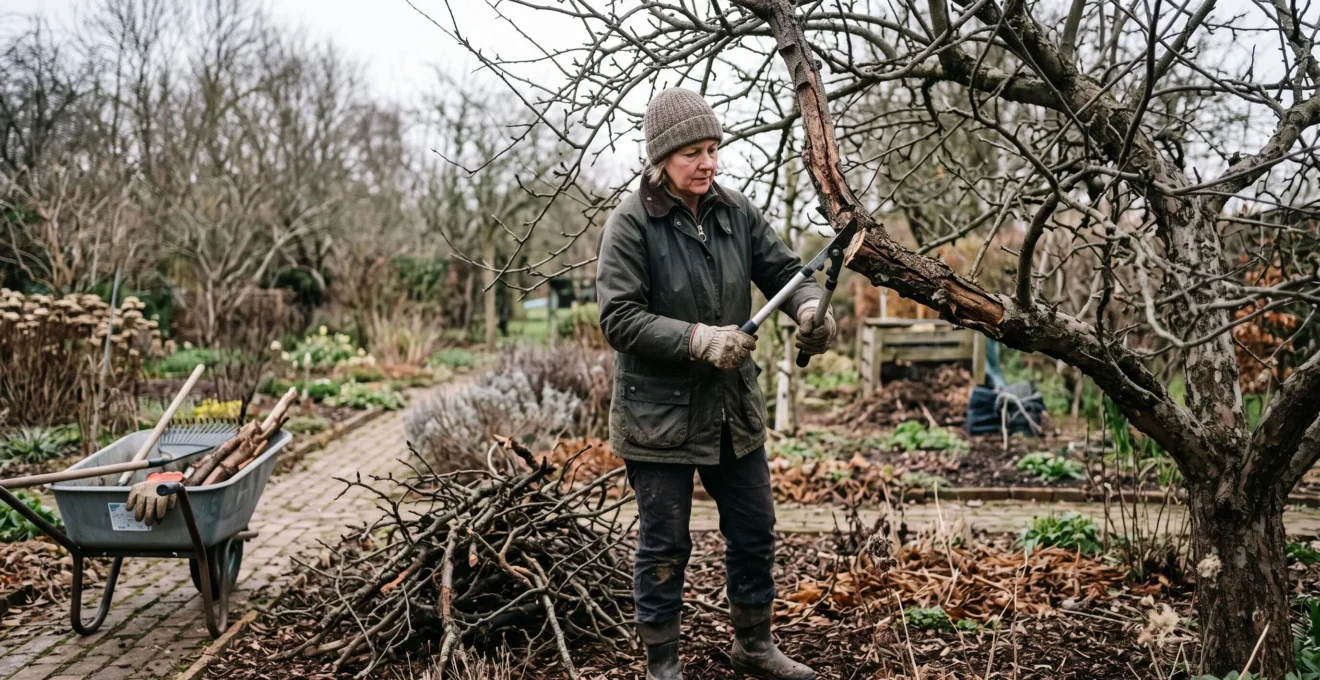
A dead branch is not always harmless. On an apple tree showing progressive dieback, cracked bark and dying shoots may harbour fungi capable of infecting adjacent wood. Leaving that material in place can allow certain pathogens to produce spores, spread during wet weather and establish new infections elsewhere in the garden.
Sanitation pruning interrupts this process by removing infected wood before it becomes a continuing source of disease. It also creates an opportunity to inspect the remaining branches, improve canopy structure and identify problems that require more than ordinary pruning.
But does removing dead or diseased wood really prevent 60% of tree and shrub diseases from spreading? There is no established universal percentage. The Royal Horticultural Society supports sanitation pruning as a disease-management practice, but its guidance does not demonstrate a 60% reduction across different plants and pathogens.
The practical result depends on identifying the infection correctly, cutting at an appropriate location, choosing a suitable pruning window and disposing of contaminated material safely. Some infections can be contained through branch removal; others persist in roots, vascular tissue or neighbouring plants.
Sanitation pruning: the essential decisions
- Remove genuinely dead or infected wood to reduce available infection sources, but confirm that dormant branches are not being mistaken for dead ones.
- Prioritise spreading cankers, damaging black knot infections and rapid dieback; use disease-specific cutting methods and disinfect equipment when appropriate.
- Choose pruning times according to the pathogen and species, remove contaminated debris and maintain an open canopy to reduce future disease pressure.
- How to Tell If Bare Winter Branches Are Dormant or Dead Before Making Pruning Cuts?
- Should You Sterilise Pruning Tools Between Every Cut When Removing Diseased Wood?
- Canker vs Coral Spot vs Black Knot: Which Wood Diseases Demand Urgent Removal?
- The Pruning Delay That Lets Disease Spread from One Branch to Kill Entire Trees
- When Should You Remove Dead or Diseased Wood to Minimise Pathogen Spread Risk?
- Heading Cuts vs Thinning Cuts: Which Pruning Technique Achieves Your Desired Plant Shape?
- Thinning Pruning vs Fungicide Sprays: Which Prevents Fungal Diseases More Effectively Long-Term?
- How Does Improved Air Circulation Reduce Powdery Mildew and Botrytis by 70%?
How to Tell If Bare Winter Branches Are Dormant or Dead Before Making Pruning Cuts?
A bare winter branch is not necessarily dead. Check for living tissue beneath the bark, test whether small twigs bend or snap, and compare buds with healthy branches of the same plant. If these signs remain inconclusive, wait until spring bud break before removing the branch, unless disease or a structural hazard requires earlier intervention.
Deciduous trees shed their leaves to survive winter, so leaflessness alone cannot establish whether a branch has died. Beech can retain dry, brown leaves through winter, a condition called marcescence. That foliage may look unhealthy even when the underlying branch is alive.
Use three simple field checks before making a permanent cut:
- Scratch test: Gently scrape a tiny patch of outer bark on a small twig. Greenish, moist living tissue beneath the bark generally indicates that the twig is alive. Dry, brown tissue may indicate death, although colour varies between species.
- Bud and bend test: Carefully flex a thin twig without forcing it. Living twigs often retain some flexibility, whereas dead twigs may snap cleanly. Examine the buds at the same time; firm, well-formed buds are more encouraging than brittle, shrivelled ones.
- Comparison test: Compare bud size, colour and branch condition with apparently healthy shoots elsewhere on the same plant. Look for consistent differences rather than judging one isolated twig.
None of these checks is infallible. A living twig can be brittle in cold weather, while recently dead wood may still contain moisture. A small scratch also reveals only the condition of the tissue immediately beneath it.
Frost cracks and sunscald can complicate the diagnosis. Bark damaged on the exposed side of a stem may appear dead even when living tissues remain on the opposite side. Where a branch is small enough to inspect safely, check several points along its length and on different sides rather than relying on a single patch.
Premature removal has a physiological cost. Living branches contain stored carbohydrates that support new growth, and some carry flower buds formed during the previous growing season. Cutting them unnecessarily reduces the plant’s reserves and may sacrifice the next flowering display.
Dead wood presents the opposite problem. It can provide an infection court for coral spot and certain canker pathogens, while damaged or weakened wood may attract wood-boring insects. Accurate diagnosis therefore determines whether the correct treatment is removal or patience.
Where the branch is not immediately hazardous and there is no clear evidence of advancing infection, marking it for reassessment at bud break is often preferable to making an irreversible winter cut.
Should You Sterilise Pruning Tools Between Every Cut When Removing Diseased Wood?
Pruning tools do not need disinfecting after every routine cut, but stricter hygiene is appropriate when removing infected material. Clean and disinfect blades before moving from diseased wood to healthy tissue or between susceptible plants, particularly when bacterial infections may be transmitted. The correct frequency depends on the pathogen, cutting sequence and disinfectant used.
A contaminated blade can move infectious material from one wound to another. However, disinfection is not the same as sterilisation: garden disinfectants reduce pathogens on cleaned surfaces without necessarily eliminating every microorganism.
The University of Minnesota Extension recommendations for disinfecting gardening tools emphasise removing visible debris before disinfection and taking particular care after working on diseased plants.
For ordinary garden pruning, this decision grid avoids both unnecessary work and preventable contamination:
| Pruning situation | Recommended hygiene | Reason |
|---|---|---|
| Removing dry, non-symptomatic dead twigs from one otherwise healthy shrub | Clean tools after the work; disinfect if infection is suspected. | The risk differs from cutting through actively infected tissue. |
| Cutting through visibly diseased wood | Clean and disinfect before making a subsequent cut through apparently healthy tissue. | Limits potential transfer from contaminated cutting surfaces. |
| Moving between diseased and healthy plants | Clean and disinfect before changing plants. | Reduces the chance of transferring pathogens between hosts. |
| Working on suspected fire blight or other readily transmitted infections | Follow pathogen-specific cutting and disinfection guidance. | Some infections require additional precautions, and not every disinfectant is equally effective. |
Disinfectant choice also matters. The options below are not interchangeable in every disease situation.
| Method | Practical advantage | Limitations and precautions |
|---|---|---|
| 70% or higher isopropyl alcohol | Convenient for treating cleaned small hand tools. | Flammable; may not adequately disinfect tools contaminated with the fire blight pathogen. |
| Household bleach diluted one part bleach to nine parts water | Accessible disinfectant option. | Corrosive to metal and cutting edges; tools require appropriate rinsing or cleaning and drying. |
| Suitable quaternary ammonium disinfectant | An alternative for small pruning tools. | Use a specifically suitable product and follow its label, including the required contact time. |
University of Minnesota Extension describes a two-minute treatment for a specified quaternary ammonium product. That duration should not be applied automatically to every formulation.
Dipping can be practical, but a shared container is not automatically safe or unsafe. Disinfectant concentration, organic contamination and contact time determine effectiveness. Replacing a dirty solution and following the product instructions are more defensible than assuming that a quick dip always disinfects a blade.
Tool hygiene should continue after the final cut. Remove sap, resin and debris, apply an appropriate disinfectant, dry metal components and lightly oil surfaces where suitable. This protects the equipment and prepares it for the next plant.
Good disinfection supports sanitation pruning, but it cannot compensate for incorrect disease identification or a cut that leaves infected tissue behind. The next decision is therefore which symptoms justify prompt removal.
Canker vs Coral Spot vs Black Knot: Which Wood Diseases Demand Urgent Removal?
Spreading cankers near structural branches deserve prompt assessment, while black knot on susceptible plum and cherry trees often requires removal during the appropriate dormant period. Coral spot on dead twigs usually indicates wood that needs clearing and a possible underlying dieback problem. Urgency depends on whether infection is active, how quickly it is progressing and how close it is to the trunk.
These diseases are visually distinctive enough to support preliminary garden triage, although uncertain cases may require professional identification.
| Disease | Visible symptoms | Pruning priority |
|---|---|---|
| Canker | Sunken or cracked bark, dead patches, sometimes gum or ooze, and a boundary between damaged and living tissue. | High where lesions are expanding, girdling branches or approaching the trunk. |
| Black knot | Hard, swollen, black or corky galls, principally on susceptible Prunus species. | Remove affected branches during the recommended dormant window where pruning is warranted. |
| Coral spot | Small pink-orange pustules developing on dead or dying woody tissue. | Remove affected dead wood and investigate the cause of dieback; urgency increases if infection advances into living wood. |
Black knot can extend internally beyond its visible gall. The fungus, Apiosporina morbosa, survives in infected branches and can release spores during wet spring conditions. The disease may already be established before its characteristic black swelling becomes visible.
According to University of Minnesota Extension guidance on black knot, pruning cuts should be made at least four inches, approximately 10 cm, below the visible gall. This is a disease-specific minimum from North American guidance, not a universal rule for cankers or a mandatory 15–20 cm margin.
Where a knot is on the trunk or a major structural limb, cutting the branch may not be an adequate or safe solution. Cracked or oozing trunk galls and suspected structural decay warrant assessment by a qualified arborist.
Cankers require a different judgement. Apple trees, stone fruits and ornamental woody plants can develop canker-like lesions from several causes. If disease is restricted to a removable branch, cutting back into unaffected wood may reduce its spread. However, the distance and timing must match the suspected pathogen, and an expanding lesion on the trunk cannot necessarily be managed through branch pruning.
Coral spot, associated with Nectria cinnabarina, commonly produces coloured fruiting bodies on dead twigs. It should not be dismissed as purely cosmetic: the Royal Horticultural Society notes that infection can extend into healthy wood. Remove affected material where appropriate and investigate stress, previous branch damage or other causes of dieback.
The strongest escalation signals are:
- Rapidly increasing dead or discoloured tissue on living branches.
- A lesion that nearly surrounds a branch or threatens a structural junction.
- Symptoms appearing on the main trunk, root collar or multiple major limbs.
- Sudden extensive dieback suggesting a vascular disease rather than isolated twig damage.
In the UK, suspected regulated pests or diseases may need to be reported to the relevant plant health authority, depending on the organism and location. Suspected Dutch elm disease, for example, should not automatically be described as subject to a universal statutory reporting duty. Check the current official requirements before moving or disposing of material suspected of carrying a regulated organism. Similar local restrictions can apply in North America.
A small infected twig and a girdling lesion on a scaffold branch do not present the same risk. Recognising the difference early is essential because delaying treatment can allow a manageable branch problem to become a structural one.
The Pruning Delay That Lets Disease Spread from One Branch to Kill Entire Trees
Delaying removal of an expanding canker can allow infection to advance from a removable branch towards the trunk. Once the trunk or vascular system is extensively affected, cutting out one branch may no longer control the problem. However, immediate pruning is not always safest: the wrong season can expose trees to additional infections.
Canker pathogens can progressively damage bark and cambium. As lesions expand, they may girdle a branch, interrupting the movement of water and sugars and causing shoots beyond the infected area to die.
When a lesion is restricted to an accessible side branch, sanitation pruning may remove the affected tissue. When it reaches the branch attachment or main stem, complete removal without unacceptable damage becomes much more difficult.
Vascular diseases create additional complications. Dutch elm disease and oak wilt involve pathogens that can move through conducting tissues. In some circumstances, insects or connections between neighbouring root systems contribute to spread. Verticillium wilt can persist in soil and plant tissues, so removing a symptomatic branch does not necessarily eliminate the infection.
These differences explain why the relevant decision is not simply how many days have passed since the first dead leaf appeared.
| Observed condition | Suggested response | Reason |
|---|---|---|
| Small, stable tip dieback on an otherwise healthy shrub | Inspect and plan removal during a suitable pruning window. | Symptoms may be localised or non-infectious. |
| Expanding canker on a substantial branch | Arrange assessment within the current growing season and follow disease-specific timing. | Progression may reduce the amount of removable healthy wood. |
| Rapid dieback affecting several major limbs | Seek prompt professional diagnosis. | A systemic or vascular problem may be involved. |
| Extensive trunk lesions, structural decay or falling-branch risk | Keep people clear of the hazard and arrange qualified arboricultural assessment. | Pruning may be insufficient or unsafe. |
Pathogens can also travel between plants through routes that ordinary branch inspection may miss. Rain splash can transfer spores from infected debris to susceptible shoots, while wind can distribute spores from diseases such as black knot. Certain insects transmit specific pathogens, and connected roots may permit the movement of some tree diseases.
The transmission mechanism matters. Bark beetles are associated with Dutch elm disease, and sap-feeding beetles can contribute to oak wilt transmission. Fire blight has different transmission pathways, including insects visiting blossoms, rain splash and contaminated tools. These mechanisms should not be treated as interchangeable.
Pruning itself creates wounds. Cutting susceptible stone fruits during wet periods may increase the risk of certain infections, while pruning elms or oaks when relevant insect vectors are active can expose fresh wounds to pathogens in affected regions.
Illustrative scenario: an expanding apple-tree canker
Consider a hypothetical apple tree with a visible canker on a secondary branch. If the lesion remains isolated, a correctly positioned removal cut during an appropriate dry pruning window may eliminate the affected branch.
If the lesion continues towards the trunk before action is taken, removing all affected tissue may require sacrificing a major structural limb or may no longer be practical. The scenario illustrates why lesion position and progression matter; it is not a measured case or prediction of inevitable tree loss.
For suspected serious diseases, early diagnosis is more valuable than cutting indiscriminately. Record where symptoms began, whether they are expanding, and which other parts of the plant are affected before selecting a treatment.
The aim is timely, correctly targeted intervention rather than pruning at the earliest possible moment. Seasonal weather and pathogen activity determine when that intervention is least likely to introduce another infection.
When Should You Remove Dead or Diseased Wood to Minimise Pathogen Spread Risk?
Remove hazardous dead branches promptly, but schedule non-urgent disease pruning according to the affected species, suspected pathogen and weather. Dry conditions generally reduce the spread of splash-dispersed pathogens during cutting. Late-winter dormancy suits many trees, although stone fruits, fire blight, oak wilt and Dutch elm disease require disease-specific exceptions.
There is no universally safe pruning month for every tree. A dormant apple tree with established canker symptoms may benefit from carefully timed winter sanitation, whereas a cherry tree susceptible to silver leaf disease may be better pruned in dry summer weather under UK conditions.
The Royal Horticultural Society’s guidance on managing pests and diseases without chemicals recommends cultural prevention, removal of diseased plant parts and open plant structures, while recognising that removing infected material does not necessarily eradicate disease.
A practical annual schedule for a temperate UK garden is:
| Season | Priority work | Important exceptions |
|---|---|---|
| Late winter | Inspect branch structure; identify dead wood; carry out suitable dormant-season sanitation and structural cuts. | Avoid assuming all stone fruits or disease-affected species should be pruned in winter. |
| Spring | Monitor emerging shoots for new dieback, cankers and blossom-related infections. | Pruning susceptible plants during active fire blight conditions can increase transmission risk. |
| Early to midsummer | Inspect fresh symptoms; address confirmed active infections when the disease-specific guidance calls for intervention. | Restrict pruning during relevant insect-vector activity for susceptible trees in affected regions. |
| Autumn | Collect infected fallen leaves, mummified fruit and accessible diseased debris. | Follow local disposal restrictions for regulated pathogens and contaminated material. |
North American advice must be adapted to its geographic context. For example, University of Minnesota Extension recommends avoiding oak pruning from April through October because of oak wilt risk in its region. That restriction should not be transferred as an identical national rule to Britain.
Weather is another practical control. Avoid cutting through wet, visibly infected material during rainfall when spores may spread by splashing. Sharp, correctly maintained tools create cleaner cuts, but pruning wounds do not simply heal faster because the day is dry: trees compartmentalise injured wood, and their response depends on species, vitality, wound size and conditions.
Once diseased wood is removed, the job is only half complete. Some pathogens survive in fallen branches, infected leaves and fruit. Leaving these materials beneath a susceptible plant may preserve an inoculum source for the following growing season.
Suitable disposal may include an authorised green-waste collection, approved disposal facility, burial where permitted, or burning where legally allowed. Home composting is generally inappropriate for material carrying persistent woody pathogens unless effective pathogen destruction is assured. Municipal facilities may have different treatment processes, so contaminated wood should not automatically be placed in a green-waste bin without checking local rules.
Five-step sanitation-pruning field checklist
- Identify the affected wood: Inspect living buds, bark and symptoms; record the affected branches on a photograph or simple sketch.
- Choose the cutting window: Check the species, suspected disease and upcoming weather; record the planned pruning date.
- Prepare the equipment: Clean the cutting surfaces and select an appropriate disinfectant where required; confirm that blades are sharp and ready.
- Remove affected branches correctly: Follow disease-specific cutting guidance, preserve the branch collar where appropriate and photograph the remaining cut surface.
- Complete sanitation: Contain and dispose of diseased material according to local rules, clean the tools and record a follow-up inspection date.
This five-step record provides a useful comparison point for the next growing season. It also prevents repeated pruning of the same plant without first determining whether the original problem has actually stopped progressing.
Once affected material has been removed, the remaining crown should be managed to support healthy growth. Choosing between heading and thinning cuts becomes the next preventive decision.
Heading Cuts vs Thinning Cuts: Which Pruning Technique Achieves Your Desired Plant Shape?
Heading cuts shorten shoots and usually stimulate new growth near the cut, making them useful for formal shaping and controlled branching. Thinning cuts remove entire branches at their origin, opening the canopy while retaining a more natural outline. For sanitation pruning, thinning is generally preferable because it can remove diseased branches and improve air movement simultaneously.
Mechanically, the difference is the location of the cut. A heading cut removes a terminal portion of a shoot, typically leaving buds below the cut capable of producing new growth. A thinning cut removes a branch back to its point of attachment or another suitable branch junction, without leaving an unnecessary dead stub.
The University of Minnesota Extension guidance on pruning trees and shrubs generally favours thinning cuts for structural pruning. It also explains that heading stimulates vegetative regrowth and that crown thinning can increase light penetration and air movement.
| Garden objective | Preferred technique | Expected response |
|---|---|---|
| Maintain a formal hedge | Heading and selective thinning | Controls the outline while reducing excessive internal congestion. |
| Restore an overcrowded ornamental shrub | Thinning and selective renewal pruning | Removes older stems and opens the plant without excessive surface regrowth. |
| Improve the structure of a fruit tree | Primarily thinning, with appropriate reduction cuts where needed | Improves branch spacing, light penetration and crown balance. |
| Control a small ornamental plant’s size | Carefully selected heading or reduction cuts, combined with thinning | Adjusts dimensions while limiting dense, weakly placed regrowth. |
| Remove a diseased side branch | Appropriate removal cut | Eliminates the affected branch where disease is sufficiently localised. |
Over two or three growing seasons, repeated heading can produce a dense collection of shoots near previous cuts. This may be desirable for a clipped hedge but undesirable for an old fruit tree whose interior already receives little light.
Thinning tends to retain a more open framework. Removing crossing, inward-growing or poorly positioned branches can increase light reaching the interior while reducing places where moisture remains trapped.
Avoid treating tree topping as routine size control. Severe topping can produce vigorous shoots with potentially weak attachments, compromise the natural structure and create large wounds. Likewise, exclusively shearing a shrub can create an outer shell of foliage that shades its interior.
For mature shrubs suitable for gradual renewal, removing a portion of the oldest stems annually may be more appropriate than cutting everything back at once. University of Minnesota Extension describes removing up to one-third of older stems in suitable renewal-pruning situations.
For fruit trees, no universally valid heading-to-thinning ratio prevents biennial bearing. Cropping behaviour also depends on cultivar, flower-bud formation, fruit thinning and growing conditions.
The best pruning cut achieves its structural purpose without creating unnecessary wounds or excessive regrowth. That same principle helps determine how much disease prevention can be achieved through pruning rather than chemical treatment.
Thinning Pruning vs Fungicide Sprays: Which Prevents Fungal Diseases More Effectively Long-Term?
Thinning pruning offers lasting structural benefits by improving light and airflow, while fungicides target particular pathogens during susceptible infection periods. Neither method is universally more effective. For many ornamental shrubs, good pruning and resistant varieties may reduce the need for sprays; highly susceptible fruit crops may still require an integrated management programme.
The two approaches act on different parts of the disease cycle. Thinning changes canopy conditions and removes selected infection sources. Fungicides, when correctly selected and authorised, can protect susceptible tissues against specified fungal diseases, often by inhibiting spore germination or other stages of fungal development.
Pruning does not provide the same protective activity as a suitable fungicide. Conversely, spraying foliage does not remove existing cankers, correct overcrowding or repair poor branch structure.
| Criterion | Thinning pruning | Fungicide treatment |
|---|---|---|
| Main mechanism | Opens the canopy and removes selected branches or infection sources. | Targets susceptible pathogens during relevant infection stages. |
| Duration of benefit | Structural improvement persists until regrowth or changed plant conditions reduce openness. | Protection depends on the product, application timing and subsequent growth or weather. |
| Recurring requirements | Seasonal inspection and selective maintenance. | Applications where needed, within product-label and legal restrictions. |
| Additional effects | Can improve branch structure, fruit exposure and access for inspection. | May suppress specific diseases that pruning alone cannot adequately manage. |
| Limitations | Cannot reliably control systemic infections or all externally introduced spores. | May involve product costs, application restrictions, non-target risks and resistance management. |
Consider a highly susceptible apple cultivar in a wet spring. Opening the crown may help foliage dry and improve penetration of any authorised treatment, but it does not eliminate the possibility of apple scab infection. Similarly, rose black spot can remain troublesome even in a reasonably open planting where susceptible foliage encounters favourable infection conditions.
For less susceptible ornamental shrubs, thoughtful pruning, suitable spacing and resistant cultivar selection may be enough to avoid routine fungicide applications. This is especially attractive in domestic gardens where exposure, biodiversity and maintenance effort are important considerations.
Repeated fungicide use also brings obligations. Some active substances pose risks to particular non-target organisms, while repeated use of the same mode of action can select for resistant pathogen populations. These effects depend on the product, exposure and application regime rather than applying equally to every fungicide.
UK home gardeners must use only plant-protection products authorised for their intended use and follow the current label instructions. A product permitted for professional horticulture is not automatically suitable for domestic application.
In exceptionally wet seasons or persistently humid environments, structural pruning may provide less disease control than expected. Likewise, pruning an already systemically infected plant may improve its appearance without eliminating the underlying disease.
Instead of choosing one intervention exclusively, start with sound plant structure and accurate disease identification, then consider whether additional authorised controls are genuinely necessary. The final component is understanding how air movement changes the environment in which fungal infections develop.
Key takeaways before improving canopy airflow
- Remove crossing and inward-growing branches selectively rather than thinning an entire canopy indiscriminately.
- Manage moisture at its source: planting density and irrigation can undermine the benefits of otherwise good pruning.
- Judge improvement through light penetration, plant health and recurring disease symptoms, not an assumed percentage reduction.
How Does Improved Air Circulation Reduce Powdery Mildew and Botrytis by 70%?
Improved air circulation can reduce conditions that favour fungal diseases, particularly Botrytis, by shortening periods of leaf and flower wetness and limiting stagnant humidity. Powdery mildew responds differently because many powdery mildew fungi can infect without free water on leaf surfaces. A universal 70% reduction for both diseases is not established by the supplied horticultural evidence.
Air movement affects the microclimate within the canopy. Dense foliage restricts ventilation, shades interior shoots and can prolong moisture retention after rain or irrigation.
Botrytis, commonly associated with grey mould, often benefits from high humidity and prolonged wetness around susceptible plant tissues. Improving airflow and spacing can make these favourable conditions less persistent, particularly in crowded plantings or sheltered growing environments.
Powdery mildew behaves differently. Many powdery mildew pathogens favour shaded, poorly ventilated foliage, but free water is not required for infection and may inhibit the germination of some species. Consequently, improving ventilation can help without necessarily producing the same response seen with moisture-dependent diseases.
The 70% figure should be treated as an illustrative headline, not a dependable performance estimate. The actual effect depends on the host species, pathogen, humidity, initial canopy density, weather and other control measures. The Royal Horticultural Society guidance supports better airflow as a preventive practice but does not establish a universal percentage for powdery mildew or Botrytis.
Gardeners can assess canopy improvement through practical observations rather than numerical promises:
- Remove dead, crossing and inward-growing branches that unnecessarily crowd the centre.
- Maintain clear spaces between major framework branches where the species and growth habit permit.
- Check whether dappled light reaches the interior rather than only the outermost foliage.
- Prevent neighbouring shrubs from compressing each other into persistently shaded, humid pockets.
- Preserve sufficient healthy foliage for photosynthesis; opening a canopy does not mean stripping it bare.
Being able to see some light through the canopy is a useful qualitative check, not a validated disease-control threshold. Excessive thinning can expose previously shaded bark and foliage to additional stress and cause vigorous regrowth.
Air circulation works best when combined with other cultural controls. Adequate plant spacing reduces long-term overcrowding. Where suitable, drip irrigation or watering the soil directly avoids repeatedly wetting leaves. Removing foliage in persistent contact with damp soil may also reduce certain disease opportunities, provided the removal suits the plant.
Resistant cultivars remain particularly important where powdery mildew repeatedly affects the same species. A genetically susceptible plant can develop infection even when its canopy is reasonably open and well maintained.
Airflow is also less relevant to pathogens that primarily occupy roots or vascular tissues. A tree suffering from a systemic wilt cannot be cured simply by allowing more wind through its branches.
After pruning, assess the plant across the following growing season. Look for better internal light, less persistent crowding and changes in disease incidence, while recognising that differences in rainfall and temperature can influence the comparison.
Begin with a ground-level inspection of the affected tree or shrub. Identify confirmed dead wood, photograph active lesions, select the appropriate pruning window and remove material that can safely be dealt with. If dieback is advancing towards the trunk, multiple structural branches are affected or the cause remains uncertain, obtain a qualified arborist’s assessment before making major cuts.
Can removing infected branches completely cure a tree?
Sometimes branch removal can eliminate a localised infection, particularly when all affected tissue is confined to a removable branch. It does not guarantee a cure. Pathogens may already have entered the trunk, roots or vascular tissues, and spores from surrounding plants can cause reinfection. Monitor the remaining growth after pruning and seek diagnosis if symptoms progress.
Should every dead branch be removed immediately?
Dead branches that threaten people or property require prompt safety assessment. Small, stable dead twigs can usually be scheduled for an appropriate pruning session. Confirm that a winter branch is genuinely dead before removing it, and avoid unsafe ladder work or cutting large structural branches without suitable professional equipment and expertise.
Should pruning wounds be sealed after cutting diseased wood?
Routine wound sealants are generally not necessary for ordinary tree pruning. Correct cut placement, preservation of the branch collar and avoidance of unnecessary damage are more important. Certain disease-specific management programmes may have additional requirements, so follow appropriate professional advice rather than applying a general wound dressing to every cut.
Can diseased branches go into a garden compost heap?
Avoid adding wood carrying persistent or serious pathogens to an ordinary home compost heap, where temperatures may not be sufficient to destroy infectious material. Check whether your municipal collection accepts the affected waste or whether another approved disposal method is required. Suspected regulated plant diseases may carry specific movement and destruction restrictions.
How can gardeners tell whether sanitation pruning has worked?
Record the original symptoms, photograph the tree after cutting and inspect new growth during the following season. Look for fresh cankers, additional dieback or new fungal fruiting bodies. Stable branch health is encouraging, but the absence of visible symptoms does not prove that every pathogen has disappeared. Repeated or expanding symptoms justify further investigation.