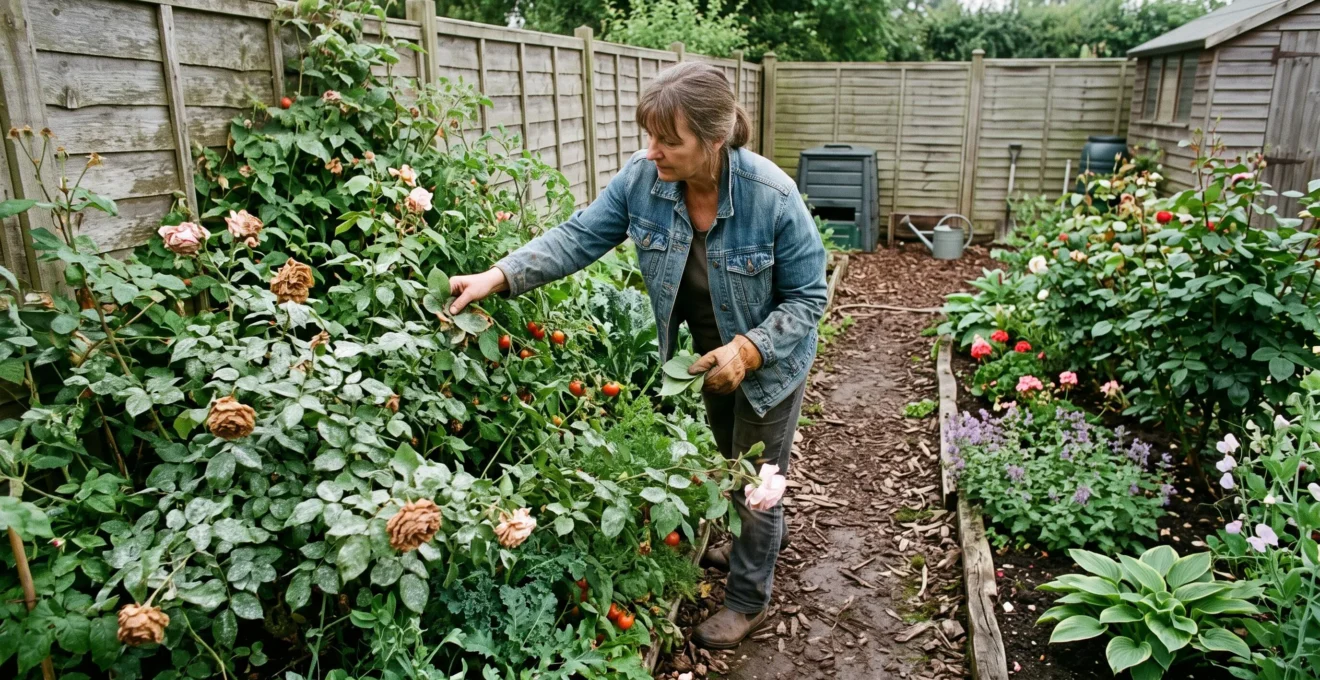
A rose bush develops white powdery patches every summer. Tomato leaves remain damp long after the morning dew has disappeared elsewhere. Despite repeated fungicide treatments, grey mould returns to the same shaded corner. The underlying problem may be less about the number of fungal spores present and more about the atmosphere surrounding the plants.
Improved air circulation helps prevent fungal diseases by reducing persistent humidity within foliage, encouraging wet leaves to dry and preventing the stagnant conditions that favour infection. The effect is particularly relevant to Botrytis, which depends heavily on prolonged moisture. Powdery mildew behaves differently: it can infect leaves without free water, although humid, sheltered conditions often favour its development.
Can better airflow reduce these diseases by 70%? That figure cannot be treated as a universal result. The institutional guidance considered here supports better ventilation, spacing and pruning, but does not establish a consistent 70% reduction across gardens. The practical goal is to make the growing environment less favourable to infection, reducing dependence on repeated spraying rather than expecting a guaranteed percentage improvement.
Garden airflow and fungal disease: the essentials
- Reduce trapped humidity: Space mature plants appropriately and open congested canopies so moisture does not persist unnecessarily.
- Combine prevention measures: Pruning, sanitation and appropriate watering address conditions that fungicide sprays alone cannot resolve.
- Maintain gentle movement: Air should pass through foliage without exposing plants to persistent, damaging winds.
- Why Do Tightly Packed Plants in Sheltered Corners Suffer More Fungal Disease Than Spaced Specimens?
- How Much Space Should You Leave Between Plants to Ensure Disease-Preventing Airflow?
- Thinning Pruning vs Fungicide Sprays: Which Prevents Fungal Diseases More Effectively Long-Term?
- The Air Circulation Mistake That Turns Beneficial Airflow Into Damaging Wind Stress
- When Should You Prune for Air Circulation to Prevent Fungal Diseases Before Peak Infection Season?
- The Companion Planting Mistake That Creates Competition Instead of Cooperation
- Why Do Gardens with Multiple Plant Layers Suffer 60% Fewer Pest Outbreaks?
- Why Does Removing Dead or Diseased Wood Prevent 60% of Tree and Shrub Diseases Spreading?
Why Do Tightly Packed Plants in Sheltered Corners Suffer More Fungal Disease Than Spaced Specimens?
Tightly packed plants in sheltered corners experience more fungal disease because their overlapping leaves restrict air exchange and create humid microclimates. After rain or dew, moisture evaporates more slowly, particularly deep inside the canopy. This favours moisture-dependent diseases such as Botrytis and can encourage powdery mildew, although the two fungi require different conditions for infection.
Consider a garden bed where two timber fences meet. Both barriers interrupt the prevailing breeze, while neighbouring shrubs create another layer of resistance. Moisture released through transpiration accumulates among the leaves, and shaded foliage receives less solar energy to accelerate drying.
Similar conditions develop inside tightly clipped hedges, against house walls and among vegetables whose mature leaves overlap. Even a reasonably exposed garden can contain pockets of nearly motionless air.
The distinction between the two pathogens matters. Botrytis blight, commonly called grey mould, particularly favours prolonged wetness or very high humidity and often colonises weakened, damaged or dying tissues. Powdery mildew fungi, by contrast, generally do not require liquid water on leaves to establish infection.
The RHS guidance on powdery mildew biology and control explains that high humidity without free water favours powdery mildew spore production and infection. This makes improving ventilation relevant even when foliage does not appear visibly wet.
Fungal spores may arrive through ordinary air movement, on plant material or from infected debris. Better circulation cannot remove every spore. Instead, it alters the environmental conditions that determine whether those spores can successfully establish disease.
To identify a problematic microclimate, compare different parts of the same garden:
- Does dew remain on inner leaves after exposed foliage has dried?
- Does mildew repeatedly appear in the same sheltered bed?
- Do symptoms begin inside the densest foliage while outer leaves remain relatively healthy?
- Does the air feel noticeably cooler and more humid beside walls or dense hedges?
None of these observations proves that poor circulation is the only cause. Together, however, they provide useful evidence that the planting arrangement deserves attention.
Once the vulnerable locations are identified, the next question is not simply how many plants to remove, but how much growing space each plant actually needs.
How Much Space Should You Leave Between Plants to Ensure Disease-Preventing Airflow?
Leave enough space for air to move between plants at their mature size, not merely when they are planted. There is no universal disease-preventing distance: the appropriate clearance depends on species, eventual canopy width, rainfall, humidity, pruning and exposure. In a damp, sheltered UK garden, additional clearance may be more useful than maximising planting density.
Seed packets and plant labels provide valuable starting points, but their recommended spacing may reflect typical cultivation, growth or productivity rather than the particular disease pressure in a sheltered garden.
A better approach begins with the expected mature spread. Imagine two shrubs, each expected to reach approximately 80 cm across. If planted 80 cm apart, centre to centre, their canopies will eventually meet. Allowing additional room may maintain a ventilation gap, although the appropriate amount depends on how they grow and whether they receive regular pruning.
Rather than following a single centimetre rule, adjust the planting arrangement to its environment.
| Garden conditions | Spacing approach | Reasoning |
|---|---|---|
| Damp, sheltered beds | Allow additional clearance beyond the mature canopy width where space permits. | Restricted air exchange makes retained humidity more likely. |
| Exposed, breezy locations | Begin with species-specific guidance and maintain moderate protection. | Natural ventilation may already be sufficient. |
| Frequently pruned plants | Maintain accessible gaps and regularly assess canopy regrowth. | Pruning can preserve openings without excessive initial spacing. |
| High-rainfall or persistently humid sites | Prioritise open canopies and avoid overlapping foliage. | Leaves may remain wet for longer periods. |
| Compact vegetable beds | Balance crop density with access, training and selective leaf removal. | Overcrowding may increase disease pressure and reduce spray penetration. |
Horizontal clearance is only part of the design. Vertical airflow also matters, especially where foliage forms a dense layer close to damp soil.
For tomatoes, remove appropriate lower foliage as plants develop, taking care not to strip healthy leaves excessively. For roses and suitable shrubs, remove selected crossing or inward-growing branches to create an open framework. Underplanting can remain useful, but low-growing plants should not form an uninterrupted damp mass beneath susceptible canopies.
The University of California‘s UC IPM recommendations for managing powdery mildew on ornamentals support adequate plant spacing and pruning excess foliage to improve circulation. The guidance also cautions against excessive nitrogen fertilisation, which can produce dense, vulnerable growth.
Greater spacing is not automatically better in every respect. Fewer plants may mean reduced harvest per square metre, while exposing more soil can increase evaporation and watering requirements. Mulching exposed soil, selecting suitable varieties and grouping plants with compatible moisture needs can help manage those trade-offs.
Where established plants cannot be moved without damage, selective pruning offers another way to create the clearances that spacing alone would otherwise provide.
Thinning Pruning vs Fungicide Sprays: Which Prevents Fungal Diseases More Effectively Long-Term?
Thinning pruning often provides a more durable foundation for fungal disease prevention because it changes the conditions inside the canopy, whereas fungicide sprays primarily act on the pathogen. Pruning can improve ventilation and light penetration between treatments, while sprays may need repeating. Neither method is universally superior: outcomes depend on the plant, pathogen, weather and infection pressure.
When a shrub becomes congested, its inner branches form a humid enclosure. Removing selected crossing, weak or overcrowded growth creates openings through which air can pass. That improvement can persist until regrowth closes the canopy again.
A fungicide works differently. Depending on its active ingredient and permitted use, it may protect susceptible tissues or suppress fungal development. However, spraying does not correct overcrowding, excessive humidity or persistent leaf wetness.
Dense foliage also complicates application. Outer leaves can intercept much of a spray before it reaches hidden susceptible surfaces. Where disease-favouring conditions persist, treatment performance may remain disappointing even when application instructions are followed.
For Botrytis, the UC IPM guidance on Botrytis blight and gray mold recommends improving circulation, adequate spacing, selective canopy pruning and sanitation. Its biological guidance describes infection risk after prolonged wetness or approximately six hours of very high relative humidity. These are context-dependent conditions, not universal thresholds for every plant and setting.
The practical choice depends on the severity of the problem and the value or vulnerability of the planting.
| Decision factor | Thinning pruning | Fungicide sprays |
|---|---|---|
| Primary action | Improves canopy structure and local air exchange. | Targets fungal infection processes according to the product. |
| Duration | Structural benefits remain until significant regrowth. | Protection varies by formulation, application and weather. |
| Maintenance | Seasonal assessment and selective cutting. | Potentially repeated applications under label instructions. |
| Main limitation | Cannot necessarily stop infection during highly favourable weather. | Does not remove underlying humidity or overcrowding. |
| Suitable role | Routine prevention and canopy management. | Complementary control where justified and legally permitted. |
In a small garden with moderate disease pressure, suitable resistant cultivars and naturally open growth, thinning and sanitation may be sufficient. Susceptible high-value plants or repeatedly affected protected crops may require a wider integrated management programme.
UK gardeners should use only products authorised for the intended plant and use, follow current label instructions and consider non-chemical measures first. Fungicides should not be applied merely because a white or grey patch appears: accurate disease identification matters.
The maintenance costs differ, too. Structural pruning requires an initial investment of time and occasional reassessment. Sprays may involve repeated purchases, suitable application conditions and careful handling throughout the growing season.
The most effective practical programme often combines environmental prevention, sanitation and carefully selected treatment where necessary. Yet opening a canopy too aggressively can introduce a different source of plant stress.
The Air Circulation Mistake That Turns Beneficial Airflow Into Damaging Wind Stress
The main airflow mistake is confusing ventilation with maximum wind exposure. Gentle, consistent air movement helps remove humid air around foliage, while strong or turbulent winds can increase water loss, tear leaves and damage vulnerable stems. The goal is to maintain enough circulation for leaves to dry without exposing plants to persistent desiccation or mechanical stress.
For example, a gardener might remove an entire section of hedge to solve mildew problems in a sheltered vegetable patch. The sudden exposure could improve drying after rain, but it could also leave soft-stemmed plants vulnerable to strong winds.
The physical difference is important. Moderate movement exchanges the air immediately surrounding leaves with the wider atmosphere. Strong gusts can bend stems repeatedly, abrade foliage and increase transpiration when atmospheric conditions promote water loss.
Not all air movement is perfectly smooth or laminar outdoors. Garden airflow is naturally variable, and the practical distinction is between useful ventilation and damaging exposure, rather than a strict separation between two airflow types.
Common problems include over-thinning a protective hedge, removing all shelter around newly planted crops, placing greenhouse fans too close to foliage and leaving tall plants inadequately supported.
A partially permeable windbreak can provide a useful compromise. Open-mesh fencing or staggered planting filters exposed airflow without creating the complete obstruction of a solid barrier. Placement should reflect the prevailing wind and the needs of the crops being protected.
Leaf movement provides a simple observational guide. Occasional gentle swaying suggests air is moving through the planting. Repeated violent whipping, persistent curling or torn foliage suggests exposure may be excessive, although pests, water stress and other causes should also be considered.
Young transplants particularly benefit from gradual exposure while their root systems establish. Temporary protection and appropriate staking can reduce movement stress without enclosing them in stagnant air.
Excessive wind can also increase irrigation needs. If exposed plants repeatedly become water-stressed, their reduced vigour may make them less resilient to some diseases. Wounded plant tissue can also offer infection opportunities to pathogens such as Botrytis.
The correct response is therefore rarely to eliminate every hedge or barrier. Filter wind rather than blocking it entirely or allowing unrestricted gusts.
Once a suitable airflow pattern is established, pruning at the right stage of growth becomes essential to maintaining it through the periods when fungal infections are most likely.
When Should You Prune for Air Circulation to Prevent Fungal Diseases Before Peak Infection Season?
Prune for better air circulation before dense growth and prolonged humid weather create favourable infection conditions. For many UK garden plants, this involves species-appropriate structural pruning during dormancy, selective thinning in spring and light maintenance during summer. Exact timing varies considerably, and pruning during wet weather or at the wrong growth stage can create additional disease risks.
The important principle is prevention. Once fungal infections are established, thinning may improve the environment for healthy remaining growth, but it cannot reverse existing lesions or guarantee that infection will stop.
Winter and early spring can offer opportunities to inspect deciduous plants while their structure is visible. However, not every shrub should be pruned in winter: flowering habits, frost sensitivity and species-specific disease risks must guide the decision.
As new growth develops in spring, previously open canopies may quickly become congested. This is an appropriate time to inspect air channels between shoots and identify growth that needs selective removal where the species tolerates it.
Summer maintenance should generally be restrained. Remove suitable overcrowded or diseased material while avoiding unnecessary loss of healthy photosynthetic foliage or excessive exposure to strong sunlight.
Pruning also creates wounds, so working conditions matter as much as the season. Cutting wet foliage may increase the opportunity to transfer infectious material, and certain pathogens can exploit fresh wounds.
Where disease is suspected, avoid transferring contaminated material between plants. Clean secateurs and disinfect them when the relevant disease creates a realistic risk of tool-borne transmission. Tool hygiene is especially important during removal of infected tissue.
The following checklist turns seasonal guidance into a practical garden inspection.
Five actions for a pre-infection airflow check
- Map recurring problem areas: Mark every bed with repeated mildew or grey mould on a simple garden plan. Deliverable: an annotated map of high-risk planting zones.
- Inspect mature canopy clearance: Record where neighbouring plants overlap or foliage forms an uninterrupted dense layer. Deliverable: a list of congested plants requiring assessment.
- Select appropriate pruning windows: Check species-specific pruning requirements before scheduling work. Deliverable: a plant-by-plant pruning calendar.
- Open suitable canopies carefully: Remove selected crossing, damaged or congested growth in appropriate conditions, using hygienic tools. Deliverable: visibly improved light and access through the canopy.
- Check drying after moisture: Compare internal and exposed leaves after ordinary rain or dew. Deliverable: a dated observation noting where moisture persists longest.
No single calendar date guarantees adequate protection. The desired result is a canopy with sufficient internal light, visible openings and foliage that does not remain unnecessarily wet after ordinary moisture events.
Equally, rapid drying is not proof that disease cannot develop. Powdery mildew can still infect under favourable humidity conditions without visible water on the leaf surface.
Good timing protects the structure of individual plants, but the arrangement of neighbouring species can either reinforce or undermine those improvements.
The Companion Planting Mistake That Creates Competition Instead of Cooperation
The most common companion planting mistake is placing supposedly beneficial neighbours so close together that their mature foliage competes for light, water and air. A planting scheme intended to discourage pests can then create sheltered, humid conditions that favour fungal disease. Companion plants should be chosen and spaced for their actual growth habits, not simply their reputation as helpful neighbours.
Consider a hypothetical vegetable bed containing tomatoes surrounded by dense herbs and flowering companions. The arrangement may look attractive early in the season, with every plant apparently occupying a useful space.
As the tomatoes expand, however, the underplanting may become heavily shaded. Moist air can remain trapped beneath the main canopy, while thirsty companions draw water from the same soil volume.
Claims about companion plants repelling particular insects should also be treated carefully. Some effects are supported in specific circumstances, but results depend on species, planting arrangement, pest behaviour and environmental conditions. A claimed insect-repellent benefit should not be assumed to compensate for poor air circulation.
The more predictable part of companion planting is its physical influence on the growing environment. Plant height, eventual spread, leaf density, root competition and watering requirements can all be assessed before planting.
Before combining species, check whether their mature foliage leaves usable gaps at canopy height. Consider whether one plant will shade the other excessively and whether both require compatible soil moisture.
For example, a low-growing companion that remains compact may cover exposed soil without obstructing the main crop. A vigorous climbing or sprawling companion might instead close the ventilation gap, requiring more frequent management.
Competition can produce indirect disease consequences. Reduced light or inadequate water may weaken a crop, although the response to individual pathogens varies. Some stressed plants become more vulnerable, whereas other diseases respond to different physiological conditions.
There is also a practical trade-off. Removing every companion may increase exposed soil and reduce habitat diversity. The more useful adjustment is often selective thinning, relocation or choosing less vigorous plants.
When companions occupy distinct spaces and receive adequate resources, they can contribute to a diverse garden without undermining disease prevention. This leads naturally to the broader question of planting in multiple layers.
Why Do Gardens with Multiple Plant Layers Suffer 60% Fewer Pest Outbreaks?
Gardens with multiple plant layers can support natural enemies of pests by providing varied habitats, shelter and feeding opportunities, but a universal 60% reduction in pest outbreaks is not established by the supplied evidence. Outcomes depend on plant species, pest populations, climate and planting density. Layered designs may benefit pest management while increasing fungal disease pressure if ventilation is restricted.
A layered garden typically includes plants occupying several vertical zones: taller shrubs or trees, medium-height perennials and lower-growing ground cover. This structural diversity can create a wider range of habitats than a single uniform planting.
Beneficial insects and other predators may use different layers for shelter, foraging or reproduction. However, the presence of diverse vegetation does not guarantee that enough effective predators will be present to suppress a particular pest outbreak.
Layered planting also modifies the microclimate. Taller growth can buffer strong winds and reduce exposure of delicate plants. Lower vegetation can shade soil and influence evaporation.
Those effects have two possible consequences. A well-designed layered bed may preserve useful ventilation while providing protection. A congested bed may instead trap humid air among overlapping leaves, creating conditions favourable to certain fungal pathogens.
Layering and overcrowding are not the same design principle. Successful layering separates plants by height and growing habit while retaining accessible spaces through which light and air can move.
To distinguish the two, inspect the bed at mature growth rather than shortly after planting. Can lower plants receive appropriate light? Can inner foliage be reached for inspection? Are leaves pressed continuously against neighbouring stems and branches?
In a damp UK garden, these questions are especially important around dense evergreen shrubs and shaded perennial borders, where sheltered conditions may persist beyond a brief rainy period.
The supplied institutional sources establish the importance of ventilation for powdery mildew and Botrytis management, but do not measure pest reductions from multilayer planting. The 60% figure should therefore be understood as an unverified, context-dependent proposition rather than a general performance expectation.
Plant diversity and disease prevention are compatible goals when a design deliberately retains airflow. The ecological benefit of providing several habitat layers should not require filling every available gap with foliage.
Even with an effective planting structure, dead branches and infected plant remains can continue harbouring pathogens. Managing those sources of infection is the final part of a preventive airflow strategy.
Key takeaways before the final garden inspection
- Inspect plants for dead, damaged and diseased material, not merely crowded living foliage.
- Combine sanitation pruning with structural thinning where appropriate, so the same work improves hygiene and ventilation.
- Recognise when a disease has progressed beyond material that can safely be removed by ordinary pruning.
Why Does Removing Dead or Diseased Wood Prevent 60% of Tree and Shrub Diseases Spreading?
Removing dead or diseased wood can reduce the spread of some tree and shrub diseases by eliminating infected material and interrupting opportunities for pathogens to survive or reproduce. It may also improve airflow when crossing or congested branches are removed. However, the supplied sources do not verify a universal 60% reduction, and pruning cannot eliminate infections that have already spread into essential plant structures.
Dead branches are not all equally dangerous. Some have died naturally and pose relatively little immediate disease risk, while others contain fungi capable of producing spores or surviving between growing seasons.
Botrytis is particularly associated with dying, weakened and wounded tissues. Where susceptible plant material remains in a humid canopy, it can provide opportunities for further fungal development and sporulation.
Removing appropriate infected material therefore addresses two related problems: the presence of potentially infectious tissue and the restricted ventilation caused by congested growth.
The first task is identifying material that is genuinely dead. During the dormant season, a leafless deciduous branch may still be healthy. Compare buds, bark and flexibility with known living growth, and use a cautious inspection of tissue beneath the outer bark where appropriate. Avoid unnecessary cutting simply because a branch has no leaves.
For a suitable small branch with localised damage, remove the affected section using an appropriate pruning cut into apparently healthy tissue, following species- and disease-specific recommendations. There is no universal safe distance beyond a visible lesion, and some diseases extend internally beyond what can be seen.
Tool hygiene is most important when infectious material may be transferred. Clean tools to remove debris and disinfect between relevant cuts or plants when dealing with suspected transmissible disease. Routine clean deadwood removal does not necessarily require disinfection after every cut.
Remove suspect infectious debris from the bed rather than leaving it beneath the plant. Disposal should reflect the diagnosed disease and local waste arrangements. Home composting is not appropriate for material that may retain viable pathogens unless the composting process is known to manage that particular risk.
Structural pruning can then improve air penetration where needed. Removing selected crossing branches and dense internal growth may reduce sheltered pockets without excessively exposing the remaining canopy.
However, not every infection can be pruned away. Extensive dieback, cankers affecting the main stem, widespread vascular symptoms, root disease or repeated decline after appropriate pruning may indicate a more serious problem.
Where these signs appear, identification should precede further cutting. For large trees, significant structural damage or suspected serious disease, seek advice from a suitably qualified arborist or plant health professional. Some conditions require isolation, controlled disposal or removal of the whole plant to protect surrounding vegetation.
The 60% figure in the heading remains an illustrative claim rather than a verified general result. Disease reductions vary with pathogen biology, infection severity, host susceptibility and the completeness of sanitation.
Start with a simple inspection of the garden’s most frequently affected plants: identify any diseased material, check for persistent moisture inside the canopy and make only the pruning changes appropriate to the species and symptoms. Reassess the results after rain and during new growth, using plant health rather than an unsupported percentage target to judge improvement.
Can better air circulation cure powdery mildew that is already visible?
Improved ventilation cannot reverse existing powdery mildew damage. It can reduce some favourable conditions for continued disease development and support healthier new growth. Depending on the plant and severity, management may also involve removing heavily affected material where appropriate, adjusting cultural practices and considering authorised treatments.
Does Botrytis need visibly wet leaves to infect a plant?
Botrytis is strongly associated with prolonged plant wetness or very high humidity. Visible water is not the only relevant indicator: sufficiently humid conditions can also favour infection. The duration and temperature requirements vary with the host and growing environment, so a single humidity reading cannot establish whether infection will occur.
Should greenhouse fans run continuously to prevent grey mould?
Fans can help distribute air and reduce stagnant pockets, but continuous operation is not automatically necessary or beneficial. Effective greenhouse management must also account for humidity, ventilation, temperature, condensation and plant water stress. Position fans to circulate air through the growing space rather than directing damaging airflow continuously onto individual plants.
Can overhead watering increase fungal disease even when plants are properly spaced?
Yes. Overhead watering may prolong foliage wetness, particularly in sheltered or humid conditions, increasing the risk of moisture-dependent diseases such as Botrytis. Watering near the base of plants, where practical, and watering early enough for incidental wet foliage to dry can help. Powdery mildew differs because free water is not required for infection.
How can a gardener tell whether airflow improvements are working?
Compare how quickly foliage dries in previously congested and exposed parts of the garden, observe whether fresh growth remains healthy and record where new symptoms emerge over time. Photographs taken under comparable conditions can help reveal patterns. Weather and seasonal disease pressure vary, so improvements in a single season do not prove a particular percentage reduction.