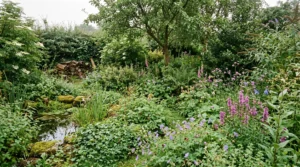
A garden does not need constant digging, spraying and tidying to remain productive and attractive. In a functioning garden ecosystem, plants, soil organisms, insects, birds and other wildlife interact in ways that naturally recycle nutrients, moderate pest populations and support plant growth.
The key is to design conditions in which these relationships can develop. A shrub shelters insects, fallen leaves feed decomposers, flowering plants provide nectar for adult predators, and ground cover protects the soil beneath them. Each element performs several functions, reducing the need for repeated human intervention.
For a busy UK homeowner, this means replacing some routine maintenance with thoughtful planting, occasional observation and targeted action. A self-regulating garden is not an abandoned garden: it still needs watering during establishment, seasonal adjustments and intervention when problems exceed acceptable limits. However, its biological systems increasingly perform work that would otherwise require regular attention.
The most reliable approach begins with understanding how these natural relationships fit together.
How self-regulating gardens work
- Layered vegetation and varied planting create habitats for predators, herbivores and decomposers, helping regulate pest populations naturally.
- Healthy, minimally disturbed soil supports nutrient cycling, while connected wildlife habitats provide shelter, food and breeding opportunities.
- Natural pest regulation develops over time. Regular observation and selective intervention work better than expecting a completely pest-free garden.
- Why Do Gardens with Multiple Plant Layers Suffer Fewer Pest Outbreaks?
- How to Design Garden Zones That Attract Beneficial Insects While Deterring Pests?
- Native-Only Gardens vs Mixed Planting: Which Creates a Stronger Ecosystem in UK Climates?
- The Monoculture Mistake That Leaves Ornamental Gardens Vulnerable to Disease
- When Should You Introduce Soil Life, Plants, and Wildlife Features in a New Garden?
- How to Create Bug Hotels, Log Piles, and Pond Edges That House Predatory Garden Wildlife?
- How to Transition from Traditional Digging to No-Dig Methods Without Yield Loss?
- How Does Maintaining Local Ecosystem Balance Reduce Garden Pest Problems Over Time?
Why Do Gardens with Multiple Plant Layers Suffer Fewer Pest Outbreaks?
Gardens with multiple vegetation layers can support more varied predator and prey communities, reducing the likelihood that a single pest population will dominate unchecked. Trees, shrubs, herbaceous plants, ground cover and living soil provide different habitats and resources. However, layered planting does not guarantee fewer outbreaks: outcomes depend on plant choices, local wildlife and growing conditions.
Consider the difference between an exposed flower bed and a border containing several vegetation levels. The exposed bed may offer abundant food for a particular herbivorous insect but relatively little shelter for its natural enemies. The layered border provides a wider range of feeding sites, hunting surfaces and overwintering locations.
Canopy foliage may support caterpillars and spiders, shrubs offer cover for birds and predatory insects, flowering perennials provide nectar, and ground vegetation shelters beetles. Beneath them, earthworms, fungi and other soil organisms process organic material.
This is more than aesthetic diversity. Each layer contributes to a connected food web, allowing predators and prey to occupy different parts of the same garden.
The RHS research findings on plant-dwelling invertebrates indicate that greater vegetation density supports more invertebrates across feeding groups, including herbivores and predators. The findings do not establish a universal percentage reduction in pest outbreaks.
Importantly, successful regulation does not mean eliminating every aphid or caterpillar. Small populations provide food for beneficial wildlife. The practical objective is to keep damage below an acceptable threshold.
For ornamental planting, a few chewed leaves may be tolerable if plant growth and flowering remain healthy. For vegetables, intervention becomes more justified when damage threatens establishment or a meaningful proportion of the harvest.
To assess an existing garden, sketch its main planting areas and record the presence of five levels: canopy, shrubs, herbaceous vegetation, ground cover and biologically active soil. Note where bare ground dominates and where one plant species occupies most of the space.
Small urban gardens need not accommodate full-sized trees. Living ground cover, a compact shrub, flowering perennials and climbers trained against a fence can provide useful vertical complexity without overcrowding.
Complete a five-step garden ecosystem audit
- Draw a simple garden map and mark existing trees, shrubs, beds and boundaries. Keep the annotated sketch.
- Identify which of the five vegetation levels are present in each area. Record the results in a layer checklist.
- Highlight exposed soil and areas dominated by one species. Mark these locations on the map.
- Observe visible predators, herbivores and signs of plant damage during a short inspection. Create a dated observation log.
- Select one missing habitat function to improve first. Record a specific planting or management change on the sketch.
Once the vegetation structure is understood, the next step is arranging its resources so beneficial insects can reach vulnerable plants.
How to Design Garden Zones That Attract Beneficial Insects While Deterring Pests?
Design a garden around three connected functions: flowering areas that feed beneficial insects, refuges that provide shelter and overwintering sites, and productive areas where vulnerable plants need protection. Keeping these functions close together helps beneficial organisms access different resources. Planting must also provide food across seasons rather than concentrating all flowers into one brief period.
A beneficial insect may need different resources during different life stages. Adult hoverflies visit flowers, while the larvae of some hoverfly species feed on aphids. Ladybirds can use both flowering vegetation and populations of suitable prey. Shelter also matters when flowers are scarce or weather conditions deteriorate.
Instead of placing a wildflower patch in an isolated corner, establish small flowering groups beside vegetable beds, roses and other susceptible plants. Position hedges, undisturbed ground and other refuges nearby without allowing vigorous plants to overwhelm crops.
There is no universally established maximum distance between a beneficial-insect zone and its target plants. As a practical design principle, distribute resources throughout the garden rather than assuming insects will move efficiently between distant areas.
Continuous flowering is more useful than a single spectacular display. Check the expected flowering months of existing plants and identify genuine gaps. In a particular UK garden, May or June may need attention; elsewhere, early spring or late autumn may be more limiting.
Early-flowering shrubs, summer herbaceous perennials and appropriately selected late-flowering plants can help maintain nectar and pollen availability. Actual flowering periods will vary with local weather, soil and aspect.
Beneficial-insect planting is not an impenetrable pest barrier. Some flowers also attract generalist herbivores, and attracting adult insects does not guarantee their larvae will suppress the species damaging nearby plants.
Observe which insects visit the flowers and whether predators appear on affected crops. When vulnerable vegetables require reliable protection, combine habitat support with targeted physical measures such as suitable insect-proof mesh.
These zones become more resilient when the plants filling them are selected for both their ecological functions and their suitability to British conditions.
Native-Only Gardens vs Mixed Planting: Which Creates a Stronger Ecosystem in UK Climates?
For many UK gardens, a predominantly native planting scheme supplemented by carefully selected non-native flowering plants offers a practical balance. Native plants can support established relationships with local insects, including specialist species, while suitable non-native flowers may extend nectar and pollen availability. Neither native-only nor mixed planting is automatically superior for every ecological function.
British native plants have an important advantage: many local herbivores, pollinators and other organisms have longstanding ecological relationships with them. Some specialist insects depend on particular host plants, so replacing those plants with visually similar ornamentals may reduce habitat value.
Mixed planting offers different opportunities. Gardeners can select suitable non-native species that flower when existing plants provide limited resources, while also considering changing temperatures, rainfall and site conditions.
Evidence from the RHS Plants for Bugs research illustrates why the distinction matters.
Less than 10% fewer
Plant-dwelling invertebrates were supported overall by the studied non-British northern hemisphere planting schemes compared with British native schemes. This measures invertebrate abundance, not pest reduction or overall ecosystem resilience.
Royal Horticultural Society, Plants for Bugs research summary.
The same research summary reports approximately 20% fewer plant-dwelling invertebrates in the studied southern hemisphere exotic planting schemes compared with British native schemes. These are comparisons between particular planting schemes, not universal rankings of individual plant species.
For pollinators, the RHS advice on native and non-native plants for pollinators recommends mixed flowering planting, with greater representation of British natives and northern hemisphere species than southern hemisphere exotics.
The two findings are complementary rather than contradictory. Native-rich foliage planting can support plant-dwelling food webs, while selected non-native flowers help maintain seasonal resources for flower-visiting insects.
Before introducing a non-native species, apply three checks:
- Escape risk: Is the species known to spread aggressively or cause environmental harm locally? Check applicable restrictions and current regional guidance.
- Wildlife value: Does the plant provide a resource used by wildlife observed in the garden, rather than merely appearing attractive?
- Ecological replacement: Would introducing it displace a native plant performing an important habitat or host-plant function?
Species such as Japanese knotweed and invasive rhododendron demonstrate why vigorous growth must not be confused with ecological suitability. Risks vary by species and by jurisdiction within the UK.
Plant selection should therefore focus on ecological roles, seasonal continuity and responsible management rather than a rigid preference for one geographical category.
However, geographical origin is only one dimension of resilience. The number of species and the way they are distributed also influence how diseases spread through ornamental planting.
The Monoculture Mistake That Leaves Ornamental Gardens Vulnerable to Disease
A large ornamental bed containing one susceptible plant species can allow a host-specific pest or pathogen to spread between neighbouring plants with few interruptions. Repeated planting of identical varieties may also concentrate shared vulnerabilities. Diversifying species and plant families can distribute risk, although it cannot prevent every disease or replace suitable growing conditions.
Uniform hedges, single-species borders and extensive lawns can be visually orderly, but their biological simplicity creates potential weaknesses. When neighbouring plants share the same susceptibility, a successful pathogen may encounter suitable hosts repeatedly.
This does not mean that every monoculture inevitably becomes diseased. Disease also depends on the presence of a pathogen, susceptible hosts and favourable environmental conditions.
Nevertheless, functional diversity reduces dependence on a single plant type. A mixed hedge, for example, can retain some screening and habitat value if one constituent species experiences a serious health problem.
In a rose border, choosing several appropriately resistant cultivars and integrating compatible companion plants may be more sensible than repeating one susceptible cultivar throughout the bed. Rose black spot illustrates why cultivar susceptibility and growing conditions matter.
Similarly, a hedge dominated by cherry laurel or privet depends heavily on the continued health and suitability of that one species. A mixed alternative using compatible shrubs distributes this dependence and can provide differing flowering, fruiting and structural characteristics.
There is no validated universal rule requiring every ornamental species to remain below a particular percentage of a border. A practical approach is to avoid making one disease-susceptible species responsible for an entire garden function.
When redesigning a planting scheme, alternate compatible species, consider different botanical families and select varieties for local conditions. Ensure each species has appropriate space, light and soil conditions rather than using diversity as a substitute for horticultural suitability.
Another risk arises when uniform planting encourages routine preventive spraying. Broad-spectrum insecticides can affect beneficial organisms alongside target pests, potentially weakening the predator communities needed for longer-term regulation.
Instead, identify the cause of visible damage before intervening and use targeted, proportionate measures when they are necessary.
Once plant selection is planned, the order in which soil, vegetation and wildlife features are established becomes the next important design decision.
When Should You Introduce Soil Life, Plants, and Wildlife Features in a New Garden?
Begin by assessing and protecting the soil, then establish suitable vegetation and introduce wildlife features as resources and conditions allow. These stages can overlap: a pond, hedge or log pile need not wait until the garden is mature. The important principle is to develop food, shelter, water and healthy growing conditions as a connected system rather than installing isolated features.
A newly cleared garden may look like an opportunity to plant everything immediately. Yet the site often contains information that is not obvious during a single visit: winter waterlogging, summer dryness, exposed corners and shaded areas that shift with the seasons.
Observing these patterns before major alterations can prevent expensive mistakes. Record where rainwater accumulates, which areas receive direct sunlight, where existing plants thrive and which parts are regularly exposed to wind.
Soil condition should guide the first interventions. Examine its texture, drainage, compaction and organic matter before purchasing plants. Earthworms and visible decomposition can provide useful clues, although they are not complete measures of soil health.
A simple spade inspection can reveal compacted layers, rooting depth and whether the soil is excessively wet. Avoid repeatedly disturbing soil solely to inspect it.
In much of the UK, autumn is suitable for establishing many hardy shrubs and trees while soil retains warmth and receives seasonal moisture. Spring offers opportunities to establish suitable perennials and annuals. Summer is particularly useful for observing heat, drought stress and insect activity.
However, soil improvement is not restricted to autumn. For no-dig beds, late-winter compost application may help avoid nutrient losses associated with prolonged winter rainfall.
The first planting phase can prioritise ground cover, hardy shrubs and plants adapted to identified conditions. Their roots and organic residues contribute to soil processes while the growing vegetation begins to provide insect habitat.
Wildlife features should be integrated where appropriate. A pond benefits from nearby vegetation and safe access for animals, while insect nesting structures need suitable food resources within the surrounding landscape.
An insect hotel installed in an otherwise bare garden may receive limited use, but its occupancy depends on local species, nesting requirements and surrounding habitat. It should not be assumed that shelters invariably remain empty until the garden reaches a particular age.
For major redesigns, observing the site through more than one season can be valuable. Small, reversible improvements can begin sooner, while expensive structural work is postponed until the site is better understood.
With plants and soil providing the foundations, small habitat features can make the garden more accessible to the wildlife that participates in natural regulation.
How to Create Bug Hotels, Log Piles, and Pond Edges That House Predatory Garden Wildlife?
Build wildlife habitats around the needs of specific organisms rather than treating every shelter as interchangeable. Solitary bees may use appropriately sized nesting cavities, ground-dwelling beetles can shelter beneath undisturbed debris, and amphibians benefit from accessible ponds with vegetated margins. These features work best when connected to suitable food, water and protective cover.
An insect hotel is not a universal home for beneficial insects. Different organisms require different nesting or sheltering environments, and some popular hotel compartments have uncertain value for their intended occupants.
Use the following distinctions when choosing habitat features.
| Habitat feature | Potential occupants | Important design considerations |
|---|---|---|
| Dry hollow stems or drilled nesting blocks | Cavity-nesting solitary bees | Smooth, suitable nesting cavities; protection from persistent rain; maintenance where needed |
| Undisturbed log and leaf piles | Ground beetles, woodlice and other invertebrates | Untreated wood, varied crevices, ground contact and nearby vegetation |
| Dense vegetation and sheltered gaps | Spiders, lacewings and other small invertebrates | Cover from disturbance and suitable feeding habitat |
| Gently sloping pond margins | Frogs, newts and aquatic invertebrates | Safe access, marginal vegetation, varying depths and escape routes |
For solitary bees, smooth cavities of suitable dimensions are more relevant than the number of decorative compartments. Appropriate cavity sizes vary between species; no single diameter suits every bee.
Purpose-built nesting tubes should remain dry, avoid sharp internal edges and be managed to reduce deterioration and potential parasite accumulation. Mud-sealed entrances can indicate nesting activity, although they do not prove that offspring have emerged successfully.
Ground beetles and other decomposer-associated organisms may benefit more from an undisturbed pile of untreated logs and leaves than from a manufactured hotel. Place such material somewhere sheltered, with enough contact with the ground to retain varied moisture conditions.
A wildlife pond adds another dimension. The RHS guidance on wildlife habitats in gardens recommends gently sloping pond access and surrounding vegetation to support amphibians and other wildlife.
Marginal plants, partly submerged stones and irregular edges create transitions between aquatic and terrestrial habitat. These areas offer cover and access, but available evidence does not establish that pond edges always suppress garden pests more effectively than the pond interior.
Avoid steep-sided ponds without exit routes, chemically treated timber and poorly maintained nesting structures. Provide secure pond access, avoid introducing fish where amphibian breeding is a priority, and consider the safety of children and pets.
After a growing season, observe whether nesting tubes have been sealed, whether the pond attracts aquatic wildlife and whether sheltered areas show signs of occupation. Avoid dismantling active habitats merely to check them.
These habitats also depend on the soil beneath the garden, making reduced soil disturbance an important part of the wider design.
How to Transition from Traditional Digging to No-Dig Methods Without Yield Loss?
Move towards no-dig gardening gradually by covering exposed soil with suitable organic mulch, minimising unnecessary disturbance and maintaining growing conditions appropriate for each crop. Existing beds can be converted without rebuilding the entire garden. However, no-dig methods cannot guarantee unchanged yields in every transition year, particularly where drainage, compaction or compost quality remain problematic.
Traditional digging can break up compacted ground temporarily, but repeated disturbance also disrupts natural soil structure, earthworm channels and fungal networks.
No-dig management allows these structures to develop with less mechanical interference. Organic material placed at the surface is gradually incorporated through biological activity, helping support soil organisms and improve conditions for roots.
The method is straightforward, but the amount of mulch matters.
According to the RHS no-dig gardening advice, new beds established over grass or weeds can use two overlapping cardboard layers covered with 10–15 cm of organic mulch. Established beds generally need no cardboard unless weed pressure is substantial, and an annual organic mulch of approximately 5 cm is recommended.
These measurements serve different purposes: initial establishment and ongoing maintenance. They should not be treated as interchangeable application rates.
Late winter, particularly February or early March when the ground is not waterlogged, can be suitable for preparing new beds. Well-decomposed mulch of sufficient depth can allow planting without a prolonged waiting period.
Heavy clay and compacted soils require additional judgement. Where compaction limits rooting or drainage, gently inserting and rocking a garden fork can loosen the soil without turning it over. Raised beds may also help where waterlogging is persistent.
Deep-rooted cover crops may contribute organic matter and rooting channels, but they should not be assumed to resolve severe compaction by themselves.
To manage the risk of disappointing harvests, convert one bed first while maintaining productive planting elsewhere. Compare crop establishment, soil moisture, weed pressure and harvest results across growing seasons, while recognising that weather and crop differences can influence the comparison.
Home-produced compost can help supply annual organic matter, although quantity and maturity need to be suitable for the intended application.
No-dig changes the maintenance routine rather than eliminating it. It reduces the need for routine soil turning, but surface weeds still need early removal, mulch requires replenishment, and paths should prevent repeated foot traffic across growing beds.
The resulting soil protection complements wildlife habitat and diverse planting, bringing the garden closer to a system in which biological processes share more of the maintenance work.
Key takeaways before putting the whole system together
- Prioritise connected habitat functions over isolated additions: flowers, foliage, shelter, water and living soil reinforce one another.
- Measure success through plant health, acceptable damage and repeated wildlife observations rather than expecting every pest to disappear.
- Make changes gradually so the garden can develop stable ecological relationships without sacrificing essential practical functions.
How Does Maintaining Local Ecosystem Balance Reduce Garden Pest Problems Over Time?
Maintaining local ecosystem balance can reduce the need for repeated pest control by supporting predators, suitable plant communities and healthy soil. Natural regulation works by limiting pest populations and their damage, not by eliminating every herbivorous insect. Its effectiveness varies by species, season and garden conditions, and serious outbreaks may still require targeted intervention.
A garden food web depends on the continued presence of both consumers and their food sources. Aphids can support ladybird larvae and certain hoverfly larvae, caterpillars provide food for birds, and decomposers process fallen organic matter.
Removing every potential pest immediately may also remove resources required by natural enemies. Conversely, ignoring severe damage can jeopardise vulnerable plants. The objective is a tolerable balance, not complete non-intervention.
This balance may develop unevenly. Beneficial insects need suitable habitat, food and opportunities to reproduce, while pest populations can respond quickly to favourable weather or abundant host plants.
The first seasons of ecological gardening may therefore include damaging outbreaks even when habitat improvements are underway. There is no universal timetable for predator populations to establish or a reliable percentage by which pest problems must decline.
Tracking observations gives a more meaningful picture than expecting immediate results. During each growing season, record visible predators, the plants affected, approximate damage severity and whether intervention was required.
An observation sheet might distinguish minor leaf damage from substantial defoliation, seedling loss or unacceptable harvest damage. The same categories can then be used during subsequent inspections.
Over time, compare whether vulnerable plants remain productive, whether natural enemies appear regularly and whether treatment frequency changes. These indicators help assess progress without attributing every improvement to a single gardening technique.
The most disruptive interventions are often those that remove several ecological functions simultaneously. Broad-spectrum insecticides may kill beneficial organisms, severe hedge cutting during the nesting season can disturb breeding birds, and complete autumn clearance removes valuable overwintering habitat.
Selective management offers an alternative: inspect plants before treatment, prune with seasonal wildlife needs in mind and retain some undisturbed leaf litter or stems where conditions allow. UK nesting-bird protections should also be respected when carrying out vegetation work.
Ultimately, the garden’s different components form one connected system. Layered plants provide structure, diverse planting distributes biological risk, flowering zones feed insects, wildlife features provide shelter, and minimally disturbed soil supports decomposition and root growth.
None of these measures guarantees freedom from pests. Together, however, they create more opportunities for the garden to regulate biological pressures with less frequent corrective work.
Choose one manageable improvement this season, record the garden’s condition and observe how it responds before making another major change. A self-regulating garden develops through informed observation and consistent, proportionate care rather than through an attempt to control every natural process.
Can a self-regulating garden still look tidy and attractive?
Yes. A self-regulating garden can combine defined paths, managed borders and carefully selected plants with less disturbed habitat areas. Dense ground cover, mixed shrubs and seasonal flowering can maintain an intentional appearance while offering ecological functions. Wildlife-friendly management does not require allowing every plant to spread without control.
Does a wildlife-friendly garden require a large pond or mature trees?
No. Small gardens can support wildlife through compact shrubs, climbing plants, flowering containers, patches of ground cover and sheltered areas. A small wildlife pond or suitable container pond may also provide habitat when safe access and appropriate conditions are available. The best choices depend on the space and local wildlife.
Should fallen leaves be removed from an ecological garden?
Not everywhere. Fallen leaves can protect soil and provide habitat for decomposers and overwintering invertebrates. They may be retained beneath shrubs or in suitable borders, while leaves are cleared from paths, drains, vulnerable lawns and other areas where accumulation causes practical problems. Diseased material may require separate management depending on the pathogen.
What should be done when natural predators fail to control an infestation?
Identify the pest and assess the seriousness of the damage before intervening. Physical removal, suitable barriers, improved growing conditions or other targeted management may be appropriate. Natural regulation does not justify allowing severe damage to continue indefinitely, but broad-spectrum treatments should not automatically be the first response.
Can a self-regulating garden be created without replacing every existing plant?
Yes. Improving existing soil cover, diversifying a border, allowing selected areas to remain less disturbed and introducing seasonal flowering resources can all be achieved incrementally. Retaining healthy established plants also preserves existing habitat and avoids unnecessary disruption. Replacement is most useful where plants are unsuitable, persistently unhealthy or providing very limited ecological function.