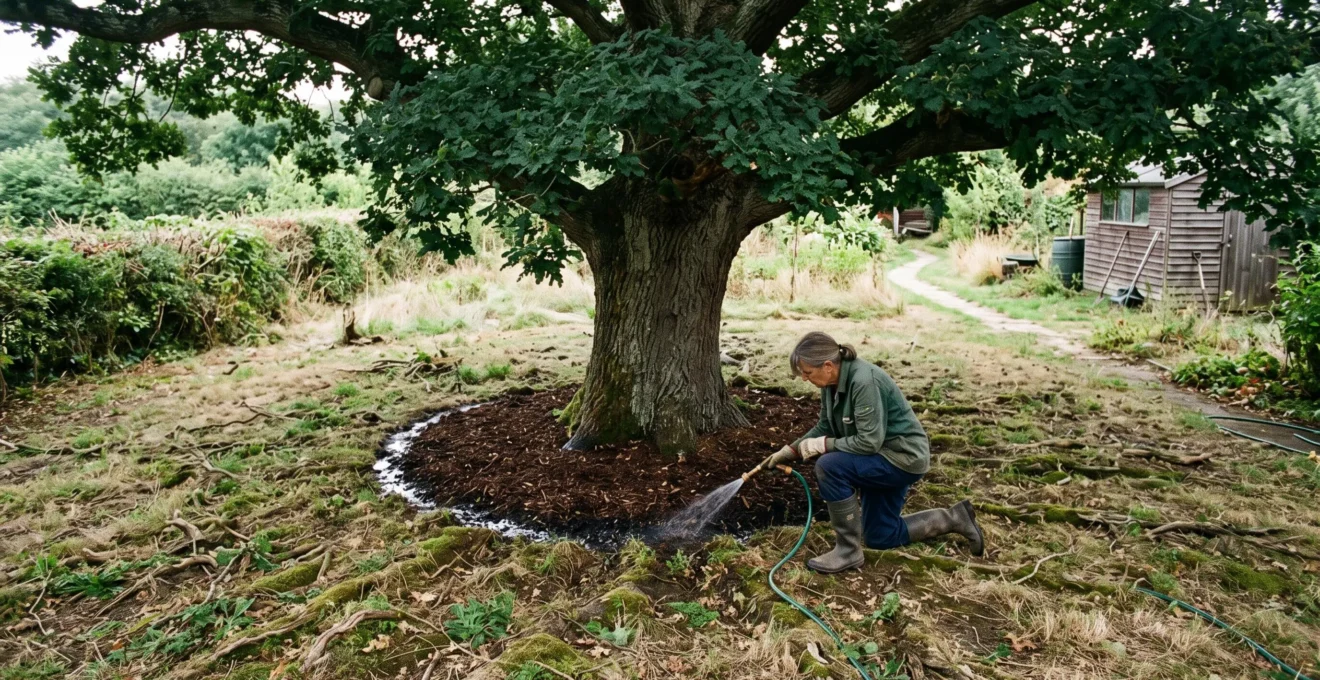
A plant can receive appropriate light, regular watering and carefully measured fertiliser yet remain frustratingly small. Its leaves may look reasonably healthy, but new shoots stay short, flowers are sparse and fruit production disappoints. Often, the missing explanation lies beneath the soil surface.
Root-zone restrictions can prevent plants from absorbing enough water, oxygen and nutrients even when those resources appear plentiful. Compacted ground, limited container volume, neighbouring roots and poorly drained soil can all restrict the underground system that supports visible growth. Feeding more or watering more frequently may achieve little if roots cannot expand or function properly.
For UK gardeners, changing conditions across a single border make these problems particularly difficult to recognise. A shrub growing beside a compacted path may struggle while an identical specimen in open soil thrives. Understanding the usable space beneath each plant provides a more reliable starting point than judging its health from the foliage alone.
Why root zones determine plant growth
- Root space matters: roots frequently extend beyond the visible canopy, so watering and soil improvement must account for their actual spread.
- Soil conditions control uptake: compaction, insufficient oxygen and restricted drainage can prevent roots from using available moisture and nutrients.
- Diagnose before feeding: examine soil structure, rooting volume, competition and moisture before adding fertiliser or changing irrigation.
- Why Do Tree Roots Extend Far Wider Than the Canopy You See Above Ground?
- How Much Soil Volume Do Tomatoes, Shrubs, and Trees Actually Need in Containers?
- Deep-Rooted vs Shallow-Rooted Plants: Which Suit Compacted Clay or Thin Soil Over Bedrock?
- The Spacing Mistake That Creates Root Competition and Stunts Every Plant in the Border
- When Do Plant Root Zones Grow Most Actively — and How Should That Guide Planting and Feeding Timing?
- Why Waterlogged-Looking Plants in Clay Soil Suffer from Oxygen Starvation, Not Overwatering
- Should You Add More Nutrients or Improve Soil Biology to Increase Nutrient Availability?
- What Does Your Soil Composition Reveal About Why Some Plants Thrive and Others Fail?
Why Do Tree Roots Extend Far Wider Than the Canopy You See Above Ground?
Tree roots commonly extend beyond the outer edge of the canopy because their role is to explore soil for water, oxygen and nutrients rather than simply support the trunk. The visible branches therefore provide an incomplete guide to the root zone. Watering only beside the trunk can leave substantial areas of actively absorbing roots without sufficient moisture.
Most fine feeder roots occupy relatively shallow soil. The University of Minnesota Extension’s guidance on watering established trees and shrubs identifies the upper 12–18 inches (approximately 30–46 cm) as an important zone for water-absorbing roots. These roots can spread laterally beyond the crown, particularly where suitable soil remains accessible.
The familiar suggestion that roots spread three times wider than the canopy is not a biological rule. The institution describes established shrub root systems as approximately 1.5–3.5 times the above-ground width, but that estimate cannot be applied universally to trees. Species, age, soil compaction, available oxygen, underground structures and moisture distribution all influence the final extent.
30–46 cm
Approximate depth of the upper soil layer containing many water-absorbing feeder roots in established trees and shrubs. This does not represent the maximum depth of the root system.
University of Minnesota Extension, Watering established trees and shrubs.
To explore your own tree’s potential rooting territory without digging a trench, examine the soil progressively from the trunk towards and beyond the drip line. A hand soil auger can reveal differences in texture, moisture and compaction. Surface roots exposed after rain provide further clues, although neither observation maps the entire root system or proves where most absorption occurs.
This wider territory matters when the surrounding lawn is mown repeatedly, walked across or allowed to dry out. Grass also competes for soil resources. Consequently, a tree may receive generous care within a narrow mulched circle while its wider rooting environment remains compacted or short of moisture.
The same hidden spread introduces another risk. Herbicide movement, fertiliser misapplication or excessive fertiliser salts in neighbouring ground may affect roots belonging to the tree. Subsequent canopy symptoms can be difficult to associate with an earlier treatment. Such exposure is a possible explanation, however, not proof of the cause of an individual tree’s decline.
Once the likely root territory has been recognised, the next question is whether the soil provides enough usable volume. That restriction becomes especially obvious in containers, where roots eventually encounter an unavoidable physical boundary.
How Much Soil Volume Do Tomatoes, Shrubs, and Trees Actually Need in Containers?
Container plants need sufficient growing-medium volume to support root expansion, store water and maintain suitable moisture and oxygen conditions. Tomatoes and other productive annuals may tolerate relatively small pots with intensive watering, but larger containers generally provide greater stability. Perennial shrubs and trees require longer-term room for growth, making mature size and intended planting duration essential considerations.
A container acts as both a water reservoir and a physical rooting boundary. Daily watering may keep a plant alive in a restricted pot, but it does not necessarily restore the growth potential of a root system that has run out of space. Limited rooting volume also reduces the margin for error during hot, windy weather.
The University of Maryland Extension’s container vegetable gardening resource gives minimum recommended volumes of 5 US gallons (approximately 19 litres) for standard tomatoes and 2 US gallons (approximately 7.6 litres) for cherry tomatoes. These are practical recommendations, not universal biological thresholds. Compact cultivars may perform adequately in smaller containers, while vigorous varieties can benefit from substantially more space.
For ornamental shrubs and trees, the appropriate volume depends on their root architecture, expected mature size and the period they will remain in the container. A shrub kept temporarily before planting out has different requirements from a small tree intended to grow in a patio planter for years.
| Plant category | Main consideration | Practical container strategy |
|---|---|---|
| Compact annual vegetables | Seasonal water storage and root development | Choose a crop-appropriate minimum and increase volume where watering is less frequent. |
| Vigorous tomatoes | Continuous root expansion during flowering and fruiting | Allow additional volume beyond the minimum where practical. |
| Perennial shrubs | Several growing seasons of root development | Match the container to expected growth and reassess regularly. |
| Container-grown trees | Long-term root architecture and water demand | Plan for repeated assessment, potential repotting and eventual size limitations. |
Volume alone does not guarantee healthy roots. Excess water can remain in the lower growing medium, particularly where drainage is inadequate, leaving part of the root ball poorly aerated. Container walls also experience temperature fluctuations, while roots that reach a rigid boundary may begin circling instead of extending naturally.
A mid-season root inspection can reveal problems before foliage deteriorates. When the plant and container allow safe removal, gently slide out the root ball and examine its sides and base. Healthy-looking roots at the perimeter are not, by themselves, evidence that the volume is adequate. A dense root mat, pronounced circling or roots obstructing drainage openings provide stronger reasons to investigate restriction and consider repotting.
Potting up before severe congestion develops may be more effective than waiting for visible stunting. Use an appropriately draining growing medium and avoid a sudden move into a disproportionately large, persistently wet container.
The same relationship between root expansion and accessible soil determines which plants succeed in difficult garden ground, where compacted layers and shallow bedrock create less obvious boundaries.
Deep-Rooted vs Shallow-Rooted Plants: Which Suit Compacted Clay or Thin Soil Over Bedrock?
Plants suited to compacted clay are not necessarily the same as those suited to shallow soil over rock. Dense, poorly aerated clay can restrict oxygen and drainage, while shallow rocky ground primarily limits rooting depth and stored moisture. Selecting plants according to their tolerance of the actual restriction is more reliable than assuming deep-rooted species will penetrate any obstacle.
A plant described as deep-rooted may develop extensive roots under favourable conditions, but that potential does not mean its roots can force their way through genuinely impenetrable subsoil or solid bedrock. Root architecture responds to the available soil profile. Some plants redirect growth sideways when downward penetration becomes difficult.
The useful distinction is therefore between potential rooting depth and adaptability to restricted soil. A plant capable of spreading laterally may establish successfully in a shallow profile provided sufficient moisture remains available. By contrast, a species dependent on a deeper, well-aerated soil reservoir may struggle despite excellent surface care.
A small test pit in a representative part of the intended planting area can reveal the underlying problem. Observe how easily the soil breaks apart, where its colour or density changes abruptly and whether water accumulates at the bottom. Take care around buried services and avoid damaging established roots.
Soil improvement also requires care. Digging an isolated planting hole into poorly draining clay and filling it with loose compost-rich material can create a localised area where water collects. Abrupt differences between backfill and surrounding soil may also influence how readily new roots extend beyond the planting hole.
Improving structure across a wider planting area, reducing compaction and addressing surface drainage are generally more useful objectives than creating one exceptionally soft pocket. Established-tree roots require particular protection, so widespread cultivation is not appropriate everywhere.
| Soil limitation | Characteristics to favour | Conditions to manage |
|---|---|---|
| Shallow soil over rock | Lateral root development and drought tolerance | Limited water storage and rapid drying |
| Dense, seasonally wet clay | Tolerance of reduced aeration and temporary saturation | Drainage, compaction and winter wetness |
| Compacted layer beneath topsoil | Ability to exploit available upper soil | Restricted penetration and surface water accumulation |
| Well-structured, deep soil | Species matched to moisture and fertility preferences | Normal establishment and long-term root competition |
These characteristics should guide species selection rather than serve as guarantees. The same clay soil can behave differently depending on slope, drainage and the season.
Even where the soil profile is suitable, roots still need territory. Crowded borders can create another restriction through competition rather than physical obstruction.
The Spacing Mistake That Creates Root Competition and Stunts Every Plant in the Border
Plants can compete intensely below ground long before their leaves or branches touch. Neighbouring root systems explore overlapping soil, drawing on the same stores of moisture and available nutrients. Where resources are limited, established or faster-growing plants may capture a disproportionate share, leaving smaller neighbours unable to develop the roots needed for vigorous growth.
Traditional planting distances often emphasise mature canopy width and visual appearance. Yet a neat gap between two shrubs does not guarantee independent rooting territory. Root overlap is normal in planted communities; the problem arises when that overlap creates competition for resources the soil cannot replenish quickly enough.
Competition is also asymmetric rather than necessarily equal. An established shrub already occupies a substantial soil volume, while a newly planted perennial initially depends on the limited roots inside its original pot or root ball. Both may share the border, but the newcomer can experience much greater stress.
Guidance from University of Minnesota Extension on newly planted woody plants identifies turf as a competitor for water, nutrients and rooting space. This helps explain why removing competing vegetation and maintaining a suitable mulched area can improve establishment.
When designing a mixed border, consider the likely root spread at maturity rather than only the immediate planting gaps. Pairings with different seasonal moisture demands or rooting patterns may reduce direct competition, although their root systems will still interact.
Five practical checks before planting a crowded border
- Sketch the existing plants: produce a simple border plan showing stems, mature canopy estimates and major permanent features.
- Mark potential rooting territory: add approximate underground spread zones, clearly labelled as estimates rather than measured boundaries.
- Check soil moisture: record whether the intended planting position is noticeably drier than comparable open ground at root depth.
- Identify dominant neighbours: note established shrubs, trees and dense turf likely to compete with a new planting.
- Decide on a correction: record whether to enlarge the available space, remove competition, change species or provide establishment watering.
In an overcrowded border, selective removal or relocation often offers a more durable solution than feeding every struggling plant. Targeted watering may help during establishment, but it cannot permanently eliminate competition for limited rooting volume.
Root pruning and physical root barriers are possible specialist interventions in selected situations. Both can damage important roots or redirect growth in undesirable ways, so they should not be treated as routine remedies near established trees or valuable woody plants.
Once adequate rooting territory is available, establishment also depends on timing. Roots and shoots do not necessarily grow fastest during the same parts of the year.
When Do Plant Root Zones Grow Most Actively — and How Should That Guide Planting and Feeding Timing?
In many temperate plants, root growth is particularly favourable during periods when soil is moist, adequately aerated and within a suitable temperature range. Spring and autumn can provide these conditions in UK gardens, although two distinct growth peaks are not universal. Planting during favourable rooting conditions helps new plants establish before heavy demands from foliage, flowers and fruit.
Root and shoot development respond differently to seasonal conditions. Above-ground growth depends strongly on light, temperature and developmental stage. Root extension additionally depends on soil temperature, available carbohydrates, moisture and oxygen.
This means a plant displaying rapid new shoot growth may not be expanding its roots equally quickly. Conversely, a woody plant can continue some root development after visible shoot growth has slowed, provided the soil remains suitable and the plant has sufficient stored resources.
For many hardy deciduous trees and shrubs, autumn planting can take advantage of moist soil and reduced atmospheric water demand. Spring planting can also work well, particularly where winter waterlogging makes autumn establishment difficult. The appropriate choice depends on the species, drainage and local conditions.
Summer planting is possible, but warm soil and high evaporative demand increase the importance of irrigation and monitoring. Identical plants receiving similar above-ground care may establish at different rates simply because their rooting environments differ after planting.
The University of Minnesota Extension’s guidance on watering newly planted trees and shrubs emphasises consistent watering until roots establish and recommends expanding the watering area as the root system grows. Establishment estimates given for Minnesota should not be transferred directly to UK gardens.
Feeding should likewise reflect active uptake rather than the appearance of the foliage alone. Fertiliser applied when roots are inactive, soils are saturated or moisture is insufficient may provide little immediate benefit and can increase nutrient losses.
Late applications of readily available nitrogen can encourage soft growth in some plants when hardening for winter is preferable. However, fertiliser timing must also reflect species, nutrient requirements and growing conditions; there is no single calendar rule for every garden plant.
Soil temperature can shift the effective rooting season. Organic mulch moderates temperature changes and reduces evaporation, but a thick layer applied to cold spring soil may slow warming. Mulch depth therefore needs to account for plant needs and drainage.
Seasonal timing improves the opportunity for roots to develop, but it cannot overcome persistently unsuitable soil. Where clay remains saturated, the fundamental limitation may be oxygen rather than the amount of water supplied.
Why Waterlogged-Looking Plants in Clay Soil Suffer from Oxygen Starvation, Not Overwatering
Plants growing in saturated clay can wilt because their roots lack oxygen, not because their leaves are receiving too much water. Water fills soil pore spaces that would otherwise contain air, restricting root respiration and the energy-dependent processes needed for absorption. Consequently, a plant may display drought-like symptoms while surrounded by wet soil.
Roots require oxygen to support cellular respiration and maintain normal metabolic activity. In well-structured soil, pores accommodate both water and air. When prolonged saturation displaces oxygen, root function can deteriorate and sensitive tissues may become damaged.
Clay is not inherently unsuitable for plants. Well-structured clay can retain useful moisture and nutrients. Problems become more likely when compaction, poor drainage or an impermeable underlying layer prevents excess water from moving away.
The diagnosis becomes especially confusing when a plant wilts after heavy rain. A gardener may interpret drooping leaves as thirst and provide additional irrigation, prolonging saturation. The correct response depends on what is happening at root depth rather than on leaf appearance alone.
Useful diagnostic observations include:
- Moisture at root depth: check beneath the dry-looking surface before deciding that more water is required.
- Soil odour: persistent sour or sulphurous smells can suggest anaerobic conditions, although their absence does not exclude poor aeration.
- Root condition: dark, soft or deteriorating roots may indicate damage, while pale, firm growing roots are generally more reassuring.
- Timing: symptoms that repeatedly worsen after prolonged rainfall point towards a drainage-related problem.
Simply reducing irrigation may help where artificial watering caused the saturation. It is insufficient, however, when water accumulates because of soil structure, runoff or seasonal groundwater conditions.
Longer-term remedies may involve improving surface drainage, avoiding cultivation while clay is wet, maintaining organic matter and using raised planting where appropriate. Broad improvement of accessible rooting conditions is preferable to creating isolated planting pockets that collect water.
Root injury can also produce delayed symptoms. A plant weakened during a prolonged wet period may appear to recover, only to struggle when subsequent dry weather increases demand on its reduced root system. This sequence is a plausible diagnostic explanation rather than proof that a later summer collapse was caused by earlier winter saturation.
Restoring aeration protects existing roots and creates better conditions for new growth. It may also improve biological processes responsible for releasing nutrients, which raises another question: whether a struggling plant actually needs more fertiliser.
Should You Add More Nutrients or Improve Soil Biology to Increase Nutrient Availability?
Improving soil conditions is often more useful than adding fertiliser when a plant’s roots are restricted, poorly aerated or unable to explore enough soil. Nutrient deficiency and nutrient inaccessibility are different problems. Fertiliser can correct a confirmed shortage, but extra nutrients may achieve little if soil pH, compaction, waterlogging or weak root development prevents effective uptake.
Garden soils contain nutrients in several forms. Some are dissolved in soil water and accessible to roots, while others are retained on clay and organic particles or incorporated into compounds that release nutrients only under particular conditions.
Soil pH affects these chemical relationships. For example, phosphorus availability can decline in acidic conditions when it reacts with iron and aluminium, or in alkaline conditions when it reacts with calcium.
The University of Maryland Extension’s explanation of soil test reports outlines how pH, organic matter and measured nutrient levels inform fertiliser decisions. It specifically cautions that adding nutrients already present at optimal or excessive levels will not improve growth.
Soil biology adds another dimension. Decomposition and microbial nutrient cycling help release plant nutrients from organic materials. Mycorrhizal associations can improve nutrient acquisition for many compatible plant species, although their effects vary with soil conditions, existing nutrient supply and plant identity.
Adding well-managed organic matter, maintaining soil cover and minimising unnecessary disturbance can support soil structure and biological activity. These practices are not automatic replacements for fertiliser where a genuine nutrient deficiency has been identified.
A useful decision process combines soil testing with physical observations:
- Check whether the soil has adequate moisture and aeration.
- Investigate compaction and rooting-space restrictions.
- Test soil pH and relevant nutrient levels.
- Match the results to the requirements of the affected plant.
- Apply targeted fertiliser only where the evidence supports it, while improving chronic soil limitations separately.
Repeated fertilisation without diagnosis can also increase soluble salt concentrations, particularly in containers. Excess salts may make water uptake more difficult and place additional stress on already restricted roots.
There is a reinforcing relationship between root health and soil function. Healthy roots contribute organic compounds and residues to the surrounding soil, while well-functioning soil communities participate in nutrient cycling. Compaction, prolonged saturation and poor plant growth can disrupt parts of that relationship.
The aim is not to choose soil biology over nutrition in every situation. It is to distinguish missing nutrients from nutrients that roots cannot effectively access.
Because texture, structure and organic matter influence all these processes, understanding the soil itself brings the separate causes of stunting into a practical diagnostic framework.
Key takeaways before assessing your soil
- Two plants receiving identical care may experience different underground conditions only a short distance apart.
- Testing moisture, drainage, rooting depth and pH helps distinguish physical restrictions from nutrient shortages.
- Effective treatment starts by classifying the soil limitation, then selecting the appropriate improvement or plant.
What Does Your Soil Composition Reveal About Why Some Plants Thrive and Others Fail?
Soil composition helps explain why plants receiving similar care can grow very differently. Sand, silt, clay, organic matter and soil structure collectively influence water storage, drainage, aeration and nutrient retention. A soil that provides adequate moisture and oxygen allows roots to function effectively, while a restricted or poorly structured soil can suppress growth despite otherwise suitable conditions.
Texture describes the relative proportions of sand, silt and clay. Structure describes how soil particles are arranged into aggregates and pores. These characteristics interact, but they are not interchangeable: a clay soil with stable structure can drain and support roots more effectively than the same material after severe compaction.
Organic matter contributes to aggregation, nutrient retention and moisture regulation. However, its benefits depend on existing soil conditions and how amendments are managed. Adding organic matter does not automatically repair severe compaction or eliminate a persistent drainage problem.
Several simple garden observations can help build a useful soil profile without requiring a laboratory for every measurement.
- Jar sedimentation test: mix a soil sample with water, allow particles to settle and observe the approximate sediment layers. This provides a rough texture indication, not a definitive laboratory classification.
- Ribbon test: moisten a sample and gently press it between your fingers. The way it holds together and forms a ribbon gives clues about clay content.
- Drainage or percolation observation: examine how water moves through a test hole, accounting for recent rainfall and initial soil moisture. A simple garden test cannot independently establish the cause of poor drainage.
- Soil pH test: use a suitable test kit or laboratory analysis to identify whether acidity or alkalinity may affect plant nutrient availability.
The value comes from interpreting results together. A sticky clay soil that holds water after rainfall suggests a different root-zone challenge from a freely draining sandy soil that dries rapidly. A shallow stony layer presents another combination of constraints even if its surface texture looks favourable.
| Soil profile | Likely root-zone challenge | Priority response |
|---|---|---|
| Drought-prone sandy soil | Limited moisture retention | Improve moisture management and choose plants tolerant of periodic dryness. |
| Dense, poorly drained clay | Low aeration and restricted root extension | Address drainage and compaction without working wet soil. |
| Shallow, stony soil | Restricted rooting depth and water storage | Choose suitable lateral-rooting plants or provide an appropriate raised growing area. |
| Well-structured loam | Usually fewer physical restrictions, though competition remains possible | Preserve structure, maintain organic matter and monitor moisture. |
A garden rarely consists of one perfectly uniform soil profile. Previous construction work, buried rubble, paths, topsoil movement and local changes in subsoil can produce substantial differences within a few metres. Consequently, a thriving plant beside a struggling one does not necessarily indicate different watering habits, disease or fertiliser requirements.
As a hypothetical example, consider two identical shrubs planted in the same border. One occupies loose, well-drained soil; the other sits above a compacted layer where water accumulates during winter. Both receive identical irrigation and feeding, yet the second may establish more slowly because its roots encounter less favourable conditions. This illustrates a possible mechanism, not a documented field experiment.
The most useful diagnosis therefore combines a soil profile with direct observations of the affected plant. Determine whether the primary limitation is rooting volume, drainage, aeration, competition or fertility before selecting a remedy. More than one limitation may be present.
Start with the weakest plant in your garden. Examine its soil moisture, investigate the accessible rooting area and compare the findings with a healthier neighbour. Record the differences before changing the watering or fertiliser routine. That simple comparison can reveal whether the solution lies above ground or in the hidden environment supporting every new leaf.
Can a root-bound plant recover after repotting?
Yes, many plants can resume healthier growth after moving into an appropriately sized container with suitable growing medium. Recovery depends on species, root condition and the severity of previous damage. Severely deformed woody roots may not correct themselves simply because additional space becomes available.
How can you tell whether compacted soil is restricting root growth?
Look for persistently hard soil, shallow or deflected roots, poor infiltration and differences between compacted areas and nearby undisturbed ground. Test-pit observations can reveal abrupt changes in density. A professional soil assessment may be needed when compaction occurs at depth or other restrictions produce similar symptoms.
Does adding compost always improve a struggling root zone?
No. Appropriate organic matter can improve soil structure and nutrient cycling over time, but compost cannot automatically resolve poor drainage, buried barriers or insufficient rooting depth. Excessive amendment in an isolated planting hole may also create unfavourable differences between the hole and surrounding soil.
Should you remove grass from around newly planted trees?
Reducing nearby turf competition can help young trees establish because grass roots use moisture, nutrients and soil space. A suitably sized mulched area also reduces direct competition and evaporation. Keep mulch away from the trunk and root flare, and avoid overly deep layers, especially on poorly drained soils.
Can damaged roots cause stunted growth even after soil conditions improve?
Yes. A plant may require time to replace roots lost through saturation, physical injury or prolonged stress. Improvements to drainage or compaction remove some causes of continuing damage, but recovery depends on remaining root health, species and growing conditions. Persistent symptoms may also warrant investigation for pests, disease or other environmental problems.