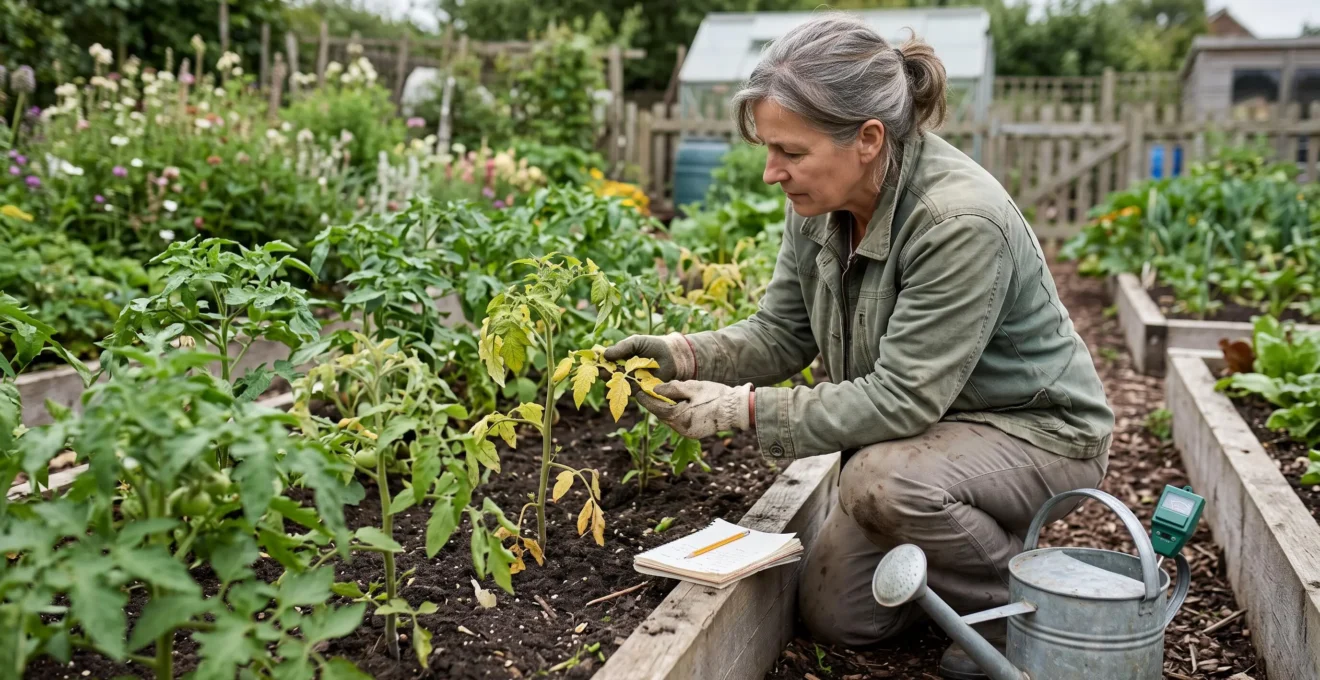
A tomato plant can appear healthy on Monday and develop yellowing leaves by the following weekend. Yet the underlying problem may have started earlier, when root activity slowed, growth faltered or the soil remained wetter than the plant could tolerate.
Identifying plant stress before serious damage means learning to recognise changes in growth rate, leaf colour, moisture conditions and pest activity. These signals can sometimes provide one or two weeks of useful warning, although the interval is not guaranteed. A container plant exposed to intense heat may deteriorate within hours, while nutrient-related problems can develop gradually over several weeks.
The key is to compare each plant with its normal condition rather than diagnose a problem from one symptom. Wilting, for example, can indicate either drought or damaged roots. Yellowing may reflect nutrient shortage, poor drainage or natural ageing.
For UK gardeners, a short weekly inspection combined with faster checks during high-risk weather offers a practical way to identify problems while effective interventions remain available.
Early plant stress: the essential warning signs
- Check soil moisture and root condition before watering a wilting plant. Wet soil and drooping leaves can indicate oxygen-starved or damaged roots.
- Measure growth and inspect leaf patterns weekly. Changes against a plant’s normal baseline may reveal developing stress before severe damage.
- Adjust inspection frequency to the season. Heat, frost, prolonged rainfall and rapidly increasing pest populations can require action sooner than the next weekly check.
- How to Tell If Wilting Is from Drought, Overwatering, or Root Disease?
- Why Should You Measure Weekly Growth to Catch Stress Before Symptoms Appear?
- Should You Focus on Fixing Plant Stress After It Occurs or Preventing It Beforehand?
- The Delay That Turns Fixable Plant Stress Into Permanent Growth Loss or Death
- When Are Plants Most Vulnerable to Stress During the UK Growing Year?
- Why Do Leaf Colour and Pattern Changes Signal Nutrient Problems 2-3 Weeks Before Growth Stops?
- How to Spot the First Aphid Scouts That Signal Intervention Needed Within Days?
- How Does Weekly Crop Monitoring Prevent 80% of Harvest Losses Before Damage Becomes Severe?
How to Tell If Wilting Is from Drought, Overwatering, or Root Disease?
To distinguish drought from overwatering or root disease, check soil moisture several centimetres below the surface, examine leaf condition and observe whether wilting persists overnight. Dry soil with limp or crisp foliage suggests insufficient water. Wet soil with yellowing, drooping leaves suggests impaired root function. If uncertainty remains, carefully inspect the roots before changing your watering routine.
Wilting happens when leaves cannot maintain sufficient internal water pressure. However, the underlying cause is not always a shortage of water in the soil. Roots deprived of oxygen by saturated conditions may fail to absorb moisture even when surrounded by it.
The RHS advice on diagnosing unhealthy houseplants recommends checking moisture beneath the growing-medium surface rather than assuming that every wilted plant needs watering.
Use three observations together to narrow the diagnosis:
| Diagnostic check | Drought stress | Overwatering or root damage |
|---|---|---|
| Soil moisture | Dry around the active root zone | Persistently wet, saturated or poorly drained |
| Leaf condition | Limp foliage, sometimes with dry or crisp edges | Drooping foliage, often accompanied by yellowing or leaf drop |
| Time of wilting | May worsen in daytime heat and improve when water demand falls | May persist overnight despite adequate soil moisture |
| Root condition | Roots may remain firm, although severe drought can damage them | Roots may become dark, soft or deteriorated |
These clues overlap. Temporary midday wilting can occur even in adequately watered plants when transpiration exceeds water uptake. Equally, drought-damaged roots can deteriorate. A single observation cannot establish the diagnosis.
When soil conditions and foliage give conflicting signals, inspect accessible roots without unnecessarily disturbing the plant. Healthy actively growing roots are often pale and firm, although normal root colour varies by species. Brown, black, mushy or unpleasant-smelling roots indicate deterioration and warrant investigation.
The RHS explains in its guidance on waterlogging that saturated soil loses the air spaces roots need for oxygen. This can interfere with both water and nutrient uptake. However, damaged roots alone do not identify a particular disease organism.
Never respond automatically to wilting by adding more water. Check the compost, drainage holes, saucer and pot weight first. A moisture meter can supplement these observations, but should not replace them.
Recovery depends on the cause and severity. Mild drought may improve promptly after watering, whereas waterlogged plants need corrected drainage and time for root function to recover. Established root decay may prevent full recovery even after conditions improve.
Once moisture problems are distinguished, the next useful signal is not necessarily another visible symptom: it may be a measurable change in growth.
Why Should You Measure Weekly Growth to Catch Stress Before Symptoms Appear?
Weekly growth measurements help reveal plant stress because reduced expansion can occur before obvious yellowing, wilting or leaf damage. Recording the same stem, shoot or leaf span over successive weeks creates a baseline. An unexpected slowdown during active growth prompts investigation, although natural dormancy, temperature changes and normal development must be considered before diagnosing a problem.
Plants often respond to unfavourable conditions by reducing cell expansion and new growth. This can conserve resources but also means that a developing problem may first appear as a change in growth rate rather than a damaged leaf.
Choose a measurable reference point: the tip of a growing shoot, the length of a young stem or the spread of a developing leaf. Record the measurement once a week, ideally under similar conditions. A ruler and a photograph containing a consistent reference object are usually sufficient.
Consider a hypothetical courgette plant whose measured shoot extension declines over successive weeks while neighbouring plants continue growing under similar conditions. That difference justifies checking soil moisture, root competition, nutrient availability and light exposure. It does not, by itself, prove any one deficiency.
The important signal is deviation from the plant’s own normal growth pattern, not an arbitrary number of centimetres per week. A fruiting plant may naturally redirect resources from shoots towards fruit, while a perennial may slow as the season progresses.
Repeated measurements are particularly useful for detecting gradual changes such as declining nutrient availability, accumulating salts in containers or persistent excess moisture. These conditions may reduce vigour without producing an immediately recognisable symptom.
The method need not become a lengthy record-keeping exercise. Measuring one selected shoot can take less than a minute. Prioritise vulnerable seedlings, valuable container plants and crops approaching flowering or fruiting.
Growth records are most valuable when combined with preventive care, because identifying a problem early is only useful if the underlying growing conditions can still be improved.
Should You Focus on Fixing Plant Stress After It Occurs or Preventing It Beforehand?
Preventing predictable plant stress is generally more effective than waiting for damage, but early diagnosis remains essential for unexpected problems. Prevention protects roots, foliage and potential yield before they are harmed. Reactive treatment may restore healthy conditions, yet cannot always reverse dead tissue or lost fruit. The most practical strategy combines basic preventive measures with regular monitoring.
The choice involves a trade-off. Reactive gardening requires less routine attention until something goes wrong, but severe problems can demand repeated treatment or replacement plants. Preventive gardening takes more consistent effort, although much of that work can be completed during soil preparation and planting.
| Criterion | Preventive care | Reactive treatment |
|---|---|---|
| Recovery prospects | Protects plant function before injury | Depends on the extent of existing damage |
| Intervention cost | Planned preparation and routine maintenance | Potentially urgent treatment or replacement |
| Crop and ornamental loss | Reduces exposure to predictable hazards | May limit further loss without restoring damaged tissue |
| Time across the season | Regular small commitments | Less routine work but potentially intensive rescue efforts |
Biology explains the difference. A leaf scorched beyond recovery cannot become green again. A flower or young fruit shed during stress may represent lost production. Damaged roots require replacement growth, provided enough healthy tissue remains.
Prevention protects growth capacity that treatment cannot always restore. However, attempting to prevent every possible problem is inefficient.
Focus structural prevention on recurring conditions: improve drainage in waterlogged beds, add suitable organic mulch where moisture loss is frequent, select plants suited to the site and avoid placing tender crops outdoors before local frost risk has sufficiently declined.
For unpredictable problems, use observation instead of elaborate permanent defences. A sudden pest outbreak or an unusual cold spell may be better addressed through prompt detection and a proportionate response.
The ideal approach is therefore a combination of one-off improvements and a manageable inspection habit. Good drainage cannot eliminate every disease, and weekly scouting cannot compensate indefinitely for unsuitable soil.
Even well-prepared gardens experience stress. What determines the outcome then is often the interval between the first warning and an effective response.
The Delay That Turns Fixable Plant Stress Into Permanent Growth Loss or Death
Plant stress becomes harder to reverse as exposure continues and living tissues lose function. The progression may begin with slower growth, followed by wilting or discolouration, then damaged leaves, roots or fruit. Once tissue dies, restoring favourable conditions cannot revive it. The time available for intervention varies greatly with the plant, the stress and its severity.
Consider a hypothetical tomato plant growing in a small container during a hot summer day. If its compost dries rapidly, leaves may initially wilt while remaining capable of recovery. Continued dehydration can injure tissues, particularly when temperatures remain high and the root system cannot meet demand.
The relevant warning period may be hours rather than weeks. By contrast, a plant exposed to gradually worsening drainage may decline over a longer period before severe root deterioration becomes apparent.
Several processes make delayed intervention costly:
- Loss of leaf function: severely dehydrated or scorched tissue may die, reducing the area available for photosynthesis.
- Root deterioration: prolonged saturation deprives roots of oxygen and can favour organisms associated with root disease.
- Reduced reproductive performance: environmental stress can interfere with flowering, fruit set or fruit development.
- Secondary problems: weakened plants may become more vulnerable to certain pests or diseases, although the relationship depends on the particular stress and organism.
The RHS guidance on waterlogging and flooding describes how saturated conditions restrict root oxygen and can lead to deterioration, yellowing and plant death. It does not establish a universal deadline after which recovery becomes impossible.
The common mistake is to interpret uncertainty as a reason to do nothing. A better response is to investigate immediately while avoiding an unverified treatment. For a stable, mildly affected plant, a 24–48-hour diagnostic period may be reasonable; rapidly worsening symptoms demand faster action.
Check soil moisture, drainage, accessible roots and leaf undersides. Record what changes after an intervention so that a temporary improvement is not mistaken for a permanent solution.
The next challenge is predicting when such problems are most likely to occur, since UK seasonal conditions change which warning signals deserve attention.
When Are Plants Most Vulnerable to Stress During the UK Growing Year?
UK garden plants are particularly vulnerable during spring establishment, periods of rapid summer growth, hot or dry weather, and prolonged autumn or winter wetness. Risk increases when plant demand for water, nutrients or suitable temperatures exceeds what the environment can supply. Monitoring should therefore follow actual weather and growth stages rather than fixed calendar dates alone.
Spring is unpredictable. Mild weather can encourage tender growth before the last frost, while newly planted vegetables may have insufficient roots to tolerate sudden drying. Aphid activity also becomes increasingly relevant as soft new shoots develop.
Summer brings a different combination of risks. Container plants have restricted root volumes and can dry quickly. Shallow-rooted crops may experience moisture shortages during fruit development, while periods of heavy rainfall can still cause saturated soil.
Autumn and winter present lower transpiration demand for many plants but greater problems where drainage is poor. Wet compost around sensitive roots, especially during cold conditions, can contribute to deterioration.
| Period | Typical risks | Priority checks |
|---|---|---|
| March–May | Late frost, transplant stress, cold wet soil | Forecast, new growth, soil conditions |
| May–June | Aphids, rapid growth demand, dry spells | Shoot tips, leaf undersides, weekly growth |
| July–August | Heat, drought, container drying | Root-zone moisture, morning and evening wilting |
| September–November | Persistent wetness, cooling soil, declining growth | Drainage, leaf condition, pot moisture |
| December–February | Cold damage, waterlogged compost, root deterioration | Pot drainage, frost protection, root-zone conditions |
These periods are indicative, not fixed forecasts. Frost dates vary across the UK, particularly between sheltered southern locations and colder inland or northern gardens.
Soil type also changes the risk. Heavy clay can remain saturated during wet weather and become hard or compacted when dry. Light soils may drain freely but require closer attention during prolonged drought.
Increase monitoring whenever plant demand and environmental supply fall out of balance. A newly transplanted courgette in a dry May spell may need more attention than an established shrub during the same week.
Use the seasonal calendar to select checks rather than performing every possible test on every plant. During summer, moisture observations may take priority; during wet autumn conditions, drainage and root health become more important.
Seasonal timing provides context, but individual leaf patterns offer more specific clues about what may be limiting plant growth.
Why Do Leaf Colour and Pattern Changes Signal Nutrient Problems 2-3 Weeks Before Growth Stops?
Leaf colour and pattern changes can reveal nutrient-related stress before a plant develops severe growth problems, although a two-to-three-week warning period is not established for every species or deficiency. Older-leaf yellowing, pale new growth and discolouration between veins provide different clues. Leaf age and growing conditions must be assessed together before adding fertiliser.
Plants distribute nutrients differently according to how readily those nutrients can move between tissues. When a mobile nutrient becomes scarce, a plant can redistribute some of its reserves from older leaves towards developing shoots.
Nitrogen and magnesium deficiencies therefore often become noticeable on older foliage. Iron deficiency, by contrast, commonly affects younger leaves because iron is not readily redistributed within the plant.
The RHS reference on plant nutrient deficiencies describes characteristic colour patterns while emphasising that environmental conditions can produce similar symptoms.
| Leaf pattern | Possible explanation | What to check first |
|---|---|---|
| Older leaves uniformly pale or yellow | Nitrogen deficiency | Growth stage, nutrient supply and natural ageing |
| Yellowing between veins, often on older leaves | Magnesium deficiency | Leaf age, feeding history and soil conditions |
| Young leaves pale with greener veins | Iron deficiency or impaired availability | Root conditions, soil pH and drainage |
| Purple or reddish older foliage | Possible phosphorus-related stress | Temperature, species characteristics and nutrient uptake |
| Distorted or damaged youngest growth | Possible calcium-related disorder or other growing stress | Water supply, root health and pest activity |
Colour alone is insufficient. Cold soil can restrict nutrient uptake even when adequate nutrients are present. Waterlogging can impair root function, while natural seasonal senescence can produce yellow leaves without indicating a deficiency.
Inspect the age and distribution of affected leaves. Compare multiple plants of the same species, then assess soil moisture, temperature and drainage. Only after those checks should a nutrient-specific correction be considered.
Applying general fertiliser to every yellowing plant can make matters worse. Excess nutrients can create imbalances, while additional feeding does not correct oxygen-starved roots.
Where a specific deficiency is reasonably established, use an appropriate amendment according to plant needs and product directions. Record the intervention and subsequent growth, recognising that already damaged leaves may not regain their original appearance.
Once foliage is being inspected systematically, the same examination can reveal another early warning sign: the arrival of sap-feeding insects on tender growth.
How to Spot the First Aphid Scouts That Signal Intervention Needed Within Days?
To detect early aphid activity, inspect tender shoot tips, developing buds and the undersides of young leaves from spring onwards. Look for individual aphids, small groups, sticky honeydew, white shed skins or ants visiting shoots. Early discovery allows a proportionate response, but a few aphids do not automatically require treatment when natural predators are already controlling them.
Many aphid species reproduce rapidly during favourable conditions. Winged adults can establish new colonies, while subsequent generations may include numerous wingless individuals. A small group can therefore develop into a larger population, although the speed depends on species, weather and natural enemies.
Check new growth first. Aphids frequently gather where plant tissues are tender, particularly beneath leaves and around flower buds. Their feeding can distort young foliage or reduce vigour when populations become substantial.
Indirect evidence can be useful. Honeydew produces a sticky sheen, discarded aphid skins may appear as tiny pale fragments, and ants sometimes attend colonies to collect honeydew. These signs justify a closer examination rather than immediate spraying.
According to the RHS, aphids rarely kill established plants directly. However, young plants can be more vulnerable to feeding damage, and some aphids transmit plant viruses. Risk therefore depends on the host plant and the particular aphid species.
The response should follow the extent of infestation:
- Observe a few isolated aphids and check whether beneficial insects are present.
- Remove a small troublesome colony by gently crushing aphids or washing them off where the plant can tolerate it.
- Inspect nearby shoots for additional colonies and monitor whether populations increase.
- Protect ladybirds, hoverfly larvae and other natural enemies rather than using indiscriminate pesticides.
- Seek plant-specific guidance if substantial distortion, persistent colonies or suspected virus symptoms develop.
Early detection does not mean automatic eradication. Ladybirds, hoverflies and parasitoid wasps can suppress aphids naturally. Removing all insects at the first sighting may disrupt beneficial relationships without improving plant health.
Check vulnerable seedlings more frequently when aphids are active. Established plants with small colonies and abundant predators may require observation rather than intervention.
Combining these pest observations with moisture, growth and foliage checks creates a single routine that is easier to maintain than several separate inspections.
Key takeaways before building your monitoring routine
- Use trends rather than isolated symptoms: a changing growth rate, repeated wilting or spreading discolouration provides more context than a single damaged leaf.
- Prioritise reversible causes first, particularly moisture and drainage, before applying fertiliser or pest treatments.
- Record both interventions and outcomes so that recurring seasonal problems can be prevented rather than repeatedly treated.
How Does Weekly Crop Monitoring Prevent 80% of Harvest Losses Before Damage Becomes Severe?
Weekly crop monitoring can reduce avoidable harvest losses by identifying developing problems before they become severe, but an 80% prevention rate is not a verified universal result. Actual benefits depend on the crop, weather, pests and timing of intervention. A consistent routine combining growth observations, leaf inspection, soil checks and pest scouting offers a practical basis for earlier decisions.
The value of monitoring comes from preventing small problems from accumulating unnoticed. A dry container may need timely watering, while an early aphid colony may require only observation or limited manual removal. If either problem progresses unchecked, more extensive damage can develop.
There is no reliable basis for promising that every gardener will avoid four-fifths of harvest losses. Some losses arise from extreme weather, diseases that develop rapidly or factors that cannot be controlled through routine inspection.
Nevertheless, repeated observations create a useful baseline. Walking the same route through the garden every week makes it easier to recognise which plants are growing normally and which are changing unexpectedly.
Your five-step weekly plant stress inspection checklist
- Measure selected shoots. Compare a marked stem or growing tip with last week’s measurement. Record the new length or attach a dated photograph.
- Inspect foliage. Check older and younger leaves for yellowing, distortion or unusual patterns. Write down the affected leaf age and location.
- Test root-zone moisture. Check several centimetres beneath the surface where appropriate. Record whether the medium is dry, moist or saturated.
- Scout for pests. Examine young shoots, buds and leaf undersides. Record aphid activity and whether beneficial insects are present.
- Decide and document. Note one justified action or a decision to monitor, along with the date for reassessment. Record the outcome at the next inspection.
Allow roughly 10–15 minutes per bed as an initial planning estimate, adjusting for planting density and the number of crops. The routine is not a substitute for daily checks during heatwaves, frost risk or rapidly worsening symptoms.
For example, a hypothetical gardener who notices the first signs of wilting can check moisture before watering. Another who identifies a small aphid colony may preserve predators and reassess shortly afterwards rather than waiting until several plants are heavily infested.
These early decisions may reduce labour, replacement costs and crop losses, but the outcome must be assessed rather than assumed. Keep notes on what was found, what changed and whether the response worked.
Over several seasons, this record becomes increasingly useful. It can reveal which beds repeatedly become waterlogged, which containers dry fastest and which crops experience recurring pest pressure. The observations then inform future soil preparation, planting choices and inspection priorities.
Start with one vegetable bed or a small group of valuable plants this week. Record their current condition, repeat the same checks seven days later and investigate meaningful changes promptly. The objective is not to eliminate every risk, but to recognise developing stress while there is still something useful to do.
Can a plant be stressed even when its leaves look completely healthy?
Yes. Unfavourable growing conditions may affect root activity or growth before obvious foliage damage develops. Weekly measurements, moisture observations and comparisons with the plant’s normal growth pattern can help identify possible problems, although reduced growth alone does not establish a diagnosis.
How often should plants be checked during a UK heatwave?
Vulnerable container plants and recently established crops may need checking at least daily, sometimes more frequently in severe conditions. Inspect compost moisture and signs of wilting rather than watering automatically. Established plants in open ground may need less frequent attention depending on soil, rooting depth and exposure.
Should yellow leaves always be removed from a stressed plant?
No. Yellowing leaves can provide diagnostic information, and partially green foliage may still contribute to photosynthesis. First identify whether the cause is natural ageing, moisture stress, nutrient availability or disease. Remove dead or diseased material where appropriate, using clean tools and plant-specific guidance.
Can a cheap soil moisture meter reliably diagnose overwatering?
A moisture meter can provide an additional indication of growing-medium conditions, but its readings depend on the device and substrate. It cannot independently diagnose root disease. Combine readings with a finger test, drainage assessment, pot weight and inspection of accessible roots when necessary.
When should a gardener seek specialist advice about plant stress?
Seek specialist advice when symptoms spread despite correcting obvious growing problems, when valuable plants show substantial root deterioration, or when an infectious disease is suspected. Photographs of the whole plant, affected foliage and roots, together with recent watering and weather records, can make diagnosis more informative.