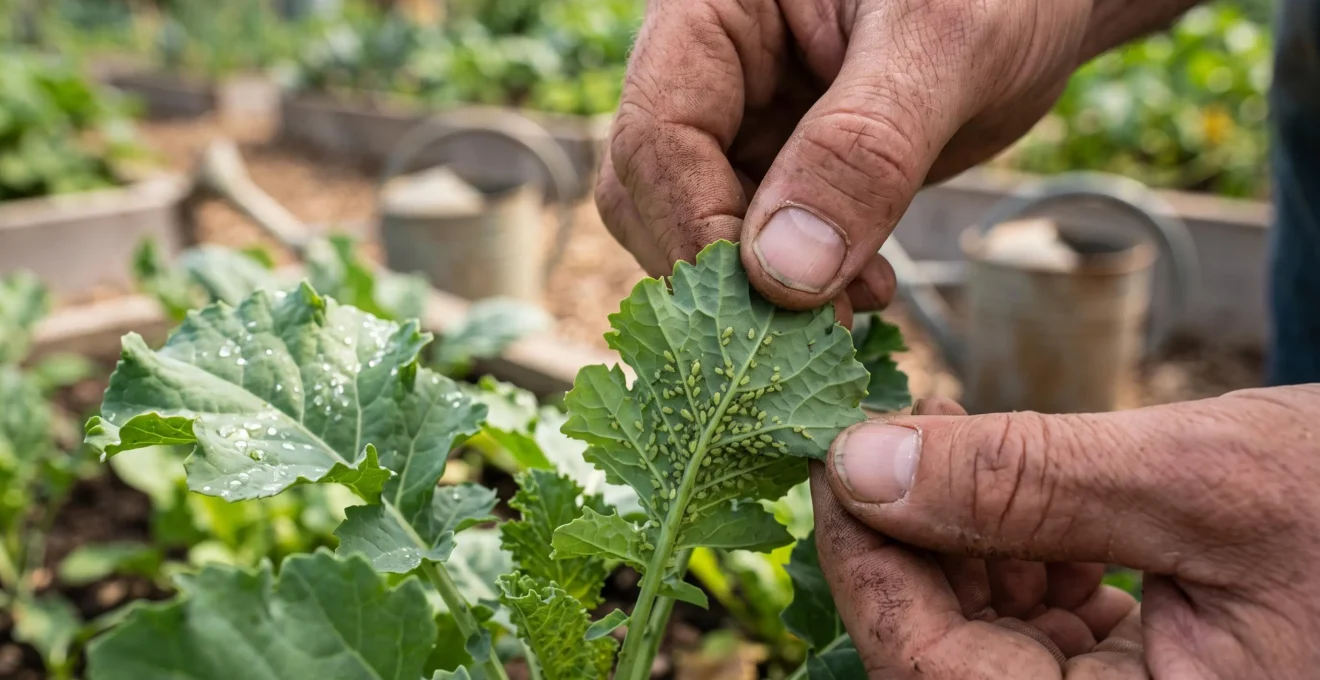
Ten aphids on a bean shoot may look harmless. Under favourable conditions, however, their descendants can multiply rapidly enough to cover growing tips, distort new leaves and spread to neighbouring vegetables before the gardener realises there is a problem.
The reason is biological: during much of the growing season, many aphid species reproduce without mating, give birth to live young and produce offspring that mature quickly. Several generations can overlap on the same plant. A population rising from 10 to 10,000 in three weeks is an illustrative outbreak scenario, not a guaranteed growth rate, but it captures the practical danger of postponing inspections.
Effective aphid control therefore begins before leaves become severely curled or colonies blanket entire shoots. Looking beneath young leaves, monitoring changes in colony size, protecting beneficial insects and using targeted water sprays can keep many outbreaks manageable without unnecessary insecticide applications.
The objective is not always to eliminate every aphid. It is to prevent multiplying populations from exceeding what the crop and its natural predators can tolerate.
Aphid population explosions: essential facts
- Rapid reproduction: Live birth, overlapping generations and short development times can turn small colonies into serious infestations during warm weather.
- Early detection: Inspect growing tips, leaf undersides and buds regularly, particularly when plants are growing rapidly.
- Targeted intervention: Remove expanding colonies where necessary while preserving ladybirds, lacewings and hoverflies that provide ongoing control.
- How to Spot the First Aphid Scouts That Signal Intervention Is Needed Within Days?
- How Effective Is Blasting Aphids with Water for Reducing Populations on Vegetables?
- Ladybirds vs Lacewings vs Hoverflies: Which Natural Predator Controls Aphids Most Effectively?
- The Underground Aphid Threat That Damages Brassicas and Lettuce Without Visible Colonies
- When Should You Intervene Against Aphid Populations for Maximum Control Effectiveness?
- How Often Should You Inspect Vegetable Crops to Catch Pest Outbreaks at Controllable Stages?
- Why Are Ladybirds, Lacewings, and Hoverfly Larvae Your Most Effective Aphid Controllers?
- How Does Weekly Crop Monitoring Prevent the Bulk of Harvest Losses Before Damage Becomes Severe?
How to Spot the First Aphid Scouts That Signal Intervention Is Needed Within Days?
The earliest warning of an aphid outbreak is usually a winged migrant arriving on tender growth or a small group of wingless young gathering beneath a leaf. Inspect shoot tips, unopened buds and the undersides of new leaves before obvious damage develops. Honeydew, shed skins and increased ant activity can reveal colonies that are otherwise easy to overlook.
Winged aphids disperse between plants and establish new colonies when they find suitable hosts. During the live-bearing reproductive phase, females can produce offspring without mating. Their wingless descendants often remain clustered around the original feeding site, where soft plant tissues provide accessible sap.
According to RHS advice on aphid biology and management, aphids commonly occupy shoot tips, flower buds and leaf undersides. The RHS also explains how overcrowding, declining host quality and seasonal changes can encourage winged forms to develop.
Look for several connected warning signs rather than waiting for an unmistakable mass of insects:
- Small groups on new growth: An early colony may still be confined to a single shoot or leaf underside.
- White cast skins: These indicate that aphids have been feeding and moulting as they develop.
- Shiny, sticky honeydew: This suggests active sap feeding and may appear on leaves below the colony.
- Curled or puckered leaves: Distortion suggests that feeding has already affected expanding tissues.
- Ant trails: Ants may be collecting honeydew and protecting aphids from natural enemies.
Do not restrict inspections to visibly affected plants. Examine vegetables close to hedgerows, weeds and other potential aphid hosts along the plot boundary. These locations can provide opportunities for migrating insects to reach crops, although the exact sources vary by aphid species.
Where ants repeatedly travel up a stem, follow their route towards the youngest leaves and hidden leaf folds. Ant traffic is a useful clue, not a reliable count of colony size. Some aphid infestations attract few visible ants.
Early signs also reveal different levels of urgency: a handful of exposed insects offers more control options than a colony already protected inside tightly distorted leaves.
Once a colony has been located, the next decision is whether physical removal is suitable for the crop and whether natural enemies are already present.
How Effective Is Blasting Aphids with Water for Reducing Populations on Vegetables?
A firm stream of water can substantially reduce exposed aphid colonies on sturdy vegetable plants by physically knocking insects off their feeding sites. It works best when colonies are accessible and plant tissues can tolerate the pressure. Water spraying provides immediate population reduction, but hidden aphids, delicate crops and subsequent recolonisation limit its usefulness as a complete solution.
Unlike insecticides, water does not need to poison aphids. It disrupts their grip on stems and leaves and dislodges them. University of California integrated pest management guidance reports that most aphids knocked off plants by a sufficiently strong spray cannot return successfully.
However, weak spraying may leave many insects attached. Aphids sheltered inside curled leaves can also escape treatment, while surviving individuals may reproduce or new winged aphids may arrive.
The practical decision depends on crop strength, colony location and weather.
| Crop condition | Recommended approach | Main limitation |
|---|---|---|
| Established bean plants with exposed colonies | Direct a firm, controlled spray at infested shoots | Avoid snapping stems or damaging flowers |
| Young seedlings | Prefer gentle manual removal where practical | Strong jets can dislodge or injure seedlings |
| Soft lettuce foliage | Use only gentle pressure if leaves can withstand it | Bruising and retained moisture are concerns |
| Severely curled leaves | Inspect affected shoots and consider targeted removal | Water may not reach sheltered aphids |
| Plants carrying predator larvae or eggs | Limit treatment to the necessary areas | Spraying may dislodge beneficial insects |
Apply water early enough in the day for foliage to dry. In persistently humid weather, prolonged leaf wetness can favour certain plant diseases. Use enough pressure to move exposed aphids without tearing leaves or stripping developing flowers.
After treatment, revisit the affected shoots to check whether colonies are shrinking. Repeating treatment may be useful when exposed aphids remain, but indiscriminate daily spraying can disturb beneficial insects as well as pests.
The goal is to reduce aphid pressure while preserving the predators capable of limiting subsequent population growth. This makes selective spraying more useful than automatically washing every plant.
Water provides short-term suppression. Lasting control is more likely when the garden also supports insects that continue feeding on aphids between inspections.
Ladybirds vs Lacewings vs Hoverflies: Which Natural Predator Controls Aphids Most Effectively?
No single predator is consistently the most effective aphid controller in every vegetable garden. Ladybird and lacewing larvae can consume numerous aphids within established colonies, while hoverfly larvae also feed on aphids and may exploit colonies across different parts of the garden. Their performance depends on species, life stage, local conditions, prey availability and whether adults establish breeding populations.
Gardeners often recognise adult ladybirds but overlook the immature predators doing much of the feeding. Ladybird larvae are elongated and often dark with contrasting markings. Lacewing larvae have prominent curved jaws, while hoverfly larvae are typically legless, soft-bodied and tapered.
The most useful comparison concerns how these insects reach aphid colonies, reproduce and remain active.
| Predator | Principal aphid-control strengths | Important limitations |
|---|---|---|
| Ladybirds | Both adults and larvae of many species consume aphids; larvae can feed intensively within colonies | Purchased adults may disperse before providing lasting local control |
| Lacewings | Predatory larvae use their jaws to seize aphids and other soft-bodied prey | Adults of some species depend on nectar, pollen or honeydew rather than feeding heavily on aphids |
| Hoverflies | Larvae of aphid-eating species attack colonies; adults also visit flowers and contribute to pollination | Only some hoverfly species have aphid-eating larvae, and control depends on successful egg-laying |
Rather than assigning an unsupported universal ranking, compare predators by whether their larvae are already present, how many colonies are accessible and whether the surrounding habitat supports reproduction.
Purchasing adult ladybirds may seem like a quick answer to an outbreak. However, UC IPM guidance on aphid monitoring and control explains that released convergent lady beetles can disperse from gardens within a few days. Its discussion of biological control illustrates why releasing adults is not equivalent to establishing a sustained predator population.
Flowers that supply nectar and pollen, suitable shelter and some available aphid prey can help naturally occurring beneficial insects remain and reproduce. These resources benefit different predator groups in different ways; they do not guarantee immediate suppression of a large infestation.
Broad-spectrum insecticides may kill beneficial larvae alongside aphids. Some sprays marketed for organic gardening can also harm insects they contact. Avoid treating occupied shoots indiscriminately, and do not remove every harmless aphid simply because predators have arrived.
A balanced predator community offers several routes to aphid suppression, but it cannot control colonies that remain hidden from inspection or physically inaccessible.
The Underground Aphid Threat That Damages Brassicas and Lettuce Without Visible Colonies
Root-feeding aphids can weaken lettuce, brassicas and other susceptible crops without producing visible colonies on their leaves. Their feeding may cause wilting, yellowing, stunted development and poor vigour, often resembling drought or nutrient deficiency. When affected plants fail to recover as expected after watering, examining their roots can reveal a hidden infestation.
Unlike aphids feeding on growing tips, root aphids remain largely concealed by soil. Some produce waxy secretions that give infested roots a pale or greyish appearance. A gardener may inspect the foliage repeatedly without finding the insects responsible for the symptoms.
Species identification matters because root aphids do not all share the same host plants or seasonal behaviour.
The lettuce-root aphid, Pemphigus bursarius, alternates between poplar trees and suitable plants in the daisy family, including lettuce.
The cabbage-root aphid, Pemphigus populitransversus, alternates between poplar and roots of plants in the cabbage family. These relationships help explain why an apparently clean vegetable bed can experience infestation following the arrival of winged migrants.
The RHS guidance on root aphid identification and management describes these host relationships, the difficulty of controlling underground colonies and the importance of examining roots.
To investigate persistent unexplained wilting, carefully lift an affected plant with surrounding soil and inspect the root system. Look for small aphids and white waxy material, while also checking whether root damage, waterlogging, disease or genuine moisture shortage could explain the symptoms. Waxy deposits alone are not conclusive because other pests, including root mealybugs, may look similar.
Control generally depends more on prevention and cultural management than on foliage spraying. Relevant measures include inspecting purchased plug plants, rotating susceptible crops away from previously affected soil and using appropriate insect-proof mesh to restrict arriving winged aphids.
In the UK, the RHS identifies May to August as a relevant period for protecting certain vegetable crops from migrating root aphids. Timing differs across species and climates, so local risk matters more than adopting these months everywhere.
Poplar trees are part of the life cycle of some species, but removing established trees is neither a universally appropriate nor a reliably sufficient control strategy. Crop rotation may reduce exposure without guaranteeing elimination of underground populations.
Whether aphids occupy roots or shoots, effective management depends on identifying the infestation early enough to choose an intervention that can reach the insects.
When Should You Intervene Against Aphid Populations for Maximum Control Effectiveness?
The best time to intervene is generally while an aphid colony remains small, localised and accessible, before extensive leaf distortion or rapid spread develops. Intervention does not always mean spraying: removing a few insects, monitoring predator activity or washing a sturdy shoot may be sufficient. Decisions should reflect crop vulnerability, population growth and natural enemy activity rather than a fixed calendar date.
The reproductive advantage of aphids explains why a short delay can matter. During favourable periods, many species reproduce by giving birth to living young without mating. Offspring mature, begin reproducing and contribute to overlapping generations before earlier adults have stopped producing young.
University of California IPM reports that, under warm conditions, many aphids can develop from newborn nymphs to reproducing adults in approximately seven to eight days. It also describes particularly high offspring production under favourable conditions. These are biological examples, not a universal timetable for every species or UK garden.
Hypothetical scenario: from ten aphids to an overwhelming colony
Imagine a gardener discovering ten aphids on a bean shoot and leaving the plant unchecked for three weeks. If conditions strongly favour reproduction, successive generations could expand the population dramatically, while winged migrants and predators influence how insects are distributed.
Reaching 10,000 aphids would represent a thousandfold increase. That outcome is a hypothetical illustration of multiplication risk, not a measured prediction supported for every species, plant or three-week period. Temperature, host quality, mortality and natural enemies can substantially change the result.
Winged aphids can develop when colonies become crowded or host quality declines, but their appearance is not an infallible sign that a particular damage threshold has been crossed. Seasonal changes can also stimulate wing production.
A practical decision rule is to examine three conditions:
- Has the colony spread beyond a few shoots or appeared on neighbouring plants?
- Are young leaves beginning to distort, or is the crop showing reduced growth?
- Are predators and other natural enemies absent or apparently unable to slow the increase?
If two of these three conditions are present, treat the situation as a warning that the opportunity for gentle, localised control may be narrowing. This is a practical screening rule, not a scientifically validated universal economic threshold.
Low aphid numbers on vigorous, established plants may cause little lasting damage. Allowing some prey to remain can help sustain natural enemies, provided colonies are not increasing rapidly or threatening vulnerable crops.
Extra caution is appropriate where aphid-transmitted viruses are a known problem. Some viruses can be transmitted soon after feeding begins, so visible colony size alone cannot determine the safety of waiting.
The deciding factor is not how many days have passed since planting, but how quickly the population is changing relative to the crop’s ability to tolerate damage.
How Often Should You Inspect Vegetable Crops to Catch Pest Outbreaks at Controllable Stages?
Inspect actively growing vegetable crops at least twice weekly when aphid risk is high, especially during warm weather and periods of rapid plant growth. A weekly inspection can provide a useful baseline during quieter periods, but it may miss fast-developing colonies. Increase monitoring when aphids are already present, susceptible seedlings are establishing or nearby plants show infestation.
Inspection intervals should reflect biological activity rather than gardening habit. Aphid development can accelerate under favourable warm conditions, meaning a colony may change substantially between two weekly visits.
A consistent route helps gardeners notice changes without examining every leaf. Start with susceptible crops and plants showing fresh, soft growth. Check selected shoot tips, buds and leaf undersides, then inspect neighbouring plants for newly established colonies.
During a routine inspection, sample plants from different parts of each bed, including exposed edges and sheltered areas. After a warm spell or a discovery of increasing aphid numbers, concentrate more closely on affected crops and surrounding plants.
Recording colony locations makes this process more useful. A dated photograph of the same shoot can reveal whether aphids are spreading, remaining stable or declining as predators arrive. Notes need not contain precise insect counts if clusters are clearly distinguishable between visits.
A five-step aphid inspection routine
- Choose priority crops: Identify susceptible beds and produce a short list of plants to inspect during each visit.
- Examine growing points: Turn over young leaves and check buds, recording which shoots contain aphids.
- Assess colony development: Note whether infestations are isolated, spreading or causing distortion, and save a dated photograph where useful.
- Check natural enemies: Look for predator larvae, ladybirds and signs of parasitoid activity, documenting their presence without disturbing them.
- Set the next action: Record whether to observe, remove aphids locally or inspect again sooner, with the next check noted in the garden diary.
Continue inspecting crops after they become established. Harvesting does not remove the need for monitoring, particularly when aphid contamination can make lettuce leaves, brassica heads or harvested legumes difficult to use.
Inspections can also reveal that different problems require different responses. Aphids on leaf undersides may be physically removable, while persistent wilting without visible insects should prompt investigation of roots and other possible causes.
Once monitoring becomes routine, the next improvement is learning to recognise the beneficial insects already regulating aphid populations between visits.
Why Are Ladybirds, Lacewings, and Hoverfly Larvae Your Most Effective Aphid Controllers?
Ladybird, lacewing and aphid-eating hoverfly larvae are valuable controllers because their development depends on finding and consuming prey. Larvae can attack aphids directly within colonies, while adults of some species rely on flowers for food and breeding resources. Their usefulness depends on successful reproduction, suitable habitat and the timing of predator arrival relative to aphid multiplication.
The distinction between adults and larvae is essential. Many ladybird adults also eat aphids, but hoverfly adults visit flowers rather than hunting aphids as their larvae do. Adult lacewing feeding habits vary between species. A garden with many visiting adults does not automatically contain enough predatory larvae to suppress an expanding colony.
Larval identification prevents well-intentioned gardeners from destroying natural enemies. Hoverfly larvae can resemble small, pale, tapered maggots, usually without visible legs. Lacewing larvae are more recognisably predatory, with elongated bodies, legs and curved jaws. Ladybird larvae often have elongated, segmented bodies that look very different from familiar rounded adults.
According to University of Minnesota Extension‘s aphid life cycle guidance for home gardens, ladybirds, lacewings, hoverfly larvae and parasitoid wasps are among the natural enemies helping regulate aphid populations. Its guidance also highlights the value of flowering plants across the growing season.
For predators to reproduce, a garden must provide more than a temporary aphid outbreak. Flowers offering nectar and pollen at different times, undisturbed shelter and suitable prey help create conditions for continuing biological control.
Hoverfly adults benefit from accessible flowers. Many lacewing adults also use floral resources, while ladybirds can exploit a mixture of prey and supplementary food sources depending on species. Hedgerows, grassy margins and less intensively managed areas can contribute habitat, although their value depends on the plants and insects present.
There is an important delay in this process. Predator populations often become conspicuous only after aphids have multiplied. Adult insects must locate colonies, reproduce and produce larvae before their offspring contribute to suppression.
Consequently, establishing a favourable habitat before peak aphid activity is more dependable than expecting predators to appear immediately after an infestation becomes severe. Even with excellent habitat, temporary local control may be necessary to protect vulnerable crops.
Predators can reduce the need for intervention, but monitoring remains necessary to determine whether their activity is keeping pace with aphid reproduction.
Key takeaways before the next inspection
- Measure change, not just presence: A small colony expanding rapidly deserves more attention than a stable colony already supporting predators.
- Protect vulnerable growth: Young shoots, seedlings and crops approaching harvest can require different responses to similar aphid numbers.
- Combine observations with action: Monitoring should determine whether to wait, intervene locally or investigate concealed pests.
How Does Weekly Crop Monitoring Prevent the Bulk of Harvest Losses Before Damage Becomes Severe?
Weekly crop monitoring can reduce avoidable harvest losses by revealing aphid colonies and other pest problems while they remain manageable. Its greatest benefit is giving gardeners time to use selective responses before damage spreads. However, no universal percentage of harvest loss prevented can be guaranteed, and rapidly multiplying aphids may require inspections more frequently than once a week.
The protective mechanism begins with early detection. A few exposed aphids can often be removed or left temporarily under observation. Once colonies occupy numerous shoots, distort developing leaves or contaminate harvestable produce, the range of effective low-impact options becomes narrower.
Some symptoms, such as fresh feeding activity and temporary growth stress, may improve when populations decline. Already deformed leaves do not necessarily return to their original shape, and virus-related damage cannot be reversed simply by removing aphids.
This explains why claims that monitoring prevents a fixed proportion of losses should be treated cautiously. Outcomes depend on the crop, aphid species, weather, plant growth stage, presence of natural enemies and speed of response. The available source evidence supports the value of regular inspection but does not establish an 80% harvest-loss prevention rate.
A simple monitoring habit links the major control measures:
- Finding exposed colonies early shows where selective water spraying may help.
- Observing predator larvae reveals whether natural suppression is developing.
- Tracking leaf distortion shows whether damage is increasing despite apparent predator activity.
- Investigating unexplained wilting helps distinguish root aphids from water, soil and disease problems.
For a gardener with limited time, a fixed weekly walk is a realistic starting point. Prioritise vulnerable vegetables and growing tips, then add shorter checks during warm spells, rapid crop growth and active infestations.
Keep a brief record of the affected plant, approximate colony size, visible damage and next action. Comparing observations over time turns inspection into a simple population-management system rather than an occasional reaction to badly damaged leaves.
Do not abandon monitoring when harvesting begins. Aphids can remain important where insects contaminate edible leaves or settle inside developing crop structures. Continuing checks also helps identify potential problems on successive plantings.
On your next garden visit, inspect the undersides of young leaves on the most vulnerable vegetables, record any colonies and check again before they have time to spread. A small, repeatable habit gives you the opportunity to intervene while the damage is still limited.
Can ten aphids really become 10,000 in three weeks?
Such an increase is a hypothetical illustration of very rapid multiplication, not a reliable prediction. Aphids can reproduce quickly through live birth and overlapping generations, but the actual growth rate depends on species, temperature, plant quality, predation and other mortality factors. The main lesson is that even a small colony can become harder to manage after a short period without inspection.
Do aphids survive winter in UK gardens?
Yes. Many aphid species overwinter as eggs on suitable host plants, while others may survive in different life stages where conditions and host availability permit. Some species alternate between woody and herbaceous hosts. Winter survival and spring colonisation patterns vary considerably between species and locations.
Are ants responsible for creating aphid infestations?
Ants do not create aphids, but they can help colonies persist by collecting honeydew and protecting aphids from predators and parasitoids. Certain ants also interact with root aphids underground. Following ant trails may help locate concealed colonies, although ants are not present at every infestation.
Will aphids disappear naturally if ladybirds are present?
Not necessarily. Ladybirds and their larvae can consume many aphids, but population suppression depends on the number of predators, available prey and the rate of aphid reproduction. Natural enemies may need time to build up after an outbreak begins. Monitor colony size and crop condition rather than assuming that a few visible ladybirds guarantee control.
Should every aphid be removed from edible vegetables?
Complete elimination is not always necessary. Established, healthy plants can often tolerate small numbers of leaf-feeding aphids, and limited prey availability supports natural enemies. However, contamination of harvested produce, damage to vulnerable growth and the risk of aphid-transmitted plant viruses may justify earlier intervention. Decisions should reflect the crop and the specific problem.