A tree that fits comfortably beside a patio today may dominate the entire garden in 15 years. Ignoring the mature size of trees and shrubs creates expensive problems because their expanding canopies and root systems eventually compete with buildings, boundaries, paved surfaces and other plants for space.
In a small UK garden, correcting these conflicts can involve specialist tree dismantling, restricted-access machinery, waste disposal, stump removal and replacement planting. A combined bill exceeding 2,000 £ is an illustrative scenario for a difficult removal project, rather than an established average or a guaranteed consequence of poor planting decisions.
The underlying mistake happens at the garden centre, where purchase size is easily confused with permanent size. A compact nursery specimen may have decades of growth ahead of it.
Effective planting design begins with the garden you expect to occupy in 10 to 20 years. Understanding ultimate height, canopy spread, root behaviour and establishment rates allows you to select plants that become valuable landscape features rather than increasingly expensive obstacles.
Planning for mature tree and shrub size: the essentials
- Slow-growing plants are not necessarily small at maturity. Verify both their ten-year dimensions and their ultimate size.
- Check the mature canopy width of every permanent specimen before determining planting distances.
- Assess soil conditions, foundation vulnerability and root behaviour separately from above-ground dimensions.
- Choose planting stock according to long-term suitability rather than immediate visual impact alone.
- Use removable temporary planting to fill gaps while permanent trees and shrubs establish.
- Why Do « Slow-Growing » Trees Still Outgrow Small Gardens Within a Decade?
- How to Find Accurate Mature Size Information Beyond Optimistic Nursery Labels?
- Dwarf Cultivars vs Standard Varieties: Which Delivers Impact Without Overwhelming Small UK Gardens?
- The Planting Distance Mistake That Damages Foundations and Costs £5,000 to Rectify
- Should You Plant Young Whips and Wait 10 Years or Invest in Semi-Mature Trees for Instant Impact?
- The Scale Mistake That Makes Small Gardens Feel Even Smaller and Cramped
- Why Do Patios and Paths Crack Within 5 Years When Planted Too Close to Trees?
- How Do Landscape Design Principles Transform Ordinary Gardens Into Captivating Outdoor Rooms?
Why Do « Slow-Growing » Trees Still Outgrow Small Gardens Within a Decade?
Slow-growing trees can outgrow small gardens because growth rate describes how quickly a plant develops, not how large it eventually becomes. A tree may remain manageable during establishment before developing a much broader canopy. Whether it exceeds the available space within a decade depends on its cultivar, growing conditions and initial planting position.
The distinction between growth rate and ultimate size is particularly important when buying conifers. A specimen described as slow-growing may take considerably longer to reach maturity without having a naturally compact mature form.
The RHS conifer growing guide explains that many conifer labels describe dimensions after ten years rather than their eventual height and spread. Even relatively slow-growing specimens can become substantial trees over time.
Growth is also uneven throughout a tree’s life. During its first few growing seasons, a newly planted specimen may devote considerable resources to establishing its root system. Subsequent extension growth can increase under favourable conditions. Multiplying the growth observed during establishment by the number of years ahead therefore produces an unreliable forecast.
For practical garden planning, distinguish three separate dimensions:
- Purchase size: the space occupied by the specimen when it arrives.
- Ten-year size: the expected intermediate footprint, useful for assessing how the garden may develop over the coming decade.
- Ultimate size: the long-term dimensions that determine whether the permanent planting position is suitable.
Draw both the intermediate and ultimate canopy outlines on a garden plan. Where the nursery provides height but no corresponding spread, obtain additional information rather than assuming that the tree will maintain its current proportions.
Boundary planting deserves particular attention. A small trunk positioned inside a fence does not mean that the eventual branches and roots will remain within the property. Anticipating these extensions helps prevent intrusive shade, difficult pruning access and potential disagreements with neighbours.
The most useful nursery label is therefore not necessarily the one promising gradual growth, but the one that provides enough information to judge the tree’s suitability throughout its life.
How to Find Accurate Mature Size Information Beyond Optimistic Nursery Labels?
Find accurate mature size information by checking the plant’s complete botanical name and cultivar against independent horticultural references, breeder information and available trial records. Confirm whether the stated dimensions represent ten-year growth or ultimate size, and prioritise canopy spread when assessing a restricted garden. Treat published measurements as expected ranges rather than guaranteed limits.
A nursery label is designed to communicate useful information within limited space. Its figures may describe an intermediate stage of development, a particular growing environment or a specific trained form. An apparently modest height measurement becomes misleading when the corresponding time horizon and canopy width are missing.
The RHS tree growing guide recommends choosing positions that accommodate mature dimensions and using the Royal Horticultural Society‘s plant database to identify suitable specimens by ultimate size.
Search using the exact cultivar rather than the species or common name alone. Where available, compare the RHS Find a Plant entry with the breeder’s technical information, relevant RHS Award of Garden Merit records and published trial observations. An award itself does not establish a plant’s eventual dimensions.
Growing conditions introduce further variation. Soil depth, moisture availability, light exposure, root restriction and pruning influence plant development. However, deliberately relying on poor growing conditions to suppress a naturally large tree can compromise its health without reliably controlling its footprint.
Visit established gardens or arboretums where possible. Observing mature specimens provides a clearer impression of branching habit, density and seasonal shade than photographs of recently planted nursery stock.
Once the expected spread is established, divide it by two to obtain the approximate canopy radius. For example, a hypothetical tree with a mature spread of four metres requires a canopy radius of approximately two metres when its crown is broadly symmetrical.
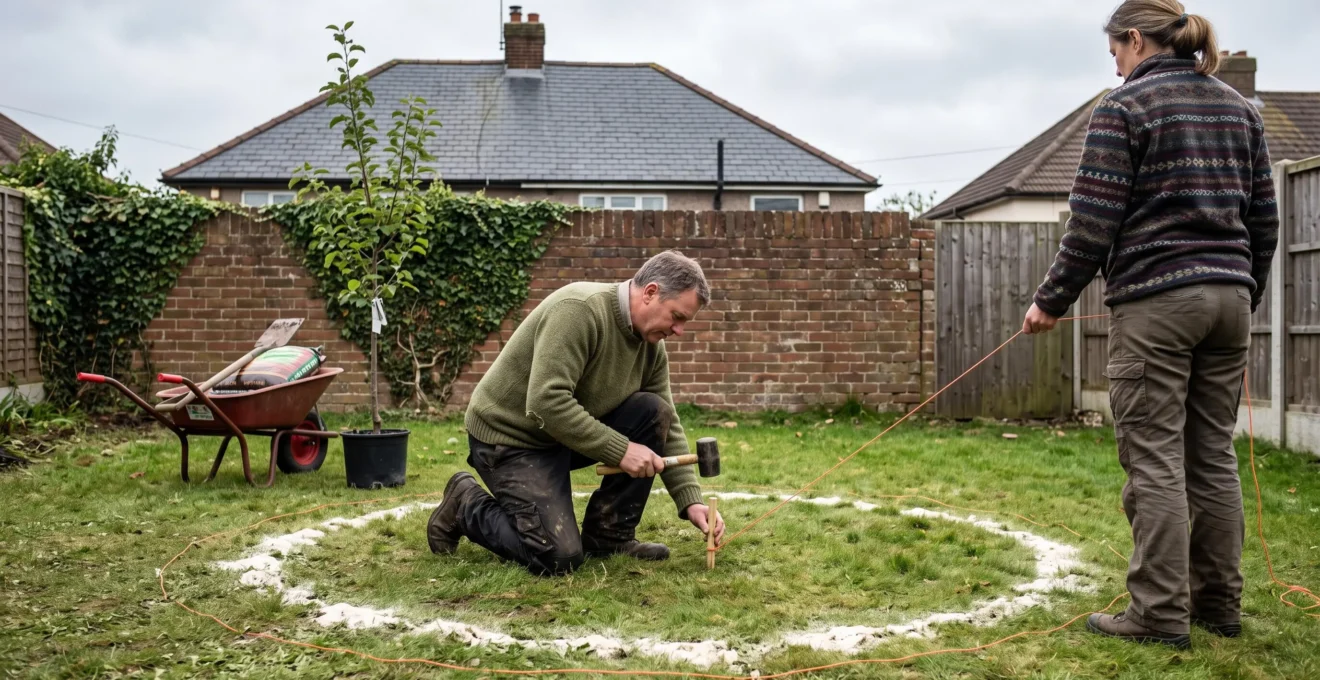
Mark that outline using a central stake, string and sand. Walk around it, check whether doors and paths remain accessible, and consider where branches could extend beyond the marked circle.
Keep a permanent planting record containing the botanical name, cultivar, expected mature height, spread and the source of those dimensions. Where reputable references disagree, investigate the reason and allow sufficient space for the larger credible estimate.
Reliable measurements also make it easier to distinguish genuinely compact cultivars from standard varieties that simply happen to be small when sold.
Dwarf Cultivars vs Standard Varieties: Which Delivers Impact Without Overwhelming Small UK Gardens?
Dwarf cultivars generally offer better long-term control where garden space is restricted, while standard varieties provide opportunities for larger canopies, stronger vertical structure and more extensive shade. The better choice depends on verified mature dimensions, growth habit and maintenance requirements rather than the dwarf designation alone. Some dwarf trees still develop surprisingly wide crowns.
Compact ornamental cultivars may result from naturally restricted growth characteristics or selection of distinctive plant forms. In fruit trees, dwarfing rootstocks are commonly used to influence the vigour and eventual size of the grafted variety.
The height of the graft union can also influence the presentation of certain ornamental forms, particularly where a compact or weeping crown is grafted onto an upright stem. Check the finished shape as well as the expected overall height.
The differences between apple rootstocks demonstrate why a cultivar name alone is insufficient for assessing space requirements.
| Rootstock | Vigour classification | Ultimate height | Ultimate spread |
|---|---|---|---|
| M27 | Extremely dwarfing | 1.2–1.8 m | 1.5 m |
| M9 | Dwarfing | 1.8–2.4 m | 2.7 m |
| M26 | Dwarfing | 2.4–3 m | 3.6 m |
| MM106 | Semi-dwarfing | 3–4 m | 4 m |
| MM111 | Vigorous | 4–4.5 m | 4.5 m |
These reference dimensions come from the RHS fruit tree rootstock recommendations and relate specifically to bush-trained apples. Actual dimensions depend on soil conditions, management and training. They should not be extrapolated to ornamental trees or shrubs.
A dwarf apple on M26 still requires considerable horizontal space. The RHS also specifies permanent staking for M27, M9 and M26 rootstocks, demonstrating that restricted vigour does not necessarily mean reduced maintenance.
Fertile soil and favourable growing conditions can influence vigour. Shoots emerging below a graft union should also be identified and managed so that rootstock growth does not interfere with the intended cultivar.
For ornamental planting, compare dwarf and standard forms according to the landscape function they must perform.
| Design criterion | Dwarf or compact cultivar | Standard variety |
|---|---|---|
| Spatial control | More manageable where compact dimensions are verified | Requires sufficient permanent growing space |
| Visual impact | Defined form, texture and proportion | Potential for substantial height and canopy development |
| Shade and habitat | Suitable for localised shade and smaller planting schemes | Potential for more extensive shade and habitat volume |
| Maintenance | May still require staking, training or pruning | Can require extensive management if poorly positioned |
| Suitable locations | Restricted borders, small courtyards and appropriately scaled hedges | Open positions that accommodate ultimate dimensions |
Compact cultivars are sensible starting points for narrow boundaries, front-of-border structure and restricted planting beds. Standard varieties become appropriate when their future crowns can develop without obstructing circulation, buildings or neighbouring space. Their actual growth rate should still be checked independently.
Even a well-proportioned crown, however, does not establish whether a tree is suitable beside a house. Below-ground growth requires a separate assessment.
The Planting Distance Mistake That Damages Foundations and Costs £5,000 to Rectify
Planting too close to a building can create structural problems when tree roots interact with vulnerable foundations, shrinkable clay soils or defective drainage. The principal subsidence mechanism is moisture extraction from susceptible soil rather than roots forcing their way through sound foundations. Most trees near buildings do not cause damage, making site-specific assessment essential.
During dry periods, trees continue extracting moisture from the surrounding soil. Where that soil contains shrinkable clay, moisture loss can cause it to contract. Foundations supported by the affected ground may move unevenly, potentially producing cracks in the building.
The RHS advice on trees near buildings identifies shrinkable clay and relatively shallow foundations as important risk factors. Older properties, particularly those built before the 1950s with shallow foundations, can be especially vulnerable under suitable conditions.
Drainage problems involve a different mechanism. Roots may exploit existing defects in leaking drains, where moisture is available. This is distinct from the assumption that roots routinely penetrate sound foundations or watertight drainage systems.
Up to 3 times tree height
Tree roots can potentially extend to distances equivalent to 3 times the height of the tree. This illustrates why the visible canopy cannot establish the full below-ground footprint. It is not a universal planting setback or a prediction for every specimen.
Royal Horticultural Society, Trees near buildings.
For preliminary layout planning, use half the mature canopy spread to estimate above-ground clearance. Assess the root system separately, particularly when considering vigorous trees such as willows and poplars or large woody shrubs such as cherry laurel near buildings.
Wall-trained plants also require below-ground consideration, even when their branches occupy little horizontal space. A restricted crown does not establish an equally restricted root system.
In the UK, subsidence assessments involving insurers and building professionals must consider soil characteristics, vegetation and foundation construction. No single distance from a house can establish structural safety for every tree species and property.
The 5,000 £ figure in this heading represents a hypothetical remediation scenario, not a documented quotation or typical UK repair price. Actual expenditure depends on investigation requirements, foundation depth, drainage condition, tree removal access and whether monitoring, repairs or underpinning are necessary.
Removing a suspected tree is not automatically the correct intervention. Where a long-standing soil moisture deficit exists, removal can sometimes contribute to ground heave. Deep root barriers may also prove impractical, and cutting substantial roots can compromise tree stability.
Where the risk cannot be established confidently, obtain site-specific arboricultural or structural advice before committing to an expensive specimen or permanent planting position.
Should You Plant Young Whips and Wait 10 Years or Invest in Semi-Mature Trees for Instant Impact?
Young whips are generally preferable when affordability, straightforward establishment and gradual landscape development matter most. Semi-mature trees suit gardens requiring immediate height or a defined focal point, provided their mature dimensions and aftercare needs are understood. Neither option guarantees a particular ten-year outcome, because establishment and growth depend on the specimen and planting conditions.
The purchase price represents only part of the investment. Young whips may require protection, watering, weed management and formative pruning over successive growing seasons. Their smaller initial dimensions make transporting and planting them comparatively straightforward.
The RHS tree growing guide notes that smaller trees generally establish readily, whereas larger specimens provide immediate visual impact but often cost considerably more and may take longer to establish.
Semi-mature specimens introduce additional practical requirements, including delivery access, handling equipment where necessary, appropriate anchoring and reliable irrigation. Poor planting or insufficient aftercare can compromise establishment and place a substantial initial investment at risk.
Compare the planting options against the function the tree needs to fulfil and the resources available for its establishment.
| Consideration | Young whips | Feathered or small multi-stem trees | Semi-mature trees |
|---|---|---|---|
| Initial investment | Generally lower | Intermediate | Generally higher |
| Immediate appearance | Limited height and branching | Visible developing structure | Substantial existing presence |
| Establishment requirements | Protection, watering and formative care | Watering, structural development and suitable support | Careful handling, anchoring and intensive initial aftercare |
| Suitable landscape functions | Hedges, gradual screening and wildlife corridors | Developing focal points and layered planting | Immediate focal points and defined spatial structure |
| Consequences of unsuitable selection | Earlier opportunities to reconsider the layout | Potential relocation or replacement | Potentially difficult and expensive correction |
Feathered young trees, which retain lateral branches, and smaller multi-stem specimens offer a useful middle option. Their existing branching structure can provide an impression of maturity without requiring the investment associated with larger stock. Three to five years may serve as a design review horizon, but not as a guaranteed development period.
A semi-mature tree purchased at four or five metres deserves especially careful scrutiny. It already occupies substantial space, making mistakes concerning crown development, neighbouring structures and delivery access immediately consequential.
Regardless of purchase size, resist filling all remaining ground with permanent plants simply because a new garden appears unfinished.
The Scale Mistake That Makes Small Gardens Feel Even Smaller and Cramped
Overcrowded planting makes small gardens feel more confined when expanding shrubs and trees interrupt views, restrict movement and reduce the amount of visible open ground. The mistake begins when planting distances reflect nursery-sized specimens rather than mature dimensions. A garden that initially appears attractively full can gradually lose its usable space and visual depth.
Newly planted borders often contain uncomfortable-looking gaps. The temptation is to purchase additional permanent shrubs to achieve immediate coverage. As neighbouring plants expand, those gaps disappear, potentially leaving intertwined branches, competing crowns and inaccessible maintenance areas.
Within a three-to-five-year planning horizon, this may become noticeable in vigorous planting schemes, although the actual timing varies considerably. The first signs may include branches extending across paths, smaller plants becoming shaded or seating areas losing their sense of openness.
Adopt the principle of planting for the end and filling for now. Position permanent trees and shrubs according to their expected mature dimensions. Use annuals, biennials and suitable short-lived perennials to occupy temporarily empty ground.
Give these temporary plants a defined role and an intended removal or review date. Their purpose is to provide seasonal interest while the permanent framework develops, not to become another layer of overcrowding.
Hypothetical planting example: allowing a border to develop naturally
Consider a narrow suburban border intended to contain several permanent shrubs. Buying additional woody plants to fill every visible gap produces an immediately dense arrangement, but their projected mature crowns extend across one another and towards the adjacent path.
An alternative design retains only the permanent shrubs whose eventual dimensions fit the border. Temporary flowering plants occupy the remaining ground until the shrubs expand. The early appearance is less structurally mature, but the layout preserves access and reduces the need to remove established woody plants later.
A small garden can still accommodate a substantial specimen where its crown has enough room and its position preserves important views. One well-proportioned tree surrounded by visible ground can create a stronger impression of depth than numerous poorly positioned shrubs.
Consider visual openness from frequently used positions, including the kitchen window, patio seating and garden entrance. Assess how each projected crown affects those views rather than judging planting density only from above.
Preventing overcrowding protects more than the appearance of the garden. It also preserves the space needed to maintain paths, patios and other permanent landscape features.
Why Do Patios and Paths Crack Within 5 Years When Planted Too Close to Trees?
Patios and paths can crack or become uneven when expanding tree roots lift paving or when changes in soil moisture cause movement beneath the surface. Damage within five years is a possible scenario rather than an established timeline. Species, root distribution, soil characteristics, planting distance and paving construction determine the actual level of risk.
The first mechanism is direct physical displacement. As woody roots increase in diameter beneath paving, they can exert pressure on slabs, edging and other lightweight structures. Surface levels may change, joints may open and previously flat paths can develop uneven sections.
The second mechanism is soil movement. On shrinkable clay, moisture extraction can contribute to ground contraction. Subsequent moisture changes can produce further movement beneath susceptible paved areas, particularly where the supporting construction cannot accommodate it.
The RHS distinguishes surface lifting from structural subsidence. Its guidance identifies cherries as particularly capable of disturbing paving because their roots may develop close to the soil surface. It also notes that much surface lifting occurs close to tree trunks, without establishing a universally safe distance beyond that area.
When positioning trees beside hard landscaping, begin by drawing the expected mature crown and identifying areas where branches would obstruct access. This establishes above-ground clearance only. Below-ground separation must account for root behaviour, available rooting volume and the construction of the paved surface.
Species such as cherries, sycamores and willows deserve particular consideration where their growth characteristics conflict with restricted rooting space or nearby paving.
Before approving a new patio containing or adjoining a tree, discuss the following requirements with the landscape designer or contractor:
- The anticipated root development and the volume of suitable soil available to the tree.
- The location, dimensions and construction details of any proposed tree pit.
- Whether engineered rooting spaces or structural soil cells are appropriate.
- The proposed slab thickness, bedding arrangement and sub-base depth in relation to the ground conditions.
- The feasibility and limitations of any root-management measures.
Root barriers can sometimes redirect growth where appropriately specified. Although early installation may simplify construction, certain barriers can also be installed during remedial work. Their suitability depends on the site, and they must not be treated as guaranteed protection.
Never cut substantial roots merely to restore a flat paving surface without considering the consequences for tree stability and health. Existing damage may require arboricultural assessment before the patio is repaired.
Coordinating planting and construction at the design stage allows both to develop as complementary parts of the garden rather than competing for the same ground.
Key decisions before finalising your garden layout
- Assign every permanent tree a specific landscape function so that its eventual size serves a purpose.
- Resolve potential conflicts between rooting space, construction requirements and future maintenance access before selecting planting stock.
- Accept a developing garden where necessary rather than purchasing additional woody plants to imitate immediate maturity.
How Do Landscape Design Principles Transform Ordinary Gardens Into Captivating Outdoor Rooms?
Landscape design principles transform gardens into outdoor rooms by using appropriately scaled trees and shrubs to define enclosure, establish focal points, organise movement and frame views. Understanding mature plant dimensions makes these functions predictable. Instead of becoming accidental barriers, developing canopies and planting layers contribute deliberately to the garden’s long-term spatial structure.
Think of a tree canopy as a potential ceiling, a hedge as a possible wall and a specimen shrub as a visual anchor. Each element needs a defined position and suitable proportions before planting begins.
Three design principles become particularly effective when applied to mature plant dimensions.
- Layering: combine canopy trees, understorey shrubs and ground-level planting according to their eventual heights, light requirements and available space. Avoid arrangements in which the developing upper layer unintentionally suppresses everything beneath it.
- Enclosure: match hedge height, crown density and planting width to the dimensions and intended atmosphere of the outdoor room. Provide privacy where needed without unnecessarily blocking daylight or creating a confined passage.
- Sightline framing: position specimens to direct attention towards attractive views, seating areas and garden features. Assess those relationships using projected ten-year and mature dimensions rather than the appearance at planting.
A single correctly scaled specimen at the junction of a dining terrace and a lawn can define both areas. Its canopy may provide a sense of enclosure above the terrace while its branching structure creates a focal point from the house. Additional trees are unnecessary if they would interrupt the same view or compete for the same space.
Whether this specimen begins as a young tree or a semi-mature purchase depends on how urgently that structure is needed. Its ultimate suitability, however, should remain the same regardless of the initial planting stock.
Before ordering trees and large shrubs, turn the proposed design into a measurable planting plan.
Five pre-purchase checks for a garden designed around mature plant size
- Measure the available garden space and produce a scaled sketch showing buildings, boundaries, paths, patios and permanent features.
- Verify the botanical name, cultivar, ultimate height and spread of every proposed woody plant, recording the reference information in a planting schedule.
- Draw projected canopy outlines on the plan and mark significant specimens on the ground, producing a layout with their expected mature footprints clearly identified.
- Identify foundation, drainage and paving conflicts, recording the locations that require further root-behaviour assessment or specialist advice before planting.
- Separate permanent specimens from temporary infill and prepare a final planting list containing establishment requirements and review dates for removable plants.
Review this plan from the house and from the main seating positions. Consider where shade will develop, how branches will influence movement and whether maintenance will remain practical as the garden matures.
Before your next garden-centre visit, mark the mature footprint of the largest tree or shrub on your lawn. If its projected canopy compromises a path, a seating area or a neighbouring boundary, reconsider the specimen or its position before spending money. That simple design decision can help prevent the complicated removal and replacement work that turns an attractive planting idea into a costly long-term problem.
Do trees eventually stop growing when they reach their stated mature height?
Not necessarily. Mature height describes an expected dimension under particular growing conditions rather than a fixed biological limit. A tree may continue developing beyond its published size, although its growth pattern can change with age. Allow some flexibility when planning permanent planting positions.
Can regular pruning keep a naturally large tree permanently small?
Suitable pruning and specialist training systems can restrict the dimensions of certain trees. However, not every species responds well to repeated size reduction. Maintaining an unsuitable tree within a restricted space can create recurring work and compromise its natural form. Selecting an appropriately sized cultivar is generally a more practical starting point.
Does planting a tree in a container guarantee that it will remain compact?
No. Container cultivation restricts the available rooting volume, which can influence growth, but does not guarantee a particular mature size. Trees in containers require suitable watering, nutrition and root management. Choose a cultivar appropriate for container cultivation rather than relying entirely on root restriction to control a naturally vigorous tree.
What should you do if an existing tree is already becoming too large for your garden?
Identify the species, assess its condition and determine which specific conflicts its growth creates. A suitably qualified arboricultural professional can advise whether selective pruning, appropriate management or removal is justified. Check whether any applicable tree protection or permissions affect the proposed work. Where foundations or shrinkable clay are involved, seek appropriate structural advice before removal.
What determines whether removing an oversized garden tree could cost more than £2,000?
The cost depends on tree height, crown spread, condition, access, proximity to buildings, dismantling requirements and waste disposal. Stump treatment and landscape restoration may add further expenditure. The £2,000 figure is an illustrative budget scenario, not a verified average removal charge. Obtain itemised, site-specific quotations before deciding how to manage an oversized specimen.