A plant labelled hardy to -10°C can survive one British winter and collapse during another that never reaches that temperature. The explanation often lies beyond the thermometer: saturated roots, exposed foliage, repeated freezing and thawing, or an unexpectedly cold corner of the garden.
Understanding your local hardiness zone helps identify which plants are likely to survive winter, but the most useful assessment combines RHS hardiness ratings, recorded local temperatures, drainage and garden-level microclimates. For borderline-hardy plants, planting season and winter protection matter just as much as the number printed on the label.
Can this knowledge prevent 70% of winter plant losses? There is no verified evidence in the supplied horticultural sources establishing that percentage. It should therefore be treated as an unproven figure, not a guaranteed reduction. What is supported is a practical approach to identifying avoidable risks before purchasing, planting or protecting vulnerable species.
The goal is a garden designed around the conditions plants actually experience, rather than a national climate classification alone.
UK plant hardiness: the essential decisions
- Use RHS hardiness ratings alongside local winter extremes; American USDA zones alone cannot predict survival in British conditions.
- Identify frost pockets, warm walls and poorly drained ground before placing borderline-hardy plants.
- Give vulnerable plants time to establish, protect them when frost threatens and manage winter wetness as carefully as low temperatures.
- Why Do American USDA Hardiness Zones Mislead UK Gardeners Into Risky Plant Choices?
- How to Identify Frost Pockets and Warm Microclimates Across Your UK Garden’s Different Areas?
- Borderline-Hardy Exotics vs Bulletproof Natives: Which Strategy Suits Colder UK Gardens?
- The Planting Timing Error That Kills Borderline-Hardy Plants Before Their First Spring
- When Should You Apply Winter Protection to Borderline-Hardy Plants in Your Hardiness Zone?
- Why Do Kale, Parsnips, and Brussels Sprouts Taste Sweeter After Frost?
- Heat-Tolerant vs Traditional Varieties: Which Tomatoes and Lettuce Cope Best with UK Heatwaves?
- How Can You Protect UK Garden Plants During Summer Heatwaves That Exceed 35°C?
Why Do American USDA Hardiness Zones Mislead UK Gardeners Into Risky Plant Choices?
American USDA hardiness zones can mislead British gardeners because they classify locations by average annual extreme minimum winter temperature, not by every condition that determines plant survival. A plant rated hardy to USDA Zone 8 may still struggle in a UK garden with wet winter soil, persistent wind or repeated temperature fluctuations, even when minimum temperatures appear comparable.
The official USDA guidance on interpreting Plant Hardiness Zones explains that the system uses average annual extreme winter minimums. Its map edition based on 1991–2020 weather observations divides areas into temperature bands, with each full zone spanning 10°F and each half-zone spanning 5°F.
That makes USDA zones useful for comparing minimum-temperature exposure, but they are not comprehensive climate descriptions. Summer warmth, humidity, soil moisture, winter sunshine and wind remain separate variables.
The UK’s maritime climate presents a particular challenge. Relatively mild winters can be interrupted by cold episodes, while alternating frost and thaw may stress tissues, expose roots through frost heave or affect plants that resume growth during temporary warmth. Waterlogged conditions may cause root or crown damage even without exceptionally low air temperatures.
RHS hardiness ratings provide a more locally useful starting point. The system ranges from H1, covering plants requiring relatively warm conditions, to H7, covering plants capable of tolerating very severe cold. Subdivisions such as H1a and H1b provide further distinctions.
| Criterion | USDA zones | RHS ratings |
|---|---|---|
| Primary purpose | Classify average annual extreme minimum temperatures | Describe plants’ cold tolerance using categories relevant to UK cultivation |
| Classification | Numbered zones and half-zones | H1a–H7 |
| Winter drainage | Not represented by the zone number | Still requires a separate assessment |
| Best use for UK gardeners | Initial screening of imported plant descriptions | Plant selection alongside site-specific conditions |
A practical purchasing method begins with the plant’s USDA designation if that is the only information available. Next, check its RHS rating and compare its stated tolerance with nearby weather-station records and the coldest conditions actually observed in the garden. Then investigate the species’ tolerance of winter wetness and exposure.
There is no reliable universal numerical conversion between the two systems that removes the need for these checks. A label describing cold tolerance is not a promise that a plant will survive every British winter.
Once the regional climate has been assessed, the next improvement comes from looking much closer: different parts of the same garden may experience meaningfully different frost risks.
How to Identify Frost Pockets and Warm Microclimates Across Your UK Garden’s Different Areas?
Frost pockets can be identified by observing where frost persists and by recording minimum temperatures in different parts of a garden. Warm microclimates commonly occur near sun-facing masonry or in sheltered positions, while cold air collects in low areas where drainage is obstructed. Measuring these differences produces a more useful planting guide than relying on a regional map alone.
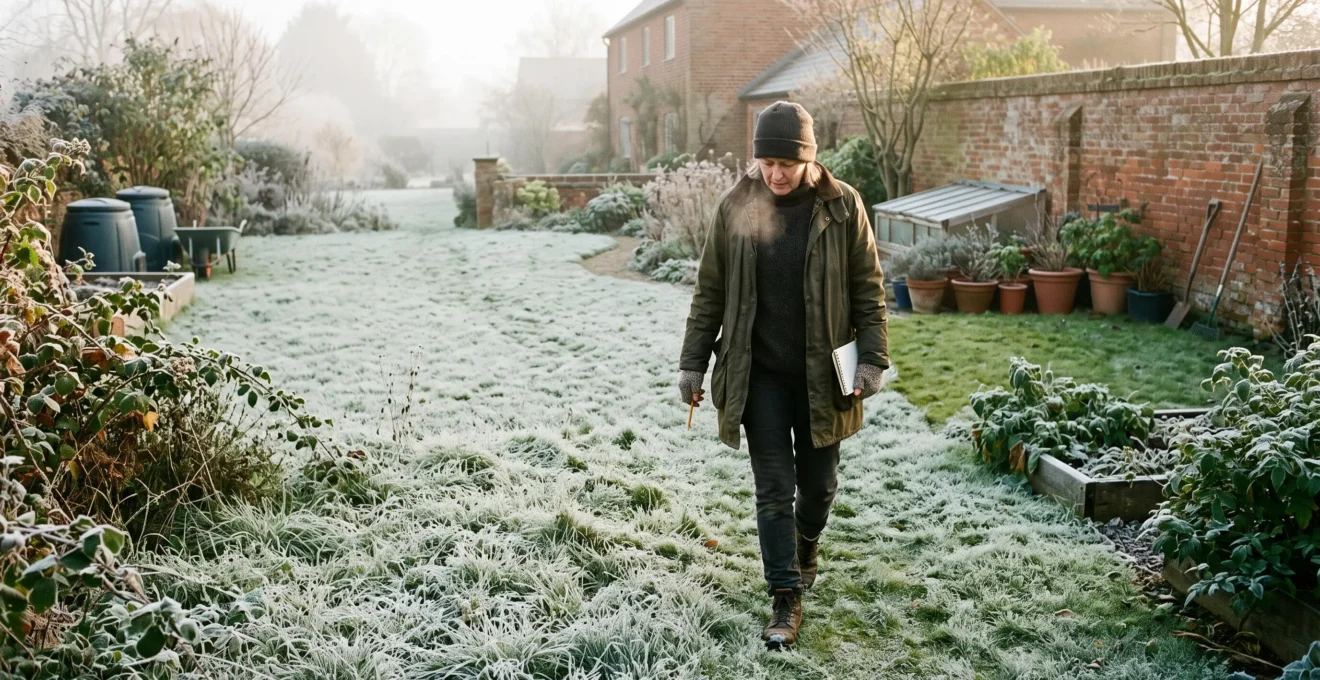
On a clear, calm winter morning, inspect the garden before sunlight has removed the frost. Look for areas where grass remains white while adjacent borders have thawed, particularly in hollows, lower lawns and behind fences crossing a slope.
Cold air is denser than warm air. During suitable weather, it moves downhill and can accumulate behind barriers. A sheltered corner at the bottom of a slope may therefore be colder than an open position farther uphill, despite feeling less windy.
The RHS guidance on assessing garden microclimates identifies topography, garden orientation, wind exposure and cold-air drainage as important influences. South-facing walls can absorb solar warmth during the day and release some of it after sunset, making adjacent planting positions more favourable for vulnerable species.
However, a warm wall is not automatically a safe planting site. Poorly draining soil at its base, cold air trapped by nearby structures or unusually exposed conditions can offset its advantages.
To verify suspected differences, place inexpensive min-max thermometers in several representative locations. Keep them at comparable heights, shield them appropriately from direct solar heating and record minimum readings over a winter season. Note the date, weather conditions and position of each instrument.
This is a suggested home-monitoring method, not a standardised RHS measurement protocol. Its value lies in comparing locations consistently rather than claiming laboratory precision.
Build a practical frost-risk map of your garden
- Sketch the garden and mark slopes, walls, fences and low areas. Deliverable: a labelled site plan.
- Photograph frost distribution on a calm winter morning. Deliverable: annotated photographs showing where frost lingers.
- Install min-max thermometers in contrasting positions and check them consistently. Deliverable: a location-based temperature log.
- Record drainage, exposure and winter sunshine in each monitored position. Deliverable: a site-condition table accompanying the readings.
- Assign planting categories based on the observations, separating colder sites from relatively protected ones. Deliverable: a garden planting-risk map.
Measurements from one season cannot guarantee future minimum temperatures. Unusually severe winters remain possible, so a personal microclimate map should inform plant choices rather than encourage planting at the exact limit of a species’ tolerance.
With those locations established, plant choice becomes a manageable decision about reliability, visual impact and the amount of winter maintenance a gardener is willing to undertake.
Borderline-Hardy Exotics vs Bulletproof Natives: Which Strategy Suits Colder UK Gardens?
Colder UK gardens generally benefit from a foundation of reliably hardy planting, with borderline-hardy exotics reserved for protected positions where the risks are understood. Exotics may provide striking foliage and architectural interest, but they often require more careful siting and winter protection. Hardy natives and proven garden perennials usually offer greater predictability, although no species is immune to unsuitable conditions.
The central decision is not simply native versus exotic. It is whether a particular plant can tolerate the garden’s recorded winter minimums, drainage conditions and exposure without demanding more intervention than the gardener wants to provide.
Native status does not automatically establish winter suitability. A British native adapted to damp woodland may struggle in dry, compacted soil, while a non-native perennial with a suitable hardiness rating may thrive for years in a colder garden.
Similarly, the term exotic does not always mean tender. Plants must be evaluated individually rather than judged by their appearance or geographical origin alone.
| Garden condition | Hardy planting foundation | Borderline-hardy exotics |
|---|---|---|
| Recorded minimum approaches the plant’s tolerance limit | Prefer species with a comfortable cold-tolerance margin | High-risk choice unless additional protection is feasible |
| Verified warm microclimate | Useful for a wider range of hardy plants | Potentially suitable after checking drainage and exposure |
| Regular winter protection possible | Often little intervention required once established | Allows more ambitious choices, without guaranteeing survival |
| Low tolerance for replacement costs | Generally the more practical foundation | Limit expensive or irreplaceable specimens |
| Cold, exposed and poorly drained position | Select plants specifically adapted to those conditions | Avoid vulnerable species until the site is improved |
A hybrid strategy combines resilient structural planting with selected exotics placed beside favourable walls, in sheltered courtyards or in other measured warm spots. Hardy shrubs and perennials maintain garden structure even if a less resilient specimen is damaged.
Establishment also affects vulnerability. A healthy, well-rooted specimen is generally better equipped for environmental stress than a recently planted individual, though larger size does not overcome a fundamental mismatch between plant and climate.
Container cultivation introduces an additional risk. Roots in pots are more exposed to ambient cold than roots surrounded by substantial soil. Containers can also become waterlogged, while small rootballs experience larger temperature changes.
For gardeners experimenting with architectural or Mediterranean-looking planting, pots offer mobility but require a realistic plan for moving, insulating or sheltering them during dangerous weather.
Even a carefully chosen species can fail if planted at the wrong time. Giving roots sufficient opportunity to establish is the next part of managing winter risk.
The Planting Timing Error That Kills Borderline-Hardy Plants Before Their First Spring
Planting a borderline-hardy perennial too late in autumn can leave it with insufficient root growth before winter. Cold, saturated soil may then restrict establishment or encourage root damage, especially in species requiring good drainage. Spring planting often offers a safer opportunity because the plant has a growing season to establish before its first significant cold exposure.
A plant’s first winter can be particularly difficult when it has recently moved from the controlled conditions of a nursery into an exposed garden. The root system may still occupy much of its original potting compost rather than extending into the surrounding soil.
If roots remain poorly established, the plant may struggle to replace moisture lost through evergreen foliage or recover from cold-related tissue damage. Soft late-season shoots add another vulnerability because they may not have hardened adequately before frost.
Late applications of nitrogen-rich fertiliser can stimulate such growth. Similarly, disruptive late repotting or planting can create additional stress when there is little growing time left for recovery.
For many borderline-hardy perennials and shrubs, spring is a sensible planting season once the immediate risk of damaging frost has passed and soil conditions are suitable. Autumn planting can still succeed in comparatively mild UK locations with free-draining ground, but it offers less establishment time before winter.
The distinction matters: autumn planting is not universally unsafe, and spring planting is not automatically successful. The species, local conditions and maturity of the plant must guide the decision.
The RHS advice on planting tender plants and avoiding late frosts recommends waiting until night-time temperatures remain above 7 °C before planting out tender and half-hardy plants. Some crops, including tomatoes, perform better when nights exceed 10°C.
Plants raised indoors or under heated glass also need acclimatisation, typically over two to three weeks. These temperature recommendations concern planting out tender plants; they should not be treated as universal survival thresholds for all borderline-hardy shrubs or perennials.
2–3 weeks
Approximate hardening-off period recommended by the RHS for plants raised indoors or in heated greenhouses before outdoor planting. This is an acclimatisation period, not a guarantee of frost resistance.
Royal Horticultural Society, guidance on planting tender plants.
Regional timing needs adjustment. A sheltered coastal garden may become suitable earlier than an exposed inland site, while local frost histories and short-range forecasts should inform the final decision.
For autumn planting, watch for consistently cold, wet ground rather than relying solely on a first-frost date. A Mediterranean-origin plant can deteriorate in saturated soil before a damaging air frost arrives.
Where plants are already established, winter protection becomes the next decision. Its timing and purpose should reflect the actual threat rather than the calendar alone.
When Should You Apply Winter Protection to Borderline-Hardy Plants in Your Hardiness Zone?
Apply winter protection when the forecast indicates frost likely to damage a particular plant, rather than automatically covering everything on a fixed autumn date. The correct trigger depends on the plant’s hardiness rating, its exposure and recent weather. Protect vulnerable roots and crowns appropriately, but avoid leaving damp, poorly ventilated coverings in place unnecessarily.
A local frost warning provides a reason to check vulnerable plants, not proof that every plant needs wrapping. A well-established H7-rated perennial and a borderline-hardy evergreen should not receive identical treatment merely because they grow in the same garden.
The RHS guidance on preventing winter damage recommends protective wrapping at the first sign of frost for susceptible plants. It also identifies sheltered positioning, suitable cultivation and avoiding late nitrogen-rich feeding as ways to limit damage.
Frost protection and winter-wetness protection serve different purposes. Horticultural fleece reduces exposure to cold air, mulch helps moderate root-zone temperature, and drainage improvements or suitable rain shelters can reduce excess moisture around sensitive crowns.
Heavier grades of horticultural fleece can provide approximately 2 °C of frost protection according to the RHS. This is an approximate benefit, not an additive guarantee that a plant rated to -5°C will necessarily survive -7°C.
Approximately 2°C
Frost protection provided by heavier horticultural fleece grades, as described by the RHS. Effectiveness depends on the material, installation, exposure and weather conditions.
Royal Horticultural Society, winter-damage prevention guidance.
Protection should match the plant and the hazard:
- Frost-sensitive foliage: use horticultural fleece arranged to provide suitable coverage without excessive compression of leaves and shoots.
- Vulnerable rootballs: insulate the root zone with appropriate mulch or protect containers from severe temperature fluctuations.
- Moisture-sensitive crowns: improve drainage and consider a ventilated rain shelter where prolonged winter saturation is the principal threat.
- Container-grown evergreens: assess both root-zone cold and moisture availability, since leaves can lose water while roots are unable to replace it.
Non-breathable plastic wrapped directly around foliage is generally unsuitable because condensation and poor ventilation can encourage damaging moisture accumulation. A rain cover may still be useful if it is positioned to shed precipitation while allowing air movement.
Protection also needs an off-switch. During mild spells, inspect coverings for overheating, trapped dampness and signs of disease. Remove or adjust temporary fleece when conditions permit, and reassess heavy mulches as spring growth resumes.
However, removing protection after the first warm afternoon can be premature if further frost is forecast. The aim is to maintain ventilation and prevent rot without exposing tender new growth to renewed cold.
Not all plants respond to frost as an injury. Some cold-adapted vegetables can turn winter conditions into a useful harvest advantage, which demonstrates why species-specific knowledge matters.
Why Do Kale, Parsnips, and Brussels Sprouts Taste Sweeter After Frost?
Kale, parsnips and Brussels sprouts can taste sweeter after exposure to cold because temperature changes influence carbohydrate metabolism and the balance of sugars within their tissues. Accumulating soluble sugars can contribute to cold tolerance and alter flavour. The response varies between species, cultivars and growing conditions, so frost exposure does not guarantee noticeably sweeter produce.
Plants exposed to declining temperatures undergo physiological adjustments that help protect their cells. One response can involve converting stored carbohydrates into soluble sugars or changing the balance between their production, storage and use.
These compounds help regulate cellular water relations and can contribute to protection against freezing injury. The precise mechanism differs among crops; not every vegetable uses identical carbohydrate pathways.
Parsnips are commonly associated with improved sweetness after cold weather because of changes in carbohydrate metabolism. Kale may also develop a milder, sweeter flavour, while Brussels sprouts can show changes in sugar balance and perceived bitterness.
Cold-induced flavour changes should not be confused with ordinary ripening. Nor should they be interpreted as proof that freezing plant tissues is beneficial in every circumstance. Severe frost can still damage vegetables, particularly if they are not sufficiently cold-acclimated.
For winter cropping, variety choice and sowing dates should therefore be planned so the vegetables reach a useful harvest stage during the colder part of the growing season.
Cold-tolerant varieties are especially relevant in exposed gardens. When choosing seeds, consider the supplier’s guidance on winter growing, maturity and harvesting performance rather than assuming every cultivar responds equally.
Traditional open-pollinated varieties may offer desirable flavour characteristics, but they are not automatically sweeter after frost than modern cultivars. The supplied sources do not establish a general breeding-related loss of cold-induced sweetness, so any such comparison needs cultivar-specific evidence.
Harvesting also requires judgement. Prolonged freezing, thawing and waterlogging can reduce quality, while crops left beyond their ideal harvest stage may lose texture or suffer other deterioration.
The broader lesson is that frost tolerance and frost response are species-specific. Conditions that improve the eating quality of a winter vegetable may severely damage a borderline-hardy ornamental growing nearby.
Temperature matching remains important beyond winter. UK gardeners increasingly need to consider how the same growing site behaves during summer heat, particularly when selecting vegetables for greenhouses and sheltered plots.
Heat-Tolerant vs Traditional Varieties: Which Tomatoes and Lettuce Cope Best with UK Heatwaves?
Heat-tolerant tomato and lettuce varieties are most useful where high temperatures repeatedly interfere with fruiting or leaf production. Tomatoes can develop poor pollen performance and fruit set during prolonged heat, while lettuce may bolt prematurely and become bitter. Traditional varieties can remain suitable in milder outdoor gardens when shade, irrigation and planting schedules reduce heat stress.
Temperature affects these crops in different ways. Tomatoes rely on successful pollen development, pollination and fertilisation for fruit production. Excessive heat can disrupt these processes even when plants have adequate water.
Lettuce responds to unsuitable high temperatures partly through accelerated reproductive development. Instead of continuing to produce the desired leaves, it may form a flowering stem and become less palatable.
Watering alone cannot fully reverse these responses. A hydrated tomato may still set fruit poorly in an overheated greenhouse, and a well-watered lettuce crop may still bolt under prolonged high temperatures.
Breeding programmes can select tomato cultivars for improved reproductive performance under heat stress and lettuce cultivars for slower bolting. However, the term heat-tolerant is not a universal performance standard, and suitability varies with the temperatures experienced and other growing conditions.
| Growing situation | Traditional or cool-season varieties | Heat-tolerant or bolt-resistant varieties |
|---|---|---|
| Outdoor garden with occasional hot spells | Often practical with suitable watering and shade | Useful where heat-related failures recur |
| Greenhouse experiencing frequent extreme heat | Greater risk of tomato fruit-set problems or lettuce bolting | Worth considering alongside temperature management |
| Cool spring or autumn production | May be well suited to the season | Heat tolerance alone offers no assured advantage |
| Strong preference for particular flavours | Choose proven cultivars suited to the site | Compare flavour and productivity as well as tolerance |
For outdoor tomatoes, a variety that performs well during an ordinary British summer may remain a sensible choice if occasional hot spells can be managed with consistent soil moisture and temporary shade.
In a greenhouse or polytunnel, the calculation can change. Air temperatures may rise substantially above outdoor readings, and repeated overheating can make reproductive heat tolerance a more relevant selection criterion.
Lettuce growers can also reduce exposure by choosing cooler production windows or using partial shade. Bolt-resistant cultivars improve flexibility, but they do not eliminate the effects of extreme heat.
No precise universal pollen-failure temperature or cultivar ranking is established by the supplied sources. Specific seed recommendations should therefore be supported by reliable cultivar information rather than an assumed threshold.
The same mapping discipline used for winter frost applies to summer: record where afternoon sunlight, paving, walls and restricted airflow create especially hot growing conditions.
Even well-matched varieties need support during exceptional heat. The final part of year-round climate resilience concerns protecting roots, leaves and developing crops when summer temperatures become extreme.
Key takeaways for extreme summer heat
- Identify which beds, containers and enclosed structures become hottest before deciding where to concentrate protection.
- Protect root-zone moisture and reduce intense solar exposure rather than relying on repeated light watering.
- Plan for recovery after the heatwave: visible leaf damage does not necessarily mean the whole plant has died.
How Can You Protect UK Garden Plants During Summer Heatwaves That Exceed 35°C?
During UK heatwaves exceeding 35°C, protect garden plants by maintaining root-zone moisture, providing temporary shade and preventing excessive heat buildup around containers and enclosed growing spaces. Deep watering, appropriate mulch and ventilation are important, but the best combination depends on plant species, soil conditions and exposure. Continue monitoring plants after temperatures fall because heat-related root damage may appear later.
The first priority is water reaching the root zone. Frequent light sprinkling may wet the soil surface without adequately replenishing moisture around deeper roots. A more thorough watering allows water to penetrate farther into the growing medium.
Water early in the morning when practical. Evening watering can also be useful where necessary, particularly when directed towards the soil rather than routinely soaking foliage.
Although droplets on leaves are sometimes blamed for scorching in sunlight, heat damage is not generally explained by water droplets acting as magnifying lenses. High leaf temperatures, intense sunlight and inadequate water supply are more important concerns. Reducing unnecessary foliage wetness may nevertheless help limit disease in susceptible crops.
Organic mulch can reduce evaporation and moderate soil-temperature fluctuations, provided the underlying soil contains sufficient moisture. Avoid piling wet mulch directly against sensitive stems or crowns.
For containers, move plants away from intense afternoon exposure when possible. Pots can heat and dry much faster than surrounding garden soil, placing roots under stress even when foliage appears temporarily unaffected.
Temporary shade cloth can reduce solar loading on vulnerable plants. In greenhouses, shading and ventilation should be considered together. A shade level around 50% may be suitable for some greenhouse situations, but it is not a universal requirement for every crop or season.
Greenhouses exceeding 35°C demand particular attention because enclosed air can remain hot despite outdoor conditions beginning to cool. Open suitable roof vents and doors to improve airflow while considering wind safety and the needs of the crops inside.
Damping down greenhouse flooring can create some evaporative cooling, especially where ventilation allows moist air to escape. In very humid conditions, however, evaporation becomes less effective and additional moisture can increase disease pressure. Avoid assuming that ventilation or floor wetting alone will maintain safe temperatures.
After a heatwave, resist the temptation to remove every scorched plant immediately. Brown foliage can coexist with living buds and roots. Check for new growth and assess stem health before deciding whether recovery is possible.
Also avoid heavy fertilisation of severely stressed plants. Damaged or dehydrated roots may be unable to use additional nutrients effectively, while stimulated growth can increase demand for water during recovery.
Keep records of where the worst damage occurred. A repeatedly overheated bed may need more permanent shading or different plant choices, just as a recurring frost pocket calls for more resilient winter planting.
Start with one practical improvement: record the coldest winter spots and hottest summer exposures on the same garden plan. Then match future plant purchases to those conditions, review vulnerable existing plants and address drainage, shade or shelter before the next extreme weather event.
Can knowing my hardiness zone really prevent 70% of winter plant losses?
There is no verified evidence in the supplied sources demonstrating a 70% reduction. Understanding hardiness ratings and local conditions can help reduce avoidable losses by improving plant selection, placement, planting timing and winter protection, but the actual benefit varies between gardens and species.
Is an RHS H5 plant guaranteed to survive in a sheltered British garden?
No. An RHS rating describes expected cold tolerance rather than guaranteed survival. Soil drainage, exposure, establishment, plant health and unusually severe conditions can determine whether an individual specimen survives. Local measurements and species-specific cultivation requirements remain important.
Should I use the nearest weather station or a thermometer in my own garden?
Use both for different purposes. Weather-station records help establish regional temperature extremes and historical context. Consistently positioned garden thermometers reveal local differences between planting sites. A single winter of home measurements is not a substitute for long-term climate records.
Does winter fleece protect plant roots from waterlogging?
No. Fleece primarily helps reduce exposure to cold and frost. Waterlogging requires separate attention to soil structure, drainage, planting position or appropriately ventilated rain protection. Keeping a moisture-sensitive plant wrapped does not correct saturated soil and may worsen damp conditions if ventilation is inadequate.
Can a garden be too cold in winter and too hot for the same plant in summer?
Yes. A garden may experience damaging winter frost and intense summer heat, especially where walls, paving or restricted airflow create strong seasonal temperature contrasts. Selecting a plant solely for its winter minimum-temperature tolerance overlooks its requirements for summer temperatures, water and exposure.