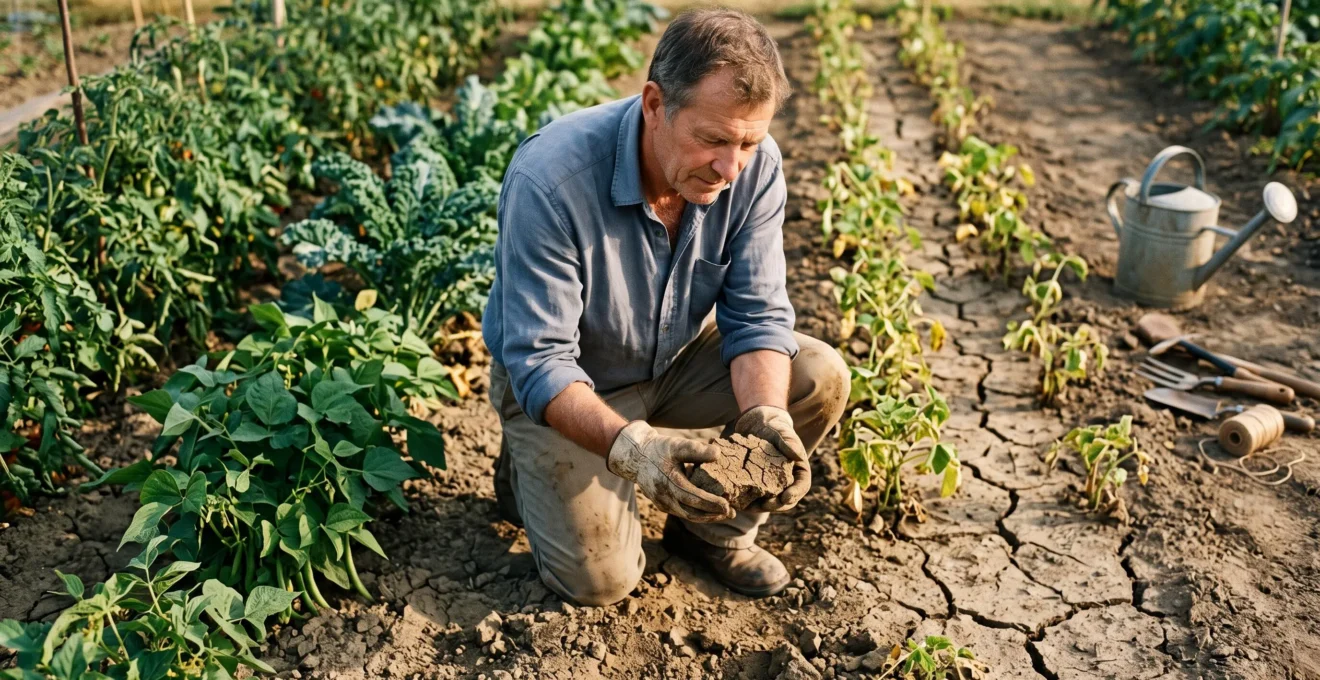
One vegetable bed produces vigorous crops while another, just a few metres away, struggles despite receiving similar watering, compost and attention. The difference may lie beneath the surface. Soil composition influences how water moves, how oxygen reaches roots, how nutrients are retained and how readily plants can explore the ground.
Yet identifying your soil as clay, sand or loam is only the beginning. Two beds with similar mineral composition can behave very differently because of compaction, organic matter, drainage and the arrangement of their soil particles.
For gardeners dealing with unpredictable results, the most useful approach is to investigate soil rather than repeatedly changing fertilisers or watering routines. A few household tests can reveal important clues, while observations across the seasons explain what those results mean for planting decisions.
The objective is not necessarily to change your soil type. It is to understand which properties limit plant growth, which can realistically be improved and where choosing better-adapted plants offers a more dependable solution.
What your soil reveals about plant performance
- Soil texture determines important water-holding and drainage characteristics, but soil structure strongly influences how those characteristics affect roots.
- Simple home tests can identify likely soil problems, although a complete jar sedimentation test takes up to 48 hours rather than 30 minutes.
- Matching plants to existing conditions, protecting soil aggregates and adding organic matter where appropriate can improve growing conditions without attempting to replace the soil.
- Why Do Clay Soils Drown Roots in Winter Yet Crack Like Concrete in Summer?
- How to Assess Your Soil Composition in 30 Minutes Using Household Items?
- Should You Amend Your Soil or Choose Plants Adapted to Its Natural Composition?
- The Hidden Soil Component That 80% of Gardeners Ignore When Testing Composition
- When in the Gardening Calendar Should You Test and Modify Soil Composition?
- How to Transition from Traditional Digging to No-Dig Methods Without Yield Loss?
- Why Do Waterlogged-Looking Plants in Clay Soil Actually Suffer from Oxygen Starvation Not Overwatering?
- How Do Regenerative Gardening Methods Reverse Decades of Soil Degradation in Home Gardens?
Why Do Clay Soils Drown Roots in Winter Yet Crack Like Concrete in Summer?
Clay soil can become waterlogged in winter and exceptionally hard in summer because its very fine particles retain water and, in some clay mineral combinations, swell when wet and shrink as they dry. These seasonal changes restrict root growth in different ways: saturated soil limits oxygen availability, while dry, dense clay can resist root penetration.
Clay particles are much smaller than sand grains and commonly have plate-like mineral structures. Their extensive surface area allows clay-rich soils to retain substantial moisture. However, the small spaces between densely packed particles can slow drainage, particularly when soil structure has deteriorated.
During prolonged British winter rainfall, water can occupy the pores that would otherwise contain air. Roots still need oxygen for respiration, even when their surrounding soil contains plenty of water. Saturation can therefore compromise root function rather than simply provide excessive moisture.
During dry weather, some clay minerals contract as water is lost. Shrinkage produces visible fissures, while the remaining ground may become hard enough to make cultivation difficult.
The Royal Horticultural Society advice on clay soils explains these seasonal challenges and recommends approaches including organic matter, careful cultivation, suitable planting and raised growing areas.
Summer cracks do not prove that the soil drains well. A bed showing deep fissures in August may have remained saturated during February. Surface appearance reflects present conditions, not necessarily the drainage experienced by roots months earlier.
Other soil textures present different limitations:
- Sandy soil: larger mineral particles generally allow rapid drainage but can make consistent moisture and nutrient retention more difficult.
- Silty soil: fine particles may support moisture retention but can be vulnerable to surface crusting and structural deterioration.
- Loamy soil: a mixture of sand, silt and clay often offers a useful balance, although compaction and poor structure can still undermine plant growth.
The crucial distinction is between a soil’s natural characteristics and the damage caused by its management. Clay is not inherently unsuitable for gardening; its behaviour simply demands particular attention to moisture and physical condition.
Before deciding whether your soil needs improvement, establish what it actually contains and how consistently those characteristics occur across your garden.
How to Assess Your Soil Composition in 30 Minutes Using Household Items?
You can make a useful preliminary assessment of soil composition in 30 minutes using a glass jar, water and simple hand tests. However, a reliable reading of all three sediment layers requires much longer settling. The first half-hour reveals initial texture, cohesion and drainage clues; completing the jar test may take 48 hours.
Begin by collecting samples from several garden beds rather than assuming the entire plot has identical soil. Separate obvious differences, such as a raised vegetable bed, a lawn and a low-lying border. For established beds, sample below the superficial mulch layer and include the soil occupied by roots.
A sample taken only from freshly added compost will describe the amendment rather than the underlying growing conditions.
Carry out the sedimentation test
The Clemson University’s soil texture jar test factsheet provides a household procedure for estimating the proportions of sand, silt and clay.
- Collect a representative soil sample, remove large stones and obvious plant debris, and sift the soil.
- Fill a transparent jar approximately one-third full with the prepared soil.
- Add clean water, leaving sufficient space to shake the contents, then close the jar securely.
- Shake vigorously until the soil and water form a uniform suspension.
- Place the jar on a level surface. After one minute, mark the upper boundary of the settled sand.
- After two hours, mark the next settled boundary representing the silt layer.
- After 48 hours, mark the final settled boundary to establish the clay layer.
- Measure the thickness of each layer, divide it by the total sediment thickness and express the result as a percentage. Use a soil texture triangle to classify the sample.
These observations produce an approximate mineral-texture classification, not a laboratory-grade analysis. They also do not directly measure soil health, compaction or nutrient availability.
Use three complementary field checks
While the jar settles, examine a separate sample through practical observations:
- Ribbon test: moisten a small amount of soil and press it between thumb and finger. Soil that forms a persistent, flexible ribbon suggests appreciable clay content.
- Squeeze-ball test: gently compress moist soil in your hand. A cohesive ball suggests finer particles or strong aggregation, while material that readily falls apart may be sandier or more crumbly.
- Drainage check: observe how water disappears from a test hole after wetting the surrounding soil. This provides information about local drainage but cannot independently identify mineral texture.
For a practical drainage reference, University of Missouri Extension describes water disappearing from a filled planting hole within approximately 18–24 hours as satisfactory under its assessment conditions. Water remaining for two days or longer suggests poor drainage. These are guidelines, not universal thresholds.
Your five-action soil investigation checklist
- Identify three contrasting growing locations and record their positions on a simple garden sketch.
- Collect a representative mineral-soil sample from each location and label three separate containers.
- Perform a ribbon and squeeze-ball assessment, recording a short texture description for every sample.
- Start a sedimentation jar for each sample, marking and recording the settling boundaries at one minute, two hours and 48 hours.
- Combine the texture results with drainage observations in a garden soil profile labelled heavy, light or balanced, noting any uncertainty.
A heavy profile suggests greater emphasis on drainage and workability. A light profile points towards moisture retention and regular organic inputs. A balanced profile still requires inspection for compaction or structural damage.
Avoid drawing conclusions immediately after unusually heavy watering or rainfall. Also record recent fertiliser or compost applications, which can affect the representativeness of the sample. For sedimentation, the important distinction is between a properly prepared sample and the moisture conditions affecting separate field tests.
Once you have identified the likely soil constraints, the next decision is whether to modify the ground or work with its existing characteristics.
Should You Amend Your Soil or Choose Plants Adapted to Its Natural Composition?
Choosing plants adapted to existing soil conditions is often more practical for large garden areas, while targeted soil improvement can be worthwhile in intensively cultivated beds. Amendments can improve structure, moisture behaviour and fertility, but they seldom transform the underlying mineral texture permanently. The right strategy depends on the planting purpose, available resources and drainage conditions.
Consider a heavy clay garden intended for ornamental shrubs. Replacing enough mineral material to create a fundamentally different texture would require substantial quantities of imported material. A more manageable approach may be to select shrubs that tolerate the existing conditions and improve surface soil health gradually.
Vegetable beds present a different calculation. They are relatively small, regularly managed and expected to support demanding seasonal crops. Investment in compost, access paths and raised growing areas may therefore deliver more useful results.
The following comparison highlights the practical trade-offs rather than claiming a universal financial advantage for either approach.
| Decision factor | Improve existing soil | Select adapted plants |
|---|---|---|
| Initial cost | May require compost, mulch, bed construction or drainage work | Primarily involves selecting suitable planting material |
| Labour | Can require preparation and continuing maintenance | Usually requires less soil intervention |
| Durability | Structural improvements require protection and maintenance | Adaptation remains useful while site conditions are broadly stable |
| Reversibility | Physical alterations may be difficult to undo | Plant selections can generally be changed |
| Best application | Vegetable beds and defined growing areas | Large borders and wider landscape planting |
A hybrid approach is often sensible: preserve the natural character of most of the garden while concentrating improvement efforts where crops or valued plants need more reliable growing conditions.
However, an isolated pocket of heavily amended material within dense clay can create problems. Water movement and root penetration may change abruptly at the boundary between the modified backfill and native ground.
The University of Missouri Extension’s landscape soil improvement publication explains these soil-interface risks and recommends matching trees and shrubs to site conditions rather than relying on unsuitable planting-hole modifications.
Where drainage or rooting space is genuinely inadequate, improving a wider growing area or using a raised bed can be more reliable than creating a narrow, sharply contrasting pocket. Avoid treating gravel beneath a planting hole as a drainage solution.
There is also an important distinction between improving a soil’s performance and changing its composition. Organic matter can help clay become more workable or sandy soil retain moisture without substantially changing the underlying mineral proportions.
Yet even a carefully classified soil can perform unexpectedly. The missing explanation is often not which particles are present, but how those particles are organised.
The Hidden Soil Component That 80% of Gardeners Ignore When Testing Composition
Soil structure is the overlooked component that helps explain why plants thrive in one bed and struggle in another with similar mineral composition. Structure describes how sand, silt, clay and organic materials form aggregates and pore networks. These arrangements control water movement, air availability and root penetration in ways that a basic texture test cannot reveal.
The suggested figure of 80% is not established by the supplied evidence and should not be treated as a measured proportion of gardeners. The underlying diagnostic issue, however, is important: texture and structure are different properties.
Texture tells you what mineral particles the soil contains. Structure tells you how those particles are arranged.
Imagine two hypothetical garden beds containing similar proportions of clay. The first has been repeatedly walked on during wet weather, while the second has been protected from trampling and regularly mulched.
Both might receive the same classification from a sedimentation test. Yet the compacted bed may have fewer connected air spaces and resist root penetration, while the protected bed may contain more stable crumbs, biological channels and usable rooting spaces.
Read soil structure directly in the garden
Lift a small, moist but not saturated clod and examine how it separates when gently broken apart.
- Crumb appearance: small, irregular aggregates that separate without excessive force suggest a more workable structure than dense, smeared masses.
- Root distribution: roots extending through the soil indicate accessible growing spaces; roots concentrated along cracks or restricted to the surface may indicate a physical limitation.
- Earthworm activity: worms and their channels provide evidence of biological activity, although their numbers also depend on season, moisture and soil conditions.
- Surface behaviour: crusting, persistent puddles and compacted patches help identify areas requiring closer investigation.
These observations are useful indicators rather than definitive measurements. For example, an absence of visible earthworms during dry weather does not automatically demonstrate unhealthy soil.
Why additional mineral material is not always the solution
Loss of organic inputs, repeated disturbance and compaction can weaken soil aggregation. When aggregates deteriorate, the spaces supporting drainage and aeration may become less effective.
Adding modest quantities of sand to heavy clay is not a dependable shortcut to creating loam. Meaningful changes in mineral proportions can require impractically large amounts of material, and unsuitable mixing can produce a dense, difficult growing medium.
250 kg/m²
The Royal Horticultural Society gives this approximate quantity of grit or gravel as an illustration of what would be required to halve the clay proportion in cultivated soil initially containing 40% clay. It is not a recommended application rate.
Royal Horticultural Society, clay soil guidance.
Protecting the aggregates that already exist is usually more realistic than trying to rebuild the entire mineral composition. Organic matter, permanent planting, reduced trampling and appropriate cultivation timing can all contribute.
Because soil structure is particularly vulnerable when moisture conditions are unsuitable, the timing of soil work becomes the next important variable.
When in the Gardening Calendar Should You Test and Modify Soil Composition?
Test soil texture when representative samples can be collected and prepared consistently, but assess drainage and structure across contrasting seasonal conditions. In much of the UK, autumn and spring provide useful opportunities for observation and soil improvement. Avoid cultivating saturated clay or extremely dry, hardened ground, because inappropriate timing can damage structure or produce misleading results.
Mineral composition changes slowly under ordinary garden management. Seasonal moisture, biological activity and aggregation can change much more noticeably.
Consequently, a single texture classification may remain useful for years, while drainage observations and soil-health checks deserve regular attention.
| Season | Useful observations | Recommended approach |
|---|---|---|
| Winter | Standing water, persistent saturation and poor drainage | Observe and record; avoid walking on or cultivating wet beds |
| Spring | Workability, soil warming and planting readiness | Assess moisture before preparation and planting |
| Summer | Cracking, rapid drying, surface crusting and crop stress | Maintain suitable mulch and monitor water availability |
| Autumn | Post-harvest structure, root development and compaction | Apply appropriate organic matter and establish protective cover |
The calendar should follow actual weather and ground conditions rather than fixed dates. A mild, wet spring can leave clay unsuitable for cultivation long after the usual planting period, while a dry autumn may limit the usefulness of certain observations.
The workability ball test
Take a handful of soil from the intended cultivation depth and squeeze it gently. Then examine how the compressed material behaves.
If it remains sticky, smears easily and forms a dense mass that resists breaking apart, cultivation may damage the structure. If it breaks into natural crumbs under gentle pressure, working conditions are generally more favourable.
Very dry clay may also be unsuitable for cultivation because it can form exceptionally hard clods. A soil that is merely dry enough not to smear is not automatically in ideal condition.
This test is a practical judgement aid rather than a precise moisture measurement. Its interpretation depends on soil texture and the activity planned.
How frequently should soil be reassessed?
Repeat a full texture assessment when establishing a new growing area, discovering substantial differences between beds or investigating imported soil. Routine annual jar testing is usually unnecessary unless the growing medium has materially changed.
Instead, monitor soil structure, infiltration, surface condition and rooting behaviour during the growing year. Comparing observations made under similar moisture conditions is more informative than treating every seasonal difference as a permanent change.
For annual vegetable production, regular records can also show whether compost, mulch and cultivation practices are improving workability over time.
One way to reduce the need for disruptive cultivation altogether is to move towards a system that improves soil from the surface.
How to Transition from Traditional Digging to No-Dig Methods Without Yield Loss?
Transitioning to no-dig gardening can preserve soil structure and support productive growing conditions, but avoiding yield loss is not guaranteed. The safest approach is to convert one manageable bed, provide adequate organic mulch, control competing weeds and monitor crop performance. Existing compaction, poor drainage and insufficient organic material can complicate the first growing seasons.
Traditional digging exposes and mixes soil layers. Although cultivation can temporarily loosen the surface, repeated disturbance may disrupt aggregates, earthworm channels and fungal networks.
No-dig systems reduce routine turning of the soil. Instead, organic materials are applied at the surface, where soil organisms gradually contribute to their incorporation and breakdown.
The Royal Horticultural Society guidance on no-dig gardening describes practical establishment methods, ongoing mulching and limitations such as persistent weeds and compacted starting conditions.
Convert one bed before changing the entire garden
- Choose an accessible growing area and record its existing crop performance, weed pressure and drainage behaviour.
- Remove or address problematic perennial weeds rather than assuming surface covering will eliminate every infestation.
- For new beds over grass or weeds, use overlapping cardboard beneath approximately 10–15 cm of suitable organic material, following the RHS method.
- For an existing growing bed, apply a comparable initial organic layer without routinely turning the underlying soil.
- Maintain access without walking on the planting surface. A bed approximately 1.2 m wide can make this easier where access is possible from both sides.
- After establishment, maintain an annual organic mulch of approximately 5 cm, adapting application timing to local conditions.
The initial material requirement can be substantial. Using mature compost or other appropriate organic material avoids relying on a thin decorative covering that does little to suppress weeds or protect the surface.
For an initial trial, consider established transplants with accessible planting positions and straightforward care requirements. Small direct-sown seeds need a suitable fine surface for germination, while root crops may reveal unresolved compaction or coarse surface material.
These are practical establishment considerations, not a proven ranking of crops by no-dig performance.
What happens during the transition?
Early results vary. A bed with manageable weeds, adequate organic material and reasonable drainage may establish successfully without a prolonged adjustment period. Severely compacted soil or persistent perennial weeds may require additional intervention.
Where soil is exceptionally firm, careful loosening with a garden fork without turning the soil can help address initial compaction. A heavily waterlogged site may benefit from raised growing areas.
No-dig should not be treated as a promise of higher yields every year. Crop choice, nutrition, weather, pests and starting soil conditions remain important. The supplied evidence does not establish a universal transition period or a guaranteed yield trajectory.
The underlying benefit is physical: protecting connected pores and biological channels can help roots and water move through soil. This matters in both clay-rich and sandy beds, even though their moisture-management challenges differ.
However, even well-managed soil can suffer temporary oxygen shortages during prolonged wet weather, especially where clay slows drainage.
Why Do Waterlogged-Looking Plants in Clay Soil Actually Suffer from Oxygen Starvation Not Overwatering?
Plants growing in saturated clay soil often suffer because water fills the pore spaces that would normally supply oxygen to their roots. This condition, known as root hypoxia, can reduce root function and produce wilting, yellowing or poor growth. Excess irrigation may cause saturation, but prolonged rainfall and inadequate drainage can produce the same problem without additional watering.
The everyday term « overwatering » describes a possible cause, but it does not fully explain the mechanism.
Roots require oxygen for normal respiration. When soil remains saturated, gas exchange becomes restricted and oxygen availability can decline. Root systems may then struggle to absorb water and nutrients despite being surrounded by moisture.
That explains a particularly confusing observation: a plant can wilt in wet soil.
The visible symptoms can resemble drought stress because both conditions interfere with water supply to the leaves. Yet the necessary responses may be very different.
| Observation | Possible oxygen shortage in clay | Possible drought stress in sandy soil |
|---|---|---|
| Root-zone moisture | Persistently wet or saturated | Dry or rapidly drying |
| Drainage behaviour | Slow disappearance of standing water | Water generally infiltrates and drains readily |
| Foliage symptoms | Wilting, yellowing or stalled growth | Wilting, drying or stalled growth |
| Useful first response | Investigate drainage and avoid additional saturation | Check root-zone dryness and restore appropriate moisture |
Leaf symptoms alone cannot reliably separate these conditions. Check moisture beneath the surface and consider recent rainfall, drainage and the plant’s rooting environment before intervening.
Correct the restriction, not just the watering schedule
Reducing irrigation is useful where unnecessary watering contributes to saturation. It cannot, however, remove rainwater trapped by poorly draining soil or correct a persistent drainage limitation.
Depending on the site, the practical response may involve:
- Preventing further compaction by keeping off saturated planting areas.
- Adding suitable organic matter at the surface to support gradual structural improvement.
- Using appropriately designed raised beds where the existing root zone is persistently waterlogged.
- Planting suitable woody plants on slightly raised mounds where conditions justify the approach.
- Investigating serious or repeated drainage problems before installing drainage measures or attempting deep soil loosening.
Deep aeration or mechanical loosening should not be treated as a universal remedy. Its suitability depends on the cause and depth of compaction, soil moisture and the presence of existing roots or underground services.
Recovery may also be gradual. Improving drainage does not immediately restore root tissue already damaged by prolonged oxygen shortage, and severely affected plants may not recover.
Once that distinction becomes clear, the long-term goal is not merely to repair individual symptoms but to build soil conditions that are more resilient to seasonal stress.
Key takeaways before rebuilding soil health
- Diagnose physical restrictions before adding fertiliser: compacted, saturated soil may prevent roots from using available nutrients effectively.
- Protect existing soil structure before attempting major changes; avoiding damage is often easier than repairing it.
- Measure improvement through repeated observations under comparable conditions rather than expecting a permanent change after a single intervention.
How Do Regenerative Gardening Methods Reverse Decades of Soil Degradation in Home Gardens?
Regenerative gardening can improve degraded home-garden soil by reducing disturbance, maintaining plant cover, increasing organic inputs and supporting biological activity. These practices can rebuild aspects of soil structure and improve the growing environment without fundamentally changing its mineral texture. Some benefits may become observable within a growing season, while deeper structural recovery requires sustained management over several years.
The principle is to treat soil as a functioning system rather than a passive container for roots.
A garden bed can lose structural quality through repeated disturbance, compaction, bare-soil exposure and insufficient organic inputs. Regenerative methods address these pressures through complementary practices rather than a single corrective product.
Five practices that target different soil problems
- Maintain living cover: use appropriate cover crops or permanent planting to protect the surface and retain active root systems when practical.
- Diversify planting: vary crops and planting families to reduce repeated dependence on the same rooting patterns and help manage some soil-borne disease risks.
- Return organic material: apply suitable compost and mulch to support aggregation, biological activity and moisture management.
- Minimise unnecessary disturbance: protect aggregates, biological channels and established pore networks by reducing routine cultivation.
- Keep roots in the soil: use successive planting or suitable groundcover so that beds remain biologically active for more of the year.
These methods work best when matched to the actual limitation. A sandy bed may benefit particularly from improved moisture retention and surface protection, while clay soil may require attention to compaction, workability and drainage.
Neither situation necessarily calls for wholesale replacement of mineral soil.
How quickly can damaged soil recover?
There is no reliable universal timetable for reversing decades of degradation. The starting condition, climate, available organic material and consistency of management all influence the outcome.
Changes in surface condition, visible biological activity or ease of cultivation may become apparent during an early growing season. Improvement in deeper aggregation, root access and the distribution of organic matter may require repeated seasons of appropriate management.
A heavily compacted or persistently waterlogged site may also need a targeted correction before biological processes can deliver substantial improvements.
Rather than assuming that improvement must occur within a particular number of months, establish observable indicators and compare them consistently.
Monitor regeneration without specialised laboratory equipment
Useful indicators include earthworms, infiltration, root depth and aggregate stability.
Earthworm observations can provide clues about biological activity when made under comparable seasonal conditions. Infiltration observations can reveal whether surface water is disappearing more readily, although antecedent moisture and rainfall influence the result.
At the end of the growing season, examine the depth and distribution of roots where this can be done without unnecessary damage. Restricted or strongly deflected roots can help identify persistent physical barriers.
Finally, compare small soil clods collected under similar moisture conditions. The presence of stable, naturally separating crumbs is a useful sign to record alongside crop performance.
A simple garden notebook can connect these observations to management changes, including mulch applications, cover crops and periods of exceptional rainfall. It also reduces the temptation to attribute every improvement or setback to one intervention.
The most revealing outcome is that the same mineral soil can support different plant performance as its structure and biological condition change. Composition establishes the starting characteristics, but it does not permanently determine the quality of the rooting environment.
Choose one underperforming bed, document its texture, drainage and structure, and introduce one or two appropriate management changes. Reassess under comparable seasonal conditions. The resulting record will be more useful than a succession of unconnected soil treatments, and it will show whether your garden is becoming a more reliable place for plants to grow.
Can two neighbouring garden beds have different soil compositions?
Yes. Soil may differ across short distances because of previous landscaping, imported material, slopes or changes in underlying ground. Even where mineral texture is similar, compaction, drainage and organic matter can vary. Test and observe contrasting growing areas separately before assuming one result represents the whole garden.
Does a soil texture test reveal whether fertiliser is needed?
No. A sedimentation test estimates the relative proportions of sand, silt and clay. It does not measure nutrient concentrations or establish whether a fertiliser application is appropriate. Nutrient assessment requires different evidence, potentially including an appropriate laboratory soil test and observations of plant performance.
Can compost turn heavy clay soil into loam?
Compost can improve the working properties of clay-rich soil by supporting aggregation, biological activity and more favourable pore conditions. However, adding organic matter does not normally convert the underlying mineral texture into loam. The practical goal is improved soil function rather than eliminating the clay fraction.
Is a raised bed always necessary for clay soil?
No. Many clay soils can support productive gardens when planting, access and soil management are appropriate. Raised beds or mounds are particularly useful where persistent waterlogging, compaction or restricted workability creates a significant limitation. They should address a diagnosed problem rather than be considered compulsory for every clay-rich garden.
How can a gardener tell whether soil improvement is working?
Compare observations of infiltration, crumb structure, rooting depth, biological activity and plant performance over time. Record seasonal moisture and weather conditions so that differences are interpreted fairly. Mineral texture may remain largely unchanged even when workability, drainage behaviour and the growing environment improve.