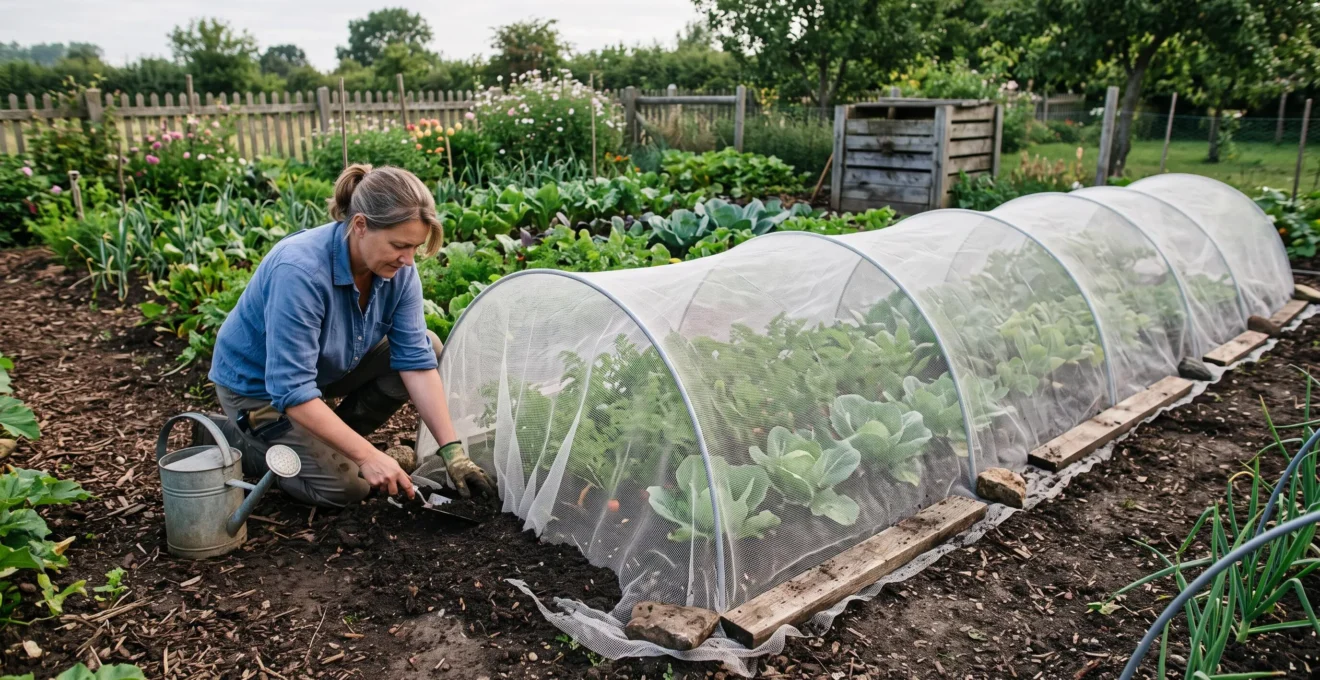
Physical pest barriers protect vegetables by preventing insects and birds from reaching vulnerable crops in the first place. Rather than killing pests after damage begins, insect-proof mesh, butterfly netting, horticultural fleece and properly constructed cages create a physical separation between the crop and the surrounding garden.
For UK gardeners growing carrots, cabbages, salads and fruit, this approach can substantially reduce pest damage without insecticide sprays. A correctly selected mesh stops its target insects from passing through the covering, while a secure perimeter prevents them from entering around the edges.
However, 100% crop protection cannot be guaranteed. Pests may already be present in the soil, insects can enter during maintenance, and coverings may interfere with ventilation or pollination. Success depends on choosing the right opening size, covering crops before exposure, sealing every accessible gap and checking conditions throughout the growing season.
The most effective system therefore combines exclusion engineering with crop rotation, regular inspection and practical adjustments as plants develop.
Physical pest barriers: the essentials
- Match mesh size to the pest. Standard 1.3–1.4 mm insect mesh can exclude carrot fly, while 4–7 mm butterfly netting is suitable for cabbage whites when foliage does not touch the net.
- Install early and seal completely. Protect susceptible crops from sowing or planting, bury the edges and prevent gaps around access points.
- Manage the growing environment. Check moisture, humidity, temperature and pollination needs so pest exclusion does not create new crop problems.
- Why Does Carrot Fly Need 0.8mm Mesh While Cabbage White Butterflies Are Stopped by 7mm Netting?
- Should You Install Physical Pest Barriers Before Planting or After Plants Emerge?
- Horticultural Fleece vs Enviromesh vs Cloches: Which Barrier Suits Which UK Vegetable Crops?
- The Barrier Installation Mistake That Lets Pests In Through Unsealed Edges
- When Should You Install or Remove Physical Pest Barriers to Avoid Overheating Crops?
- How to Control Garden Pests Using Barriers, Traps, and Hand-Picking Before Resorting to Sprays?
- Horticultural Fleece vs Enviromesh vs Cloches: Which Barrier Suits Which UK Vegetable Crops?
- How Can Low-Chemical Gardening Practices Reduce Toxin Exposure While Controlling Pests Effectively?
Why Does Carrot Fly Need 0.8mm Mesh While Cabbage White Butterflies Are Stopped by 7mm Netting?
Carrot fly does not strictly require 0.8 mm mesh: standard insect-proof mesh with 1.3–1.4 mm openings can also exclude it. The difference between fine insect mesh and 7 mm butterfly netting comes from the size of the pests being excluded. Smaller insects require smaller openings, while larger butterflies can be stopped by relatively coarse netting, provided they cannot reach the foliage through it.
Mesh selection is an engineering decision. The openings must be sufficiently small to prevent the target pest from reaching the crop, but the covering must also allow adequate light, air and moisture to support plant growth.
According to the RHS advice on insect-proof mesh, different materials protect against different groups of garden pests.
| Mesh opening | Target pests | Important limitation |
|---|---|---|
| 4–7 mm | Cabbage white butterflies | Leaves must remain clear of the netting. |
| 1.3–1.4 mm | Carrot fly, cabbage root fly, onion fly, moths and butterflies | Not reliable against several smaller insects. |
| 0.8 mm | Carrot fly, flea beetles, aphids, cabbage whitefly and several other small pests | Ventilation and humidity need consideration. |
| 0.3–0.6 mm | Very small insects, including thrips | Fine coverings require particular attention to growing conditions. |
A cabbage white butterfly is much larger than a carrot fly. That allows a relatively open net to prevent adult butterflies from entering a brassica enclosure. However, butterflies may still lay eggs on foliage pressed against the material. Supporting netting above the leaves prevents this contact.
Carrot flies are smaller and reach vulnerable plants through openings that would easily exclude butterflies. A tighter mesh therefore provides more appropriate protection, particularly where multiple small pests threaten the same bed.
Choosing the finest available mesh is not automatically best. Finer fabrics may restrict airflow and influence humidity and temperature beneath the covering. The practical effect depends on the material, weather, installation and crop.
Before buying, identify the principal pest, determine when adults are active and establish whether they attack through leaf contact, flight or soil emergence. Then select a covering that excludes the relevant insect without unnecessarily restricting the crop environment.
Opening size is only the first part of successful exclusion. Even an appropriate mesh will fail if it is installed after eggs have been laid or if pests can enter around its perimeter.
Should You Install Physical Pest Barriers Before Planting or After Plants Emerge?
Install insect-proof barriers before vulnerable crops become exposed to egg-laying pests. For direct-sown vegetables, this usually means fitting the covering immediately after sowing; for transplants, protect the bed as soon as clean plants are installed. Waiting until seedlings are visibly established may leave enough time for insects to lay eggs that subsequently develop inside the enclosure.
The central principle is to exclude the pest before the first opportunity to attack, rather than responding after damage appears.
For carrots, this matters because adult carrot flies lay eggs near host plants. Their larvae subsequently feed on roots, creating damaged tunnels that may remain unnoticed until harvest. Covering an already infested crop does not remove eggs or larvae.
The RHS identifies May to October as the main carrot fly activity period in UK gardens, with egg-laying periods including late spring and late summer. Its information on carrot fly biology and management also explains why rotation is essential when using protective coverings.
Carrot fly may overwinter as immature stages in the soil. If a tunnel is installed over a previously infested bed, emerging adults can find themselves enclosed with a fresh host crop. The barrier then restricts their escape rather than preventing the original infestation.
A practical installation sequence is straightforward:
- Choose a growing area that accounts for the previous season’s susceptible crops.
- Prepare the bed and complete soil work before fitting the covering.
- Position hoops or a suitable frame without leaving uncovered planting areas.
- Sow seeds or insert inspected, pest-free transplants.
- Secure the mesh immediately and confirm the perimeter is closed.
Early covering introduces maintenance challenges. Gardeners still need access for thinning, watering, weeding and checking seedlings. A removable side secured beneath timber battens or soil-filled weights can make these jobs manageable without dismantling the entire structure.
For carrots, sowing thinly reduces the need for disturbing the crop later. This is useful because thinning releases plant odours that can attract carrot flies.
Cloche timing is slightly different where the principal objective is warmth. A cloche used to warm soil may be positioned before sowing, while insect mesh is generally fitted around the time crops are planted or seeds are sown.
Installing early is valuable only when the soil and planting material are free from the relevant pest. Once the enclosure is in place, the next decision is which protective material best supports the crop.
Horticultural Fleece vs Enviromesh vs Cloches: Which Barrier Suits Which UK Vegetable Crops?
Choose horticultural fleece for short-term seedling protection and additional warmth, insect-proof mesh such as Enviromesh for extended exclusion of flying pests, and cloches for warming or sheltering individual plants and small rows. The best choice depends on the crop’s growth period, the target pest, ventilation requirements and whether insects must reach flowers for pollination.
These products differ in function, not simply appearance. A fleece cover modifies the growing environment while offering a physical barrier. Purpose-made insect mesh concentrates on exclusion with comparatively little additional warmth. A cloche creates a small sheltered growing space but is less dependable as a complete insect-exclusion system.
| Feature | Horticultural fleece | Insect-proof mesh, including Enviromesh | Garden cloches |
|---|---|---|---|
| Best application | Young seedlings and temporary warmth | Longer-term insect exclusion | Early crops, transplants and isolated plants |
| Temperature effect | Provides some insulation | Generally adds less warmth than fleece | Can produce substantial warming |
| Durability | Relatively delicate | Potentially reusable over several seasons | Depends on construction and material |
| Airflow and moisture | Humidity needs monitoring | Air and rainfall can pass through, subject to material | Ventilation and watering may need active management |
| Main weakness | Tearing, dirt accumulation and damp conditions | Gaps, incorrect openings and restricted pollination | Overheating and weaker insect exclusion |
Heavier horticultural fleece can provide approximately 2 °C of frost protection under suitable conditions. This makes it useful for young crops during unsettled spring weather. However, fleece can tear during removal for routine cultivation and may deteriorate more quickly than woven insect mesh.
Purpose-made insect-proof mesh can remain serviceable for approximately five to ten years, depending on its condition. It is therefore a practical option for repeated seasonal protection of carrots, brassicas and other susceptible vegetables.
Enviromesh is a product name rather than a universal mesh-size specification. Gardeners should check the stated opening dimensions instead of assuming that every mesh product excludes the same insects.
Cloches are especially useful when warm soil and shelter matter. They can protect tender transplants and assist early growth, but poor ventilation may lead to high humidity, excessive warmth and fungal disease.
Pollination changes the decision. Courgettes and strawberries require insect access for normal fruit production. Leaving them fully enclosed through flowering may protect against certain pests while reducing fruit set.
In the UK’s variable climate, neither persistent dampness nor strong sunshine should be ignored. A cool, wet period may favour moisture accumulation under fleece, while a bright day can make a poorly ventilated cloche unsuitable for tender plants.
Once the material is chosen, effective protection depends on installation quality. A durable, accurately specified covering cannot compensate for an open route into the crop.
The Barrier Installation Mistake That Lets Pests In Through Unsealed Edges
The most damaging installation mistake is leaving gaps around the edges of an otherwise insect-proof covering. A mesh with 0.8 mm openings cannot exclude flying pests if a loose corner creates an entrance several centimetres wide. Effective protection requires a continuous enclosure, with secured edges, tightly managed corners and no unintended access beneath the structure.
Think of the mesh as one component of a complete enclosure. Every section of its boundary must prevent the target insect from entering, including areas where the material meets soil, timber, supports or access flaps.
The RHS recommends burying the edges of protective insect mesh beneath at least 5 cm of soil. An alternative practical arrangement uses continuous weights, such as boards or soil-filled bags, to keep material firmly in contact with the ground.
A framed tunnel is often easier to secure consistently than unsupported fabric laid directly over plants. The frame establishes a predictable perimeter and provides room for crop growth without stretching the mesh across foliage.
Common points of failure include:
- Loose corners where overlapping material lifts away from the soil.
- Uneven beds that leave openings beneath straight timber battens.
- Wind lifting unsecured sections of fabric.
- Damaged or stretched mesh with enlarged openings.
- Access flaps that are not fully resealed after gardening work.
- Infested transplants or contaminated soil already containing the target pest.
Excessive stretching deserves particular attention. Pulling insect mesh tightly across hoops can enlarge the openings, potentially reducing its ability to exclude the insects for which it was selected.
Five checks for an insect-proof vegetable tunnel
- Identify the pest and covering: Record the target insect, selected mesh opening and crop in a simple bed-protection note.
- Inspect the planting area: Check crop history, soil exposure and transplants; make a short record of potential infestation risks before sealing.
- Secure the complete perimeter: Bury edges beneath at least 5 cm of soil or use continuous, stable weights; complete a full perimeter inspection.
- Check corners and supports: Examine every junction for openings, stretched fabric and plant contact; mark any repairs completed.
- Test the maintenance access: Open and close the designated access point, then confirm that no visible gaps remain.
Even a carefully sealed structure needs repeated inspection. Wind, soil movement, growing plants and routine maintenance can all change its condition after installation.
A secure enclosure prevents pests from bypassing the chosen mesh, but it also changes conditions around the foliage. Ventilation and seasonal timing become the next critical considerations.
When Should You Install or Remove Physical Pest Barriers to Avoid Overheating Crops?
Install barriers before the relevant pest becomes active and maintain them while the crop remains vulnerable. Remove or adjust coverings when pollination, excessive humidity or overheating makes full enclosure unsuitable. In UK gardens, seasonal pest activity provides a better guide than a fixed removal date, while visible plant stress helps determine when ventilation or a different covering is necessary.
Carrot fly illustrates the importance of seasonal timing. The pest can remain active across much of the UK growing season, with important egg-laying periods in late spring and late summer. Removing carrot protection after the first period may expose the roots to another generation.
Regional conditions, seasonal weather and the crop’s development can shift the practical risk period. Use relevant local pest observations alongside established UK horticultural guidance rather than relying solely on the calendar.
Overheating is especially relevant to cloches and fleece. Under favourable conditions, cloches can raise local soil temperatures by up to 10 °C, according to the RHS. This is a conditional potential increase, not a typical temperature rise for every garden.
The RHS advice on using garden cloches explains their warming benefits as well as the need for ventilation and appropriate access for pollination.
Watch for warning signs that the protective environment needs attention:
- Wilting foliage during warm weather, particularly when soil moisture is inadequate.
- Persistent condensation inside a cloche or beneath a covering.
- Continually damp leaves or poor air movement around crowded plants.
- Slower growth or deterioration that may indicate unsuitable growing conditions.
- Flowers developing on crops that require insect pollination.
These symptoms are not conclusive proof of overheating. Water stress, disease and other growing problems can produce similar signs, so assess moisture and plant health before deciding what to change.
Adjustable coverings make these competing needs easier to manage. A cloche with vents allows air exchange without complete removal. A fleece tunnel with repositionable side weights provides access and ventilation, although any opening may also admit pests.
Where insect exclusion remains essential, replacing a heat-retaining covering with suitably selected insect mesh may be more appropriate than leaving the crop exposed. Mesh generally provides less additional warmth than fleece, although humidity and airflow still require monitoring.
When a cover must be lifted, choose a practical maintenance opportunity, inspect for pest activity and reseal it promptly. Ventilation should never be described as preserving complete exclusion while an opening remains accessible.
Seasonal adjustment is part of prevention rather than evidence of barrier failure. When pests are detected despite protection, complementary mechanical controls can help identify and correct the problem.
How to Control Garden Pests Using Barriers, Traps, and Hand-Picking Before Resorting to Sprays?
Control garden pests without automatically resorting to sprays by combining physical exclusion, regular inspection, appropriate monitoring traps and manual removal. Barriers prevent many flying pests from reaching crops, traps can reveal changes in some pest populations, and hand-picking addresses accessible insects or slugs already present. Each method has limits, so interventions should follow identification and observation rather than a fixed treatment routine.
Physical exclusion works particularly well when the threat is predictable. Carrot flies, cabbage whites and other crop-specific pests can be targeted with suitable coverings before egg laying begins.
Traps provide a different service. Yellow sticky traps may help monitor certain flying insects, while species-specific pheromone traps can indicate activity in pests for which an appropriate monitoring product exists.
However, a trap that catches insects does not necessarily provide effective population control. Its main value may be showing whether pest pressure is increasing or when a particular intervention deserves attention.
The RHS advice on managing pests without chemicals supports combining monitoring, preventive cultivation, manual intervention and the conservation of beneficial organisms.
There is no single trapping method suitable for every garden insect. In particular, general pheromone-trap advice should not be interpreted as evidence that a specific trap reliably monitors carrot fly.
Hand removal provides another useful correction method, especially when pest populations are small and accessible. Caterpillars and egg clusters can be checked on the undersides of brassica leaves. Slugs may be easier to find during damp conditions or after dark.
A practical monitoring routine can follow four observations:
- Inspect vulnerable leaves, growing tips and plant bases regularly.
- Record which pests, eggs or damage symptoms are actually present.
- Check whether barriers have gaps or whether insects may already be enclosed.
- Remove accessible pests or correct the barrier, then examine the crop again.
Keep records concise: crop, date, pest observed, action taken and condition at the next inspection. Over time, these notes can reveal recurring periods of attack without implying that a particular calendar date applies to every season.
Not every insect sighting warrants intervention. Small amounts of cosmetic feeding may be tolerable, and beneficial predators such as hoverfly larvae naturally feed on aphids.
Mechanical controls can reduce the number of situations in which a gardener considers pesticides. Avoiding unnecessary treatments also avoids the associated application exposure and helps conserve non-target organisms, although the size of these benefits depends on the products and circumstances involved.
The strongest routine is preventive but adaptable. Its effectiveness improves when the materials, pest risks and maintenance requirements are considered for each crop rather than treated as identical across the garden.
Horticultural Fleece vs Enviromesh vs Cloches: Which Barrier Suits Which UK Vegetable Crops?
For carrots, use insect-proof mesh from sowing; for cabbages, choose butterfly netting or finer mesh according to the pests present; for onions, prioritise suitably fine insect protection; and for young salads, select fleece or mesh according to seasonal conditions. Strawberries require a different approach because protection must allow pollinators to reach flowers before fruit protection becomes the main concern.
Matching materials to individual crops makes the system more economical and easier to maintain. A single covering type cannot provide equally suitable pest exclusion, thermal protection and pollinator access for every vegetable or fruit crop.
| Crop | Recommended protection | When to protect | Main precaution |
|---|---|---|---|
| Carrots | Standard 1.3–1.4 mm insect mesh or suitable finer mesh | Immediately after sowing, accounting for carrot fly activity | Rotate crops and prevent soil-emerging pests being enclosed. |
| Cabbages | 4–7 mm butterfly netting or finer insect mesh | From transplanting or early crop establishment | Keep foliage clear of the net and secure the entire perimeter. |
| Onions | Insect-proof mesh sized for the target pest | From planting during relevant pest-risk periods | Standard mesh may not exclude all small allium pests. |
| Salads | Light fleece for warmth or insect mesh for pest exclusion | During vulnerable early growth and relevant pest activity | Monitor moisture, ventilation and potential slug activity. |
| Strawberries | Adjustable cloche for early shelter; appropriately supported bird protection after pollination | Early growth or as fruit becomes vulnerable | Provide flower access for pollinating insects and keep bird netting secure. |
Carrots benefit especially from complete mesh coverage because a low vertical barrier is less reliable than a properly enclosed crop. Protection should also account for related susceptible plants such as parsnips and parsley.
Brassicas face several different insects, including cabbage white butterflies and smaller pests. Coarse butterfly netting may be entirely appropriate when butterflies are the main threat, but it should not be mistaken for all-purpose insect protection.
Allium crops require the same pest-specific thinking. Standard insect mesh can exclude onion fly, yet smaller threats such as allium leaf miner may call for finer protection.
For strawberries and other soft fruits, the engineering problem changes as plants grow and flower. A temporary cloche may shelter early plants, but a larger crop-support structure can be more appropriate for bird protection as fruit develops.
Fruit bushes may need a supported bird-proof enclosure rather than a low fleece tunnel. Netting should be securely tensioned and maintained to reduce the risk of birds becoming trapped or entangled.
Budget comparisons should consider cost per usable season, rather than purchase price alone. A relatively expensive insect mesh may prove economical when reused over several years, whereas delicate fleece may require more frequent replacement.
However, there is no universal price or lifespan advantage. Wind exposure, UV deterioration, storage, handling and the amount of material needed can change the calculation. Cloches likewise vary considerably according to construction and durability.
A reusable, well-maintained frame can improve the practical value of different coverings because the gardener may change the material without rebuilding the entire support system.
The right long-term investment is not necessarily the strongest or finest covering. It is the system that protects the crop’s vulnerable stages while remaining practical to inspect, maintain and adapt.
Key takeaways before choosing a chemical-free strategy
- Prevent exposure rather than treating damage: correctly timed, sealed barriers can eliminate the need for many insecticide applications against targeted flying pests.
- Preserve the crop environment: ventilation, pollination access and soil health are part of successful physical protection, not separate concerns.
- Recognise the limitations: pests already in the soil, slugs, access gaps and incorrect mesh selection can prevent complete control.
How Can Low-Chemical Gardening Practices Reduce Toxin Exposure While Controlling Pests Effectively?
Low-chemical gardening reduces potential exposure to pest-control products by preventing damage before treatment becomes necessary. Properly selected barriers, healthy growing conditions, crop rotation and monitoring can control many problems without routine pesticide applications. This approach reduces opportunities for contact with spray products, but it does not guarantee zero exposure to all harmful substances or complete protection from every garden pest.
A physical barrier works differently from a pesticide. Rather than applying a substance to kill or suppress an organism, the gardener prevents the target pest from reaching the crop.
When exclusion succeeds, there may be no reason to apply an insecticide against that pest. This is particularly relevant to household vegetable gardens used by children and pets, where gardeners may wish to avoid unnecessary handling, application and storage of pest-control products.
However, claims about quantified reductions in human exposure require evidence specific to the products, application methods and exposure pathways involved. A chemical-free barrier system should not be described as proving a particular percentage reduction in health risk.
It is also important not to assume that products marketed as natural or biological are automatically harmless. Their potential effects depend on their ingredients, intended targets, application and conditions of use.
Reducing pesticide reliance moves effort towards preventive cultivation:
- Crop rotation: avoid repeatedly growing susceptible crops in soil where relevant pests may survive between seasons.
- Suitable planting conditions: support healthy roots and foliage through appropriate soil preparation, watering and spacing.
- Targeted physical exclusion: install coverings for identifiable pest risks instead of applying one method indiscriminately.
- Crop observation: identify actual damage and distinguish pest activity from disease or environmental stress.
- Beneficial wildlife: support natural predators with appropriate habitat and flowering plants.
Hoverflies, lacewings and ground beetles can contribute to biological regulation of garden pests. Avoiding unnecessary broad-spectrum treatments helps reduce direct disturbance to non-target organisms, while suitable habitat provides opportunities for beneficial species to persist.
These biological processes complement physical exclusion rather than replacing it. A mesh covering can prevent a cabbage white butterfly from laying eggs, while natural enemies may help manage pests elsewhere in the garden.
Mechanical barriers nevertheless have limits. They cannot reliably eliminate organisms already established beneath the covering, and they may not protect roots against every soil-dwelling pest. Poorly timed protection can also trap insects inside, while unnecessarily prolonged covering may interfere with flowering or increase humidity.
The appropriate objective is therefore reliable, measurable reduction of avoidable pest damage, not an unsupported promise of universal 100% control.
For the next planting, choose one vulnerable bed, identify its principal pest, fit an appropriate barrier before exposure and inspect the enclosure throughout the growing period. Record the resulting crop condition and any pest damage. That provides a practical basis for improving protection season after season without relying on routine sprays.
Can insects emerge inside a completely sealed mesh tunnel?
Yes. Some insects, including carrot fly, can survive part of their life cycle in the soil. If a protected crop is planted where these pests overwintered, adults may emerge inside the enclosure. Crop rotation and appropriate bed selection are essential complements to sealing the mesh.
Can rain pass through insect-proof mesh?
Insect-proof mesh generally allows rain to pass through, unlike solid plastic cloches that may exclude direct rainfall. However, the amount of water reaching the soil depends on the material and conditions. Inspect soil moisture regularly rather than assuming plants receive enough water beneath any covering.
Can physical barriers protect vegetables from pigeons as well as insects?
Yes, properly supported and secured netting can prevent pigeons from reaching vulnerable leaves, particularly young brassicas. Use a structure that keeps the net away from the plants and prevents birds entering beneath it. Inspect the covering for loose sections or arrangements that could entangle wildlife.
Should damaged insect mesh be repaired or replaced?
Repair is reasonable when a covering can be restored to a continuous, secure barrier with openings appropriate for the target pest. Replace mesh when tears, stretched openings or material deterioration can no longer be corrected reliably. Its original mesh specification alone does not establish that it remains insect-proof.
Can vegetable mesh remain in place throughout winter?
Some durable insect mesh can remain outdoors over extended periods, but winter use depends on the crop, weather exposure and condition of the supports. Mesh is not equivalent to frost-protective fleece. Inspect it for wind damage, accumulated debris and unnecessary moisture retention, and remove or adjust it when continued protection no longer serves a useful purpose.