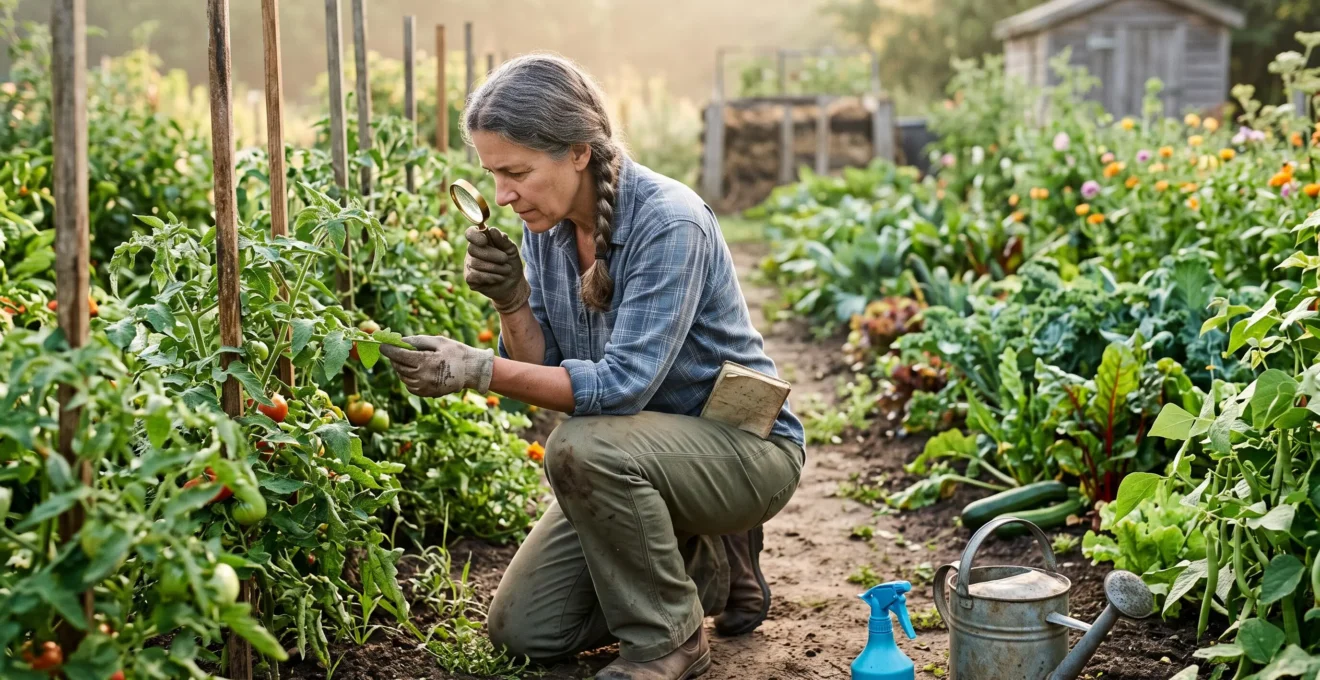
Organic gardening can produce healthy plants and substantial harvests without relying on routine synthetic pesticides or fertilisers. The key is not finding a supposedly harmless replacement for every conventional product. It is building a system that prevents problems, identifies them early and uses targeted interventions when necessary.
For gardeners accustomed to conventional treatments, the biggest adjustment is often the timing of decisions. Organic methods depend more heavily on observation, soil conditions, crop diversity and physical protection. They may require additional labour and accept some cosmetic damage, but that does not mean accepting unhealthy plants or consistently disappointing harvests.
Integrated pest management provides a practical framework: prevention first, monitoring second, physical and biological controls next, and selective treatments when the level of damage justifies them. This approach can be used in small domestic gardens and larger vegetable plots, although local climate, crop varieties and pest pressure influence the results.
Organic Gardening: The Essential Principles
- Inspect plants regularly and intervene before pests or diseases become established.
- Prioritise healthy soil, crop rotation, airflow, physical barriers and accurate watering.
- Use organic sprays selectively rather than assuming that natural ingredients are automatically harmless or effective.
- Why Do Organic Gardening Techniques Demand More Observation and Earlier Intervention Than Chemical Methods?
- How to Make Effective Organic Pest Sprays from Garlic, Soap, and Neem Oil?
- Organic Fungicides vs Cultural Controls: Which Prevents Blight and Mildew More Effectively?
- The Organic Fertiliser Mistake That Pollutes Waterways Despite Being Chemical-Free
- Should You Switch to Organic Gardening Techniques Immediately or Transition Over Several Seasons?
- How to Control Garden Pests Using Barriers, Traps, and Hand-Picking Before Resorting to Sprays?
- Marigolds vs Chives vs Garlic: Which Companion Plants Deter Which Vegetable Pests?
- How Can Low-Chemical Gardening Practices Reduce Toxin Exposure While Controlling Pests Effectively?
Why Do Organic Gardening Techniques Demand More Observation and Earlier Intervention Than Chemical Methods?
Organic gardening requires regular observation because its effectiveness depends on preventing problems and responding while they remain manageable. Rather than relying on a treatment after damage becomes obvious, gardeners monitor developing plants, pest populations, soil moisture and early disease symptoms. This gives physical, cultural and biological controls a better opportunity to work.
However, the distinction is not absolute: conventional integrated pest management also relies on prevention and monitoring. The difference is that gardeners who depend on broad-spectrum or readily available chemical treatments may become accustomed to correcting visible problems rather than managing the conditions that cause them.
University of Maryland Extension recommends inspecting plants before problems become too advanced, including examining leaf undersides where pests and early symptoms can be difficult to see. Its integrated pest management guidance also recognises that some plant damage is acceptable when growth and harvests remain healthy.
A practical inspection routine takes only a few minutes. Walk through the garden daily when pest pressure is high, or at least twice a week during quieter periods. Check:
- Leaf undersides: Look for aphids, eggs, larvae, webbing and unusual spotting.
- Stem bases: Check for chewing damage, rot and insects near the soil surface.
- New growth: Look for distorted leaves, discolouration and stunted shoots.
- Soil moisture: Check whether roots are receiving adequate water without remaining saturated.
- Plant development: Compare growth with previous observations to identify deterioration.
The intervention window depends on the problem. A small aphid colony on a few shoots can often be addressed through physical removal or a targeted treatment. Powdery mildew is easier to manage when affected leaves are first noticed than when much of the plant is covered. With blight, early recognition matters because severe infection can progress rapidly and become difficult to contain.
There is no universal numerical threshold for these problems. Crop variety, plant age, weather and the severity of infestation all influence the appropriate response. University of Maryland Extension offers a general guideline that healthy plants can sometimes tolerate 20–30% leaf defoliation without long-term damage or reduced yield. This is not a target or a rule for every crop: seedlings and transplants generally need faster intervention than established plants.
The important mindset shift is to stop treating every insect or damaged leaf as an emergency. Organic management aims to maintain a healthy balance rather than eliminate every organism from the garden.
20–30%
A general leaf-defoliation tolerance guideline for healthy plants in the University of Maryland Extension guidance. It should not be applied indiscriminately to all crops, growth stages or pests.
University of Maryland Extension, integrated pest management guidance.
Once observation becomes habitual, gardeners can make more selective decisions. The next challenge is choosing a treatment that matches the pest rather than spraying indiscriminately.
How to Make Effective Organic Pest Sprays from Garlic, Soap, and Neem Oil?
Garlic, insecticidal soap and neem oil are not interchangeable pest treatments. Soap can kill susceptible soft-bodied insects through direct contact, neem-based products may interfere with feeding and insect development, and garlic preparations are generally used as repellents. Choosing the correct approach requires identifying the pest, checking the product instructions and considering effects on beneficial insects.
Homemade sprays are attractive because their ingredients are accessible, but an important distinction is necessary: the available institutional sources do not establish validated mixing ratios or tested recipes for homemade garlic, neem or soap mixtures. It would therefore be misleading to present precise quantities as scientifically tested or universally safe.
Instead, gardeners should distinguish between the three approaches before deciding whether a spray is justified.
| Preparation | Intended action | Main limitation |
|---|---|---|
| Garlic preparation | Repellent effect intended to discourage some pests. | Should not be treated as a reliable insecticide or guaranteed control. |
| Insecticidal soap | Contact action against susceptible soft-bodied insects. | Requires direct coverage and can affect non-target organisms. |
| Neem-based product | May affect feeding and insect development, depending on the formulation. | Effectiveness and permitted use depend on the specific product and label. |
For insecticidal soap, coverage is particularly important. A spray that only wets the upper surface of a leaf may miss aphids sheltering underneath. Contact treatments also do not provide a guarantee of lasting protection against insects that arrive later.
Neem products should be selected and used according to their specific instructions. Do not assume that a homemade combination of neem oil, soap and water has the same formulation, stability or safety profile as a manufactured product. Follow the label for dilution, application frequency, crop suitability and harvest restrictions.
Application conditions matter as much as ingredient choice. Avoid spraying plants during intense sunshine or when they are drought-stressed. Test a treatment on a small number of leaves first and observe for damage before treating the entire crop. Evening application may reduce direct exposure of daytime pollinators, but it does not make a product harmless to beneficial insects.
Soap-based products can affect susceptible non-target insects and other small arthropods, including beneficial species exposed directly to the spray. Neem-based products also require careful application. Avoid spraying flowering plants visited by pollinators, and never assume that a natural ingredient is automatically safe for wildlife, pets or people.
After rain, check whether the treatment remains effective before considering another application. Repeated spraying without inspecting the plants can create unnecessary exposure and damage.
Before choosing a spray, ask three questions: has the pest been correctly identified, is the damage serious enough to justify treatment, and is the selected product appropriate for that crop and pest?
When the problem is fungal rather than insect-related, the same principle applies: prevention and accurate diagnosis usually matter more than simply choosing a stronger treatment.
Organic Fungicides vs Cultural Controls: Which Prevents Blight and Mildew More Effectively?
Cultural controls are generally the first line of defence against garden diseases because they reduce the conditions that allow pathogens to establish and spread. Organic fungicides may help protect susceptible plants or slow certain infections when used appropriately, but they should not be treated as universal cures. For many home vegetable gardens, spacing, airflow, watering and sanitation are more dependable foundations than repeated spraying.
Plant diseases often develop when susceptible crops encounter favourable environmental conditions. Dense foliage, prolonged leaf wetness, infected planting material and poor sanitation can all contribute to disease pressure.
University of Minnesota Extension recommends several practical preventive measures:
- Space plants appropriately to improve airflow.
- Stake or support sprawling crops where necessary.
- Water at soil level or use drip irrigation to limit leaf wetness.
- Water overhead early in the day when foliage needs time to dry.
- Remove infected leaves and rotten produce where appropriate.
- Rotate crop families to reduce the accumulation of certain soil-associated pathogens.
- Choose healthy seeds, transplants and disease-resistant varieties.
For many vegetable crops, the University of Minnesota guidance recommends avoiding replanting the same crop family in the same location for two to four years. The precise rotation period should be adapted to the crop and the disease involved.
Powdery mildew and blight require different expectations. Powdery mildew can remain relatively cosmetic in some circumstances, although severe infections can reduce plant performance. Blight, particularly on susceptible crops in favourable weather, can progress rapidly and destroy valuable foliage and fruit.
Organic fungicides such as copper-, sulphur- or bicarbonate-based products are not interchangeable. Their permitted uses, effectiveness and potential plant damage vary. Copper can accumulate in soil with repeated use, while sulphur can injure sensitive plants under unsuitable conditions. Protective fungicides also generally work best before infection becomes established rather than attempting to reverse extensive damage.
Consequently, choosing a product without correcting the conditions that favour disease is often disappointing. A treatment cannot compensate indefinitely for overcrowding, persistent moisture or repeated planting of susceptible crops in the same location.
For gardeners with limited rotation space, combine resistant varieties, careful sanitation, good airflow and appropriate watering. Where disease is already severe, removing an infected plant may be more practical than repeatedly treating it and risking further spread.
University of Minnesota Extension also advises that some disease damage can be tolerated without preventing a good vegetable harvest. The objective is a productive crop, not necessarily flawless foliage.
Healthy plants also need balanced nutrition. However, replacing synthetic fertilisers with organic inputs does not automatically eliminate environmental risks.
The Organic Fertiliser Mistake That Pollutes Waterways Despite Being Chemical-Free
The most important fertiliser mistake in organic gardening is applying more nutrients than the soil and crops can use. Manure, compost, blood meal and other organic inputs can contribute to nutrient pollution when overapplied. Their natural origin does not prevent excess nitrogen or phosphorus from leaving the garden through leaching and runoff.
Plants need nutrients in appropriate quantities and at suitable stages of growth. When additional nitrogen is supplied unnecessarily, plants may develop excessive leafy growth at the expense of fruit production. Excess nitrogen can also increase vulnerability to certain pests and diseases.
The environmental problem occurs when nutrients move beyond the root zone. Rainwater and irrigation can transport soluble nutrients into groundwater, drainage systems and surface waterways. This is not an exclusively synthetic-fertiliser problem: both organic and conventional inputs can contribute to nutrient losses.
University of Maryland Extension recommends basing vegetable fertilisation on laboratory soil tests and crop requirements rather than applying fertiliser automatically every season.
Organic matter can release plant-available nutrients gradually during the growing season, but the speed of release varies with material composition, soil conditions, moisture and temperature. It is therefore incorrect to assume that every organic fertiliser releases nutrients slowly or that compost can never supply too much.
Fresh and well-composted manure should also be distinguished. Fresh manure can present additional pathogen and plant-injury concerns, while mature compost is generally more suitable for routine soil improvement. However, the available source pack does not establish specific pathogen reduction periods or universal application rates for different manure types. Follow appropriate local food-safety and composting guidance rather than assuming that appearance alone proves maturity.
A soil-test-first approach is straightforward:
- Obtain a laboratory soil test before adding fertiliser.
- Check nutrient levels, especially nitrogen, phosphorus and potassium where reported.
- Identify the nutrient requirements of the crops being grown.
- Select an input that addresses an actual deficiency rather than adding nutrients indiscriminately.
- Monitor plant growth and reassess fertilisation needs instead of repeating the same application automatically.
University of Maryland Extension gives general nitrogen examples of two pounds per 1,000 square feet for vegetable crops and three pounds per 1,000 square feet for certain heavy-feeding crops, including tomatoes, broccoli and beets. These are examples within its specific gardening guidance, not universal rates for every garden or a substitute for soil-test recommendations.
One particularly useful principle is that an established garden with substantial organic matter may produce good harvests without additional fertiliser. Adding more is not necessarily better.
5–10%
The approximate soil organic matter target described in the University of Maryland Extension gardening guidance. It is contextual guidance, not a universal target for every soil type or region.
University of Maryland Extension, vegetable fertilisation recommendations.
Organic gardening only delivers its environmental advantages when inputs are managed responsibly. Avoiding synthetic products while overloading the soil with nutrients simply replaces one potential pollution pathway with another.
With soil management under control, the next decision is how quickly to change the rest of the gardening system.
Should You Switch to Organic Gardening Techniques Immediately or Transition Over Several Seasons?
Switching immediately to organic gardening can simplify input management, but a gradual transition is often more practical for gardeners who depend on reliable harvests. The best choice depends on existing soil conditions, crop priorities, local pest pressure and the time available for monitoring. There is no evidence in the available sources establishing one transition speed as universally superior.
An immediate change has the advantage of establishing a consistent management approach from the beginning. The gardener can concentrate on compost, soil structure, crop diversity, observation and preventive controls without relying on routine synthetic treatments.
However, the first season may expose weaknesses in the existing system. Soil may be compacted or low in organic matter, pest populations may be difficult to manage, and the gardener may not yet recognise early symptoms. These challenges do not prove that organic methods are ineffective; they indicate that management skills and growing conditions need attention.
A phased transition can reduce the risk of disrupting crops that are particularly important to the household.
| Consideration | Immediate transition | Phased transition |
|---|---|---|
| Management change | All routine practices change together. | Changes are introduced progressively. |
| First-season risk | Existing problems may become more visible. | Important crops can receive more targeted attention. |
| Learning process | Requires rapid development of observation skills. | Allows experience to accumulate over several seasons. |
| Best suited to | Gardeners comfortable managing uncertainty. | Gardeners prioritising continuity of harvests. |
A practical phased approach begins with low-risk improvements:
- Stop routine preventive spraying when no justified pest problem exists.
- Introduce compost based on soil conditions and crop requirements.
- Use mulch where appropriate to protect the soil surface.
- Improve spacing, irrigation and crop hygiene.
- Develop a regular inspection habit before reducing other targeted interventions.
For valuable crops during the first season, targeted treatments may still be appropriate when justified and compatible with the gardener’s chosen standards. If the objective is certified organic production, the permitted-input rules of the relevant certification scheme must also be respected.
Four factors should guide the transition:
- Soil condition: Depleted or compacted soil may need sustained improvement.
- Crop priorities: High-value food crops may justify a more cautious transition.
- Regional pest pressure: Local climate and common pests influence intervention needs.
- Available time: A system based on frequent inspection requires a realistic monitoring routine.
Temporary pest increases, slower growth or uneven harvests can occur during adjustment, but they should be diagnosed rather than automatically attributed to the absence of synthetic chemicals. Nutrient deficiencies, watering problems, unsuitable varieties and disease can all produce similar symptoms.
Once the preventive system is established, physical controls can reduce pest pressure without requiring a spray every time insects appear.
Key Decisions Before Managing Garden Pests
- Choose physical barriers when a specific pest can be excluded before reaching vulnerable crops.
- Use monitoring and hand-removal for localised infestations instead of treating the entire garden.
- Combine companion planting with crop health, airflow and other controls rather than relying on plants as guaranteed repellents.
How to Control Garden Pests Using Barriers, Traps, and Hand-Picking Before Resorting to Sprays?
Barriers, traps and hand-picking can control many garden pests without applying any spray. Their effectiveness depends on matching the method to the pest, protecting the crop at the right growth stage and monitoring results. For small gardens, these methods can be particularly practical because infestations are often visible and manageable before they spread.
Physical controls work in different ways. Barriers prevent pests from reaching plants, traps help detect or capture certain insects, and hand-picking removes visible pests directly.
| Method | Most useful application | Important limitation |
|---|---|---|
| Fine mesh row covers | Excluding flying pests from vulnerable vegetable crops. | Can also exclude pollinators. |
| Plant collars | Protecting young stems from certain soil-level pests. | Must be correctly positioned and suited to the pest. |
| Copper or abrasive barriers | Discouraging slugs and snails around selected plants. | Effectiveness depends on installation and conditions. |
| Sticky traps | Monitoring certain flying insects and identifying population changes. | Capture does not necessarily solve an infestation. |
| Hand-picking | Removing larger visible pests or small localised populations. | Labour-intensive when the garden or infestation is large. |
Row covers deserve particular attention. A fine mesh can protect young brassicas from flying insects, but the same mesh may prevent pollinators from reaching flowering crops. Remove or open covers when pollination is necessary, unless the crop does not require insect pollination.
Traps also have a monitoring function. Their value is not simply the number of insects captured. Regularly checking them can reveal whether pest activity is increasing, decreasing or remaining stable. This helps gardeners decide whether physical controls are sufficient or whether further intervention is justified.
Hand-picking is especially useful for larger insects, caterpillars, slugs and snails when their numbers are still manageable. Inspect affected plants regularly and remove visible pests using an appropriate method. The method becomes less practical when the infestation is widespread or the garden is too large for consistent inspection.
University of Maryland Extension recommends physical removal, pruning and other non-chemical interventions as part of integrated pest management. Its guidance also emphasises continuing to monitor plants after treatment to establish whether further action is necessary.
Your Five-Step Physical Pest-Control Routine
- Identify the pest and record the affected crop, plant location and visible symptoms.
- Inspect leaf undersides and growing points, recording where eggs, larvae or insects are concentrated.
- Install an appropriate barrier and record which plants or beds it protects.
- Check traps and hand-remove visible pests, keeping a simple dated count of observations.
- Reinspect treated plants and record whether damage is stable, improving or spreading before deciding on another intervention.
Physical methods are not always sufficient, but they provide a useful first response. A small, well-monitored infestation does not necessarily justify spraying an entire bed or vegetable plot.
Companion planting can provide another layer of support, particularly when it is used to diversify the garden rather than replace direct pest management.
Marigolds vs Chives vs Garlic: Which Companion Plants Deter Which Vegetable Pests?
Marigolds, chives and garlic can contribute to a more diverse vegetable garden, but their pest-deterrent effects should not be exaggerated. French marigolds have research interest in relation to certain plant-parasitic nematodes, while aromatic alliums may influence the behaviour of some pests. None of these plants provides guaranteed protection against every insect attacking neighbouring vegetables.
Companion planting is best understood as a supporting technique. Its potential benefits include greater plant diversity, additional flowers and habitat for beneficial insects, and possible reductions in pressure from particular pests. The strength of the evidence varies considerably between plant combinations and target organisms.
| Plant | Potential role | Practical limitation |
|---|---|---|
| French marigolds | Some varieties have evidence of suppressing particular root-lesion nematodes. | Results depend on species, variety, nematode and planting conditions. |
| Chives | Aromatic allium that may help diversify planting and influence some pest behaviour. | Not a dependable stand-alone aphid control. |
| Garlic | Aromatic allium sometimes used in mixed planting for its possible repellent effects. | Repellent effects are not guaranteed and do not replace monitoring. |
Marigolds are frequently recommended around vegetable beds, but the specific type matters. Claims about nematode suppression should not be extended to every marigold species or every nematode problem. The strongest practical approach is to identify the relevant pest and select an appropriate plant variety where evidence supports its use.
Chives and garlic are members of the allium group. Their characteristic aromas are sometimes associated with repelling or confusing sap-feeding pests, including aphids. However, companion-planting claims often go beyond what the available evidence can establish. They should therefore be regarded as possible supplementary benefits rather than a dependable treatment.
Spacing is equally important. Over-planting companion species can create competition for water, light and nutrients. Excessively dense foliage also reduces airflow and can increase humidity around leaves, creating conditions favourable to some fungal diseases.
For a practical vegetable garden, use companion plants without overcrowding the main crop. Leave enough space for inspection, watering, harvesting and airflow. Continue using barriers and monitoring where pest pressure justifies them.
Companion planting works best as one element of a wider system:
- Use suitable plant varieties and healthy transplants.
- Maintain appropriate spacing between crops.
- Monitor for pests instead of assuming companion plants have solved the problem.
- Encourage beneficial insects through appropriate habitat and flowering plants.
- Use physical controls or targeted treatments when pest populations become damaging.
The main advantage is diversification, not immunity. A garden containing marigolds, chives and garlic can still experience aphids, caterpillars, slugs and fungal diseases.
Combining these methods creates a more complete approach to reducing unnecessary chemical use while maintaining productive vegetable beds.
How Can Low-Chemical Gardening Practices Reduce Toxin Exposure While Controlling Pests Effectively?
Low-chemical gardening reduces reliance on routine pesticide applications and can limit opportunities for exposure through treated crops, spray drift and environmental contamination. It does not mean eliminating every treatment or assuming that organic substances are automatically harmless. The most effective approach combines prevention, monitoring, physical controls and carefully selected products only when necessary.
Exposure can occur through several pathways. Gardeners may come into contact with products while mixing or applying them, children and pets may encounter recently treated areas, and spray drift can affect nearby plants and organisms. Runoff and leaching can also move substances and nutrients away from the garden.
Reducing unnecessary applications therefore has practical value beyond the appearance of the harvest. Avoiding routine spraying reduces the number of occasions on which people and non-target organisms may encounter pesticides.
However, the available evidence does not quantify a specific percentage reduction in exposure from adopting organic gardening. It would be inaccurate to promise that organic methods eliminate residues or remove every exposure risk. Products still need to be handled according to their safety instructions.
A useful low-chemical decision sequence is:
- Prevent: Improve soil conditions, crop spacing, watering and sanitation.
- Monitor: Inspect plants regularly and identify the actual pest or disease.
- Control physically: Use barriers, traps, pruning and hand-removal where appropriate.
- Support biological balance: Encourage beneficial organisms and maintain plant diversity.
- Treat selectively: Apply an appropriate product only when the problem threatens plant health or harvests.
This system can deliver results comparable to conventional approaches for many everyday gardening challenges, particularly when prevention and soil management are effective. It is less realistic to expect identical outcomes in every situation. Organic gardeners may spend more time monitoring, tolerate some cosmetic damage and accept occasional losses when a pest outbreak or severe disease cannot be contained.
Conventional products can offer faster or more predictable control in certain situations, but their use also requires attention to environmental and safety risks. The comparison should therefore consider harvest quality, crop survival, labour, product exposure and long-term soil management rather than measuring success only by the absence of visible insects.
Keeping simple garden records makes the system progressively more reliable. Record the crop, the problem, the date symptoms appeared, the intervention used and the result. Over several seasons, this information helps distinguish recurring problems from isolated incidents and shows which preventive measures are actually working.
University of Maryland Extension recommends continuing to monitor plant condition after treatment to determine whether further action is necessary. This principle is equally valuable when the treatment is physical, biological or an organic product.
Organic gardening is not a promise of perfect leaves or effortless pest control. It is a method of managing the garden with fewer unnecessary inputs while protecting plant health and maintaining realistic expectations about yield.
The most productive next step is to choose one vegetable bed, begin recording observations and introduce preventive improvements before the next growing season. That practical evidence will show which organic methods suit the garden, its crops and its local conditions.
Can organic gardening produce the same yields as conventional gardening?
Organic gardening can produce substantial harvests, particularly when soil fertility, crop selection, watering and pest prevention are well managed. However, identical yields are not guaranteed. Results depend on climate, soil conditions, pest pressure, crop varieties and the time available for monitoring.
Are organic pesticides completely safe for bees and other beneficial insects?
No. Natural or organic origin does not guarantee safety for non-target organisms. Soap-based treatments can harm susceptible insects on contact, and other products can also create risks depending on their formulation and application. Avoid unnecessary spraying, protect flowering crops and follow product instructions carefully.
How often should an organic vegetable garden be inspected?
A short inspection several times a week is a practical routine when pest pressure is significant. At a minimum, inspect plants regularly throughout the growing season. University of Minnesota Extension recommends weekly inspections for home vegetable gardens, with particular attention to early disease symptoms and affected foliage.
Does compost eliminate the need for fertiliser?
Not always. Compost contributes organic matter and nutrients, but the amount available depends on its composition and soil conditions. Established gardens with substantial organic matter may not require additional fertiliser, while other soils may have specific nutrient deficiencies. A laboratory soil test is the most useful starting point.
What is the best first step for converting a conventional garden to organic methods?
Start by inspecting the soil and plants, then stop unnecessary routine spraying. Improve watering, spacing and sanitation, and use compost or mulch where appropriate. Introduce physical barriers for vulnerable crops and keep simple records of pest activity and harvest results. These changes establish a practical foundation without requiring every gardening practice to change at once.