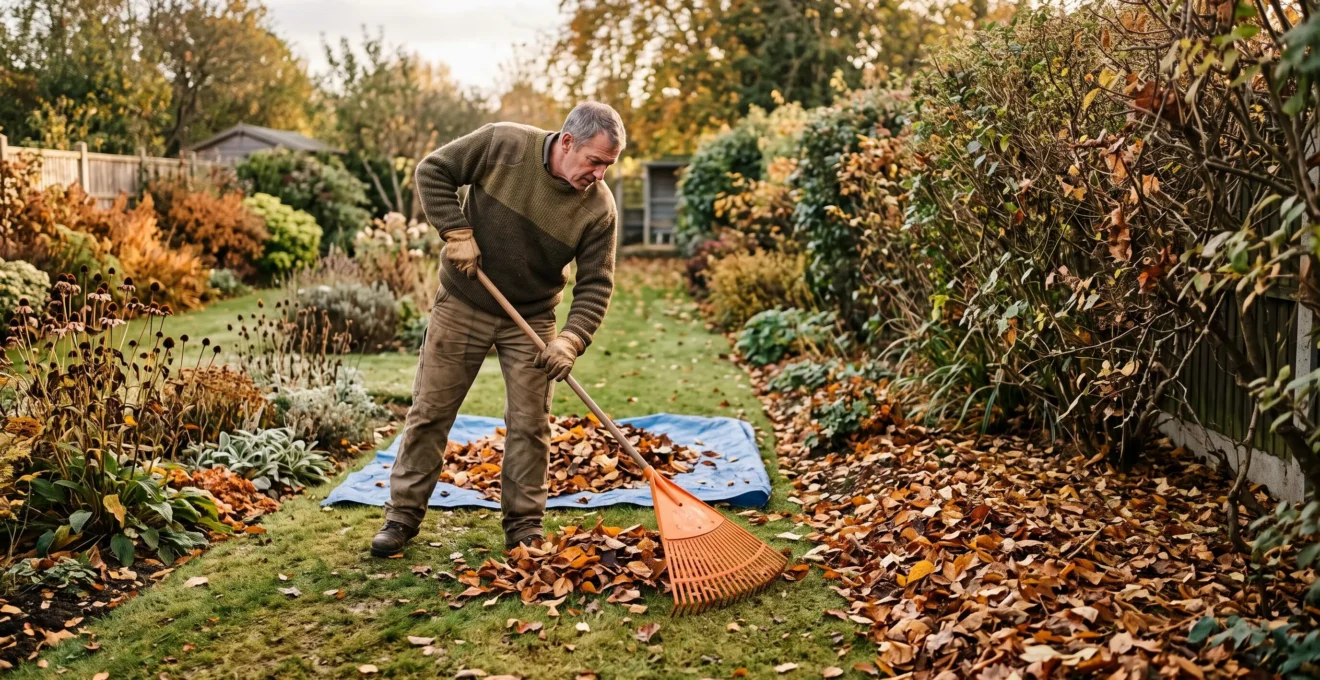
Autumn garden cleanup is not a choice between a spotless garden and an untidy wildlife sanctuary. The most effective approach is selective: remove material that threatens plant health, safety or access, while retaining the leaves, stems and sheltered spaces that beneficial wildlife needs through winter.
For UK gardeners, the traditional autumn routine of raking every border, cutting every perennial to ground level and clearing all fallen vegetation can remove habitats used by pollinators, predatory insects and other garden wildlife. Yet abandoning maintenance altogether can create different problems, including smothered lawns, damaged plants and persistent disease.
The distinction lies in identifying what genuinely needs attention. A slippery path deserves clearing; an undisturbed leaf drift beneath a hedge generally does not. Diseased crop residues may require disposal, while healthy seed heads can remain standing. Timing matters too: a task that seems harmless during active growth can disrupt insects sheltering inside dormant stems.
A wildlife-friendly autumn cleanup therefore follows three principles: maintain essential functions, protect valuable habitat and postpone unnecessary disturbance.
Autumn garden cleanup: the essential decisions
- Clear selectively: remove leaves from paths and excessive accumulations on lawns, but retain whole leaves beneath hedges and in suitable borders.
- Keep healthy structure: leave useful perennial stems, seed heads and sheltered corners through winter; remove diseased or hazardous growth when necessary.
- Work with wildlife: avoid disturbing occupied winter habitats, and spread spring clearance over several weeks rather than completing it in one session.
- Should You Remove All Autumn Leaves or Leave Some for Soil Enrichment and Wildlife?
- Should You Cut Down Herbaceous Perennials in Autumn or Leave Them Until Spring?
- Can You Compost Diseased Plant Material or Should It Be Burned or Binned?
- The Autumn Tidying That Kills Ladybirds, Lacewings, and Solitary Bees Sheltering for Winter
- When Should You Begin Autumn Garden Cleanup Without Harming Wildlife?
- How to Build a Garden Maintenance Calendar That Ensures No Critical Task Gets Missed?
- How to Conduct Early Spring Garden Cleanup Without Damaging Emerging Perennials?
- Which Garden Maintenance Tasks Are Truly Essential Versus Optional for Healthy Productive Gardens?
Should You Remove All Autumn Leaves or Leave Some for Soil Enrichment and Wildlife?
No, removing all autumn leaves is unnecessary and can eliminate valuable winter habitat. Keep fallen leaves in suitable borders, beneath hedges and around established plants, while clearing paths and preventing thick accumulations from smothering lawns or vulnerable low-growing plants. The best approach is to manage leaves according to where they fall rather than treating the entire garden alike.
Fallen leaves perform several useful functions. As they break down, they contribute organic matter to the soil, help retain moisture and moderate temperature changes. Intact leaf litter also creates sheltered spaces used by overwintering invertebrates.
However, the same material can cause problems in the wrong location. A dense, wet blanket of leaves may exclude light from grass, while heavy accumulations around small alpine plants or moisture-sensitive crowns can encourage damaging damp conditions.
A practical decision grid allows each garden area to serve its particular purpose.
| Garden zone | Recommended action | Reason |
|---|---|---|
| Lawn | Remove dense or persistent mats; tolerate light, scattered coverage where grass remains visible. | Maintains grass access to light while allowing limited leaf decomposition. |
| Flower beds | Retain loose leaves around suitable established plants, keeping vulnerable crowns clear. | Supports soil protection and winter shelter. |
| Shrub borders | Allow natural leaf accumulation where it does not bury sensitive plants. | Creates relatively undisturbed habitat. |
| Under hedges | Preserve whole leaves and natural drifts. | Provides sheltered overwintering conditions. |
| Paths and steps | Clear leaves regularly, relocating clean material where appropriate. | Reduces slipping hazards and maintains access. |
| Alpine and gravel gardens | Remove heavy accumulations from sensitive foliage and crowns. | Reduces excessive moisture retention around vulnerable plants. |
There is no universally safe leaf depth measured in centimetres. Instead, look for functional warning signs: grass disappearing beneath a compacted layer, leaves remaining waterlogged, or small plants being completely buried. These observations are more useful than an arbitrary thickness rule.
Whole leaves and shredded leaves serve different purposes. Shredding can accelerate decomposition and make material easier to distribute as a soil amendment. Yet it may also injure insects, eggs, caterpillars and cocoons already present among the leaves.
The Xerces Society‘s autumn wildlife habitat recommendations favour keeping leaves intact and moving excess material into suitable habitat rather than automatically shredding or discarding it.
A sensible compromise is to retain whole leaves in undisturbed areas and reserve shredding for material collected from places where habitat preservation is not the immediate priority. Even then, freshly fallen leaves should not be assumed to be free of wildlife.
Timing also changes the impact. Early autumn collections may disturb caterpillars or developing insects that have not completed their seasonal transition. Avoid repeated raking in established habitat areas, and do not dismantle leaf piles merely because temperatures have dropped.
The aim is not to preserve every leaf where it lands. It is to keep the ecological benefits of leaf litter without compromising the plants and spaces that genuinely need clearing. The same selective principle applies to perennial stems.
Should You Cut Down Herbaceous Perennials in Autumn or Leave Them Until Spring?
Most healthy herbaceous perennials can remain standing through winter, particularly when their stems provide insect habitat, their seed heads feed birds or their old growth protects dormant crowns. Autumn cutting is more appropriate for diseased, badly decaying or obstructive material. The decision should depend on the plant’s condition and winter needs, not simply whether its foliage has turned brown.
Many traditional gardening routines treat dead top growth as waste. In reality, dried stems and seed heads can continue to serve important functions after flowering ends. Upright vegetation creates winter structure, intercepts falling leaves and sometimes helps protect the soil and plant crowns beneath it.
Not every perennial should be managed in the same way.
| Plant condition or characteristic | Autumn decision | Main consideration |
|---|---|---|
| Healthy hollow or pithy stems | Leave standing where possible. | Potential nesting or overwintering habitat. |
| Persistent seed heads | Retain through winter. | Potential bird food and garden structure. |
| Borderline-hardy perennials | Delay cutting until frost risk has passed. | Old growth may protect the crown. |
| Growth showing significant disease | Remove affected material appropriately. | May reduce surviving disease inoculum. |
| Collapsed stems blocking access | Move or shorten only the necessary portions. | Restores access while preserving remaining habitat. |
| Plants spreading through unwanted seed production | Remove selected seed heads before dispersal. | Prevents excessive self-seeding without unnecessary total cutting. |
| Evergreen perennials | Assess individually; remove damaged growth selectively. | Living foliage requires different treatment from dormant stems. |
The RHS advice on cutting back perennials distinguishes between plants that benefit from autumn tidying and those better left until spring. It specifically notes that old stems can protect the crowns of relatively tender plants such as penstemons.
Stem height matters when cutting becomes necessary. As a practical compromise, gardeners can consider retaining approximately 10–30 cm of standing stubble where appropriate, rather than cutting every stem flush with the soil. This is a management option, not a scientifically established universal height for insect survival.
Some insects use standing stems as nesting sites, and occupied stems may remain important beyond the first warm days of spring. Leaving intact stems for longer is generally preferable wherever space allows.
Extra care is warranted for plants known to respond poorly to cutting outside their recommended pruning season. Certain woody or semi-woody plants can lose sap when pruned at unsuitable times, while others need their old top growth for frost protection. Check the plant-specific pruning guidance instead of applying the same autumn cut to every species.
Storm damage does not require a complete winter clearance. If wind flattens a border, remove broken growth that obstructs paths or threatens neighbouring plants. Leave stable stems intact, and relocate clean fallen material gently to a sheltered position when feasible.
A winter border may look less orderly than a freshly cut one, but dried seed heads, grasses and stems provide structure that remains useful until spring.
Leaving healthy plants standing is a relatively low-risk decision. Material affected by significant disease, however, calls for a different assessment because its disposal can influence garden health in the following growing season.
Can You Compost Diseased Plant Material or Should It Be Burned or Binned?
Diseased plant material should not automatically go into a domestic compost heap. Some pathogens can survive inadequate composting and potentially re-enter the garden when the compost is used. Identify the likely disease first, then choose an appropriate disposal route. Council-approved green-waste collection or other authorised disposal may be preferable for higher-risk material; burning is neither automatically necessary nor universally permitted.
Ordinary home composting is effective for recycling many healthy plant residues, but it is not equivalent to a verified hot-composting treatment.
University of Minnesota Extension advises that diseased material can be composted when the heap reaches at least 148 °F, approximately 64°C, and the plant material completely breaks down. This condition does not mean that every heap reaching that temperature briefly will eliminate every pathogen.
148°F (approximately 64°C)
A temperature condition identified by University of Minnesota Extension for composting diseased plant material, alongside complete decomposition. It is not a universal guarantee of pathogen elimination.
University of Minnesota Extension, Managing plant diseases in the home garden.
Without reliable temperature monitoring and suitable compost management, persistent or uncertain plant diseases deserve additional caution.
Start by distinguishing minor leaf damage from potentially transmissible disease. Weather scorch, natural senescence and physical damage are not themselves infections. Conversely, material associated with clubroot, verticillium wilt or other persistent soil-borne diseases may present risks that ordinary decomposition does not resolve.
Potato and tomato blight also require accurate identification and pathogen-specific handling rather than a blanket assumption about compostability.
Before selecting a disposal method, establish four points:
- Is the problem confirmed as infectious, or could it be weather damage, ageing or nutrient stress?
- Can the suspected organism survive in plant residues, soil, roots or other structures?
- Is the composting system demonstrably capable of meeting relevant treatment conditions?
- Will the chosen council or collection service accept that particular material?
The available options have different advantages and limitations.
| Method | Appropriate use | Important limitation |
|---|---|---|
| Domestic compost | Healthy material and disease-affected material confirmed suitable for the actual composting process. | Unmanaged heaps may not reliably destroy pathogens. |
| Municipal green-waste service | Material accepted by the local authority or treatment provider. | Acceptance rules and treatment processes vary. |
| Authorised residual-waste disposal | Material unsuitable for home composting or available garden-waste services, where permitted. | Local disposal requirements must be followed. |
| Garden bonfire | Only where the material and circumstances meet applicable rules. | Smoke, pollution, nuisance and fire risks; often avoidable. |
In the UK, UK Government rules on garden bonfires explain restrictions relating to pollution and smoke nuisance. Garden bonfires are not subject to a blanket national prohibition, but that does not make burning every type of garden waste lawful or advisable.
Gardeners elsewhere in the English-speaking world must consult the rules applicable to their own jurisdiction. Council waste services and applicable plant-health restrictions should be checked before disposal.
For food-growing areas, remove infected crop residues where appropriate, collect rotten produce, clean contaminated supports and tools, and assess crop rotation. Such hygiene can reduce opportunities for disease to persist or spread, although it cannot eliminate every soil-borne problem.
Good sanitation is one of the autumn tasks that can deliver a genuine plant-health benefit in spring. Yet indiscriminate clearing of healthy material has the opposite potential: destroying the insects that help keep gardens biologically balanced.
The Autumn Tidying That Kills Ladybirds, Lacewings, and Solitary Bees Sheltering for Winter
Some apparently harmless autumn tidying can destroy beneficial insects by removing or disturbing their winter shelters. Clearing every leaf pile, cutting hollow stems to ground level, dismantling log stacks and covering exposed nesting soil can damage habitats used by ladybirds, lacewings and solitary bees. Protecting these insects means identifying where they shelter and limiting disturbance in those locations.
The danger is easy to overlook because overwintering insects are often concealed. A pile of dry leaves may look empty, while a hollow stem can contain developing offspring or other insects even when nothing is visible at its opening.
Different beneficial groups use different structures, and some species within the same group have contrasting overwintering habits.
| Beneficial insect group | Potential shelter | Cleanup risk |
|---|---|---|
| Ladybirds | Leaf litter, sheltered vegetation, bark crevices and protected structures, depending on species. | Removing shelter or sweeping up inactive overwintering adults. |
| Lacewings | Protected vegetation, leaf litter or sheltered crevices, with the overwintering stage varying by species. | Disturbing sheltered material or discarding occupied debris. |
| Stem-nesting solitary bees | Suitable hollow or pithy stems and existing nesting cavities. | Cutting, shredding or composting occupied stems. |
| Ground-nesting solitary bees | Undisturbed soil containing nesting tunnels. | Digging, compaction or covering entrances with heavy material. |
Not every hollow stem contains an insect, and not every solitary bee nests in stems. The broader principle is to preserve a range of habitats rather than relying on one type of shelter.
Ground nesting is particularly important. The Xerces Society notes that approximately 70% of bee species nest in the ground. This figure refers to species, not the percentage of individual bees nesting in a particular garden, and should not be interpreted as a UK-specific survey result.
It also explains why excessive soil disturbance is problematic. Thick mulch applied over an active nesting area can obstruct entrances, and repeated cultivation may damage underground nests. The solution is not to abandon mulching everywhere, but to maintain suitable open or lightly vegetated soil where nesting activity is observed.
Relocation is a compromise, not a risk-free rescue. If leaves or stems must be cleared, gently lift them without shredding or compacting them and place them in a sheltered location nearby. Keep stems intact and avoid repeatedly moving the new pile. Some insects may still be disturbed, and relocation cannot guarantee survival, especially for individuals attached to the original site.
Existing log piles, undisturbed rockery spaces and naturally sheltered corners are also worth preserving. Dismantling them for cosmetic reasons can expose wildlife to cold, predators and physical injury.
A wildlife-friendly garden can unintentionally lose much of its habitat value through overly thorough autumn maintenance. Planting pollinator flowers is useful, but those plants need to be accompanied by somewhere for insects to complete their life cycles.
A quick garden self-audit should ask whether every dead stem is cut, every sheltered leaf pile is removed, every patch of bare earth is covered and every log is tidied away. If the answer is yes, the garden may offer summer food without sufficient winter shelter.
Protecting these shelters requires more than changing the tools used. It also means changing when work happens, because the insects using them do not all become active or emerge at the same time.
When Should You Begin Autumn Garden Cleanup Without Harming Wildlife?
Begin essential autumn maintenance when it is needed, but postpone disruptive habitat clearance wherever possible. Paths, diseased material and equipment can be addressed early; healthy stems, leaf drifts and sheltered corners can often remain through winter. Use local weather, plant condition and wildlife activity to guide decisions rather than assuming one calendar date makes every cleanup task safe.
In a typical UK garden, leaf fall, the first frosts and persistent cold do not occur on exactly the same dates every year. Coastal and sheltered gardens can remain comparatively mild while exposed inland sites experience colder conditions.
These differences affect plant dormancy and insect behaviour. Some insects enter dormancy in response to changes in day length and temperature, while others remain active during favourable periods.
Frost is a seasonal signal, not permission to disturb everything. Several cold nights may indicate that some insects have entered winter dormancy, but dormant insects can be particularly vulnerable to being moved, exposed or destroyed.
The safest timing depends on the task itself.
| Task | Useful timing signal | Wildlife precaution |
|---|---|---|
| Clear paths and steps | When leaves create slipping or access problems. | Move material gently to suitable habitat. |
| Remove affected crop residues | When confirmed disease or deteriorating material presents a management risk. | Separate affected waste from healthy habitat material. |
| Clean tools and store hoses | Before freezing weather or seasonal storage. | Little habitat disturbance is required. |
| Manage excessive lawn leaves | During leaf fall, before dense wet mats persist. | Avoid shredding material potentially occupied by insects. |
| Cut healthy perennial stems | Delay until appropriate spring conditions, or longer where suitable. | Preserve potentially occupied stems. |
| Remove established leaf habitat | Prefer late spring if removal is genuinely necessary. | Check for visible wildlife and retain undisturbed refuges. |
Waiting until all leaves have fallen may reduce repeated raking, but it does not prove that leaf litter is unoccupied. Likewise, seed heads may remain valuable after seeds appear to have dispersed, and the first hard frost does not establish a universal safe clearance date.
For low-visibility corners, the simplest option is often to leave natural vegetation untouched until late spring. Where clearance cannot be avoided, inspect the material gently for visible nests, insects or other wildlife before handling it.
Such checks have limits: occupants inside stems or beneath the soil may not be visible. Preserving an undisturbed portion is therefore more reliable than assuming visual inspection confirms that a site is empty.
This flexible approach becomes easier to maintain when it is built into a garden calendar that includes deliberate periods of non-intervention, not just lists of jobs to complete.
How to Build a Garden Maintenance Calendar That Ensures No Critical Task Gets Missed?
Build a garden maintenance calendar around task priorities, seasonal conditions and wildlife protection periods rather than fixed dates alone. Separate structural, protective, sanitary and wildlife-sensitive activities, then assign each an appropriate trigger. A short monthly review keeps the calendar aligned with actual weather and plant development while preventing essential work from being lost among optional tidying tasks.
A conventional maintenance calendar often presents autumn as a sequence of chores to complete before winter. That encourages gardeners to finish everything at once, even when certain tasks would be better delayed.
A more useful calendar records both action windows and periods when specific areas should remain undisturbed.
| Task category | Examples | Scheduling approach |
|---|---|---|
| Structural | Pruning, dividing, repairing supports. | Follow plant-specific requirements, safety needs and suitable conditions. |
| Protective | Protecting vulnerable crowns, checking drainage, safeguarding tender plants. | Act ahead of damaging weather where necessary. |
| Sanitary | Removing infected crop debris, cleaning tools and supports. | Respond to confirmed problems and appropriate seasonal opportunities. |
| Wildlife-sensitive | Handling leaf piles, cutting hollow stems, disturbing nesting soil. | Mark retention periods and postpone unnecessary work. |
A useful calendar entry contains more than a date. For example, instead of writing « October: clear all leaves », write « During leaf fall: inspect paths and lawns; relocate excess leaves to suitable undisturbed areas. »
For perennial borders, the entry might read « Autumn through winter: retain healthy stems and seed heads; inspect only for disease, hazards or storm damage. »
Downloaded calendar templates can provide a starting framework, but their dates need adjustment for local climate, plant types and exposure. A task appropriate for a sheltered southern UK garden may be premature for a colder location or unsuitable for a garden in another country.
Reserve approximately 15 minutes each month for a walk-through. Check what has changed, identify actual risks, review upcoming weather and decide which planned tasks still make sense.
Create a five-step wildlife-friendly autumn maintenance plan
- Map the garden: identify lawns, paths, borders, productive beds and wildlife corners. Deliverable: a labelled sketch with maintenance zones.
- Classify the work: separate essential safety, plant-health and protection tasks from cosmetic clearance. Deliverable: a prioritised task list.
- Mark retention areas: identify leaf drifts, standing stems, logs and undisturbed soil to protect. Deliverable: clearly marked no-disturbance zones.
- Assign observable triggers: connect each task to leaf accumulation, plant condition, frost risk or wildlife activity. Deliverable: a condition-based calendar.
- Review monthly: inspect the garden and update completed, postponed or newly necessary tasks. Deliverable: a revised calendar with a dated review note.
Keep the calendar realistic. An overfilled autumn schedule can create unnecessary pressure to rush cleanup during cold weather. Prioritisation prevents essential jobs from being buried beneath tasks that mainly affect appearance.
Include an explicit reminder that a postponement can be a completed management decision. Leaving a healthy border standing through winter is not an unfinished chore when its purpose is habitat protection.
The calendar should also extend into spring. That is when gardeners must balance new plant growth with the risk of disturbing insects that spent winter inside the very material left standing for them.
How to Conduct Early Spring Garden Cleanup Without Damaging Emerging Perennials?
Clean spring borders gradually rather than cutting and clearing everything at once. Locate emerging perennial crowns, work from paths or firm ground, and remove old vegetation in stages as growth resumes. Where stems may shelter insects, retain them longer or place cut material loosely in a protected location. Mild weather and visible pollinator activity are useful clues, but do not guarantee every overwintering insect has emerged.
Spring creates a difficult overlap between horticultural and ecological needs. New shoots may require space and light, yet the old stems and leaves above them may still contain developing insects.
The Royal Horticultural Society describes cutting back many perennials from March onwards in typical UK conditions. That is a horticultural guide, not a universal wildlife-safe date. Some insects can remain inside stems after gardens begin visibly growing.
Staged clearance reduces unnecessary disturbance while allowing the gardener to respond to new growth.
Start by identifying perennial crowns and marking plants that have not yet emerged. This is particularly helpful in densely planted beds, where dormant plants may be difficult to distinguish from empty soil.
Work on one section of the border at a time. Where clearance is needed, shorten or remove old growth carefully without pulling against tender new shoots. Leave adjacent sections untouched so that some overwintering habitat remains available.
Where clean stems must be removed, place them loosely in a sheltered, suitable corner for several weeks rather than immediately shredding them. This provides an opportunity for some occupants to emerge, although it does not guarantee that all insects will complete development or escape successfully.
A longer retention period may be preferable for stems likely to contain later-emerging species. Avoid moving material repeatedly or stacking it so densely that emergence routes are obstructed.
Protect the soil while working. Walking or kneeling directly on wet beds can compact soil and damage emerging plants. Use established paths or suitable access boards when necessary, and avoid pulling away old leaves aggressively from crowns.
Mulching also requires judgement. Do not bury emerging growth or cover known ground-nesting sites. Around vulnerable plants, consider soil conditions, plant-specific guidance and the risk of moisture being trapped against crowns rather than applying thick mulch automatically.
The appearance of foraging bees during a warm spell is encouraging, but different species have different emergence times. There is no single temperature or date at which all insects have vacated the garden.
Spring borders often look untidy precisely when gardeners feel the strongest pressure to clear them. A partially cut border, however, can be an intentional transitional stage rather than evidence of neglect.
Once spring maintenance is planned in stages, the remaining decision becomes simpler: distinguish the tasks that materially protect a productive, healthy garden from those performed chiefly to achieve a tidy appearance.
Key takeaways before prioritising your cleanup
- Judge a job by the damage that could result from skipping it, not by how untidy the garden looks.
- Give priority to access, significant disease, vulnerable plants and productive growing areas.
- Treat retained leaves and stems as deliberately managed habitat, while keeping intervention available when genuine problems arise.
Which Garden Maintenance Tasks Are Truly Essential Versus Optional for Healthy Productive Gardens?
Essential garden maintenance prevents meaningful problems such as unsafe access, avoidable crop disease, damage to vulnerable plants or hazardous structural failures. Most cosmetic autumn clearing is optional, including removing healthy perennial stems and every fallen leaf. A productive, wildlife-friendly garden needs targeted intervention rather than continuous tidiness, with greater sanitation attention generally required in fruit and vegetable areas.
The most useful prioritisation question is simple: what happens if this task is not done?
If postponing a job is likely to create a safety hazard, worsen a significant plant-health problem or expose vulnerable plants to preventable damage, it deserves priority. If the main consequence is that a border looks less orderly, it can usually wait.
The distinction is especially valuable when time is limited.
| Priority | Typical tasks | Reason |
|---|---|---|
| Essential when needed | Clear slippery paths; address hazardous branches; manage confirmed significant disease; protect plants facing damaging conditions. | Prevents meaningful risks to safety, plant health or survival. |
| Condition-dependent | Remove heavy lawn leaf mats; support damaged plants; manage excessive self-seeding; adjust mulch around sensitive crowns. | Benefits depend on actual plant condition and location. |
| Generally optional | Cut healthy perennials for appearance; remove all leaves from shrub borders; dismantle sound log piles; clear every dried seed head. | Primarily changes appearance and may remove useful habitat. |
Structural tree pruning deserves particular care. Dangerous or damaged branches may require prompt professional assessment, but routine pruning is not automatically an autumn necessity. Appropriate timing depends on the tree species, condition, wildlife use and relevant local protections.
For vegetable and fruit gardens, sanitation carries more weight because infected crop residues and spoiled produce can contribute to future disease problems. Remove material where disease management calls for it, clean reusable supports and protect exposed soil with suitable cover or mulch.
Ornamental borders generally allow more flexibility. Healthy stems can stand, leaves can remain in appropriate spaces and natural winter shelter can persist without undermining the garden’s function.
A minimum viable autumn cleanup for a gardener with limited time is therefore straightforward:
- Keep essential paths and access areas safe.
- Identify and appropriately dispose of significant diseased material.
- Protect vulnerable plants and address genuine structural risks.
- Prevent excessive leaf accumulation where it threatens lawns or sensitive plants.
- Preserve healthy stems, useful leaf litter and undisturbed wildlife refuges.
Everything beyond that list should earn its place in the schedule. Pruning for shape, clearing healthy borders and removing natural-looking vegetation can be legitimate preferences, but they are not automatically horticultural requirements.
Indeed, apparent messiness often has a function: dried seed heads may feed birds, fallen leaves can protect soil, and hollow stems can provide nesting opportunities. Conversely, relentless raking and cutting may offer little measurable benefit to healthy ornamental plants.
The objective is not to eliminate maintenance. It is to spend gardening effort where it provides clear value, while accepting that an ecologically useful garden changes appearance across the seasons.
On your next autumn garden walk, identify one task that prevents real damage and one sheltered area that can remain untouched. Complete the necessary work, protect the habitat and record what can wait until spring. That small change turns routine garden tidying into selective, wildlife-conscious maintenance.
Can leaving autumn leaves attract unwanted pests?
Leaf litter can shelter many organisms, including some gardeners may consider pests, but it also supports beneficial insects and soil life. The practical response is to manage leaves by location, removing excessive accumulations from sensitive plants and functional areas while keeping suitable undisturbed habitat elsewhere.
Should fallen leaves be cleared from around roses?
Where roses have suffered significant infectious leaf disease, removing affected fallen foliage may form part of appropriate sanitation. Healthy leaf litter elsewhere in the border need not automatically be removed. Check the likely disease and plant-specific recommendations before treating all fallen leaves as contaminated.
Is a garden wildlife pile better made from leaves or logs?
Both provide different shelter opportunities. Whole leaves create protected ground-level spaces, while logs and woody material provide crevices and longer-lasting structure. Where space permits, retaining both in a quiet area supports a wider range of potential occupants than relying on a single material.
Can a small, tidy garden still support overwintering insects?
Yes. Even a compact garden can retain a sheltered patch of leaves, selected perennial stems, suitable undisturbed soil or a modest woody habitat area. Keeping paths and frequently used spaces clear is compatible with conserving small refuges. Avoid repeatedly dismantling or relocating them.
Does a warm day in early spring mean it is safe to remove all winter habitat?
No. Different insects emerge at different times, and a brief warm spell does not indicate that every occupied stem or leaf shelter is empty. Delay non-essential removal, work gradually and retain some material for longer wherever possible.