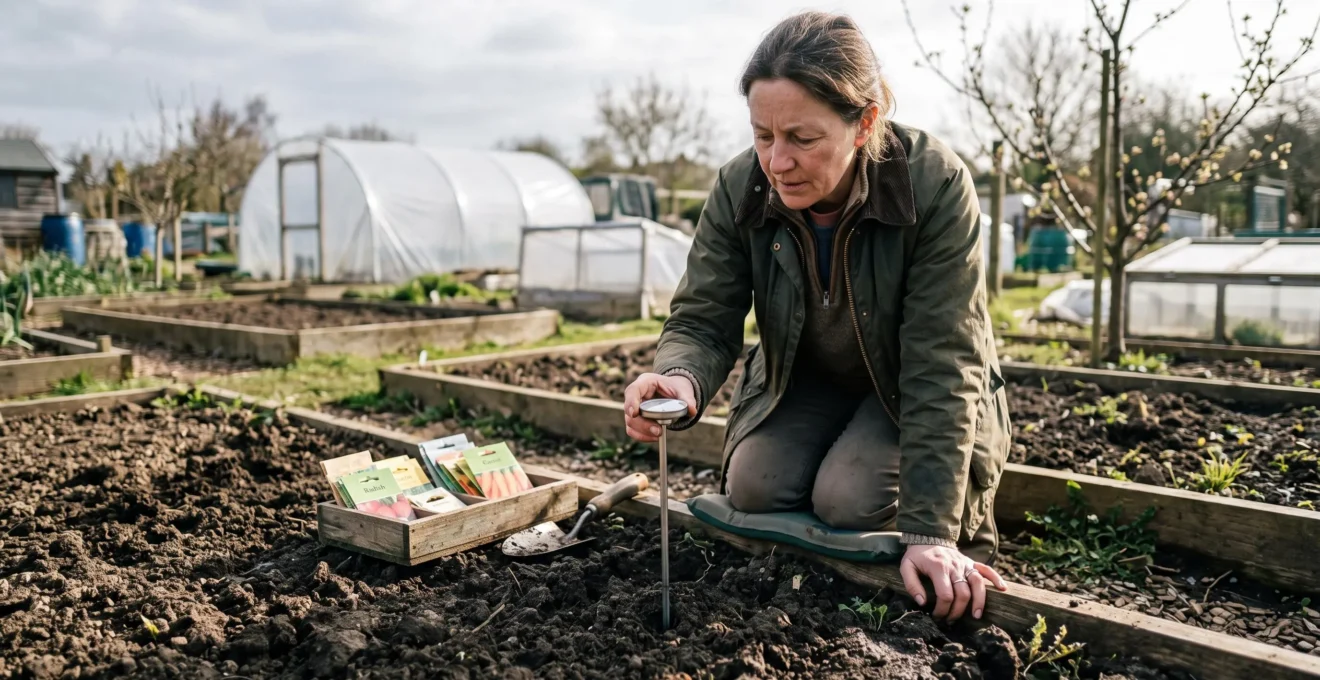
A sunny April afternoon can feel warm enough to sow almost anything. Yet beneath the surface, the soil may still be too cold for seeds to germinate efficiently. The result is familiar to many UK gardeners: patchy rows, delayed seedlings and expensive seed that never emerges.
Soil temperature predicts germination conditions more directly than calendar dates because it influences the biological processes that allow seeds to absorb water, activate metabolism and begin growing. A planting calendar estimates when suitable conditions usually arrive. A thermometer reveals whether those conditions have actually reached the seedbed.
That distinction matters particularly in British springs, when warm days, cold nights and persistent rainfall can produce large differences between air and soil conditions.
Successful thermal timing involves three decisions: identifying a crop’s temperature requirements, measuring the soil where the seed will sit, and checking whether favourable conditions are likely to continue. Calendar guidance remains useful for planning, but actual sowing decisions become more reliable when grounded in local observations.
Soil temperature and germination: the essentials
- Measure the seedbed, not the air. Soil temperatures can remain unsuitable even after several warm spring afternoons.
- Match temperature to the crop. Lettuce and peas tolerate cooler germination conditions than tomatoes and other warmth-loving vegetables.
- Look for sustained warming. Several consistent readings, suitable soil moisture and a favourable short-term forecast provide a stronger sowing signal than one warm day.
- Why Won’t Tomato Seeds Germinate Below 15°C While Lettuce Sprouts at 5°C?
- How to Measure Soil Temperatures at Sowing Depth for Accurate Germination Timing?
- Black Plastic Mulch vs Cloches: Which Warms Soil Fastest for Early Spring Sowing?
- The Spring Sowing Mistake That Rots Seeds Despite Warm Sunny Weather Above Ground
- How Often Should You Check Soil Temperatures in Spring to Catch Perfect Sowing Conditions?
- The Soil Temperature Mistake That Kills Seeds Before They Germinate Despite Perfect Timing
- How to Build a Custom Planting Schedule for Your Specific UK Postcode and Microclimate?
- How Do Accurate Planting Schedules Increase Germination Rates and Harvest Yields?
Why Won’t Tomato Seeds Germinate Below 15°C While Lettuce Sprouts at 5°C?
Tomato seeds can germinate below 15°C, but they generally germinate more slowly and less reliably in cool soil than in warmer conditions. Lettuce seeds can begin germinating at considerably lower temperatures because the two crops have different physiological temperature requirements. The crucial distinction is between temperatures that permit germination and those that encourage rapid, dependable emergence.
Germination begins when a viable seed absorbs sufficient water and resumes metabolic activity. Enzymes mobilise stored reserves, respiration supplies energy, and the embryonic root eventually emerges through the seed coat.
Temperature affects the rates of these processes. Each species has a minimum temperature below which germination is severely restricted, an optimum region where germination performance is strongest, and an upper limit beyond which germination becomes inhibited.
These boundaries are not perfectly sharp switches. Seeds within the same species can differ in vigour, dormancy and temperature response, while moisture and oxygen availability also influence the outcome.
The following comparison separates physiological minimum temperatures from practical sowing considerations.
| Crop | Temperature evidence | Practical sowing implication |
|---|---|---|
| Tomato | Approximate minimum 10°C; optimum near 29°C | Avoid treating 10°C as a dependable outdoor sowing target. Warmer propagation conditions favour faster establishment. |
| Lettuce | Approximate minimum 2°C; optimum near 24°C in the cited temperature table | Cool spring soil may permit germination, but emergence can still be slow near the minimum. |
| Peas | Approximate minimum 4–5°C; best germination temperature around 24°C in the cited guidance | Early sowing is possible when soil conditions are sufficiently drained and suitable for establishment. |
| Beans | Warmth-loving crop; no verified numerical threshold supplied for this comparison | Wait for warmer, consistently suitable soil rather than using the same threshold as peas. |
| Carrots | Suitable for cool-season sowing; no verified numerical threshold supplied for this comparison | Assess seedbed warmth and moisture rather than assuming an early calendar date guarantees emergence. |
These figures are based on the vegetable germination temperature information discussed in Penn State Extension‘s seed and seedling biology article, alongside the crop-specific information supplied by University of Minnesota Extension.
The distinction matters when interpreting seed packets. An ideal propagation temperature is not necessarily the lowest temperature at which a seed can germinate, nor is a laboratory optimum necessarily a practical outdoor target.
At the opposite extreme, lettuce can experience high-temperature germination inhibition, commonly described as thermoinhibition or thermodormancy. Responses vary with variety and growing conditions; germination does not universally stop above 25°C. This explains why simply following an instruction to sow lettuce in summer can produce disappointing results in overheated seedbeds.
Once the relevant crop threshold is understood, the next challenge is establishing what temperature the seeds will actually experience underground.
How to Measure Soil Temperatures at Sowing Depth for Accurate Germination Timing?
Measure soil temperature by placing a suitable thermometer probe into the prepared seedbed at the depth relevant to the intended sowing. Take readings at a consistent time, preferably during the morning, and repeat them over several days. These observations are more useful than air-temperature forecasts because they describe conditions in the soil where germination will occur.
A practical approach begins with the seed packet. Identify the recommended sowing depth, then measure at that level where the probe permits. Many vegetable seeds are planted within the upper few centimetres of soil, but sowing depth varies considerably by crop.
For consistent general soil assessment, Penn State Extension describes inserting a thermometer approximately 7.6–10.2 cm deep. That standardised depth can help track underlying soil warming, but it is not interchangeable with measurements at the exact depth of a shallow-sown seed.
- Choose the intended sowing bed. Do not assume a sheltered raised bed has the same temperature as an exposed vegetable plot.
- Establish the measurement depth. Follow the crop’s sowing instructions and use an appropriate probe for that depth.
- Insert the probe securely. Ensure adequate contact with the surrounding soil without forcing or damaging the instrument.
- Allow the reading to stabilise. Wait according to the thermometer’s response characteristics before recording the result.
- Repeat under comparable conditions. Record measurements at approximately the same mid-morning time over successive days.
Mid-morning is a practical repeatable monitoring time rather than a scientifically universal optimum. Soil temperature fluctuates during the day, especially near the surface, so readings taken at different times cannot be compared without considering that variation.
A useful spring decision rule is to seek two or three consecutive days of suitable readings, particularly for warmth-loving crops. This is a gardening heuristic, not a universally validated requirement for every species. A forecast cold spell may still justify delaying sowing.
A kitchen temperature probe may provide an inexpensive alternative if it is designed to measure the expected temperature range and can be used safely in soil. However, probe thickness, response time and insertion depth can limit its usefulness for shallow measurements.
Without an instrument, gardeners can observe soil moisture, seasonal plant development and the speed at which a seedbed dries after rain. Such cues reveal aspects of spring progression but cannot establish whether a particular temperature threshold has been reached.
The reason is thermal inertia. Soil responds to changes in air temperature over time, with the lag influenced by water content, depth, soil composition and exposure. Wet soil can remain cold despite warm afternoon air.
When readings show that soil is still too cold, gardeners can sometimes improve conditions by warming the seedbed before sowing.
Black Plastic Mulch vs Cloches: Which Warms Soil Fastest for Early Spring Sowing?
Neither black plastic mulch nor cloches can be declared universally faster at warming spring soil without considering weather, soil moisture and installation. Black plastic changes how solar energy reaches and is retained by the covered seedbed, while a transparent cloche creates a sheltered space above it. Both can encourage warming, but they serve somewhat different purposes.
Black plastic absorbs incoming solar radiation and changes heat exchange between the soil and surrounding air. When laid correctly over prepared soil, it can help create warmer growing conditions, although actual results depend on surface contact, sunlight and the soil beneath.
A cloche forms a small protected growing environment. Solar radiation enters through its transparent covering, while the enclosure reduces exposure to wind and modifies heat loss.
Because a cloche also protects the space around emerging seedlings, it may remain useful after sowing. However, temperatures inside transparent covers can rise substantially in bright sunshine, making ventilation important.
| Criterion | Black plastic mulch | Transparent cloche |
|---|---|---|
| Primary mechanism | Modifies solar heat absorption and heat exchange at the soil surface | Creates a sheltered air space that modifies warming and heat loss |
| Before sowing | Can cover a prepared bed while it warms | Can protect and pre-warm a prepared seedbed |
| After sowing | Usually needs removal or appropriate openings for direct-sown rows | Can remain over emerging seedlings when managed correctly |
| Management | Secure edges and monitor conditions beneath the covering | Check ventilation and the risk of overheating |
| Best choice | Useful where a covered bed is practical before sowing | Useful where continued protection after sowing is desirable |
The RHS advice on warming soil for sowing and planting recommends covering prepared ground before planting and explains that covers encourage daytime warming while reducing overnight heat loss.
Importantly, the Royal Horticultural Society advises allowing several weeks for pre-warming: at least six weeks when starting in winter, with four weeks potentially sufficient later in the season. A one- or two-week period should therefore not be treated as a dependable universal solution.
Wet clay presents a particular difficulty because it retains moisture and warms slowly. The RHS notes that cloches can be preferable to fleece in such circumstances because the soil also needs an opportunity to lose excess moisture.
A useful sequence is to prepare and cover the bed, monitor its temperature, remove or open the cover when necessary to sow, and then restore suitable protection. This allows pre-warming and post-sowing shelter to serve separate purposes.
Neither method guarantees protection against a severe frost, and warming a bed does not eliminate the need to assess moisture, drainage and likely weather after sowing.
Whatever covering is selected, the soil must be warm and aerated enough for seeds to germinate rather than merely appearing inviting on the surface.
The Spring Sowing Mistake That Rots Seeds Despite Warm Sunny Weather Above Ground
The spring sowing mistake is planting after a brief spell of warm air without checking whether the seedbed has warmed and drained. Sunshine may heat the exposed surface while deeper soil remains cold and saturated. Seeds then germinate slowly, remain vulnerable to disease and may decay before seedlings emerge, particularly when wet, chilly weather returns.
Consider a hypothetical UK allotment in early spring. Several sunny afternoons encourage a gardener to sow a tender crop on Saturday. The surface looks dry and feels warm, but the seed layer remains wet from recent rain.
During the following week, overnight temperatures fall and further rainfall keeps the bed saturated. Instead of emerging promptly, seeds remain in conditions that restrict oxygen availability and delay metabolic development.
This combination matters because seeds require oxygen for respiration as well as water and suitable temperatures. Saturated or compacted soil can restrict gas exchange, making even otherwise viable seeds less likely to establish successfully.
Cool, wet conditions can also favour organisms responsible for damping-off. These include pathogens that attack seeds before emergence and seedlings shortly after emergence.
University of Minnesota Extension‘s guidance on preventing seedling damping-off explains that conditions which delay germination can increase vulnerability to disease, especially when weather becomes cool and wet after sowing.
Seed decay and damping-off are not identical processes. A seed may fail because of poor viability, inadequate oxygen or other conditions without a confirmed pathogen being responsible. Similarly, not every period of cold, wet weather produces disease.
3 conditions
Temperature, moisture and oxygen availability must all be suitable for successful germination. A warm surface reading alone cannot establish the condition of the seedbed.
Germination requirements described by Penn State Extension; cool, wet disease risks discussed by University of Minnesota Extension.
Before sowing after a warm weekend, open a small section of the prepared bed at the intended seed depth. Measure its temperature, then inspect whether the soil is waterlogged, excessively sticky or reasonably workable.
A hand assessment is useful for identifying obvious moisture problems, but touch cannot reliably establish an exact temperature. The thermometer remains necessary when the decision depends on a narrow thermal threshold.
If the soil is saturated, waiting for better drainage can be more productive than immediately covering it to trap warmth. A cover cannot compensate for a seedbed in which water is restricting oxygen.
Once the soil begins warming and draining, regular observations help identify when the risk has declined enough to justify sowing.
How Often Should You Check Soil Temperatures in Spring to Catch Perfect Sowing Conditions?
Check soil temperature approximately once a week while conditions remain well below the crop’s useful germination range, then increase to daily checks as the seedbed approaches it. During rapidly changing spring weather, repeated readings help identify sustained warming and distinguish a promising sowing window from a temporary temperature spike.
The important event is not simply reaching a particular number on one afternoon. It is entering a period when soil conditions are sufficiently suitable for the chosen crop to germinate and establish.
For practical monitoring, gardeners can group their attention around illustrative temperature bands: approximately 5–7°C for some cool-tolerant crops, around 10°C as a further spring warming marker, and around 15°C when assessing conditions for more warmth-demanding sowings.
These bands are monitoring landmarks, not universal planting thresholds. Individual species and varieties differ, and temperature alone cannot establish safe outdoor sowing conditions.
A small notebook can turn isolated readings into useful local records. Include the date, time, measurement depth, soil temperature, recent rainfall and the exact bed being monitored.
After several seasons, these observations can show whether particular beds consistently warm earlier and whether soil warming follows a predictable pattern for that garden.
The pattern should not be extrapolated too confidently. A sheltered wall, raised bed, shaded border or exposed allotment may behave differently during the same week. Short-term weather can also disrupt an otherwise consistent seasonal trend.
Five actions for a reliable spring sowing decision
- Select the crop and identify its germination requirements. Write down the crop, variety and relevant temperature guidance.
- Mark the intended sowing bed and measurement depth. Record the location and depth so future readings are comparable.
- Measure and log the soil temperature. Produce a dated series of readings taken at a consistent time.
- Check moisture and the short-term forecast. Note drainage conditions and any expected cold or wet spell.
- Record the sow-or-wait decision. Enter the chosen sowing date or the reason for delaying it, ready for later comparison with germination results.
This system helps prevent a common recording error: comparing a warm measurement from one sheltered spot with an earlier cold measurement from a different, exposed bed.
It also supports future decisions. A bed that repeatedly reaches favourable conditions earlier than another may justify a separate sowing schedule, even when both are in the same garden.
Even after the appropriate threshold has been reached, however, the conditions immediately following sowing remain important.
The Soil Temperature Mistake That Kills Seeds Before They Germinate Despite Perfect Timing
Sowing at a suitable soil temperature does not guarantee that conditions will remain suitable afterward. A warm spell can be followed by several cold, wet days that delay germination and increase the risk of seed decay or damping-off. A subsequent temperature drop does not automatically kill seeds, but it can undermine an otherwise well-timed sowing.
There are two different timing errors to recognise. The first is sowing before the soil has reached a useful temperature. The second is sowing during a temporary warm interval that ends before seeds have established.
The second error can be especially frustrating because the gardener measured correctly on the day of sowing. The problem was not necessarily the measurement; it was assuming that the observed temperature would persist.
Germination takes time, and the speed of development depends on the crop and its environment. When temperatures fall, many seeds slow their metabolic activity. Some remain viable and resume germination when conditions improve, while others become more vulnerable to decay in prolonged unfavourable conditions.
University of Minnesota Extension’s damping-off guidance specifically identifies cool, wet weather after planting as a factor that can slow germination and increase disease vulnerability. It does not establish that several days below a crop’s preferred or minimum temperature necessarily kill every seed.
For marginal spring windows, waiting until the soil is warming more consistently can therefore provide better establishment prospects than sowing at the earliest possible opportunity.
Sowing depth also matters. Temperature fluctuations are generally more pronounced near the surface than deeper in the soil. However, deeper placement is not automatically protective: it may expose seeds to cooler or wetter conditions and require seedlings to travel farther before emergence.
Depth should follow the crop’s appropriate sowing guidance rather than being altered solely to escape a cold snap.
A simple pre-sowing decision combines three observations:
- Is the measured soil temperature suitable for this crop?
- Is the soil sufficiently drained and aerated?
- Does the short-term forecast suggest conditions will remain reasonably favourable during early germination?
If the answer to the final question is uncertain, the response depends on crop tolerance and the severity of the expected change. Cold-tolerant species may cope well with a temporary slowdown, while warmth-loving crops often warrant greater caution.
Combining this check with observations from previous springs provides the foundation for a planting schedule tailored to the specific garden.
How to Build a Custom Planting Schedule for Your Specific UK Postcode and Microclimate?
Build a custom UK planting schedule by combining local climate averages, crop-specific germination requirements and temperature measurements from your own garden. Use the postcode or nearest representative climate location to understand general seasonal conditions, then adjust sowing dates according to exposure, soil type, drainage and actual seedbed readings.
Begin with regional climate context. The Met Office‘s location-specific climate averages provide historical information about air temperatures, rainfall, air frost and other weather variables.
These records help gardeners understand whether their general area experiences relatively mild or cold spring conditions. Reference periods include 1991–2020, although data availability varies between stations and measurements.
They do not provide a guaranteed last-frost date for a particular year or live soil temperatures for an individual postcode. The linked Met Office page is associated with Cairnwell; its station readings must not be treated as representative of every UK garden.
After identifying a relevant local climate context, assess the garden itself. A south-facing bed beside a sheltered wall may warm differently from a shaded, exposed or poorly drained bed nearby.
Differences in soil moisture, sunlight and exposure can be large enough to make a single postcode-level sowing recommendation unsuitable for every bed.
The objective is to replace broad instructions such as « sow in April » with decisions based on the crop’s requirements and the garden’s measured conditions.
| Record field | What to enter | How it improves decisions |
|---|---|---|
| Crop and variety | Exact seed being planted | Keeps different germination requirements separate |
| Bed and exposure | Raised bed, open plot, sheltered wall or shaded area | Identifies microclimate differences |
| Sowing temperature | Measured temperature and depth | Links timing to real seedbed conditions |
| Moisture and forecast | Drainage observations and expected weather | Records important post-sowing risks |
| Germination outcome | First emergence date and observed establishment | Allows future comparison between sowings |
For example, consider a hypothetical gardener who finds that a sheltered bed consistently reaches favourable temperatures ahead of an exposed plot. Rather than applying the same planting date to both areas, the gardener can maintain separate sowing windows.
Over several seasons, records of temperature, sowing date and emergence can reveal whether the earlier opportunity genuinely produces dependable results.
Record failures as well as successes. A sowing that fails after heavy rain may indicate a drainage issue rather than an incorrect temperature threshold, while delayed emergence without obvious disease may suggest that the crop was planted near the lower end of its germination range.
Last-frost considerations remain relevant to tender seedlings. Soil warm enough for germination does not guarantee that emerging plants will survive exposure to freezing air.
Consequently, a useful custom calendar should include both the conditions needed for germination and any separate frost-protection requirements during establishment.
The resulting schedule is not a fixed list of annual dates. It is a record-based system that becomes more useful as planting conditions and outcomes are documented.
Key takeaways before planning the next sowing
- Use each crop’s germination requirements to define a suitable sowing window, not an arbitrary date.
- Separate present soil conditions from the weather risks that may affect seeds and seedlings afterward.
- Evaluate success through emergence and establishment records, not simply whether seeds were planted earlier.
How Do Accurate Planting Schedules Increase Germination Rates and Harvest Yields?
Accurate planting schedules can improve germination and support better harvests by aligning sowing with suitable soil temperatures, moisture and weather conditions. Faster, more uniform emergence reduces the time seeds spend vulnerable in the ground and helps seedlings establish together. However, the size of any improvement depends on the crop, growing season and previous sowing practices.
A claim that temperature-based schedules increase germination rates or harvest yields by 50% should not be presented as a universal result. The available evidence explains the biological and horticultural mechanisms involved but does not establish that percentage as a consistent outcome across crops or gardens.
The more defensible conclusion is that improved thermal timing can reduce avoidable germination failures and make planting decisions more repeatable.
When seeds encounter favourable conditions, their metabolic processes can proceed more efficiently, often allowing emergence sooner than in marginally cold soil. This can shorten the period during which seeds are exposed to prolonged moisture, soil pathogens and other establishment hazards.
More uniform emergence also makes a vegetable bed easier to manage. Seedlings at similar developmental stages can be watered, protected and tended more consistently than an uneven row in which some plants emerge much later than others.
That improvement may influence harvest timing. Earlier establishment can provide more time for crop development and may create opportunities for succession sowing or an additional crop within the available growing season.
Nevertheless, germination success and final yield are different outcomes. Weather, nutrients, pests, plant spacing, water availability and subsequent crop management all affect the harvest. Better sowing timing cannot eliminate these other limitations.
The complete thermal-timing approach connects four decisions:
- Crop requirements: identify the temperature range that supports useful germination.
- Direct measurement: establish what the soil is doing at the intended sowing depth.
- Practical intervention: improve conditions through drainage management, suitable covers or delayed sowing where appropriate.
- Local scheduling: record observations and outcomes to improve future planting decisions.
For gardeners who have experienced patchy germination, the greatest immediate benefit is diagnostic. A failed sowing can be assessed against recorded temperatures, moisture conditions and subsequent weather rather than being attributed vaguely to an unusually difficult spring.
Over time, that information can help distinguish crops that benefit from earlier sowing from those that consistently perform better when planted later into reliably warmer soil.
For the next sowing, choose one crop and one bed, measure the soil at the intended depth for several mornings, check drainage and the forecast, then record the germination outcome. That single comparison begins the shift from calendar-based guesswork to a practical, evidence-led planting schedule.
Can seeds germinate if the soil temperature drops overnight?
Yes. A temporary overnight temperature drop does not necessarily prevent or destroy germination. Its effect depends on the crop, the severity and duration of cooling, and the moisture conditions. Repeated cold, wet periods can slow emergence and increase vulnerability to disease, making sustained soil-temperature patterns more informative than a single reading.
Should soil temperature be measured before or after watering?
For routine comparisons, use a consistent measurement method and record whether the soil has recently been watered or exposed to rainfall. Water can affect soil temperature and heat transfer. A reading taken under unusually wet conditions may not be directly comparable with an earlier reading from a dry seedbed.
Does a raised bed warm faster than ordinary garden soil?
A raised bed can warm differently because its drainage, exposure and soil composition may differ from surrounding ground. However, it should not automatically be assumed to be warmer. Measuring both beds at comparable depths and times provides the most useful answer for a particular garden.
Can a soil thermometer predict the last frost?
No. Soil temperature describes conditions within the ground, while frost risk depends on atmospheric and local surface conditions. A seedbed may be suitable for germination even when vulnerable seedlings still require protection. Use local weather forecasts and historical climate information alongside soil measurements.
Is it better to sow seeds early in cool soil or wait for warmer conditions?
It depends on the crop. Cool-tolerant vegetables may be suitable for early sowing once the soil is workable and sufficiently drained. Warmth-loving species generally benefit from waiting until soil temperatures are more favourable and reasonably stable. The earliest possible sowing date is not always the date that produces the earliest healthy seedlings.