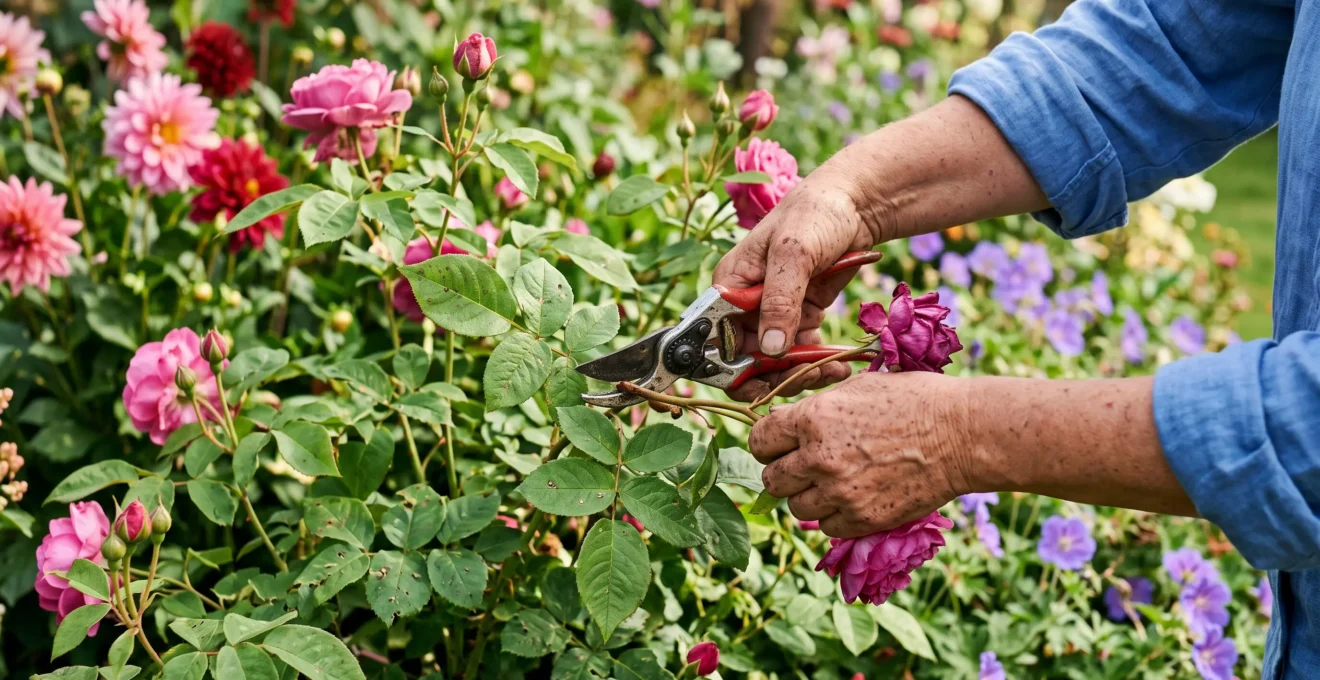
A rose bush that finishes flowering in June does not necessarily have to remain bare until next year. Many repeat-flowering plants can produce fresh buds through summer and into autumn, provided their fading flowers are removed before substantial seed development begins. This simple practice, known as deadheading, helps direct the plant’s resources towards further growth and flowering rather than seed production.
Deadheading can substantially extend the flowering season of roses, dahlias and certain border perennials. However, the idea that it automatically doubles flowering duration is not supported by a universal measurement. The actual benefit depends on the plant’s natural flowering cycle, the timing and position of each cut, and conditions such as moisture, nutrition and temperature.
For UK gardeners, the greatest advantage comes from understanding which flowers respond, where to cut and when to leave seed heads untouched. Used selectively, deadheading can keep established borders colourful for longer without repeatedly buying or planting replacements.
Deadheading for longer-lasting garden colour
- Choose responsive plants: Repeat-flowering roses and dahlias can produce successive blooms, while many single-flowering plants cannot.
- Cut at the right point: Remove fading flowers above a suitable leaf joint, bud or developing side shoot rather than indiscriminately shortening stems.
- Adjust throughout the season: Check plants regularly during active flowering, but retain selected seed heads for self-sowing, wildlife and winter interest.
- Why Do Roses and Dahlias Rebloom After Deadheading While Delphiniums Rarely Do?
- Should You Pinch Just the Dead Flower or Cut Back to the First Leaf for Better Reblooming?
- How Often Should You Deadhead Spent Blooms to Maintain Continuous Flowering?
- The Deadheading Mistake That Eliminates Self-Sowing Annuals You Wanted to Return
- When Should You Stop Deadheading Spent Blooms to Allow Attractive Autumn Seed Heads?
- The Deadheading Mistake That Cuts Your Flowering Season Short by 2 Months
- Should You Pinch Just the Dead Flower or Cut Back to the First Leaf for Better Reblooming?
- How Can You Achieve Continuous Flowering Without Gaps Throughout the UK Growing Season?
Why Do Roses and Dahlias Rebloom After Deadheading While Delphiniums Rarely Do?
Roses and dahlias can flower again after deadheading because many varieties naturally produce successive flowering shoots. Removing faded blooms prevents resources being committed to developing seeds and can encourage further buds. However, the comparison with delphiniums needs qualification: some perennial delphiniums also produce a second flowering flush when their faded spikes are cut back appropriately.
Once a flower is pollinated, the plant may invest carbohydrates and nutrients in developing seeds and fruits. Deadheading interrupts that process. In plants capable of repeated flowering, resources can instead support new shoots and developing flower buds. Removing old flowers does not create flowering capacity where the plant lacks it, however.
For practical gardening purposes, plants can be grouped by their response to removing faded flowers. These are useful management categories rather than strict botanical classifications.
| Flowering habit | Examples | Likely response |
|---|---|---|
| Repeat-flowering | Repeat-blooming roses, dahlias, many bedding plants | Further buds and flowers can develop throughout the growing season. |
| Single-flush | Peonies, many once-flowering roses | Improved appearance and reduced seed formation, but usually no second flowering flush. |
| Flower-spike plants | Delphiniums, lupins | Removing finished spikes can encourage further flowering in suitable varieties and conditions. |
| Cut-back responders | Some hardy geraniums, catmint and lady’s mantle | Shearing after the first flush can encourage fresh foliage and another display of flowers. |
A particularly important exception concerns delphiniums. According to the RHS guide to growing perennial delphiniums, faded flower spikes can be cut down to ground level to encourage further flowers. Belladonna Group varieties may bloom in early and late summer, while some Elatum Group plants can flower again in autumn.
The distinction matters because simply pinching individual flowers from a spike is not equivalent to removing the completed spike. Likewise, certain hardy geraniums respond more effectively to substantial cutting back than to removing individual flower heads.
Doubling flowering duration is a possibility, not a reliable prediction. A plant that naturally produces multiple flushes may remain attractive much longer with suitable care, but neither a fixed percentage increase nor a guaranteed doubling applies across species.
Once a plant’s flowering potential is established, the next decision is how much stem to remove without sacrificing buds that are already forming.
Should You Pinch Just the Dead Flower or Cut Back to the First Leaf for Better Reblooming?
Pinching is generally appropriate for soft stems when removing a faded flower does not leave an unwanted stalk. Cutting back to a healthy leaf node or developing side shoot is often better for thicker stems and plants such as dahlias. For roses, the most suitable method depends on the variety and its growth, rather than a universal instruction to cut to the first leaf.
The underlying principle is to preserve viable buds and growing points. New flowering shoots may arise from buds at leaf axils, existing side branches or basal growth, depending on the species. Cutting too far below these structures can remove shoots that would otherwise flower soon.
Before making a cut, look for a healthy leaf joint, a visibly swelling bud or a developing side shoot. An outward-facing bud can help direct new growth away from the crowded centre of a shrub.
The decision becomes clearer when the two main techniques are compared.
| Decision factor | Pinching or removing the flower head | Cutting back to a node |
|---|---|---|
| Suitable growth | Soft, easily detached flower stalks | Firm, woody or elongated flowering stems |
| Main purpose | Remove the fading flower while retaining existing growth | Remove the spent stem and retain a suitable point for regrowth |
| Typical examples | Soft-stemmed bedding plants; some roses | Dahlias, many roses and selected perennials |
| Main risk | Leaving an unsightly or unproductive stalk | Removing developing side shoots or too much healthy foliage |
For dahlias, identify the spent head and follow its stem down to a leaf joint. Healthy developing buds should remain intact. The Royal Horticultural Society explains the correct method in its RHS dahlia growing guide, which also identifies the difference between rounded developing buds and more pointed spent heads.
Roses require more flexibility than the traditional five-leaflet rule suggests. Some hybrid tea roses can rebloom more quickly when the faded flower is snapped off rather than the stem cut substantially shorter. Other roses can have spent flowers or entire clusters removed immediately above the next suitable leaf.
A newly planted or drought-stressed specimen also deserves a lighter approach. Removing extensive healthy growth reduces its leaf area while it is already coping with limited resources. Where only a faded flower needs removing, there is little reason to cut away additional foliage.
Careful cutting protects the next flush, but regular observation determines whether spent flowers are removed early enough to support continued blooming.
How Often Should You Deadhead Spent Blooms to Maintain Continuous Flowering?
Deadhead when flowers begin to fade, rather than following an inflexible calendar. During peak flowering, checking the garden several times a week makes it easier to identify spent blooms, while a weekly session is a practical routine for dahlias and repeat-flowering roses. The ideal frequency varies with the species, weather, flowering speed and available time.
The biological advantage comes from removing flowers before significant resources have been invested in developing seeds. A flower that has only just started to fade is generally a better candidate than one already carrying a well-developed seed head.
Nevertheless, missing a few days does not mean the entire flowering cycle has been lost. The RHS advice on deadheading plants notes that some summer bedding plants benefit from daily attention, while certain border perennials need attention only weekly or fortnightly. Delays of several days, or even a week, do not necessarily cause a major reduction in flowering performance.
A seasonal approach is more realistic than treating every plant identically:
- During vigorous early-summer growth: Inspect developing flower displays and remove fading blooms from responsive plants.
- At the summer flowering peak: Make short, regular checks, paying particular attention to dahlias, repeat roses and heavily flowering bedding plants.
- As flowering slows: Continue deadheading plants with healthy developing buds, but reduce unnecessary cutting elsewhere.
- Approaching autumn: Decide which plants should continue flowering and which should be left to form decorative or wildlife-friendly seed heads.
In a large mixed border, concentrating on the most responsive plants is often more effective than trying to remove every faded flower. A few minutes spent on actively flowering roses and dahlias can be more useful than extensive work on perennials that have already completed their natural display.
A five-step deadheading routine for a UK flower border
- Identify repeat-flowering plants in the border and make a short list of the specimens that need regular attention.
- Inspect each selected plant for fading flowers and visibly developing buds, noting which stems are ready for cutting.
- Follow each spent flower stem to a suitable leaf joint or growing point, leaving the chosen node intact.
- Remove faded flowers with fingers or suitable clean cutting tools, then check that healthy buds remain on the plant.
- Review the border after each session and record which plants are producing fresh buds, which need watering and which should retain seed heads.
Deadheading is most successful when treated as a small part of ongoing plant care. Adequate water, suitable nutrition and healthy foliage are also necessary for continued flowering; removing spent blooms cannot compensate for a plant that lacks the resources to develop new buds.
Regular cutting also requires knowing when not to intervene, particularly where annual flowers depend on retained seeds to establish the following year’s display.
The Deadheading Mistake That Eliminates Self-Sowing Annuals You Wanted to Return
Removing every faded flower from self-sowing annuals can prevent them from returning naturally the following year. Plants such as poppies, love-in-a-mist (Nigella) and calendula can depend on seeds falling into suitable soil to produce the next generation. By eliminating their seed heads, systematic deadheading interrupts the very process that keeps these flowers appearing without replanting.
This creates an important conflict between immediate colour and next year’s garden. Removing old flowers can encourage further blooms on responsive plants, but allowing flowers to mature into seed pods provides the material needed for natural regeneration.
For example, a gardener who removes every spent Nigella flower may enjoy a tidy border but lose the decorative seed capsules and much of the potential for self-sown seedlings. Leaving some capsules to mature makes the outcome more compatible with a low-maintenance cottage-garden style.
Selective deadheading offers both benefits. Rather than treating all flowers identically, leave a portion of healthy stems to form seeds while removing other faded blooms where continued flowering is desirable. No particular percentage is universally required: the appropriate amount depends on how freely the plant self-seeds and how many seedlings are welcome.
The choice can be made by the plant’s intended purpose:
- For extended flowering: Deadhead responsive annuals while they are actively producing new buds.
- For next year’s seedlings: Leave selected flowers to mature and release seed naturally.
- For ornamental seed pods: Preserve the structures that provide visual interest after the petals fall.
- For wildlife: Retain suitable seed-bearing stems where birds can access them later in the season.
Self-sowing is not guaranteed simply because seed heads are left intact. Seed maturity, suitable ground conditions and subsequent weather all influence germination. However, removing every seed head eliminates a major opportunity for these plants to reproduce without deliberate sowing.
There is also a wildlife consequence. Seeds retained on suitable annuals and perennials may contribute to winter food availability for seed-eating birds. A border managed solely for continuous summer flowers can therefore offer fewer resources later in the year.
That principle becomes increasingly important as the growing season progresses and the garden begins its transition from fresh flowers to autumn seed heads.
When Should You Stop Deadheading Spent Blooms to Allow Attractive Autumn Seed Heads?
Stop deadheading selected plants when their seed heads will provide more value than another flowering flush. In UK gardens, this decision often becomes relevant from late summer onwards, although there is no universal stopping date. Allowing echinacea, suitable sedums and other seed-bearing perennials to mature can create autumn structure, while repeat roses and dahlias may continue flowering until colder weather intervenes.
The change is both practical and aesthetic. A summer border depends heavily on fresh petals and strong colour. An autumn border can retain interest through seed heads, dry stems, ornamental grasses and the contrasting shapes of plants entering dormancy.
It is important to distinguish plants primarily grown for their flowers from those valued for their later structures. Ornamental grasses are often retained for their flowering plumes and seed heads, while decorative allium heads may remain attractive long after flowering without requiring continued deadheading.
On repeat-flowering plants, allowing seed or fruit development can reduce the resources available for subsequent blooms. However, the impact varies by species, and not every retained seed head represents a measurable loss of flowers.
For roses grown specifically for attractive hips, the RHS recommends stopping deadheading around midsummer so the fruits have time to develop. This differs from the treatment of repeat-flowering roses maintained primarily for their floral display.
A useful stopping criterion is whether fresh buds can realistically develop into worthwhile flowers before seasonal conditions end the display. Plants still carrying healthy buds may justify continued attention. Those slowing significantly can instead be allowed to develop their remaining seed heads.
This is especially relevant in regions of the UK where early frosts bring flowering to an abrupt end. The same plant may continue blooming longer in a sheltered coastal garden than in an exposed or frost-prone inland position, so local conditions matter more than an arbitrary date.
Leaving some stems standing also benefits wildlife. Appropriate seed heads can provide food for birds, while retained vegetation contributes shelter and overwintering habitat for garden invertebrates.
The opposite mistake is stopping care too soon on plants that still have significant flowering potential, particularly when healthy buds are already developing.
The Deadheading Mistake That Cuts Your Flowering Season Short by 2 Months
Incorrect cutting can shorten a flowering season by removing developing buds or side shoots that would otherwise produce another flush. Prematurely abandoning deadheading and watering can also reduce late-season flowering. However, a loss of exactly two months is not an established consequence: the delay may range from a relatively short interruption to much longer, depending on the species, growing conditions and remaining season.
One of the most damaging errors is treating deadheading as heavy pruning. A stem carrying an old flower may also support smaller developing buds below it. Cutting beneath those buds removes the next potential display along with the spent flower.
This is particularly relevant when a plant has already initiated new growth. At that stage, the aim is not to stimulate regrowth at any cost but to preserve the flowering shoots that are already present.
Before cutting, inspect the stem from its tip downwards:
- Identify the spent bloom and distinguish it from unopened buds.
- Look for healthy side shoots immediately below the faded flower.
- If a suitable side shoot or bud is present, cut just above it.
- If no suitable shoot is visible, locate an appropriate lower leaf node, following the plant’s specific deadheading requirements.
- Avoid removing extensive healthy growth unnecessarily, particularly on stressed or recently established plants.
The cumulative effect of poor maintenance can be greater than that of one incorrectly positioned cut. Consider a hypothetical garden where repeat roses produce their first substantial flush, after which the gardener stops removing faded flowers and allows the soil to become persistently dry.
In that scenario, declining flowering may reflect both continuing seed development and water stress. The plants might produce fewer late-season flowers than similar well-maintained plants, but the precise difference in duration cannot be calculated without observations or comparative evidence.
Another common mistake is cutting back an entire flowering plant when only selected stems need attention. Some perennials genuinely benefit from shearing after their first flush, but that treatment should not be applied indiscriminately to roses, dahlias or plants already carrying healthy flowering shoots.
Deadheading is not a substitute for season-long care. Even a perfectly positioned cut cannot sustain blooming where insufficient water, nutrients or favourable temperatures prevent new buds from developing.
With that distinction clear, the practical challenge is choosing a repeatable technique for different stem types rather than relying on a single cutting rule.
Should You Pinch Just the Dead Flower or Cut Back to the First Leaf for Better Reblooming?
For repeat-flowering plants, the correct technique depends on where the next buds are positioned. Soft-stemmed annuals can often be pinched immediately above a healthy leaf pair, while dahlias generally need their spent flowering stems cut to a lower leaf joint. Roses require a more adaptable approach, sometimes involving removal of the faded head alone rather than cutting down to a five-leaflet leaf.
The following plant-specific methods translate that principle into a practical routine.
For repeat-flowering roses:
- Identify a faded bloom or completed flower cluster.
- Examine the stem for a healthy leaf and outward-facing bud.
- Remove the spent flower immediately above a suitable leaf where appropriate.
- On suitable hybrid tea roses, consider removing the faded head without shortening the stem substantially, particularly when encouraging rapid repeat flowering.
- Retain healthy foliage and developing shoots that can contribute to the next flush.
A five-leaflet leaf is a useful visual landmark on many roses, but it is not a mandatory cutting destination for every variety. The most appropriate position depends on the growth and the type of rose.
For dahlias:
- Find the spent flower head, which often becomes pointed after its petals fall.
- Distinguish it from rounded developing flower buds.
- Trace the spent flowering stem down to a healthy leaf joint or developing side shoot.
- Cut the spent stem just above that joint with suitable secateurs.
- Check that nearby unopened buds remain undamaged.
For soft-stemmed annuals: Support the stem gently and pinch off the faded flower above a suitable leaf pair or growing point. Where the stalk is tougher or resists clean removal, use scissors or secateurs instead of pulling, which could damage the remaining stem.
Tool hygiene becomes more important when working with woody or visibly unhealthy material. Clean secateurs help produce precise cuts, while cleaning tools between diseased plants reduces the risk of transferring contaminated material.
If a rose stem also shows symptoms such as blackspot or another disease, the cutting decision should take the affected growth into account. Remove material requiring disease management appropriately rather than insisting on the usual deadheading point. Healthy foliage should not be removed unnecessarily.
Pinching generally preserves more existing stem and foliage, whereas cutting back to a node removes additional growth and can influence the plant’s shape and subsequent branching. Neither method guarantees faster or stronger flowering in every species.
Once these techniques become familiar, they can be combined with staggered planting and seasonal care to maintain colour across the whole border rather than on isolated specimens.
Key takeaways for planning longer-lasting colour
- Build the main summer display around plants with proven repeat-flowering habits rather than expecting every perennial to rebloom.
- Plan overlapping flowering periods so a second or third flush supplements plants already entering bloom.
- Support repeat-bloomers with suitable watering and feeding while allowing selected seed heads to develop for autumn and winter.
How Can You Achieve Continuous Flowering Without Gaps Throughout the UK Growing Season?
Continuous flowering in a UK garden comes from combining plants with overlapping flowering seasons, using repeat-flowering varieties as the summer backbone and deadheading them consistently. No single cutting technique can eliminate every gap. Early perennials, summer roses and dahlias, and suitable autumn-flowering plants must succeed one another, supported by adequate watering, nutrition and timely cutting back.
The essential principle is succession: when one plant finishes its main display, another should already be opening flowers. Deadheading then extends the contribution of repeat-bloomers and helps bridge intervals between the principal flowering periods.
A practical UK sequence can be organised around the following seasonal roles.
| Seasonal stage | Plants to consider | Maintenance priority |
|---|---|---|
| Spring to early summer | Aquilegia, hardy geraniums and other early-flowering perennials | Manage finished flowers selectively; cut back suitable geraniums after flowering to encourage refreshed growth. |
| Early to midsummer | Repeat-flowering roses and perennial delphiniums | Deadhead roses and remove completed delphinium spikes where a second flush is desirable. |
| Midsummer to late summer | Dahlias, repeat roses and summer bedding plants | Remove spent flowers regularly and support vigorous flowering with appropriate water and nutrition. |
| Late summer to autumn | Dahlias, repeat-flowering roses and suitable autumn perennials | Continue managing active blooms while selecting plants whose seed heads should remain. |
| After flowering ends | Echinacea, ornamental grasses and other plants with attractive retained structures | Preserve suitable seed heads and stems for seasonal interest and wildlife. |
The schedule is a framework rather than a guarantee of flowering dates. Individual cultivars, local weather, exposure and regional frost patterns affect when blooms appear and finish. Dahlias can continue until the first frosts under favourable conditions, while many repeat-flowering roses remain productive into autumn.
Early-flowering hardy geraniums provide a useful example of how cutting back changes the handover between plants. Some varieties can be sheared after their first flush to encourage fresh foliage and further flowers. Aquilegia, by contrast, should not automatically be treated as a reliable repeat-bloomer; retaining seed heads may be preferable where natural self-sowing is wanted.
Nutrition is another important part of the strategy. The RHS guide to growing roses recommends feeding established border roses in March or April and again around midsummer after their first flush, particularly for repeat-flowering varieties. This helps support the subsequent growth required for further blooms.
Container plants need particular attention because their root systems have access to a smaller volume of growing medium. For container-grown dahlias, RHS guidance recommends a potassium-rich liquid fertiliser fortnightly from early July to early September. Suitable watering is equally important, especially during warm, dry spells.
For a hypothetical mixed border, a useful arrangement might combine early hardy geraniums, repeat-flowering roses and summer dahlias with autumn-flowering perennials. The roses and dahlias provide recurring colour, while the other plants contribute their main displays at different stages. Any gaps would depend on the cultivars and actual growing conditions rather than on the planting concept alone.
The most reliable approach is to observe the existing border before adding plants. Record when each species starts and finishes flowering, identify periods with little colour, and choose additional varieties that naturally flower during those intervals. Deadheading can then maintain the established flowering framework instead of being expected to solve gaps that result from plant selection.
Start with the repeat-flowering plants already in the garden: identify their developing buds, remove spent blooms at suitable cutting points and maintain consistent care. Use the next growing season’s observations to refine the planting scheme, preserving seed heads wherever autumn interest or self-sowing is more valuable than further flowers.
Can deadheading really double the flowering season?
Deadheading can substantially extend flowering in plants naturally capable of producing repeated blooms, but doubling is not guaranteed. No universal evidence establishes a twofold increase. The outcome depends on the cultivar, cutting method, growing conditions and timing of seasonal frosts.
Should you deadhead flowers during a hot, dry spell?
Faded flowers can still be removed during dry weather, but avoid unnecessary heavy cutting of plants already under significant stress. Maintaining appropriate soil moisture is important because a water-stressed plant may struggle to produce further buds even after deadheading.
What happens if you accidentally remove an unopened flower bud?
That bud cannot develop into a flower after removal. A healthy repeat-flowering plant may produce additional buds from other growing points, although this takes time and depends on its growth habit and growing conditions. On dahlias, distinguish rounded unopened buds from more pointed spent flower heads before cutting.
Do all roses need deadheading?
No. Repeat-flowering roses are generally deadheaded to encourage further blooms, while once-flowering roses may benefit mainly from a tidier appearance. Roses grown for decorative hips should be allowed to develop fruit; for these, deadheading is usually stopped around midsummer.
Should spent flowers always be removed before winter?
No. Seed heads can provide winter structure, food for birds and habitat for wildlife. Retaining suitable stems on echinacea, ornamental grasses and other seed-bearing plants can be more beneficial than clearing every faded flower. The decision should reflect the species, plant health and the garden’s intended winter appearance.