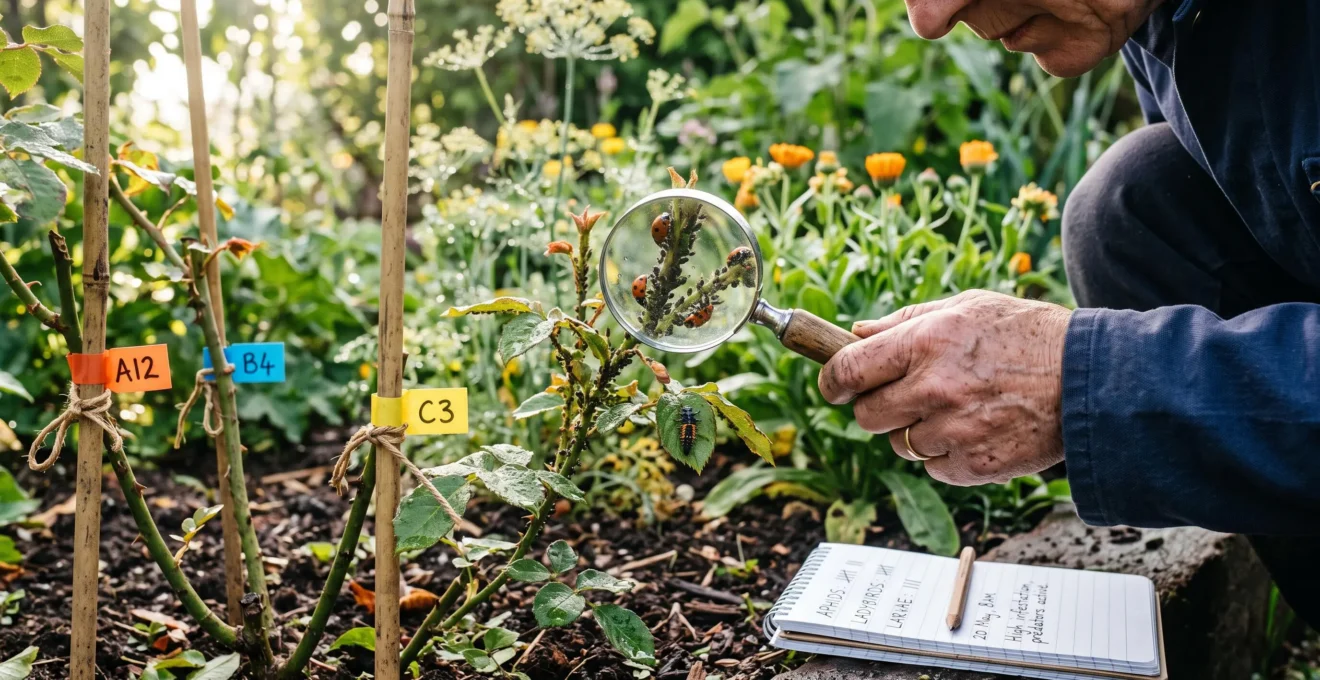
Aphids covering new shoots, slugs damaging seedlings overnight and caterpillars stripping brassica leaves can make a chemical-free garden feel like a losing battle. Yet many of the insects and other animals capable of controlling these pests already live nearby. The challenge is attracting them before damage becomes serious and giving them reasons to remain.
Natural predators can substantially suppress garden pests, but a 90% reduction is not a scientifically established universal outcome. Success depends on which predators are present, when they arrive, how quickly pests reproduce and whether the garden provides food, shelter and undisturbed habitat throughout the year.
The most effective approach is therefore not to release as many beneficial insects as possible. It is to recruit a functioning community of ladybirds, lacewings, hoverflies, ground beetles and other wildlife that responds naturally to developing infestations.
With a few targeted habitat changes and a simple monitoring routine, gardeners can reduce unnecessary intervention while discovering how much biological control their own garden actually delivers.
Natural pest control: what matters most
- Recruit predators before pests multiply. Provide seasonal flowers, overwintering shelter and undisturbed refuges rather than relying on purchased insects.
- Measure suppression instead of expecting eradication. Monitor pests and predator activity together, tolerating minor infestations only where crops remain healthy.
- Protect the predators already working. Avoid broad-spectrum sprays, excessive soil disturbance and unnecessary removal of overwintering habitat.
- Why Are Ladybirds, Lacewings, and Hoverfly Larvae Your Most Effective Aphid Controllers?
- How to Create Insect Hotels and Hedgehog Homes That Actually House Natural Predators?
- Should You Aim to Eliminate All Pests or Maintain Low Populations to Feed Natural Predators?
- The Pest Control Mistake That Kills Your Predator Army and Worsens Future Infestations
- When Should You Install Natural Predator Habitat to Ensure Populations Are Ready Before Pest Surges?
- Why Are Slow Worms, Ground Beetles, and Centipedes Your Garden’s Most Valuable Pest Controllers?
- How to Use Nasturtiums and Mustard as Trap Crops to Protect Brassicas and Beans?
- How Does Maintaining Local Ecosystem Balance Reduce Garden Pest Problems by 80%?
Why Are Ladybirds, Lacewings, and Hoverfly Larvae Your Most Effective Aphid Controllers?
Ladybirds, lacewings and hoverflies are valuable aphid controllers because their larvae actively hunt aphids on infested plants. Supporting all three increases the variety of natural enemies available throughout the growing season. However, their effectiveness depends on predator abundance, prey availability and timing, not simply on which species happens to be present.
The first recruitment lesson is recognising the insects actually doing the hunting. Adult ladybirds are familiar, but their elongated, often dark, spiny-looking larvae are easily mistaken for pests. Lacewing larvae have prominent curved jaws and an elongated body, while hoverfly larvae resemble small, legless, translucent or greenish maggots moving through aphid colonies.
Do not remove unfamiliar larvae from an aphid-covered shoot until they have been identified. The larvae of all three groups can consume substantial numbers of aphids while developing. Adult ladybirds also eat aphids, whereas adult hoverflies generally depend on nectar and pollen.
The best recruitment strategy combines flowers with different flowering periods. Early spring flowers support emerging beneficial insects. Open-faced flowers such as dill and calendula can provide accessible food for adult hoverflies, while a succession of flowering herbs and other nectar-producing plants maintains resources later in the season. Lacewings may also use pollen, nectar and honeydew, depending on species and life stage.
This matters because adult insects must find suitable feeding opportunities before they can reproduce successfully near pest colonies.
University of Minnesota Extension identifies ladybirds, lacewing larvae, hoverfly larvae and parasitoid wasps as important natural enemies in home gardens. Its guidance on garden pests and beneficial insects also explains why habitat diversification often offers a more dependable strategy than purchasing predators.
To measure the results, select 10 shoot tips on vulnerable plants and mark them discreetly. Count the visible aphids on each tip once a week, preferably at a consistent time, and note whether predatory larvae or adults are present.
For example, in a hypothetical monitoring exercise, a gardener might record 20 aphids per shoot one week and 8 the next. That represents a 60% decline in the observed average, but it does not prove predators caused the reduction: weather, plant growth and aphid movement may also contribute.
Purchased ladybirds can be disappointing outdoors because released adults may disperse rather than remain on the target plants. Carefully managed biological-control releases can be more practical in enclosed greenhouses, where environmental conditions and predator retention are easier to manage.
A successful aphid-control programme starts with food plants and identifiable predators, but those insects also need somewhere safe to shelter between feeding opportunities.
How to Create Insect Hotels and Hedgehog Homes That Actually House Natural Predators?
Functional insect hotels and hedgehog homes provide dry, protected shelter close to natural feeding habitats. The most useful designs match the needs of their intended occupants rather than prioritising appearance. Yet a shelter alone cannot establish biological pest control: nearby flowers, prey, water and habitat connections determine whether beneficial wildlife can survive and return.
Many decorative insect hotels combine unsuitable materials in cramped compartments. A more practical arrangement separates different nesting and shelter requirements.
For cavity-nesting solitary bees, solid untreated wood with smooth, cleanly drilled, blind-ended holes of different suitable diameters can provide nesting opportunities. Bundles of correctly prepared hollow stems can also support cavity nesters. These structures primarily benefit pollinators rather than guaranteeing lacewing recruitment.
Adult lacewings may shelter in dry vegetation and suitable crevices, but a conventional bee hotel is not a proven substitute for the vegetation and prey they require. Retained stems, hedges and sheltered planting offer more broadly useful cover.
Position nesting structures securely, protect them from persistent rain and avoid locations where damp conditions encourage deterioration. Observe whether nesting tubes become sealed with mud or other materials; this indicates nesting activity by cavity-nesting insects, not necessarily occupation by pest predators.
Hedgehogs require a different approach. A suitable house has a dark, dry chamber and a protected entrance incorporating a tunnel or internal baffle. Place it somewhere quiet and sheltered, near hedges or established garden cover, without disturbing occupied nests.
According to the Royal Horticultural Society‘s hedgehog-friendly gardening advice, hedgehogs can travel up to 2 km in a night. They benefit from connected gardens, shallow drinking water and safe resting places. A gap at the base of a suitable boundary fence can help connect neighbouring habitat where safe and permitted.
Hedgehogs may occasionally eat slugs, but slugs and snails are not their principal food. A hedgehog house should therefore be understood as a wildlife-conservation measure with possible wider ecological benefits, not a guaranteed slug-control device. Avoid slug pellets and other potentially harmful garden chemicals.
Check whether hedgehogs visit using nocturnal observations, droppings or a wildlife camera, without opening an occupied house. Spider webs across an entrance might suggest little recent movement, but they are not reliable proof of vacancy.
A minimum useful habitat corner includes shelter, undisturbed vegetation, access to shallow clean water and flowering plants within the wider garden. The most important feature is that these resources remain available rather than disappearing after a brief flowering period.
Once natural enemies have somewhere to live, the next question is less intuitive: whether eliminating every last pest would actually undermine their survival.
Should You Aim to Eliminate All Pests or Maintain Low Populations to Feed Natural Predators?
Maintaining a small, manageable pest population can support natural enemies better than attempting complete eradication. Predators need prey to feed and reproduce, but tolerance is only sensible when crop damage remains acceptable and beneficial organisms are visibly active. An infestation that keeps expanding without predators present requires intervention rather than indefinite patience.
In a functioning food web, some insects become resources for other insects. Aphids support predatory larvae and parasitoid wasps. If every colony disappears, some natural enemies may leave, fail to reproduce or struggle to persist until the next outbreak.
This does not mean deliberately allowing valuable crops to become heavily infested. The appropriate tolerance threshold depends on the plant’s age, its importance and the type of damage occurring.
| Garden observation | Recommended response | Reason |
|---|---|---|
| A few aphids on vigorous established plants, with predators present | Monitor and tolerate temporarily | Natural control may develop without meaningful crop loss. |
| Aphid numbers stable or declining across repeated checks | Continue observation | There is no clear evidence of an escalating outbreak. |
| Rapidly increasing pests on young seedlings | Protect seedlings promptly | Young plants have limited capacity to withstand damage. |
| Expanding colonies with no natural enemies detected | Consider targeted non-chemical control | Waiting without evidence of biological control may allow further damage. |
A more deliberate version of this approach is the banker plant system, used in professional biological-control programmes. A non-crop host plant maintains an alternative prey or host organism that supports selected beneficial insects between outbreaks of the target pest.
For example, a carefully selected non-crop plant hosting a non-damaging aphid species may support particular parasitoids or predators. However, host specificity matters: an unsuitable banker plant could maintain an aphid capable of damaging cultivated plants, while some parasitoids may not attack the target crop pest.
In a domestic garden, a simpler adaptation is to preserve harmless insect activity on suitable non-crop vegetation, provided it is not creating a reservoir of pests that threaten nearby crops.
Look for evidence that the system works: ladybird or hoverfly larvae hunting, lacewing larvae, parasitoid emergence from aphid mummies, and monitoring counts that are stable or falling. Mummified aphids can indicate parasitoid activity, although not every natural enemy present will necessarily control the species causing damage.
Simply tolerating larger aphid colonies without detecting predators is not biological control. It is an unmanaged infestation.
Keeping predators active requires a measured tolerance for minor damage, but that balance can be destroyed rapidly by indiscriminate pest treatments.
The Pest Control Mistake That Kills Your Predator Army and Worsens Future Infestations
The most damaging mistake is treating every visible pest with a broad-spectrum pesticide. Such treatments can kill beneficial insects alongside their prey, leaving plants temporarily unprotected while surviving or incoming pests reproduce. Even products marketed as natural may harm predators when applied indiscriminately, making prevention, monitoring and targeted physical controls preferable whenever possible.
Aphids can reproduce rapidly under favourable conditions, including through reproduction without mating. Predatory insects frequently require more time to build an effective population. If a non-selective treatment removes both groups, surviving aphids or newcomers may multiply before predators recover.
This process is known as pesticide-induced pest resurgence. It is a recognised biological-control risk, although a worse infestation does not inevitably follow every pesticide application.
Natural-origin products are not automatically predator-safe. Pyrethrin can harm a broad range of insects. Insecticidal soaps can affect exposed beneficial organisms through direct contact. Diatomaceous earth may also affect non-target arthropods that contact treated surfaces.
For gardeners committed to chemical-free management, begin with physical intervention: remove badly infested shoots where appropriate, dislodge aphids with water, or protect vulnerable plants with suitable insect-exclusion barriers.
Where a gardener nevertheless considers a permitted pesticide, any application must follow the product’s UK label, authorised uses and safety instructions. Restricting treatment to affected plants can reduce unnecessary exposure, but spraying at dusk alone does not guarantee predator safety; beneficial larvae may remain active or exposed on foliage.
Another overlooked threat is excessive autumn clearance. Cutting every hollow stem, removing leaf litter and disturbing every soil edge can eliminate overwintering shelter for beneficial insects. Conversely, leaving heavily diseased plant material in place may create legitimate plant-health problems.
Selective cleanup resolves much of this conflict: remove problematic crop residues while retaining some healthy stems, leaves and undisturbed habitat. Delay unnecessary cutting of overwintering vegetation until later in spring where practical, checking for nesting activity first.
Five checks before treating a pest outbreak
- Identify the pest. Record the affected plant and a clear photograph of the insect or damage.
- Inspect for predators. Check affected shoots and leaf undersides, recording any beneficial larvae, adults or parasitised aphids.
- Measure the trend. Compare current pest counts with the previous inspection and record whether damage is increasing.
- Assess plant vulnerability. Note whether seedlings, growing tips or established plants are at risk and document the damage requiring action.
- Select the least disruptive response. Record a targeted physical action, or a justified decision to monitor, together with a date for reassessment.
This procedure creates a small, verifiable record of why treatment was necessary. It also helps distinguish genuine intervention failures from pest populations that were already declining naturally.
Protecting beneficial insects already present is essential, but the greatest advantage comes from establishing their habitat before pest numbers begin increasing.
When Should You Install Natural Predator Habitat to Ensure Populations Are Ready Before Pest Surges?
Install and maintain predator habitat before the main pest season, ideally beginning the previous autumn and continuing through early spring. Beneficial insects need time to find food, occupy shelter and reproduce. A predator population already active when aphids first appear has a better opportunity to limit growth than predators recruited after an infestation becomes severe.
Timing matters because different organisms follow different life cycles. Some ladybirds and ground beetles overwinter locally and resume activity as conditions become suitable. Other beneficial insects may arrive from the surrounding landscape during the growing season, although many hoverflies and parasitoids also have locally overwintering species.
Providing early flowers supports emerging or arriving adults, while retained vegetation and undisturbed soil protect insects that survived winter nearby.
A practical UK temperate-garden calendar can guide recruitment, with actual timing adjusted to local weather and plant development.
| Season | Priority action | What to verify |
|---|---|---|
| Autumn | Retain suitable stems, create log refuges and reduce unnecessary disturbance. | Protected overwintering areas remain intact. |
| Winter | Plan a succession of flowering plants and inspect shelter condition without disturbing occupants. | Early and later flowering periods are covered. |
| Early spring | Provide early floral resources, prepare suitable nesting sites and preserve ground cover. | Food and refuge are available as activity resumes. |
| Late spring | Start weekly aphid monitoring and identify beneficial insects. | Predator activity is recorded before major infestation. |
| Summer | Maintain flowering plants, water and habitat while responding selectively to outbreaks. | Pest numbers and crop damage remain manageable. |
Installing a shelter during a summer infestation is not necessarily pointless, but it cannot instantly produce an established predator population. Its greatest value may emerge later in the same season or in subsequent years.
A useful improvement is to record the date of the first aphid colony each year. Compare it with the first observed hoverfly larvae, ladybird larvae or other beneficial activity. Over successive seasons, those observations reveal whether predator recruitment is occurring early enough in that particular garden.
The proposed 90% suppression figure should be approached as a performance target to investigate, not an expected result. Meaningful evidence would require comparable counts over time, consistent sampling and consideration of other causes of pest decline.
Early recruitment of flying predators protects foliage from aphids, but pest species living on or beneath the soil require another set of natural enemies.
Why Are Slow Worms, Ground Beetles, and Centipedes Your Garden’s Most Valuable Pest Controllers?
Slow worms, ground beetles and centipedes are important garden predators because they hunt closer to the soil than ladybirds, lacewings and hoverflies. Depending on species, they consume slugs, insect eggs, larvae and other small invertebrates. Their value lies in extending biological control into damp, sheltered areas where flying aphid predators have little influence.
Ground beetles are diverse hunters. Some species consume caterpillars, slug eggs or small slugs, while others feed on different invertebrates or plant material. Their diets vary considerably, so not every ground beetle should be expected to control the same pests.
Slow worms are legless lizards native to Britain. They may eat slugs, snails and other small invertebrates, making undisturbed gardens valuable habitat for them. Centipedes hunt small soil-dwelling organisms, although their presence does not guarantee meaningful control of any particular crop pest.
These predators depend on habitat features often removed during intensive garden maintenance:
- Log piles that retain moisture and provide protected crevices.
- Flat stones and dense vegetation offering dark refuges.
- Undisturbed soil edges and appropriate organic mulch.
- Hedges, ground cover and connected areas of sheltered vegetation.
Repeated deep cultivation can disturb or injure ground-dwelling organisms and remove the conditions they need. Excessive bare ground also reduces the availability of sheltered routes between feeding areas.
The simplest way to assess ground-predator activity is to inspect suitable areas after dusk with a torch, particularly during mild, damp conditions. Record beetles, centipedes and any slow worms observed without handling or disturbing them unnecessarily.
Ecologists sometimes use pitfall traps to sample ground-active invertebrates, but unattended traps may injure or kill non-target animals. For domestic gardens, repeated torchlight observations and careful checks beneath existing refuges are generally less intrusive. If pitfall sampling is undertaken for a justified reason, it requires safeguards, close supervision and prompt release of captured animals.
Expect limitations with slug control. Large or invasive slug species, including the Spanish slug where present, may not be effectively controlled by locally occurring predators. Identifying the pest species helps avoid assuming that every slug has the same vulnerability.
For British gardeners, slow worms should be left undisturbed: they are protected under wildlife legislation against intentional killing, injury and sale. Avoid chemical slug treatments and protect known refuges from digging or machinery.
Once both foliage and ground predators are supported, trap crops offer another way to concentrate selected pests in places where control is easier to observe.
How to Use Nasturtiums and Mustard as Trap Crops to Protect Brassicas and Beans?
Nasturtiums and selected mustard varieties can serve as trap crops by attracting particular pests away from vulnerable plants. Mustard has documented uses against flea beetles in brassica production, while nasturtiums may attract certain aphids and cabbage-associated insects. Success requires choosing the right pest, establishing the trap plants early and managing infestations before the trap becomes a breeding reservoir.
Trap cropping works by offering a more attractive host plant near the protected crop. Rather than distributing pests evenly throughout a vegetable bed, a successful trap concentrates them on a designated planting where gardeners can monitor them and intervene selectively.
For flea beetles affecting brassicas, the choice of trap plant is especially important. University of Minnesota Extension describes mustard and other selected brassicas as useful trap crops, including evidence concerning Pacific Gold Mustard and pak choi.
Its flea beetle management recommendations advise establishing suitable trap crops 7–14 days ahead of the main brassica crop. This timing is specific to flea beetle trap cropping and should not be treated as a universal planting rule for every pest.
In a home vegetable plot, mustard may be positioned along the edge of the protected brassicas. The arrangement should be monitored to establish whether flea beetles actually prefer the sacrificial plants under local conditions.
Nasturtiums can attract some aphids and offer flowers useful to visiting insects, but their effectiveness as trap crops depends on the target pest and surrounding plants. They should not be assumed to protect beans automatically: common bean aphids and other bean pests may not respond to nasturtiums in the desired way.
Similarly, attracting cabbage white butterflies to nasturtiums does not establish that neighbouring brassicas will remain protected. Gardeners need to inspect both trap plants and crops for eggs, larvae and feeding damage.
A practical management routine is to examine trap plants weekly during active pest periods, increasing attention when numbers are rising. A fortnightly review can be used for broader planning, but it is not a validated universal interval and may be too infrequent during rapid infestation.
Then choose between two responses:
- Retain the trap growth temporarily when predators are clearly feeding on the concentrated pests and neighbouring crops remain protected.
- Remove heavily infested trap material before pest spread becomes unacceptable, checking for beneficial larvae and other wildlife first.
A removed trap crop should be handled so that living pests do not simply transfer back to the protected plants. The appropriate disposal method depends on the pest and the affected plant material.
Mustard’s relatively rapid growth can make it useful as a sacrificial annual. Nasturtiums may additionally provide flowers and shelter, although these benefits do not compensate for poor pest control.
The decisive question is not how many insects the trap crop attracts. It is whether pest pressure and damage on the protected crop are lower without creating a larger subsequent infestation.
Trap crops work best as part of a wider ecological system in which pests, predators, refuge and flowering resources remain connected across the garden.
What to carry into a whole-garden strategy
- Match habitats to predator groups. Flowering plants support many flying beneficial insects, while undisturbed ground cover provides refuge for soil-level hunters.
- Make decisions from observations. Compare pest trends, crop damage and predator activity before assuming a wildlife-friendly garden is controlling an outbreak.
- Think beyond the boundary fence. Wildlife movement and long-term population survival depend partly on neighbouring habitats and the wider landscape.
How Does Maintaining Local Ecosystem Balance Reduce Garden Pest Problems by 80%?
Maintaining local ecosystem balance can reduce garden pest pressure by supporting a broader, more resilient community of natural enemies. However, an 80% reduction is not a universal research finding for domestic gardens. Results vary with habitat quality, pest species, seasonal conditions and the surrounding landscape. Gardeners should measure improvements against their own baseline rather than expect a fixed percentage.
The central principle is that biological control operates as an interconnected system. Shelter helps predators survive between feeding periods. Flowers provide food for adult beneficial insects. Small, manageable prey populations allow some predators to continue reproducing, while undisturbed ground cover supports hunters that operate beneath the foliage.
Remove one of these components and the remaining system may become less effective. A garden full of nectar plants but lacking overwintering shelter may lose locally resident insects. A log pile surrounded by heavily disturbed bare soil offers limited connected habitat. A productive vegetable bed repeatedly treated with non-selective insecticides may struggle to retain beneficial populations.
41% increase in beneficial arthropods and associated services
A 2026 meta-analysis of agricultural diversification across 449 publications and 19,421 data points reported this average increase compared with non-diversified controls. It also found an average 33% reduction in herbivore abundance and plant damage. These are aggregate agricultural findings, not guaranteed reductions in domestic garden pests.
Seimandi-Corda and colleagues, 2026, 2026 meta-analysis in Agronomy for Sustainable Development.
The research examined practices including intercropping, floral resources, agroforestry and semi-natural habitat maintenance. Effects varied among practices and management contexts. It supports the ecological value of diversification without demonstrating that every wildlife-friendly garden will achieve an 80% or 90% pest reduction.
Landscape connectivity adds another layer. Hoverflies, parasitoid wasps and other mobile beneficial insects can use resources beyond a single plot, while hedgehogs depend on access across a much wider area. A network of gardens with flowers, hedges and safe refuges can provide more continuous habitat than one isolated planting.
Neighbouring households can contribute by maintaining connected hedgerows, reducing unnecessary pesticide applications, providing wildlife access where appropriate and participating in local wildlife-gardening schemes.
To assess results, record crop damage at consistent intervals or at comparable stages each growing season. A simple illustrative rating system might classify damage as none, slight, moderate or severe. Use the same definitions and sampling method each year, noting that differences in weather and pest pressure limit direct comparisons.
For gardeners seeking a more numerical assessment, average aphid counts from marked shoots can be compared across equivalent observation periods. Any reported percentage should identify exactly what was counted and should not be represented as proof that predators alone produced the change.
A final garden audit can focus on five features:
- Verified natural enemies: beneficial adults or larvae have actually been observed on plants or within ground habitats.
- Seasonal flowering diversity: suitable flowers are available at different points in the growing season.
- Undisturbed refuges: some ground cover, logs, stems or protected vegetation remain throughout the year.
- No routine broad-spectrum insecticide use: natural enemies are protected from unnecessary treatment.
- Accessible water and connected habitat: wildlife can find suitable resources and move safely through the garden.
A garden meeting these conditions is better positioned to support biological pest control, but habitat quality must still be evaluated against actual pest damage and predator activity. The objective is a resilient garden that requires fewer disruptive treatments, not one permanently free from insects.
Choose one vulnerable crop this week, mark 10 shoots and record pest numbers alongside any predators you can identify. Add one missing habitat resource, then repeat the observation weekly. That record will show whether the garden’s natural defences are improving without relying on an unverified percentage promise.
Can a small urban garden support enough predators to control pests naturally?
Yes, a small garden can support natural enemies when suitable flowers, shelter and prey are available. Results depend partly on the surrounding landscape and whether beneficial insects can reach the plot. Containers of flowering plants, undisturbed corners and connected neighbouring gardens can contribute, but pest suppression should still be measured rather than assumed.
Are natural predators safe around children, pets and vegetable crops?
Ladybirds, hoverflies and lacewings generally pose little concern during ordinary garden observation, and many beneficial insects can coexist with edible crops. However, wildlife should not be handled unnecessarily. Ground-dwelling predators may bite defensively, and pets should be kept from disturbing hedgehogs or other protected wildlife. Garden safety also depends on avoiding hazardous materials and maintaining clean water sources.
Will natural pest control work during a particularly severe aphid outbreak?
Natural enemies may contribute significantly, but their populations sometimes develop too slowly to prevent immediate crop damage. Where vulnerable plants are already suffering, targeted removal of affected growth or a strong water spray may help reduce aphid numbers while avoiding unnecessary harm to predators. Continue monitoring so further action reflects the actual infestation trend.
Do insect hotels need cleaning or replacing every year?
Insect hotels should be checked for damage, excessive moisture and deteriorating materials, but occupied nesting tubes should not be disturbed or emptied casually. Some nesting materials require periodic replacement to limit problems associated with mould or parasites. Maintenance depends on the structure and its occupants. Preserving surrounding natural habitat is generally more important than repeatedly replacing decorative hotels.
How long does it take to establish a self-sustaining predator population?
There is no universal establishment period. Some beneficial insects may discover a new flowering patch within the growing season, while improvements associated with overwintering habitat and connected vegetation may emerge over successive seasons. Regular observations of predators, pest abundance and crop damage provide a more reliable indication of progress than a predetermined deadline.