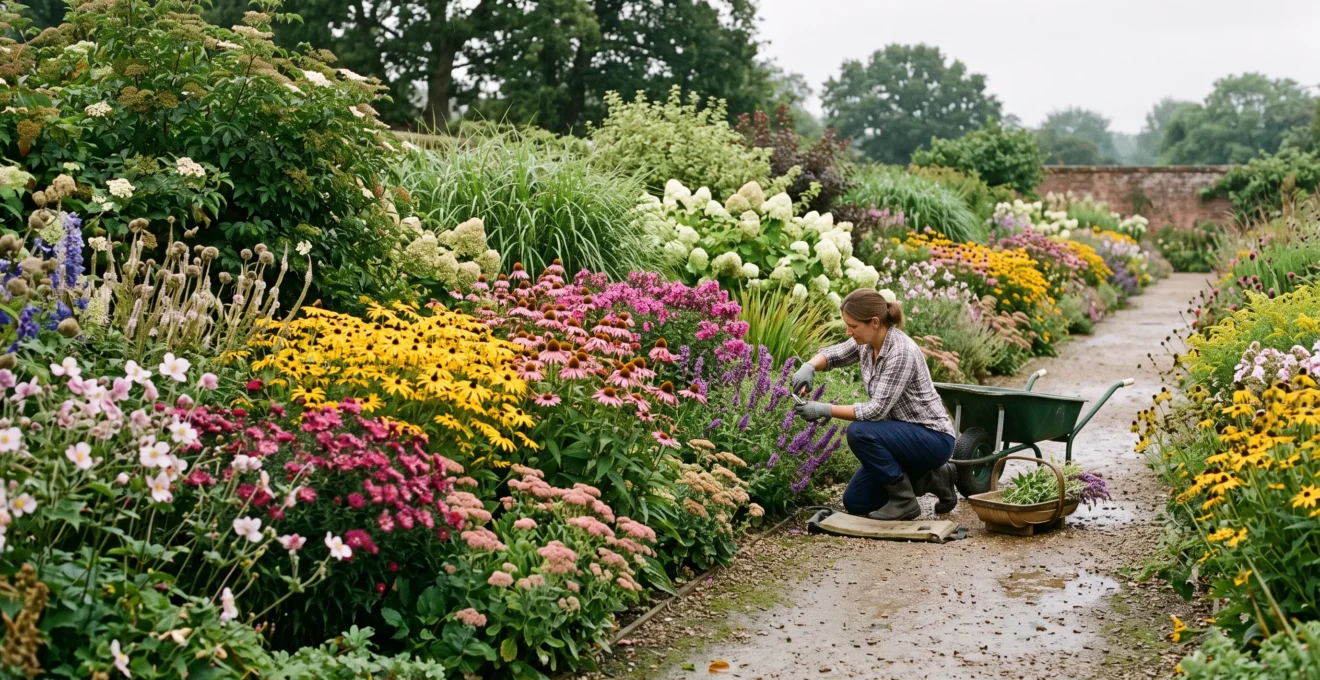
A border overflowing with flowers in May can become an almost entirely green planting by August. The problem is often not poor gardening but poor timing: too many plants reach their flowering peak together, leaving nothing ready to take over.
Achieving continuous flowering throughout the UK growing season means designing overlapping waves of bloom rather than relying on individual plants to flower indefinitely. Early bulbs and winter-flowering plants provide the first colour, spring and summer perennials carry the main display, and late-flowering perennials and shrubs extend interest into autumn. Selective deadheading helps responsive plants contribute more than one wave.
For a February-to-November display, the objective is to have something flowering somewhere in the garden throughout that period, not every plant in continuous bloom. Actual flowering dates depend on location, weather, cultivar and exposure. A sheltered southern garden may retain flowers considerably longer than an exposed northern site.
The most reliable approach begins with observing when the existing border loses colour, then selecting plants for those specific weeks.
Continuous flowering: the essentials
- Plan overlapping flowering windows: map existing plants by month and identify where one display ends before the next begins.
- Build three planting layers: bulbs for early colour, perennials for successive summer waves, and shrubs or structural grasses for late-season continuity.
- Manage each plant according to its flowering habit: deadhead genuine repeat-flowerers, cut back suitable perennials after their first flush, and retain valuable seedheads.
- Why Do Traditional UK Herbaceous Borders Look Stunning in Spring Then Disappoint by August?
- How to Layer Spring Bulbs, Summer Perennials, and Autumn Shrubs for Non-Stop Colour?
- Bedding Plants vs Perennial Succession: Which Achieves Continuous Flowering with Less Work?
- The Deadheading Mistake That Cuts Your Flowering Season Short by 2 Months
- When Should You Audit Your Garden’s Flowering Performance to Plan Next Year’s Improvements?
- Why Do Roses and Dahlias Rebloom After Deadheading While Delphiniums Rarely Do?
- How to Plant Pollinator Corridors That Provide Nectar from March Through October?
- How Does Deadheading Spent Blooms Double the Flowering Duration of Repeat-Blooming Plants?
Why Do Traditional UK Herbaceous Borders Look Stunning in Spring Then Disappoint by August?
Traditional herbaceous borders often lose colour by August because their plants share similar flowering periods. Aquilegias, oriental poppies and some hardy geraniums produce impressive displays in late spring or early summer, but may finish before later perennials take over. The resulting gap reflects the border’s planting composition rather than an inevitable feature of the UK climate.
Traditional border design frequently emphasises a concentrated seasonal spectacle. Historical approaches to herbaceous planting have influenced this aesthetic, although attributing modern flowering gaps specifically to Victorian gardening fashions would be too simplistic.
In a border dominated by early-flowering herbaceous plants, several species may finish within a few weeks of one another. The emerging problem is both floral and structural: oriental poppies can leave declining foliage, aquilegia stems become untidy, and some geraniums lose their compact shape.
Without plants ready to occupy the space, the border can look tired even when its foliage remains abundant.
The Royal Horticultural Society’s recommendations for perennial border plants demonstrate how flowering times can be staggered from late spring into autumn. They also emphasise that dates vary between gardens and seasons.
The practical solution is to diagnose the border’s actual flowering pattern rather than assuming August will always be the problem.
Find your flowering gap with a monthly grid
Create a grid with individual plants down the left and months from February to November across the top. Mark the periods when each plant produces an appreciable display, rather than counting the occasional isolated flower.
For closer accuracy, divide July, August and September into fortnightly periods. A border might appear covered on a monthly calendar while still suffering a conspicuous three-week gap between successive displays.
For example, imagine a border where aquilegias and oriental poppies provide most of the early display, followed by Shasta daisies in summer. If those daisies finish before rudbeckias or asters begin, the calendar exposes the missing handover. The appropriate correction is a plant flowering during that interval, not simply more plants with an attractive catalogue photograph.
A second distinction matters for wildlife. An apparent June shortage of nectar and an August shortage of visible flowers are not interchangeable. Nectar availability depends on the plants present and whether pollinators can access their flowers, while visual continuity depends on how the overall planting appears.
Neither gap occurs universally. Both need local observation before intervention.
Once the weak weeks are visible, the next task is to assemble overlapping layers that fill them without sacrificing the border’s strongest existing displays.
How to Layer Spring Bulbs, Summer Perennials, and Autumn Shrubs for Non-Stop Colour?
Continuous flowering becomes more achievable when bulbs, perennials and shrubs occupy the same border at different heights and times. Bulbs produce early colour before neighbouring plants expand, summer perennials gradually conceal declining bulb foliage, and late-season perennials and shrubs take over as earlier flowers fade. The key is arranging overlapping flowering periods, not isolated seasonal peaks.
This approach combines temporal succession, which determines when plants flower, with physical layering, which determines how their foliage, stems and flowers occupy the space.
Build the border in successive flowering waves
A practical UK planting sequence can use the following combinations. All flowering windows are indicative and should be checked against the selected cultivars and local conditions.
| Flowering phase | Planting choices | Design role |
|---|---|---|
| February–March | Crocuses, early daffodils, hellebores | Introduce colour before most perennials emerge. |
| April–May | Tulips, later daffodils, emerging hardy geraniums | Bridge the transition from early bulbs into perennial growth. |
| May–June | Alliums, catmint, hardy geraniums | Provide flowering overlap as bulb foliage begins to decline. |
| June–July | Salvias, Shasta daisies, selected penstemons | Carry the main summer display. |
| August–September | Rudbeckias, asters, late-flowering sedums | Take over when earlier summer perennials fade. |
| September–November | Late asters, suitable hydrangeas, ornamental grasses | Combine remaining flowers with seedheads and structural interest. |
November should be treated as a weather-dependent extension, not a guaranteed flowering month. In colder or exposed gardens, seedheads, grasses and shrub structure may provide the main interest after autumn flowers finish.
Choose bulbs for their handover dates
Early crocuses and daffodils are valuable for winter-to-spring colour, but they do not automatically connect the border to summer. Where that transition is weak, later-flowering tulips and alliums can bridge into the first perennial displays.
For example, tulips emerging among hardy geraniums can give way to expanding geranium foliage. The tulips supply colour first; the geraniums increasingly occupy the surrounding ground after flowering.
Bulb foliage must be allowed to die back naturally so that the bulbs can replenish their reserves. Cutting green leaves prematurely may weaken subsequent displays.
The perennial layer therefore needs enough spring growth to disguise yellowing foliage without overwhelming the bulbs while they are actively growing. This balance should be judged by observing the plants together over successive seasons.
Use shrubs and grasses as the late-season framework
Hydrangeas can contribute substantial summer and autumn flowerheads, while late asters, rudbeckias and sedums bring fresh flowers into the same period. Ornamental grasses provide movement and structure, particularly as perennial stems begin to decline.
A grass does not replace a nectar-rich flower, nor does a dried hydrangea flowerhead count as fresh bloom. However, these features prevent the border from appearing empty when the season’s supply of flowers becomes less reliable.
Rather than placing all late bloomers at the back, repeat selected plants through the middle and foreground. These recurring groups create a visual handover across the entire border.
With the framework established, the next decision is whether temporary bedding plants should supplement it or replace it as the main source of colour.
Bedding Plants vs Perennial Succession: Which Achieves Continuous Flowering with Less Work?
Perennial succession planting often offers a more sustainable long-term framework for continuous flowering, while seasonal bedding provides faster, more flexible colour where gaps appear. Neither is always the lower-maintenance option. Bedding involves recurring propagation, purchasing and seasonal replacement; perennials need establishment, selective cutting, division and occasional redesign. A hybrid system often offers the best balance.
Traditional bedding schemes are useful when a garden needs an immediate display or when precise colours must appear in a particular position. Perennials, by contrast, develop into a recurring planting framework that can become more coherent over time.
Comparing the systems by initial appearance alone misses their differences in workload, continuity and resilience.
| Criterion | Seasonal bedding | Perennial succession |
|---|---|---|
| Initial cost | Recurring purchases or propagation materials; costs vary by scheme. | Potentially greater initial investment, with established plants returning in subsequent years. |
| Annual labour | Seasonal replacement, establishment and care; tender plants may need frost protection. | Seasonal cutback, editing, occasional division and staking where required. |
| Flowering duration | Some varieties flower for long periods, especially with suitable care. | Individual plants may bloom briefly, but different species can provide successive waves. |
| Gap-filling flexibility | High: plants can be added or replaced for a particular season. | Requires more planning but creates a recurring framework. |
| Pollinator value | Depends on flower type and nectar accessibility. | Also depends on species, varieties and flowering diversity. |
| Autumn performance | Tender summer bedding is frost-sensitive; hardier seasonal bedding can continue or replace it. | Hardy late bloomers, grasses and seedheads may provide a gradual seasonal transition. |
The RHS explains in its advice on bedding plants and seasonal displays that many bedding schemes are changed twice a year, generally in late spring and early autumn. It also suggests annuals as useful additions for filling temporary gaps in established borders.
That makes a mixed planting strategy particularly practical.
Keep the main border occupied by well-chosen perennial groups, then reserve small pockets for annuals where the flowering audit reveals a genuine shortage. Cosmos, zinnias or other appropriate summer annuals can contribute supplementary colour without requiring the entire border to be replanted.
The maintenance question is ultimately about rhythm. A gardener who enjoys propagating and changing displays may find bedding manageable. Someone who prefers periodic seasonal tasks may favour established perennials, even if they need division or staking every few years.
Pollinator performance should not be inferred from the label « annual » or « perennial ». Flower structure, nectar accessibility, cultivar and flowering period matter more.
A stable perennial framework with selectively placed annuals reduces dependence on wholesale seasonal changeovers. Its flowering performance can then be extended further through plant-specific deadheading.
The Deadheading Mistake That Cuts Your Flowering Season Short by 2 Months
The most damaging deadheading mistake is applying the same cutting method to every flowering plant. Removing an entire flowering stem can eliminate developing side buds on some species, while cutting too lightly may fail to stimulate fresh growth on others. Incorrect technique can reduce subsequent flowering, but a two-month loss is not a universal or scientifically established outcome.
Deadheading works because removing fading flowers can reduce the plant’s investment in seed production and, where its growth habit permits, encourage additional flowering.
However, where to make the cut depends on the plant.
Choose between individual deadheading and cutting back
Roses, dahlias and many penstemons generally benefit from removing individual spent flowers or flower stems at a suitable point above healthy foliage, a developing bud or a side shoot.
For plants that produce additional flowering shoots from leaf axils, cutting below those shoots unnecessarily can remove the next potential display.
Some hardy geraniums need a different approach. Once the first flowering flush has finished and the foliage becomes untidy, cutting back the clump can encourage fresh foliage and sometimes another flush of flowers.
Catmint and lady’s mantle may respond similarly. Delphiniums and lupins can also be cut back after flowering, although the appropriate cutting point depends on the plant and available buds.
The illustrated cutting point is appropriate when the stem has a viable lateral bud worth preserving. It should not be treated as the universal method for hardy geraniums: certain cultivars respond better to cutting back the entire tired clump after flowering.
The RHS instructions for deadheading flowering plants distinguish these treatments and identify species that respond differently to post-flowering pruning.
Do not remove every spent flower automatically
Plants retained for decorative seedheads or wildlife value may be better left alone. Oriental poppies, honesty and selected ornamental grasses provide interest beyond their flowering period.
Hydrangea flowerheads can also contribute to the autumn and winter display, even when their fresh floral colour has faded. Their retention is a design decision rather than a failed deadheading task.
To assess whether correct deadheading genuinely extends flowering, compare similar plants of the same cultivar under comparable conditions. Record when the first flush ends, the date of cutting and when any further flowers appear.
A single comparison will not establish a universal rule, but it can help determine whether a particular plant responds reliably in that garden.
The objective is not maximum cutting. It is preserving the growth capable of producing further flowers while retaining valuable structure when reblooming is unlikely.
When Should You Audit Your Garden’s Flowering Performance to Plan Next Year’s Improvements?
Audit your border throughout the growing season, with particularly careful reviews in late July and late autumn. Monthly photographs from February to November establish the seasonal pattern, while observations during disappointing weeks reveal gaps that spring photographs conceal. Each finding should become a specific planting requirement, not simply another plant added to a shopping list.
Spring is often the least informative time to decide whether a border needs more flowers. When bulbs and early perennials are performing well, they can disguise the fact that little has been planted to succeed them.
By late July, the situation is easier to judge. Early perennials may have finished, late-season plants may still be developing, and temporary bare patches become visible.
Build a repeatable flowering audit
Photograph the same border from the same viewpoint each month. Where possible, take an additional photograph during a suspected flowering gap. Keep the images alongside brief notes on flowering intensity, plant condition, weather and maintenance.
A useful audit records four observations for each border area: plants currently flowering, plants past their peak, visible foliage or structural gaps, and the period when replacement colour is needed.
Translate these observations into measurable planting briefs.
For example, a hypothetical sunny border might reveal that its central section becomes predominantly green in August, with an available space approximately 60 cm high and soil that dries quickly. The planting brief would be: « Upright flowers in August, approximately 60 cm tall, suitable for a sunny, relatively dry position. »
This is more useful than deciding to buy an attractive perennial without knowing whether its flowering period and dimensions solve the problem.
Five-step flowering continuity audit
- Photograph each border monthly: save a dated February-to-November photo sequence from a consistent viewpoint.
- Record flowering periods: complete a month-by-month grid showing each plant’s main flowering window and any secondary flush.
- Identify exposed intervals: highlight weeks when an area lacks meaningful colour and mark the affected position on a border sketch.
- Write targeted planting briefs: specify the missing flowering period, available height, light conditions and soil requirements for each gap.
- Select and review changes: prepare a shortlist for the appropriate bulb, perennial or shrub layer, then check the revised border against the same photographs next season.
The late-autumn review serves a different purpose from July’s. It establishes which plants continued to flower, which supplied attractive seedheads, and which areas became visually empty after the first cold weather.
It also reveals where the existing shrub and grass structure is sufficient without adding further plants.
Do not interpret the calendar rigidly. A cold spring, summer drought or exceptionally mild autumn can shift flowering periods, so record what actually happened alongside the expected schedule.
Once gaps have been identified, the next useful distinction is between plants capable of extending their own flowering season and those that need a different species to take over.
Why Do Roses and Dahlias Rebloom After Deadheading While Delphiniums Rarely Do?
Repeat-flowering roses and dahlias can produce successive blooms because suitable varieties continue initiating flowering growth during the season. Many delphiniums concentrate their display into one main flowering period and may produce only a smaller second flush after cutting back. The difference lies in each plant’s growth habit, flowering potential and response to post-flowering care.
Deadheading does not create an ability to rebloom that a plant lacks. It helps responsive plants avoid allocating resources to seed production while suitable growing conditions allow new flowers to develop.
Distinguish repeat-flowerers from limited second-flush plants
Modern repeat-flowering roses can develop new flowering shoots after earlier blooms are removed. Dahlias also continue producing flowers through active growth while temperatures and growing conditions remain suitable.
Neither group flowers indefinitely without regard to weather, moisture or cultivar. Some roses produce only one main annual flush, so the term « rose » alone is not enough to predict reblooming.
Delphiniums operate differently. Many produce substantial early-summer flowering spikes. Removing those spikes after flowering may encourage new growth and, in favourable conditions, a smaller later display.
The second flush may be less impressive because the plant has already invested considerable resources in its primary flowering stems. However, saying delphiniums never rebloom would be inaccurate.
Once the first display ends, suitable delphiniums can be cut back to an appropriate lower shoot or towards the base, depending on the plant’s condition. Healthy remaining foliage, adequate moisture and appropriate nutrition support recovery.
Do not remove healthy basal growth simply to achieve a shorter appearance.
Classify plants by observed flowering behaviour
A practical garden observation is to look for fresh flowering shoots emerging from the base or leaf axils after the first display. Their appearance suggests potential for further flowering, though it does not guarantee a second flush.
Where a plant produces no further flowering growth after appropriate care, treat it as a limited-duration contributor for planning purposes. This observation should be combined with information about its cultivar rather than used as a definitive botanical classification.
Repeat-flowerers extend a flowering window; single-flush plants define its boundaries. A successful border uses both deliberately.
Position genuinely repeat-flowering plants where they can sustain visible colour for several weeks, then schedule shorter-flowering species so their strongest displays overlap with another group’s arrival.
This distinction also supports wildlife planting: a long visual display is helpful, but pollinators benefit most when accessible nectar and pollen sources remain available across successive months.
How to Plant Pollinator Corridors That Provide Nectar from March Through October?
A pollinator corridor in a garden is a connected arrangement of flowering resources that offers bees and other pollinators successive opportunities to forage from spring into autumn. It works best when different plant groups overlap in flowering time, provide accessible nectar or pollen, and are distributed through usable garden space. Continuity matters more than simply maximising flower numbers in midsummer.
A corridor need not be a narrow strip. It may consist of a sequence of flowering drifts through borders, around paths and beside shrubs, helping pollinators encounter suitable flowers as they move through the garden.
The design objective is to avoid a garden where nectar-rich flowers are abundant in one period but scarce during another.
Provide overlapping nectar sources
Early-season choices can include crocuses, hellebores, lungwort, willows, pieris and skimmia, depending on available space and growing conditions.
As spring progresses, suitable hardy geraniums, campanulas, catmint, comfrey, lavender and honeysuckle can help provide further flowering resources. Their actual flowering windows should be confirmed locally rather than assumed from a generic calendar.
The often-mentioned « June gap » describes a potential shortage between spring and summer flowering periods. It is not a universal feature of British gardens.
Some gardens already contain ample June flowers; others rely heavily on earlier bulbs and later summer plants, creating an obvious interval.
The correct response is to inspect the existing supply rather than assume every garden requires the same June additions.
Late-season choices can include sedums, asters, oregano, echinacea, Verbena bonariensis and ivy where suitable. Ivy is particularly useful as an autumn-flowering climbing plant when allowed to mature and flower.
Where space allows, planting several compatible specimens together creates conspicuous flowering patches. However, there is no universal minimum drift size or proven rule that grouped specimens always outperform isolated plants in every garden.
59 UK gardens
Research involving residential gardens in Bristol recorded flowering plants and estimated nectar provision through monthly surveys from March to October 2019. The findings describe this study population, not every garden in the UK.
The research recorded 636 flowering plant types from 98 families. Estimated annual nectar production varied substantially between gardens, from 2.3 g to 1.66 kg, and the aggregate nectar supply peaked in July.
More diverse flowering plant communities generally provided a more stable seasonal nectar supply. Importantly, nectar availability differed between individual gardens, so the findings do not establish a nationwide shortage during any particular month.
The study also found no correlation between garden size and nectar quantity in its sample. A modest garden can therefore contribute useful floral resources when its planting is appropriately selected, although this does not guarantee a particular nectar output.
Flower accessibility matters too. Highly modified flowers may be less useful to some pollinators than accessible single or open forms. A visually impressive flower display is not automatically an equally productive nectar source.
The most useful result is a border whose succession works on two levels: visible colour for the gardener and appropriately timed floral resources for visiting wildlife.
Key takeaways before extending your flowering season
- Identify which plants can produce additional flowering growth before investing time in frequent deadheading.
- Use the appropriate cutting method for each plant: preserving lateral buds, cutting back entire clumps or retaining decorative seedheads.
- Judge success by the extra weeks of useful flowering observed in your own garden, not by a promised percentage increase.
How Does Deadheading Spent Blooms Double the Flowering Duration of Repeat-Blooming Plants?
Deadheading can substantially extend the flowering period of genuinely repeat-blooming plants by removing spent flowers before they develop seeds, encouraging the plant to invest in additional flowering growth where its biology permits. Some plants may flower for much longer with regular care, but doubling flowering duration is not a guaranteed result and depends on cultivar, weather and growing conditions.
When a flower is pollinated and begins developing seeds, the plant may increasingly allocate resources towards reproduction rather than producing new flower buds.
Removing fading flowers can interrupt that process. On responsive plants such as many modern roses and dahlias, this can encourage continued floral production.
The response depends on the presence of growth capable of producing further flowers. Deadheading an inherently single-flowering plant will not necessarily create a second display.
Use the right timing, cutting point and aftercare
Remove spent flowers as they begin to fade, before substantial seed development. Waiting a few days is not necessarily damaging, but regularly allowing seedheads to develop may reduce the flowering response in suitable plants.
Cut just above an appropriate healthy leaf, bud or side shoot where that is the recommended method. Roses require attention to their particular flowering habit; dahlias benefit from removing spent flower stems without damaging developing flower buds.
For plants that respond to cutting back, removing tired flowering growth after the first flush may be more effective than repeatedly clipping individual flowers.
Adequate moisture matters during active growth. Plants struggling with drought may have insufficient resources to produce new flowering stems even after correct deadheading.
Where feeding is appropriate, follow the plant’s nutritional requirements and avoid assuming that additional fertiliser always produces more flowers. Excessive feeding can favour leafy growth or create other problems.
Deadheading also has a seasonal limit. As colder weather approaches, the opportunity for a meaningful new flush diminishes. Dahlias are frost-sensitive, and their late-season management should take account of local frost risk and the intended treatment of their tubers.
There is no established universal rule that dahlias must stop being deadheaded in early autumn to improve tuber storage.
Measure flowering extension rather than assume it
A simple comparison can help evaluate whether deadheading makes a worthwhile difference in a particular border.
Select two similar plants of the same cultivar, growing in comparable conditions. Deadhead one according to the recommended method while leaving the other untreated, provided retaining seedheads is suitable for that plant.
Record the beginning and end of meaningful flowering for each plant, along with any secondary flush. Also note watering, weather and other care that might influence the result.
For example, a hypothetical plant that flowers for six weeks without deadheading and twelve weeks with deadheading would show a doubling of its observed flowering duration. That example illustrates the calculation, not an established performance expectation.
Flowering duration should be measured in the garden rather than inferred from a general claim. A single-season comparison is informative locally but does not prove a universal causal effect.
There are also reasons not to remove every fading bloom. Seedheads can provide food for birds, support natural regeneration and contribute winter texture. Removing wet spent flowers may reduce fallen-petal litter and some associated problems, but deadheading is not a substitute for appropriate plant spacing, hygiene and disease management.
In a long-season border, selective deadheading is most effective when combined with a planting scheme that already contains successive species. It extends the performance of responsive plants while other groups take their turn.
Start with one border: identify its weakest flowering weeks, check which existing plants are capable of reblooming, then choose one suitable addition for the most important gap. Photograph the result next season and refine the planting from what actually flowers.
Can a UK garden really have flowers from February to November?
Yes, it is a realistic design objective in suitable conditions, particularly in sheltered gardens with carefully selected early- and late-flowering plants. However, uninterrupted flowering is not guaranteed in every location or year. Cold springs, drought and early autumn frosts can shorten flowering periods, especially in exposed or northern gardens.
How many different plants are needed for continuous flowering?
There is no fixed number. The requirement depends on border size, individual flowering duration, climate and whether plants repeat-flower. A small selection with well-overlapped flowering periods may achieve better continuity than a large collection whose blooms all peak simultaneously. Build a flowering calendar before deciding how many additions are necessary.
Should all herbaceous perennials be cut down after flowering?
No. Certain hardy geraniums, catmint and other suitable plants may respond to cutting back with fresh foliage and additional flowers. Others produce no second flush, while retained stems and seedheads may be valuable for structure or wildlife. Apply plant-specific advice instead of cutting everything down at the same time.
What should be planted in a border that has colour in spring but none in September?
Consider suitable late-flowering asters, rudbeckias, sedums and other autumn perennials, choosing according to sunlight, soil moisture, available space and local flowering dates. Hydrangeas and ornamental grasses can contribute surrounding structure, although their decorative interest is not always equivalent to fresh flowers. Check the exact varieties before planting.
Can a small garden support flowering succession and pollinators at the same time?
Yes. A small garden can combine early bulbs, flowering perennials, selected shrubs and suitable climbers to provide seasonal colour alongside nectar and pollen. Prioritise diversity, accessible flowers and overlapping bloom periods. Research on Bristol gardens indicates that nectar provision is not determined simply by garden size, although performance varies considerably between individual sites.