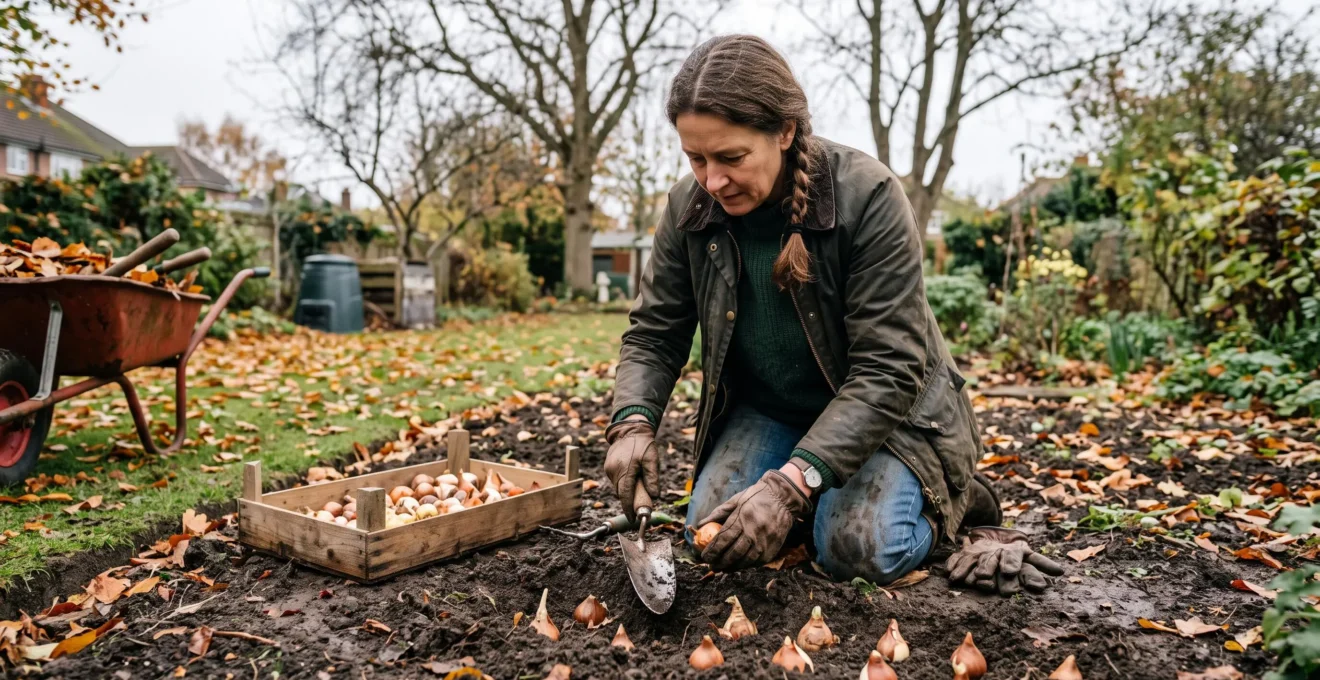
Reliable spring flowering begins months before the first shoots appear. Tulips, daffodils and crocuses need time to establish roots while the soil remains workable, followed by the appropriate winter conditions that support their development. For gardeners in the UK, October and November provide an important planting opportunity, particularly for tulips, although the ideal date depends on the species.
The distinction between planting a dormant bulb and buying a plant already in flower is fundamental. A bulb contains stored resources, but successful flowering also depends on its condition, the timing of planting, soil drainage and, for species that require it, sufficient winter chilling. Plant too late, store bulbs badly or bury them at inconsistent depths, and the result may be disappointing spring displays.
The Royal Horticultural Society (RHS) recommends planting daffodils, crocuses and hyacinths preferably by the end of September, while tulips are recommended for November. These recommendations demonstrate why a single autumn date should not be applied indiscriminately to every bulb. A well-planned planting schedule takes species requirements and local conditions into account.
The essentials for successful spring bulbs
- Plant each species within its appropriate autumn window, allowing roots to establish before the ground freezes.
- Choose firm, healthy bulbs and follow a consistent planting-depth rule adapted to bulb size and soil conditions.
- After flowering, retain foliage until it yellows naturally so the bulb can replenish its reserves for the following season.
- Why Won’t Spring Bulbs Flower Properly if Planted Too Late or Stored Warm Over Winter?
- How Deep Should You Plant Tulips, Daffodils, and Crocuses for Best Results?
- Should You Plant Spring Bulbs in Drifts in Lawns or Grouped in Borders?
- The Planting Orientation Mistake That Buries Bulb Shoots Under Soil
- When Should You Feed Spring Bulbs for Strongest Repeat Flowering Next Season?
- Spring vs Autumn Planting: Which Season Delivers Better Results for Broad Beans and Garlic?
- Why Must Some Early Spring Garden Preparation Tasks Happen in February Regardless of Weather?
- How Do Accurate Planting Schedules Increase Germination Rates and Harvest Yields by 50%?
Why Won’t Spring Bulbs Flower Properly if Planted Too Late or Stored Warm Over Winter?
Spring bulbs can produce short stems, delayed flowers or no satisfactory flowering when planting is postponed or bulbs are stored in unsuitable conditions. Many spring-flowering species need an appropriate sequence of autumn root establishment and winter conditions before producing normal flowers. Tulips are particularly associated with a chilling requirement. If that requirement is not met, the foliage may emerge without the expected flower display.
Winter chilling is part of the bulb’s developmental process. It helps regulate subsequent growth, including the elongation of the flower stem. Insufficient chilling can result in flowers appearing unusually close to the ground. Clemson Cooperative Extension specifically describes this problem in spring-flowering bulbs that have not received enough cold exposure.
Very short flower stems
Insufficient chilling can cause spring-flowering bulbs to produce flowers close to the ground rather than developing normal stems. The effect depends on the species and its growing requirements.
Clemson Cooperative Extension, Clemson University, Clemson Extension’s spring-flowering bulb factsheet.
Calendar dates are useful, but they do not describe every autumn equally well. Soil temperature, rainfall and the expected arrival of freezing conditions influence the time available for root development. Rutgers Cooperative Extension recommends planting spring-flowering bulbs in its New Jersey context when soil temperatures fall below 60°F (approximately 15.6°C), between mid-September and October. This is a regional reference, not a universal threshold for UK gardens.
For British gardeners, the practical objective is to plant at the appropriate species-specific time while the ground remains workable. The RHS recommends earlier planting for daffodils, crocuses and hyacinths, and November for tulips. Waiting until the ground is persistently cold or frozen reduces the opportunity for roots to establish before winter.
Storage conditions matter just as much as planting dates. Bulbs left for extended periods in heated cupboards or garages may lose moisture, deteriorate or begin sprouting prematurely. Before planting delayed purchases, inspect each bulb individually:
- Firmness: healthy bulbs should feel firm rather than soft or collapsing.
- Surface condition: discard bulbs that are rotten or extensively affected by mould.
- Basal plate: check that the flattened root-bearing base remains intact.
- Sprouting: an already sprouted bulb may still be worth planting, although subsequent flowering can be variable.
Pre-chilled bulbs can offer an alternative when the normal planting window has been missed. Some suppliers sell bulbs that have already received chilling treatment. However, the supplied evidence does not establish a universal home-refrigeration duration or a standard protocol for every species. Artificial chilling should therefore not be treated as a guaranteed substitute for correctly timed outdoor planting.
The main lesson is to assess both timing and bulb condition. A firm bulb planted at the right time has a better opportunity to establish than one that has spent months in warm storage. The next decision is how deeply to place it, because correct positioning also influences its establishment.
How Deep Should You Plant Tulips, Daffodils, and Crocuses for Best Results?
Most spring-flowering bulbs should be planted at approximately two to three times their own depth, according to the RHS. Larger bulbs such as tulips and daffodils therefore need deeper planting holes than small crocuses. The measurement should be taken from the soil surface to the base of the hole, not simply to the top of the bulb. Soil type and species remain important considerations.
Planting depth influences temperature stability, moisture exposure and the distance a developing shoot must travel before reaching the surface. Bulbs planted too shallowly are more exposed to changing temperatures and physical disturbance. In contrast, excessive depth can make emergence more demanding, particularly in heavy soils.
The RHS provides a practical example: a bulb measuring 5 cm in height should be planted in a hole approximately 10–15 cm deep. This illustrates the two-to-three-times rule. However, the measurement basis matters. Clemson Cooperative Extension gives a different general recommendation of three to four times the bulb’s width, measured from its base. These are not identical measuring systems, so the figures should not be combined into a single formula.
Soil conditions also influence the practical choice. Light, sandy soil generally offers easier drainage and may allow deeper planting within the recommended range. Heavy clay retains more moisture and can become difficult for emerging shoots to penetrate. Improving drainage and avoiding excessive depth are particularly important in these conditions.
Shallow planting can also expose bulbs to pests. Squirrels are identified by the RHS as pests affecting tulips and crocuses. Planting depth alone does not guarantee protection, but leaving bulbs close to the surface makes them easier to disturb.
Consistency is especially important when planting several dozen bulbs together. If the first bulbs are planted deeply and the last ones only just covered, their emergence and flowering may become uneven. A bulb planter with depth markings or a trowel with a marked handle provides a simple way to maintain a consistent measurement.
For a practical planting session:
- Measure the height of a representative bulb.
- Use the RHS two-to-three-times-depth guideline as the starting reference.
- Check the soil structure and drainage before digging.
- Measure the hole consistently across the planting area.
- Position the bulb with its growing point facing upwards.
Planting depth also influences the long-term behaviour of bulbs. Bulbs left too close to the surface may experience greater environmental fluctuations, while appropriately planted bulbs have a better opportunity to establish in their intended position. Nevertheless, depth recommendations should not be treated as guarantees of perennial flowering.
Once the depth is established, the next decision concerns the overall arrangement. A lawn drift and a formal border can both produce an attractive spring display, but they require different planting methods and maintenance commitments.
Should You Plant Spring Bulbs in Drifts in Lawns or Grouped in Borders?
Plant bulbs in lawn drifts when the aim is a naturalistic spring display that can gradually blend into grass, and choose borders when easier maintenance, concentrated colour and precise positioning matter more. Both arrangements can work well, provided the soil is suitable and the foliage is allowed to complete its natural dieback after flowering.
The choice should reflect how the garden is used throughout the year. A lawn covered with crocuses in February can look striking, but it cannot be mown immediately after flowering. A border offers greater control over planting positions and aftercare, although it may require more deliberate spacing around established perennials.
| Criterion | Lawn drifts | Garden borders |
|---|---|---|
| Visual effect | Naturalistic, scattered colour across grass | Concentrated displays and layered planting |
| Planting technique | Lift turf flaps or remove small sections of grass | Dig individual holes or prepare planting groups |
| Soil considerations | Compaction beneath established turf may restrict establishment | Soil can be improved across the planting area |
| Maintenance | Delayed mowing until foliage dies back | Foliage can remain among surrounding plants |
| Naturalisation | Suitable for bulbs that tolerate grassland conditions | Suitable for planned combinations with perennials |
| Long-term management | Requires careful mowing and access planning | Requires awareness of bulb positions when digging |
For lawn planting, lifting a flap of turf is a practical method. A sharp spade can cut three sides of a small section, allowing the grass to fold back while exposing the soil underneath. The soil can then be loosened and checked for compaction before bulbs are positioned. Replace the turf carefully after planting, keeping the bulbs at the appropriate depth.
Compaction is an easily overlooked problem. Established lawns can have dense soil that restricts drainage and root development. Perfect planting dates will not compensate for unsuitable ground conditions. Where the exposed soil is compacted, improve its structure before replacing the turf rather than forcing bulbs into hard ground.
Bulbs in borders offer more control. Autumn planting can take place as herbaceous perennials begin dying down, creating an opportunity to position bulbs beneath or between established plants. Marking perennial crowns before removing foliage helps prevent accidental digging and makes it easier to identify where spring flowers should appear.
The major practical difference appears in spring. Grass cannot be cut short while bulb foliage is still green and actively replenishing the bulb. Cutting it prematurely removes the plant’s opportunity to build reserves for the following year. The lawn may therefore remain untidy for several weeks after flowering, depending on the species and growing conditions.
Early-flowering bulbs can help manage this inconvenience. Positioning drifts away from the most visible lawn areas or choosing locations where a delayed first cut is manageable makes naturalisation easier to maintain. Borders avoid much of this conflict because foliage can remain among surrounding plants.
Whichever arrangement is selected, the objective is to create a display that can be maintained after flowering. Once planting positions are established, individual bulb orientation becomes the next practical consideration.
The Planting Orientation Mistake That Buries Bulb Shoots Under Soil
Most spring-flowering bulbs should be planted with their pointed growing tip facing upwards and their basal root plate facing downwards. This gives emerging shoots the most direct route towards the surface and allows roots to develop from the correct end. However, an accidentally inverted bulb does not automatically fail: some bulbs can reorient their growth, although emergence may be delayed.
Identifying the correct orientation is straightforward with familiar varieties. Tulips and daffodils generally have a recognisable pointed nose at the top and a flatter base at the bottom. The basal plate is the area from which roots emerge, while the pointed end contains the developing shoot.
When handling unfamiliar bulbs, look for the following features:
- Pointed end: usually the growing tip, which should face upwards.
- Flattened base: the basal plate, where roots develop.
- Root remnants: dried roots or root scars can help identify the lower surface.
- Irregular shapes: some bulbs are less obviously directional, so examine the base carefully rather than relying on appearance alone.
The consequences of incorrect orientation should not be exaggerated. Bulbs possess the ability to direct their shoots towards the surface, and some can recover from sideways or inverted planting. The additional growth effort can nevertheless delay emergence and may weaken the initial display, particularly when combined with deep planting or heavy soil.
Small bulbs create a practical challenge. When planting hundreds of crocuses or snowdrops in a naturalistic drift, individually checking every bulb can make the job unnecessarily slow. If the basal plate and tip are obvious, careful orientation is worthwhile. If the shapes are irregular and the bulbs are very small, consistent depth and suitable soil conditions may be more productive priorities than attempting perfect positioning for every individual.
The autumn window also offers a useful recovery period. Planting while the soil remains workable gives bulbs time to establish before the main growing season. This is particularly valuable when planting conditions are less than perfect, although it does not remove the importance of correct depth and drainage.
For large tulips and daffodils, take the time to identify the pointed end before covering each bulb. For smaller bulbs planted in drifts, prioritise a suitable planting area and a reasonably consistent depth rather than turning the task into an impractical exercise in precision.
Successful planting is only the first stage of repeat flowering. The next important decision comes after the flowers fade, when the foliage is still actively supporting the development of the following season’s bulb.
When Should You Feed Spring Bulbs for Strongest Repeat Flowering Next Season?
Spring bulbs should not automatically receive fertiliser simply because they are being planted in autumn. Their first flowering relies substantially on resources already stored inside the bulb. For repeat flowering, the more important task is to preserve the foliage after the flowers fade, allowing photosynthesis to replenish the bulb before the leaves die back naturally.
After flowering, green leaves continue to capture light and produce carbohydrates. These resources are transferred into the bulb and help support future growth. Removing the foliage too early interrupts this process, potentially producing smaller or weaker bulbs and reducing the quality of subsequent displays.
Rutgers Cooperative Extension advises leaving the remaining foliage in place until it turns yellow and dies naturally. It also explains that removing foliage prematurely reduces the plant’s ability to replenish stored nutrients. The practical implication is simple: avoid cutting, tying or mowing green bulb leaves merely because the flowers have disappeared.
Feeding recommendations require some care because they depend on the growing system and the particular product. Rutgers advises against fertilising spring-flowering bulbs after flowering has started. Its guidance should not be confused with separate recommendations for feeding container-grown bulbs or other horticultural systems. A universal high-potassium feeding schedule cannot be established from the available sources.
Deadheading is a separate decision. Removing faded flowers prevents the plant from investing resources in seed production. Rutgers supports removing spent flowers to limit this use of stored resources. However, the approach should reflect the desired outcome: gardeners seeking naturalisation may deliberately allow some species to produce seed, while gardeners prioritising repeat flowering from individual bulbs may prefer to remove spent flower heads.
Soil preparation before planting is more useful than indiscriminately adding fertiliser to individual planting holes. Improving the planting area with suitable organic matter can support soil structure and drainage. Avoid placing concentrated fertiliser directly against the basal plate, and follow the product’s instructions where a specific fertiliser is required.
The practical aftercare sequence is therefore:
- Allow flowers to finish naturally.
- Remove spent flower heads where seed production is not wanted.
- Keep foliage intact while it remains green.
- Avoid mowing or cutting the leaves prematurely.
- Remove foliage only after natural yellowing and dieback.
These measures matter particularly for bulbs expected to flower repeatedly rather than being treated as disposable seasonal decorations. A strong spring display depends not only on the autumn planting operation but also on how the plants are managed after flowering.
The same underlying principle applies beyond ornamental bulbs. Garlic and broad beans also benefit from planting schedules that take seasonal conditions into account, although their biological requirements and ideal planting windows differ.
Spring vs Autumn Planting: Which Season Delivers Better Results for Broad Beans and Garlic?
Autumn planting is often advantageous for garlic and broad beans because it allows plants to establish before the main spring growing period. However, it is not automatically the best option in every garden. Winter rainfall, soil drainage, frost exposure and crop variety determine whether autumn planting is appropriate or whether spring planting offers a safer alternative.
Garlic provides a particularly clear parallel with spring-flowering bulbs. According to the RHS, most garlic varieties are generally planted from mid-autumn to early winter because they need a period of cold for good bulb development. The organisation identifies a requirement of one to two months at temperatures between 0°C and 10°C for most varieties.
This chilling information applies specifically to garlic. It should not be transferred directly to tulips, daffodils or crocuses, which have their own developmental requirements.
Autumn garlic planting can provide favourable conditions for bulb development, but wet winter soil creates a disease risk. In heavy, poorly drained ground, the RHS describes an alternative: start cloves in modules during autumn and plant them outdoors in spring.
Spring planting remains a viable option for some garlic varieties, particularly where winter conditions are unsuitable. The choice should therefore depend on the variety and the conditions of the planting site rather than an assumption that autumn planting always produces superior results.
Broad beans also offer a useful comparison. Autumn-sown crops can establish before spring and may produce earlier harvests, but winter losses can undermine that advantage in colder districts. The available source pack does not provide comparative yield figures or sufficient evidence to quantify the effect of autumn versus spring sowing for broad beans.
| Crop | Autumn planting | Spring planting |
|---|---|---|
| Garlic | Generally recommended for most varieties, subject to drainage and winter conditions. | Suitable for some varieties and for situations where winter soil conditions make autumn planting unsuitable. |
| Broad beans | Can provide earlier establishment and an earlier crop, but winter losses are a consideration. | An alternative where local winter conditions make autumn sowing risky. |
Three conditions should influence the decision:
- Waterlogged soil: persistent winter wetness increases the risk of problems for autumn-planted garlic.
- Severe winter exposure: very cold conditions and hard freezing can increase the risk of crop losses.
- Variety requirements: some garlic varieties are more suitable for autumn planting, while others tolerate later planting.
The RHS guidance on garlic also demonstrates the importance of distinguishing between crops rather than assuming that every plant responds identically to cold. The same garden can have suitable conditions for autumn tulips but unsuitable conditions for garlic, depending on drainage and variety.
For vegetable gardeners, the useful lesson is to assess the soil before choosing a season. A cool, well-drained planting area can support autumn establishment, whereas a saturated or severely exposed site may favour a protected or later approach.
Autumn planting is therefore a conditional advantage rather than an absolute rule. This makes forward planning essential: the next useful point in the gardening calendar is February, when preparation and observation can prevent avoidable mistakes later in the year.
Key decisions before the next growing season
- Match planting dates to the requirements of each species rather than applying one autumn deadline to every crop.
- Assess drainage and winter exposure before deciding whether garlic or broad beans should be planted in autumn.
- Protect the foliage of established spring bulbs until it dies back naturally, preserving resources for subsequent flowering.
Why Must Some Early Spring Garden Preparation Tasks Happen in February Regardless of Weather?
February is an important inspection and preparation period because bulbs and other garden plants can already be moving through their seasonal growth cycles before the weather feels consistently spring-like. Some tasks are therefore best planned around plant development rather than waiting for warmer days. Checking frost-heaved bulbs, identifying emerging shoots and recording gaps in existing displays can all help prepare for the next planting season.
Weather can be misleading in late winter. A mild afternoon does not mean that the soil is suitable for every planting operation, and a cold spell does not necessarily mean that dormant plants have stopped developing. The garden’s internal seasonal progression continues even when temperatures fluctuate.
For spring bulbs, February offers an opportunity to assess how autumn planting has performed. Look for bulbs that appear to have been pushed towards the surface by frost, signs of rot and evidence of damage from animals. Avoid disturbing healthy emerging shoots simply to inspect their position.
Waterlogged ground deserves particular attention. Walking repeatedly across saturated soil can increase compaction and damage the structure of planting areas. Where the ground is frozen, avoid forcing tools into the soil around emerging bulbs.
A practical February inspection should cover the following areas:
- Bulb condition: inspect visible growth for damage, rot and frost heave.
- Emergence: identify areas where shoots are appearing earlier than expected.
- Soil condition: avoid working or walking repeatedly over frozen or waterlogged planting areas.
- Display gaps: note where the spring display is sparse while flowering patterns are still visible.
- Next autumn: record which areas need additional bulbs and which varieties performed well.
February is also useful for planning tasks that must be completed before plants enter active growth. However, the timing of pruning, moving shrubs and weed-control operations varies by species and method. These activities should not be treated as universal February deadlines without checking the requirements of the individual plants.
A warm spell can trigger premature emergence. Once shoots have begun growing, there is no practical way to reverse that development. The sensible response is to protect vulnerable new growth where frost threatens and avoid disturbing plants unnecessarily.
For bulbs, the most useful February action may be observation rather than intervention. Recording flowering dates, plant height and gaps in the display creates a more accurate basis for ordering bulbs in autumn. This avoids relying on memory when the planting season returns.
February preparation is not about forcing every gardening task into a fixed date. It is about recognising which decisions depend on plant development and which can wait for more suitable weather. That distinction leads naturally to a broader question: how can a planting schedule become a genuinely useful tool rather than a collection of arbitrary dates?
How Do Accurate Planting Schedules Increase Germination Rates and Harvest Yields by 50%?
Accurate planting schedules can improve germination, establishment and eventual harvests by matching sowing or planting conditions to each crop’s requirements. However, a universal 50% increase in germination rates or yields cannot be confirmed from the available evidence. The effect depends on species, variety, soil temperature, moisture, light conditions and local weather. Scheduling is a useful performance tool, not a guaranteed percentage improvement.
The first distinction is between germination and establishment. Seeds need appropriate conditions to germinate, while bulbs need suitable conditions for root development and subsequent growth. A seed sown into cold, saturated soil may remain vulnerable to decay, whereas one planted under appropriate conditions can establish more reliably.
Soil temperature is one important variable. The Rutgers Cooperative Extension recommendation for spring-flowering bulbs illustrates this relationship: in its New Jersey context, bulbs are planted when soil temperatures fall below 60 °F (approximately 15.6°C), allowing roots to establish before the ground freezes.
That temperature should not be interpreted as a universal planting threshold. Different species and climates require different conditions, and the UK planting calendar supplied by the RHS distinguishes between bulbs such as daffodils, crocuses and hyacinths, which are preferably planted by late September, and tulips, which are recommended for November.
Moisture is equally important. Seeds and bulbs need access to water, but excessive moisture in poorly drained ground can create conditions favourable to rot and disease. The RHS garlic guidance provides a practical example of this distinction: heavy, wet winter soil can make autumn planting problematic, while starting cloves in modules offers an alternative.
Day length and seasonal temperature also influence development. A schedule that works for one region may produce poor results in another because frost dates, seasonal rainfall and the length of the growing season differ. This is why copying another gardener’s calendar without adapting it to the local environment can lead to disappointing outcomes.
A useful planting schedule should therefore combine several types of information:
- Local climate and expected frost conditions.
- Species-specific planting and establishment requirements.
- Soil temperature and drainage.
- Expected rainfall and seasonal moisture.
- Target flowering or harvest periods.
Build a planting schedule you can actually use
- Identify the plants and varieties you intend to grow, recording their individual planting requirements.
- Record your local hardiness zone or expected last-frost date, together with relevant seasonal conditions.
- Check soil temperature and moisture before planting, using a thermometer where temperature is relevant.
- Work backwards from the intended flowering or harvest period, allowing for each crop’s establishment requirements.
- Keep a garden record of planting dates, emergence, flowering and harvest results so the next schedule can be adjusted using actual observations.
For spring bulbs, this method means recording which varieties were planted, when they went into the ground, how deeply they were positioned and when they flowered. If tulips emerge with short stems, for example, the record can help distinguish between a possible chilling issue and other factors such as bulb condition or planting depth.
For garlic, the same record can reveal whether autumn planting was affected by excessive soil moisture or whether a spring planting strategy would be more appropriate. For broad beans, it can help compare the performance of autumn and spring sowings under the garden’s actual winter conditions.
The proposed 50% figure should remain a hypothesis rather than a guaranteed outcome. No quantitative study in the supplied sources establishes that accurately timed planting universally increases germination or harvest yields by this amount. A credible improvement must be measured against a defined baseline, using the same crop and comparable growing conditions.
The broader principle remains consistent across ornamental and edible gardening: successful planting depends on matching the timing and growing environment to the needs of the plant. October-November bulb planting, seasonal choices for garlic and broad beans, and February garden inspections are different applications of the same planning discipline.
Begin with a small, measurable record of planting dates and flowering results rather than relying on a generic calendar or an unsupported yield promise. That evidence will make each subsequent season more predictable and help identify the changes that genuinely improve the garden.
Can you still plant spring bulbs in December?
Yes, some bulbs may still be worth planting in December if the soil remains workable and the bulbs are firm and healthy. However, late planting can result in poorer flowering or shorter flower stalks. The RHS recommends November for tulips and earlier planting for daffodils, crocuses and hyacinths, so December should be regarded as a delayed option rather than the preferred schedule.
Should spring bulbs be watered immediately after planting?
The available sources emphasise suitable soil conditions and establishment but do not provide a universal watering schedule for all spring bulbs. The practical priority is to avoid planting in persistently waterlogged ground while ensuring that the soil is not excessively dry. Watering decisions should reflect rainfall, soil structure and the moisture requirements of the species.
Can tulips and daffodils be planted in the same border?
Yes. Tulips and daffodils can be combined in borders, provided their planting positions and depths are suitable. The RHS recommends November for tulips, while daffodils are preferably planted by the end of September. Their different planting windows can therefore influence how the border is prepared in autumn.
Why do spring bulbs produce leaves but no flowers?
Possible reasons include insufficient winter chilling, poor bulb condition, unsuitable planting depth and premature removal of foliage in the previous growing season. Clemson Cooperative Extension identifies insufficient chilling as a cause of unusually short flower stems. The RHS also warns that delayed planting and lengthy storage can result in poor flowering.
When should you stop mowing a lawn containing spring bulbs?
Allow bulb foliage to turn yellow and die naturally before cutting it. Rutgers Cooperative Extension specifically advises against removing or mowing the remaining foliage before natural dieback. Cutting green leaves too early reduces the plant’s ability to replenish its stored resources and can result in weaker bulbs for the following season.