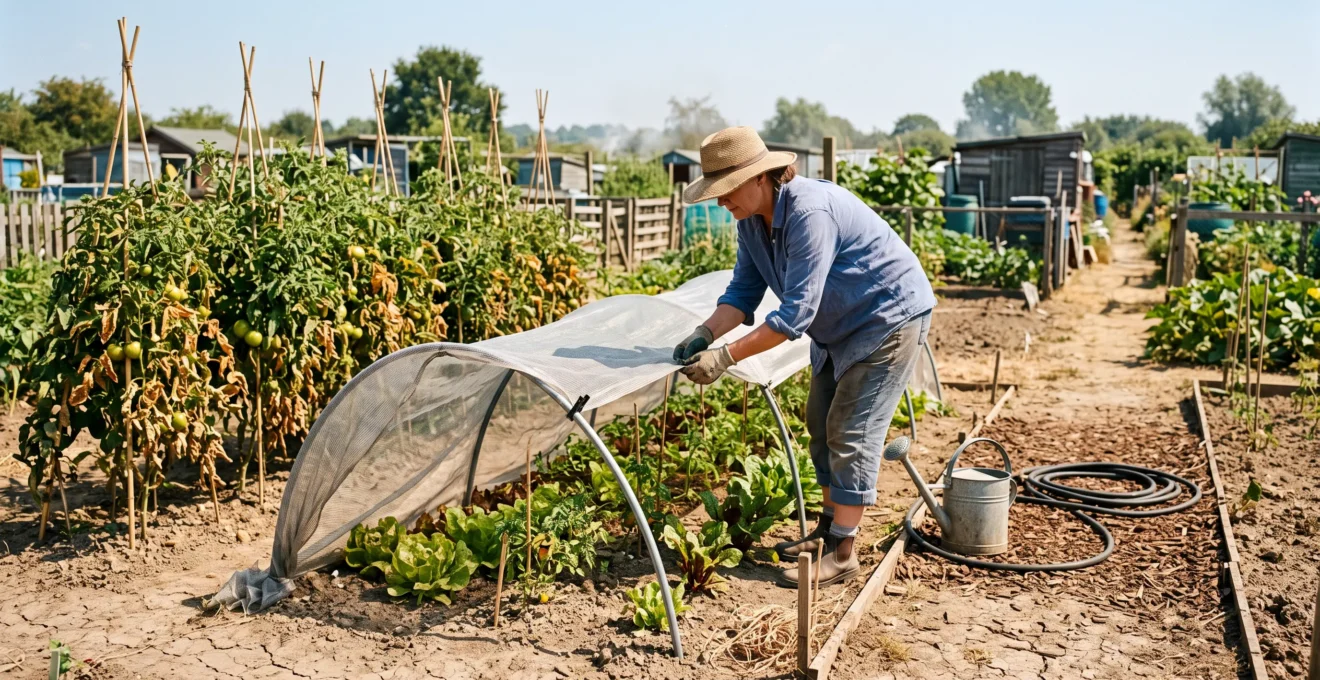
When summer temperatures climb above 30°C, a productive UK vegetable garden can suddenly stop behaving as expected. Tomato flowers fall without setting fruit, lettuce becomes bitter, and apparently healthy plants wilt despite regular watering. The problem is not always a shortage of water. Excessive heat can interfere directly with the processes that allow plants to grow, flower and produce crops.
Keeping vegetables productive during a heatwave requires managing the temperature around their leaves, roots and flowers, rather than simply increasing irrigation. Temporary shade, cooler soil, effective ventilation and carefully timed watering can reduce damage. Choosing suitable varieties and preparing protective structures before temperatures rise makes these measures considerably easier to implement.
Not every crop needs identical protection. Lettuce may benefit from afternoon shade while tomatoes still require sufficient sunlight for fruit development. Containers can overheat faster than open beds, and greenhouses may become dangerously hot even when outdoor conditions seem manageable. The practical objective is to protect the most vulnerable crops without sacrificing the light, airflow and soil conditions they need to recover.
Keeping vegetables productive during UK heatwaves
- Control temperature, not just moisture: watering cannot fully prevent heat-related flower loss, poor pollination or premature bolting.
- Adjust shade and irrigation to each crop: protect vulnerable plants during peak heat while preserving airflow and adequate light.
- Prepare before the forecast turns extreme: establish mulch, test irrigation and secure shade supports before emergency protection becomes necessary.
- Why Do Plants Stop Growing During Heatwaves Even When Adequately Watered?
- How Much Shade Should You Provide for Vegetables During 30°C+ Summer Temperatures?
- Heat-Tolerant vs Traditional Varieties: Which Tomatoes and Lettuce Cope Best with UK Heatwaves?
- The Summer Watering Timing Mistake That Wastes Water and Stresses Plants Further
- When Should You Install Summer Temperature Defences Before Heatwaves Actually Arrive?
- How to Tell If Wilting Is from Drought, Overwatering, or Root Disease?
- How to Rig Emergency Shade Protection for Garden Plants During Heatwave Alerts?
- How Can You Protect UK Garden Plants During Summer Heatwaves That Exceed 35°C?
Why Do Plants Stop Growing During Heatwaves Even When Adequately Watered?
Plants can stop growing during heatwaves because high temperatures disrupt photosynthesis, flowering and fruit development, even when their roots have sufficient water. Watering can prevent dehydration, but it cannot necessarily restore temperature-sensitive biological processes. A well-watered tomato plant may therefore remain green while producing fewer fruits, and lettuce may become bitter despite consistently moist soil.
Plants depend on enzymes to drive photosynthesis and other metabolic processes. When temperatures exceed the suitable range for a particular crop, these processes become less efficient. Respiration can consume more of the sugars produced during the day, leaving less energy available for new leaves, roots and fruit.
Heat also affects reproduction. According to AHDB research on tomato fruit set and pollen viability, temperatures around 30 °C are generally associated with reduced fruit set in many tomato cultivars. High temperatures can interfere with pollen production and viability, with sensitive stages occurring before flowers open.
This explains why cooling a plant after its flowers have already been exposed to excessive temperatures may not immediately restore cropping. The effect depends on the variety, duration of exposure and conditions during flower development.
Other vegetables show different symptoms:
- Tomatoes: flowers may drop or fail to develop into fruit despite healthy foliage.
- Beans: sustained heat can interfere with flowering and pod development, although responses differ between species and varieties.
- Lettuce: hot conditions can encourage bolting, producing elongated flowering stems and increasingly bitter leaves.
- Fruiting vegetables: excessive heat can slow growth and increase the risk of sun damage to exposed produce.
A useful practical concept is the recovery burden following heat exposure. Sometimes described informally as a thermal debt, this means a plant may need time to repair damaged tissues and resume normal development. It is not a standard quantified horticultural measure, and recovery time cannot be predicted from temperature alone.
Do not interpret every pause in growth as a nutrient deficiency. Additional fertiliser will not correct heat-damaged pollen or immediately restart photosynthesis.
Once soil moisture is adequate, reducing exposure to excessive heat is usually more useful than repeatedly adding water. The next decision is how much shade each crop actually needs.
How Much Shade Should You Provide for Vegetables During 30°C+ Summer Temperatures?
During UK heatwaves above 30°C, provide enough temporary shade to reduce damaging afternoon exposure without unnecessarily restricting photosynthesis. Leafy vegetables generally tolerate more shade than fruiting crops, while tomatoes and peppers still need substantial light. Shade intensity should respond to crop type, sunshine, soil moisture and ventilation rather than following one universal percentage.
Shade cloth is commonly sold with ratings such as 30% or 50%, indicating approximate light interception. These figures describe the material, not a scientifically established ideal for every vegetable. Treat them as adjustable starting points and observe how plants respond.
The following matrix offers practical starting choices rather than experimentally validated crop-specific requirements.
| Crop and conditions | Suggested protection | What to monitor |
|---|---|---|
| Lettuce and tender leafy crops; strong afternoon sun | Light to moderate temporary shade, potentially using 30–50% cloth | Bolting, leaf scorching and excessive stretching |
| Tomatoes and peppers; sunny conditions above 30°C | Start with light afternoon shade, such as 30% cloth where needed | Flower drop, fruit scorch and reduced light |
| Established vegetables; cloudy, humid heat | Prioritise airflow; use shade only where exposure warrants it | Persistent dampness, disease symptoms and temperature |
| Containers with limited watering capacity | Shade pots and root zones, with additional afternoon canopy protection if necessary | Root-zone drying, pot temperature and recovery overnight |
These options require adjustment. A dry, exposed raised bed may need more protection than a mulched bed with adequate moisture. Conversely, heavy shade during several cloudy days can reduce growth and cause weak, elongated stems.
Observe the plant at different times. Slight midday drooping that disappears as temperatures fall may be a temporary protective response. Persistent wilting, scorching or continued flower loss warrants closer investigation, but shade alone may not resolve the cause.
Materials also behave differently. Purpose-made shade cloth generally allows better airflow than tightly woven household fabric. Old bedsheets can provide emergency cover if raised above foliage, while tall crops and trellises create useful natural afternoon shade.
Horticultural fleece is primarily designed for other protective purposes and may retain unwanted warmth in hot weather. It should not automatically replace ventilated shade cloth.
The RHS advises using the minimum shading necessary to manage temperatures in protected cultivation. Its greenhouse ventilation and shading advice also emphasises air movement, which helps cool leaf surfaces.
Temporary shade works best as an adjustable defence. The next level of protection begins much earlier, with varieties selected for their ability to perform during warm summer conditions.
Heat-Tolerant vs Traditional Varieties: Which Tomatoes and Lettuce Cope Best with UK Heatwaves?
For increasingly hot UK summers, choose tomatoes with documented performance under warm growing conditions and lettuce varieties described as slow to bolt or suitable for summer sowing. Traditional favourites can still produce excellent crops, but their performance during prolonged heat varies. The most resilient choice depends on the individual cultivar, not simply whether it is labelled modern or traditional.
For tomatoes, catalogue descriptions should be examined for more than fruit colour and flavour. Useful selection criteria include reliable fruit set during warm conditions, tolerance of fluctuating temperatures and resistance to fruit cracking.
Smaller-fruited cultivars can be worth trialling because some perform reliably under challenging conditions. However, small fruit size does not guarantee heat tolerance. Similarly, determinate growth can simplify crop management, but it is not itself proof of resistance to high-temperature pollen damage.
For lettuce, the priorities are different. Heat encourages premature flowering, so bolt resistance and suitability for summer cultivation are particularly valuable.
The RHS guide to growing lettuce explains that hot, dry weather can trigger bolting and bitter leaves. It identifies crisphead types as relatively resistant to bolting and recommends light shade during summer cultivation.
Nevertheless, no lettuce variety is guaranteed to remain productive throughout prolonged temperatures above 30°C.
| Selection criterion | Tomatoes | Lettuce |
|---|---|---|
| Priority trait | Reliable flowering and fruit set in warm conditions | Slow bolting and summer-sowing suitability |
| Useful secondary trait | Crack resistance and manageable growth habit | Flexible harvesting and suitable maturity period |
| Main heat-related risk | Reduced pollination and fruit development | Premature flowering and bitter leaves |
| Practical strategy | Trial resilient cultivars alongside established favourites | Use successive small sowings of summer-suitable cultivars |
There is also a balance between flavour, yield and resilience. A variety selected primarily for dependable cropping may not have the exact texture or flavour of a longstanding favourite. Equally, it would be misleading to assume that all heat-tolerant varieties sacrifice eating quality.
A useful two-tier approach is to grow preferred traditional varieties during cooler parts of the season while reserving some peak-summer space for cultivars selected specifically for warm-weather performance.
Make these decisions before summer. Ordering seeds during winter or early spring gives more time to compare catalogue descriptions and establish succession plans. Waiting until a July heatwave may restrict the varieties available locally.
Variety selection improves the odds of a useful harvest, but even resilient plants need appropriate watering. Timing and delivery methods become particularly important when evaporation and transpiration increase.
The Summer Watering Timing Mistake That Wastes Water and Stresses Plants Further
The main summer watering mistake is applying small amounts repeatedly without checking whether moisture reaches the roots. Early morning is generally a practical time to water vegetables because plants enter the hottest part of the day with available moisture. Evening watering can also work, particularly at soil level, but routinely wetting foliage overnight may increase disease risks.
Watering in the evening is not inherently harmful. The problem arises when overhead irrigation leaves foliage damp for extended periods, especially in humid or poorly ventilated conditions. Wet surfaces can favour some fungal diseases and may create conditions attractive to slugs.
Likewise, midday watering is not automatically wasted. Although exposed water may evaporate more quickly, irrigation directed into the soil can still be useful when plants genuinely need moisture. A severely dehydrated plant should not be left untreated simply because the clock indicates midday.
Choose watering times according to the delivery method:
| Watering method | Preferred approach | Main consideration |
|---|---|---|
| Watering can at soil level | Early morning; additional watering when genuinely needed | Check penetration rather than judging by surface appearance |
| Drip irrigation or soaker hose | Morning scheduling is convenient, with flexibility according to soil moisture | Confirm emitters work and water reaches the root zone |
| Overhead sprinkler | Prefer periods allowing foliage to dry | Avoid prolonged overnight leaf wetness |
| Containers | Check regularly and water whenever root-zone moisture is insufficient | Small pots may dry rapidly and need more frequent attention |
Deep watering encourages moisture to reach a greater proportion of the active root zone. Frequent shallow applications may leave deeper soil dry and encourage plants to rely on the surface layer, which is particularly vulnerable during hot spells.
To check whether irrigation has worked, wait approximately 30–60 minutes after watering and inspect the soil with a trowel. This is a practical observation interval, not a universal scientific standard. The aim is to see whether moisture has moved below the surface towards the roots.
In raised beds, examine more than one location. Water may travel unevenly through dry compost or escape through preferential channels. In containers, check both drainage and moisture beneath the surface rather than assuming that water emerging from the base means the entire root ball is adequately wetted.
Water demand varies with plant size, container volume, soil composition and weather. A fixed daily quantity or universal irrigation interval would therefore be misleading.
Effective watering is easier when beds are mulched and irrigation equipment is already working. These are preparations to complete before the heatwave, not jobs to begin after plants start collapsing.
When Should You Install Summer Temperature Defences Before Heatwaves Actually Arrive?
Install permanent or semi-permanent heatwave defences several weeks before the hottest weather is expected. Test irrigation, prepare mulch, secure shade supports and check greenhouse ventilation early. Temporary shade fabric and container relocation can wait until a reliable hot-weather forecast, but the supporting infrastructure should already be ready to use.
Preparation should follow the order in which different growing environments become vulnerable. Greenhouses and polytunnels can accumulate heat rapidly, making ventilation and temperature monitoring particularly urgent. Containers positioned beside walls or paving also need early attention because their root zones can become unusually hot.
The RHS advises monitoring protected-growing temperatures and warns that conditions above approximately 27 °C can become damaging. This guidance concerns greenhouses rather than a universal outdoor threshold.
A useful preparation sequence is:
- Several weeks ahead: test irrigation, improve soil moisture retention, inspect greenhouse vents and establish shade attachment points.
- When hot weather is forecast: check root-zone moisture, position temporary shade and move vulnerable containers.
- During the heatwave: monitor plant recovery, ventilation, soil moisture and signs of scorching.
- After temperatures fall: inspect damage and adjust defences before the next hot spell.
Mulch is especially useful when applied correctly. Organic material helps reduce evaporation and moderate temperature fluctuations around the soil surface. However, applying mulch over severely dry soil without first rewetting it does not restore the missing moisture.
Some dry growing media can become difficult to rewet. In such cases, apply water gradually, allow it to soak in and verify penetration before adding a protective mulch layer.
Five heatwave preparations to complete before summer
- Test irrigation: run the watering system and record any blocked emitters, leaks or dry areas requiring correction.
- Inspect greenhouse ventilation: open and close every vent, confirm access and record any repairs needed.
- Prepare soil and mulch: check moisture below the surface, rewet dry beds where necessary and note which beds have been mulched.
- Secure shade supports: inspect fixings, hoops and anchoring points, producing a list of equipment ready for use.
- Identify vulnerable plants: mark exposed containers, tender salads and valuable fruiting crops on a simple garden plan.
Windbreaks and structural supports should also be inspected before extreme weather. Any temporary cover must remain secure without restricting necessary ventilation or creating a hazard.
Preparation reduces risk, but it does not eliminate wilting. Correctly identifying why a plant is drooping is essential before deciding whether more water, better drainage or additional shade is required.
How to Tell If Wilting Is from Drought, Overwatering, or Root Disease?
To identify the cause of wilting during a heatwave, check moisture at root depth before watering again. Dry soil suggests insufficient available water, while persistently wet soil raises concerns about poor aeration or root damage. A plant that droops at midday but recovers overnight may simply be responding temporarily to intense heat.
Wilting occurs when leaves lose enough internal water pressure to become limp. This can happen because roots cannot obtain sufficient moisture, because water loss exceeds uptake during peak heat, or because damaged roots cannot function normally.
Start by examining the soil below its visible surface. Dry-looking mulch or compost does not necessarily indicate that the root zone is dry. Equally, a recently wetted surface may conceal a dry root ball beneath it.
Next, compare symptoms with the following patterns.
| Possible cause | Typical observations | Appropriate next check |
|---|---|---|
| Drought stress | Dry root-zone soil, possible crisp leaf edges, poor recovery when moisture remains insufficient | Check moisture penetration and water appropriately |
| Temporary heat-related drooping | Midday wilting with adequate soil moisture and recovery during cooler hours | Observe evening recovery and reduce excessive exposure |
| Overwatering or poor drainage | Wet soil, possible yellowing lower leaves and continued wilting | Inspect drainage and avoid further unnecessary watering |
| Root disease | Persistent or uneven wilting, sometimes with discoloured, soft or decaying roots | Inspect roots carefully and assess the extent of damage |
These signs overlap. Yellow leaves alone do not prove overwatering, and brown roots are not always diseased. Diagnosis requires considering soil conditions, drainage, plant history and the pattern of symptoms.
For a plant that remains wilted despite adequate moisture, gently inspect a small part of the root system if this can be done without causing substantial damage. Healthy roots vary by species, but widespread softness, decay or unpleasant odour can indicate a serious problem.
One of the most damaging reactions to heat-related wilting is repeatedly watering already saturated soil. Excess water can displace air from soil pores, reducing the oxygen available to roots. If drainage is poor, this can weaken root function and increase vulnerability to disease.
When soil is moist and the plant recovers after sunset, observe before intervening. When soil is dry at root depth, water thoroughly and reassess. Persistent wilting despite suitable conditions requires closer investigation.
Once moisture-related causes have been assessed, emergency shade can be installed where excessive solar exposure remains a significant risk.
How to Rig Emergency Shade Protection for Garden Plants During Heatwave Alerts?
Emergency shade can be assembled using household materials such as bamboo canes, garden chairs, string, pegs and old bedsheets. Position the cover above the foliage, secure it against wind and leave sufficient space for air movement. Prioritise exposed salads, vulnerable containers and plants showing signs of scorching during the hottest part of the day.
A simple setup uses two sturdy supports and a raised line of string to form a ridge over a vegetable bed. Drape a lightweight sheet across the line, then peg or tie its edges to secure anchor points. Keep the fabric clear of leaves and stems, and ensure the structure cannot fall onto plants.
Another option is to clip horticultural shade cloth over existing hoops. This can be particularly convenient for raised beds because the frame maintains a gap between the cover and the crop.
Garden chairs may serve as temporary supports for small beds, provided they are stable and the fabric cannot catch enough wind to overturn them.
These arrangements can sometimes be completed in under an hour when materials are ready, but assembly time depends on the size and complexity of the bed.
Avoid impermeable tarpaulins positioned close to plants. These can restrict airflow and trap warm, humid air beneath the covering. Likewise, fabric resting directly against leaves may cause abrasion, restrict ventilation or create localised heat problems.
Inspect temporary covers throughout the heatwave. Remove or open them when protection is no longer needed, particularly during cooler periods, to restore light and ventilation. Do not leave unsecured fabric in place when strong winds are forecast.
Containers offer another rapid intervention. Move vulnerable pots to locations receiving morning sunlight and afternoon shade, such as the eastern side of a suitable wall. Grouping pots can reduce exposure around their sides, although spacing must still permit airflow.
Moving containers away from heat-retaining paving or walls may also reduce root-zone heating. Lightly wetting hard surfaces can produce temporary evaporative cooling where appropriate, but the effect is short-lived and should not replace proper ventilation or irrigation. Avoid wasting water during restrictions.
For greenhouses, open suitable vents and doors where safe, provide external shading when practical and monitor internal temperature. Shading an enclosed structure without ventilation may leave plants exposed to dangerous heat.
These temporary measures help during ordinary hot spells, but temperatures exceeding 35°C demand a more selective approach. At that point, preventing irreversible damage becomes more important than maintaining maximum growth.
Key takeaways before extreme heat arrives
- Protect by vulnerability: prioritise valuable established crops, exposed roots and plants approaching harvest rather than treating every bed identically.
- Preserve recovery capacity: avoid unnecessary fertilising, severe pruning and excessive watering while plants are under acute stress.
- Plan for the aftermath: some flowers and leaves may be lost even with protection, so assess recovery before deciding what to remove or resow.
How Can You Protect UK Garden Plants During Summer Heatwaves That Exceed 35°C?
When temperatures exceed 35°C, protecting UK garden plants becomes an exercise in damage limitation rather than maintaining normal yields. Prioritise established perennials, valuable fruiting vegetables and crops close to harvest. Reduce direct solar exposure, protect roots from overheating and maintain adequate moisture without waterlogging. Accept that some tender salads and young sowings may be better replaced after the heatwave.
Extreme heat creates several overlapping risks. Leaves may lose water faster than roots can replace it, flowers may fail to set fruit, and exposed produce can develop sunscald. Containers are particularly vulnerable because the growing medium can heat rapidly when pots stand in direct sunshine.
At these temperatures, the garden’s most valuable plants are not necessarily those showing the most dramatic symptoms. A mature tomato plant carrying developing fruit may justify immediate protection, while a small batch of bolting lettuce may be more economically and practically replaced.
Consider the following triage priorities:
- Protect established perennials and long-term crops. Preserve plants whose loss would take a season or longer to replace.
- Protect fruiting vegetables near harvest. Shade vulnerable fruit and maintain root-zone moisture to limit additional damage.
- Move exposed containers. Reduce direct sunshine on pots and avoid contact with exceptionally hot surfaces.
- Harvest produce that is ready. Picking mature vegetables can prevent further quality deterioration during extreme exposure.
- Reconsider expendable sowings. Tender salads or recently germinated crops that have been badly damaged may be resown when conditions improve.
The RHS expert heatwave advice for community gardens recommends thorough watering, organic mulching and moving or grouping containers to improve their immediate growing conditions. It also advises postponing feeding and pruning during extreme heat.
This distinction matters because fertiliser does not reverse acute temperature damage. Encouraging soft new growth while plants are already stressed may increase their vulnerability rather than improve survival.
After the heatwave, recovery should be gradual. Remove or reduce temporary shade progressively where plants are likely to be sensitive to renewed direct exposure. Continue checking soil moisture rather than assuming irrigation needs have immediately returned to normal.
Do not remove every scorched leaf at once. Some damaged foliage may still provide shade to fruit or remaining healthy tissue. Wait until the extent of injury becomes clearer, then remove material that is definitively dead or diseased where appropriate.
Resume feeding when active growth has returned and there is a genuine nutritional need. Where flowering has failed, allow time for new flowers to develop under more suitable temperatures before concluding that the crop is finished.
For lettuce and other short-season vegetables, consider a fresh succession once conditions are favourable. Repeated sowing into excessively hot soil may produce disappointing germination and waste seed.
Walk through the garden once temperatures have fallen, inspect root-zone moisture and identify which crops are recovering. Record where shade, mulching and ventilation worked, then use those observations to improve protection before the next heatwave. The aim is not to prevent every lost leaf or flower, but to preserve healthy plants and keep useful harvests coming through the rest of the season.
Can vegetables recover after several days above 30°C?
Many vegetables can recover if their roots and growing points remain healthy. Temporary wilting and limited leaf scorching do not necessarily mean permanent damage. However, flowers affected by excessive temperatures may not develop into fruit, and lettuce that has already bolted will not return to its earlier growth stage. Recovery depends on the crop, duration of exposure and severity of injury.
Should greenhouse doors stay open overnight during a heatwave?
Overnight ventilation can help release accumulated heat when conditions remain warm, provided the structure is secure and temperatures are suitable for the crops. Decisions should account for local overnight forecasts, wind, pests and security. Monitor greenhouse temperature rather than assuming that daytime ventilation alone is sufficient.
Is it safe to water vegetables during the hottest part of the day?
Yes. If root-zone soil is genuinely dry and plants need water, irrigation should not be delayed solely because it is midday. Direct water towards the soil to reduce unnecessary evaporation and leaf wetting. Early morning remains a convenient routine watering period, but immediate plant needs take priority over a rigid schedule.
Does mulch keep vegetable roots cool during extreme heat?
Organic mulch can reduce moisture loss and moderate soil temperature fluctuations by shielding the surface from direct sunlight. Its effectiveness depends on the material, soil conditions and application. Check that soil is adequately moist before mulching, because covering an already dry root zone does not replace the water plants need.
Should heat-damaged tomato flowers be removed immediately?
Usually there is no need to remove flowers simply because a hot spell has occurred. Some may still set fruit, while others will drop naturally. Maintain suitable growing conditions and monitor subsequent flowering. Avoid aggressive pruning during extreme heat, particularly when remaining foliage is helping protect developing fruit from direct sunlight.