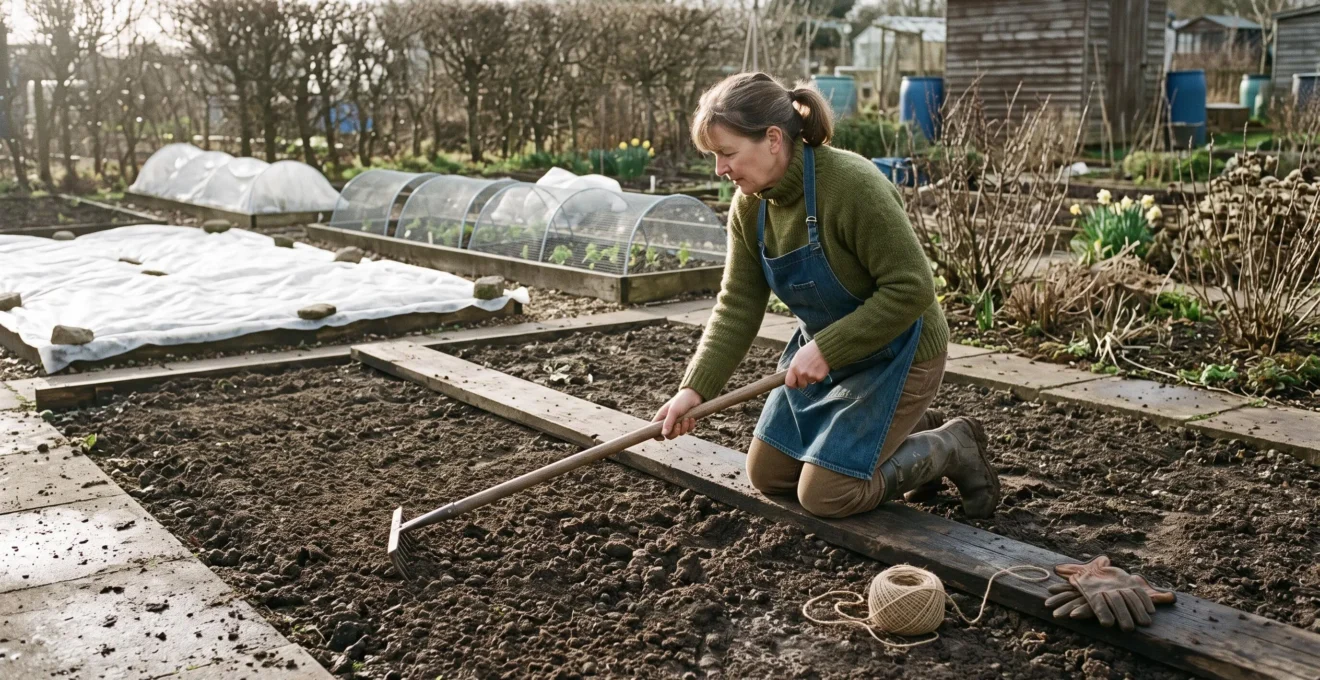
The most valuable early spring garden preparation begins before the weather feels like spring. Pruning suitable dormant plants, checking seed supplies, preparing protective covers and planning sowing dates all reduce the work competing for attention when conditions finally improve.
For a UK gardener accustomed to catching up every March, this advance organisation can make the difference between using the first suitable planting opportunity and missing it. Preparing seedbeds under cover, selecting appropriate early crops and scheduling successive sowings can also help extend the productive season.
A four-to-six-week extension is a planning objective, not a guaranteed harvest gain. The actual advantage depends on local frost risk, soil conditions, crop selection, protection and the weather that follows. Soil coverings may require four to six weeks of preparation themselves; that period should not be confused with an equivalent increase in harvesting time.
The practical aim is to complete work that can safely be done in winter, leaving only weather-dependent decisions for spring.
Early spring garden preparation: the essentials
- Finish time-sensitive dormant-season work and order essential supplies before the spring workload builds.
- Protect emerging perennials, avoid working wet soil and prepare the first seedbeds under suitable covers.
- Calculate sowing dates from local conditions, then use a weekly maintenance calendar to protect critical planting windows.
- Why Some Early Spring Garden Preparation Tasks Must Happen in February, Whatever the Weather
- How to Tidy the Garden in Early Spring Without Damaging Emerging Perennials
- Should You Prepare Seedbeds as Soon as Frost Clears or Wait for Soil to Dry?
- The Sowing Timing Mistake That Produces Weak Transplants from Premature February Starts
- When Should You Order Seeds and Garden Supplies to Avoid Spring Shortages?
- How to Build a Garden Maintenance Calendar That Ensures No Critical Task Gets Missed
- How to Build a Custom Planting Schedule for Your Specific Postcode and Microclimate
- Which Garden Maintenance Tasks Are Truly Essential Versus Optional for Healthy, Productive Gardens?
Why Some Early Spring Garden Preparation Tasks Must Happen in February, Whatever the Weather
February is the right time to complete certain garden preparation tasks because their deadlines depend on plant development or the approaching planting season, not on a spell of warm weather. Ordering seeds, servicing equipment and checking suitable dormant-season pruning can proceed while the soil remains frozen or waterlogged. Digging and sowing, by contrast, must wait for appropriate conditions.
The distinction matters because plant dormancy does not end according to a gardener’s preferred weekend. Different trees and shrubs respond to seasonal temperature patterns and internal development, with buds eventually moving towards active growth. Once that transition begins, the appropriate window for particular dormant-season operations may have passed.
Pruning requires particular discrimination. Some established deciduous plants benefit from pruning during dormancy, but spring-flowering shrubs may carry the flower buds that provide their next display. Stone-fruit trees also have different pruning requirements from many other fruit trees. February should therefore trigger a species-specific check, not indiscriminate cutting.
Similarly, dormant-season sprays should only be considered where a specific plant problem and an appropriately authorised product justify treatment. There is no reason to spray every dormant plant as routine preparation.
Organise February work into three categories:
| Priority | Typical tasks | Decision rule |
|---|---|---|
| Before bud break | Species-appropriate dormant pruning or moving suitable dormant plants | Check plant development and species requirements before acting. |
| Before workable soil is needed | Order seeds, plan beds, repair cloches, service tools and arrange soil protection | Complete preparations without entering saturated beds. |
| Flexible | Clean storage areas, reorganise labels and improve non-urgent garden infrastructure | Fit around critical work and suitable weather. |
The hidden cost of postponement is not simply that a task gets done later. It joins transplanting, direct sowing and weed management during the same limited spring weekends. An unfinished February list can quickly consume the time reserved for planting.
Once the time-sensitive work is identified, the next priority is making beds accessible without disturbing the plants and wildlife already sheltering there.
How to Tidy the Garden in Early Spring Without Damaging Emerging Perennials
Early spring garden cleanup should be selective rather than comprehensive. Clear paths and working areas first, then remove dead perennial growth carefully as new shoots become visible. Keep some stems and leaf litter undisturbed while overwintering insects remain sheltered, and avoid stepping directly onto wet beds or areas containing hidden perennial crowns.
A border that appears dormant in February may already contain fragile shoots beneath last year’s stems. Late-emerging perennials are particularly vulnerable because the absence of visible growth can be mistaken for an empty planting space.
Work from the edge of each bed towards the centre, checking the soil surface before cutting or reaching into established clumps. Mark plants whose positions are difficult to recognise. Where access is unavoidable, a temporary board can distribute weight, although waiting until the ground is firmer remains preferable.
Dead stems also serve a purpose beyond protecting the crowns below them. The University of Illinois Extension recommendations for spring garden cleanup explain that fallen leaves can shelter butterflies, moths and bumblebee queens, while old stems may provide nesting sites for solitary bees.
Its regional advice encourages delaying extensive clearance until conditions become reliably warmer. That guidance should not be treated as a fixed UK cleanup date: insect species emerge at different times, and a warm afternoon does not establish that all sheltered insects have departed.
A practical three-zone approach makes selective clearance easier:
- Paths and lawns: remove obstructions, deal with accumulated debris where necessary and restore safe access.
- Active borders: cut back dead growth gradually when new shoots can be identified, retaining suitable undisturbed habitat elsewhere.
- Late-emerging perennial areas: leave protective markers and avoid unnecessary disturbance until the position of new growth is clear.
When removing hollow stems, consider leaving suitable sections in a sheltered habitat area rather than immediately shredding or disposing of everything. Avoid spreading material showing signs of serious plant disease.
There is also a soil-management benefit to restraint. Repeated traffic on saturated ground can compact the soil, reducing pore space and making later cultivation more difficult. Long-handled tools and access from established paths often achieve enough without entering the beds.
A tidy garden need not be a bare garden. Once working areas are accessible, assess whether the soil beneath them is genuinely ready for preparation.
Should You Prepare Seedbeds as Soon as Frost Clears or Wait for Soil to Dry?
Wait until the soil is workable rather than preparing seedbeds immediately after a frost clears. Air temperature can rise while the soil remains cold, saturated and vulnerable to compaction. A simple squeeze test helps establish readiness: soil that breaks into small crumbs is more suitable for cultivation than soil that remains compressed into a sticky ball.
Thawed ground is not necessarily dry ground. Soil contains water and air within its pore spaces, and cultivation while excessively wet can compress or smear its structure. Clay-rich soils are especially susceptible to forming persistent clods when worked at the wrong moisture level.
The University of Minnesota Extension vegetable planting recommendations describe a straightforward test: squeeze some soil in your hand. At a suitable moisture level, it breaks into small clumps; if it retains the moulded shape, cultivation should be delayed. Soil sticking to shoes or tools is another warning sign.
Perform the test with soil from the bed and depth you intend to cultivate, rather than relying on the dry appearance of the surface.
There is no need to wait passively for every bed to warm naturally. According to the Royal Horticultural Society advice on warming soil for planting, cloches or horticultural fleece can encourage earlier sowing by warming protected soil. Winter coverings may need at least six weeks, while four weeks can be sufficient when installed later.
Coverings must be secured against wind, and their effectiveness depends on soil conditions. Waterlogged clay needs to shed excess moisture before meaningful warming can occur; a cloche may help by excluding additional rain. Opaque sheeting can also protect or suppress weeds, but it should not be assumed to offer the same warming conditions as transparent covers.
4–6 weeks
Indicative advance-covering periods described by the RHS: around four weeks when covering later, or at least six weeks during winter. These are preparation periods, not measured harvest extensions.
Royal Horticultural Society, guidance on pre-warming soil.
Prepare the earliest beds first, especially those intended for hardy crops such as peas, spinach, radishes or early carrots. Check soil temperature and each crop’s requirements before sowing. Keep later beds protected until their own planting windows approach.
A rolling two-week preparation horizon can serve as an organisational target: identify beds expected to be needed soon, test them individually and cultivate only those that are ready. It is not a rule that every bed must be prepared exactly fourteen days before sowing.
Properly prepared beds create an early opportunity, but seedlings must also be ready at the right time. Starting them indoors too soon can waste the advantage gained outdoors.
The Sowing Timing Mistake That Produces Weak Transplants from Premature February Starts
The common mistake is starting seedlings in February without checking when they can realistically be planted outside. Limited winter light, unsuitable indoor temperatures and a long wait before transplanting can produce tall, weak plants. A better approach is to calculate sowing dates backwards from local planting conditions and each crop’s required indoor growing period.
Germination and healthy development are different challenges. A warm room may encourage seeds to germinate, but seedlings also need sufficient light. When light is inadequate, stems can elongate as plants stretch towards the brightest available position. Windowsill-grown seedlings are particularly vulnerable during dull winter weather.
The University of Minnesota Extension advice on starting seeds indoors identifies tall, thin seedlings as a common windowsill problem and recommends suitable artificial lighting. Its crop-specific sowing schedules also demonstrate why a single February starting date is inappropriate for all vegetables.
For a UK garden, the calculation begins with a realistic outdoor planting window, including local frost risk and any protection available. Subtract the recommended indoor growing period for the particular crop, then allow sufficient time for gradual hardening off.
Consider a hypothetical tomato crop expected to be ready for outdoor planting after the site’s usual late-frost risk has passed. If the chosen variety’s instructions call for roughly six weeks of indoor growth, plus a hardening-off period, count backwards from that outdoor date. Do not automatically sow in February simply because the seed packet is already available.
Slow-developing crops may genuinely need an earlier start. The relevant question is whether adequate light, space and growing conditions can be maintained until planting becomes safe.
If seedlings have already become elongated, improve the light immediately and review temperature, watering and spacing. Potting on may provide necessary root space, but it should not be treated as a reliable method of slowing growth. Acclimatise transplants gradually before planting outside.
Where plants are severely weak and the outdoor planting window remains distant, resowing may be more practical than maintaining unsuitable seedlings. A later sowing under better light can sometimes catch up with an earlier one, although the exact outcome depends on the crop and conditions.
Once sowing dates are realistic, purchase decisions become easier: each packet and growing supply can be matched to a planned use rather than an impulse.
When Should You Order Seeds and Garden Supplies to Avoid Spring Shortages?
Order essential seeds and seasonal supplies during winter, once the planting plan is sufficiently clear. This gives more opportunity to choose preferred varieties, confirm availability and arrange alternatives before spring demand increases. Buy items needed for early growing first, while delaying bulky or short-lived materials when local purchasing closer to use is more practical.
Seasonal availability varies between retailers and years, so shortages should not be assumed for every seed variety or supplier. Nevertheless, leaving an essential purchase until the day of sowing creates an avoidable dependency: a missing packet, propagation tray or suitable compost can hold up the entire task.
Seed potatoes, onion sets, specific vegetable cultivars and propagation supplies deserve an early inventory check if they are central to the season’s plan. For each essential variety, identify an acceptable substitute before ordering. Match substitutes to the intended growing conditions and maturity requirements rather than selecting solely by appearance.
Use two purchasing lists:
- Must-have supplies: crops and materials that support the established planting schedule, with acceptable substitutes recorded beside them.
- Optional experiments: unusual varieties, additional crops and equipment improvements that can be omitted without disrupting essential work.
Check existing seed packets before purchasing replacements. Their age, storage conditions and expected viability matter; older seed may justify a germination check where practical. Avoid accumulating more seed than can reasonably be used while it remains viable.
Not everything benefits from early delivery. Living plants may require immediate appropriate care, and large compost purchases need suitable storage. Materials exposed to prolonged wet conditions can become inconvenient or unsuitable before use.
Ordering also establishes the practical limits of the planting plan. A calendar based on varieties that have not been obtained remains provisional. Once seed choices and expected delivery arrangements are confirmed, sowing windows and bed allocations become more dependable.
With tools, materials and crop choices accounted for, the next step is to turn scattered preparation jobs into a manageable weekly routine.
How to Build a Garden Maintenance Calendar That Ensures No Critical Task Gets Missed
Build a garden maintenance calendar around local planting milestones rather than generic monthly instructions. Record expected last-frost conditions, planned first sowings and deadlines for seasonal preparation. Then separate fixed tasks from observations that must be checked weekly, such as bud development, soil moisture and emerging weeds. Leave spare capacity for unsuitable weather and missed weekends.
Begin with two reference points: the site’s estimated last-frost period and the earliest realistic sowing opportunities for the intended crops. These are planning anchors, not guarantees. They help position seed starting, bed preparation, protection and transplanting in a sensible sequence.
A useful calendar has two layers. The first records actions that can be scheduled in advance: ordering seeds, checking tools, preparing labels and reviewing appropriate dormant-season pruning. The second lists environmental signals that determine when a task actually proceeds.
For instance, a calendar might specify a weekly soil check from the anticipated start of outdoor sowing. It should not insist that a bed must be cultivated on a particular Saturday regardless of moisture conditions.
Conduct a short weekly walkthrough and answer the same questions: Which plants are budding? Which beds have become workable? What has germinated? Are protection materials ready? Which task will lose its opportunity if postponed?
Create your five-part early spring garden plan
- Mark your seasonal anchors: record an estimated last-frost period and intended first outdoor sowing window on one calendar page.
- Inventory essential supplies: create a checked list of seeds, tools, covers and materials already available or still required.
- Assign beds to crop groups: produce a simple bed map showing the earliest planned sowings and the areas to protect first.
- Record conditional tasks: add weekly reminders to inspect soil moisture, new growth and frost forecasts rather than prescribing unsafe work dates.
- Identify backup priorities: mark essential deadlines and at least one deferrable task for busy or weather-disrupted weeks.
Maintain a small amount of spare capacity. Jobs such as tool-storage improvements may tolerate a delay of a fortnight, while an appropriate transplanting window or urgent frost protection may not. The calendar should make those differences visible before they become stressful.
Review completed work each week and move unfinished conditional tasks forward only when the relevant conditions justify doing so. A calendar that adapts to observation is more useful than a rigid schedule that becomes obsolete after one wet weekend.
A calendar provides structure, but it becomes more accurate when the garden’s own temperature differences and frost patterns are taken into account.
How to Build a Custom Planting Schedule for Your Specific Postcode and Microclimate
Create a postcode-specific planting schedule by combining nearby frost records with observations from your own garden. A regional last-frost estimate offers a starting point, but slopes, walls, exposure and cold-air accumulation can make individual beds behave differently. Map these differences, then assign early, intermediate and frost-sensitive crops to locations where their growing requirements are most likely to be met.
A postcode does not describe every condition within a garden. A sheltered bed near a sun-facing wall may warm earlier than exposed ground nearby. Conversely, a low-lying corner can collect cold air, allowing frost to persist after more elevated areas have thawed.
Use nearby weather-station information, gardening records from previous seasons and observations from neighbouring gardeners to estimate local frost patterns. Where records are limited, treat the first season as a period of measurement rather than pretending that a precise personal last-frost date is already known.
During cold mornings, record where frost remains longest and which beds thaw first. Note the areas that receive direct sunlight, the direction of prevailing exposure and where protected structures could be installed safely.
Divide the garden into three practical zones:
- Early zone: relatively sheltered beds that warm and drain sooner, suitable for considering the first hardy sowings when soil conditions permit.
- Intermediate zone: ordinary growing areas used as conditions improve and the main planting programme develops.
- Late or exposed zone: colder, wetter or windier locations where sowing may need to be delayed or protection strengthened.
For example, a hypothetical garden with a sheltered raised bed and a frost-prone lower border could use the raised bed for early spinach and radishes, provided the soil is workable. Tender plants would still require appropriate temperatures and frost protection; a sheltered position alone does not make them frost-proof.
Record the actual outcomes. If seeds repeatedly fail in one bed while the same crop establishes elsewhere, investigate soil moisture, temperature, pests and exposure before moving its next sowing date.
The greatest scheduling benefit often comes from combining suitable locations with successive sowing opportunities. Not every bed needs to begin production simultaneously. Hardy crops can occupy earlier-ready ground while later plantings follow as conditions improve.
These records will refine future schedules, but the plan must still work when time is limited. That requires deciding which maintenance tasks genuinely deserve priority.
What matters before the season gets busy
- A task becomes urgent when delay closes an important biological or planting window, not merely because it appears on a monthly list.
- Soil condition, local frost exposure and seedling readiness should override convenient but unsuitable calendar dates.
- Protecting work already invested in plants and seedbeds generally takes precedence over cosmetic improvements.
Which Garden Maintenance Tasks Are Truly Essential Versus Optional for Healthy, Productive Gardens?
Essential garden maintenance protects plant survival, soil condition and important growing windows. Optional work improves appearance, convenience or potentially productivity without causing major harm when postponed. Prioritise frost protection, suitable sowing and planting, necessary watering and serious plant-health problems before decorative tidying or non-urgent improvements. The distinction changes with the weather, season and crops being grown.
Most gardens have more possible jobs than available time. Effective management therefore depends on the consequences of missing a task, not the length of the to-do list.
For each job, ask three questions: Does the opportunity close soon? Will postponement make the problem substantially worse? Does this task protect plants, soil or materials already invested in?
Use the following comparison to make decisions during a crowded spring weekend.
| Task | Typical priority | Reason |
|---|---|---|
| Protect vulnerable transplants from a forecast frost | Essential | Delay may expose established young plants to irreversible damage. |
| Sow a crop during a suitable but limited planting window | Essential | Missing the opportunity may reduce or postpone the intended harvest. |
| Water newly planted crops when they genuinely need it | Essential | Moisture stress can threaten establishment. |
| Control weeds approaching seed production | High priority | Delay can increase subsequent weed-management work. |
| Complete ornamental edging or perfect border symmetry | Usually optional | Deferral normally affects appearance more than plant survival. |
| Reorganise an already functional tool shed | Optional | The task can generally wait without affecting planting opportunities. |
The familiar 80/20 principle offers a useful management mindset: concentrate effort on the smaller group of tasks with the greatest effect. It should not be interpreted as a measured claim that exactly 20% of garden work produces 80% of the harvest.
The same caution applies to a four-to-six-week growing-season extension. Early preparation, protective growing methods and successive sowings may create a longer productive window, but no fixed gain can be promised across different UK gardens.
When illness, workload or persistent rain disrupts the schedule, use a predetermined triage order. First protect vulnerable living plants. Next preserve any suitable planting opportunities and prevent avoidable soil damage. Then address worsening weed or plant-health problems. Defer decorative work and optional experiments until essential growing tasks are stable.
Do not compensate for lost time by cultivating saturated beds or planting tender crops into unsuitable conditions. A missed opportunity is inconvenient; an unnecessary setback to soil structure or plant establishment can create additional work.
For the next practical step, choose the earliest planned crop, check its sowing requirements and assign it to a suitable bed. Then complete one preparation task that can be done now without depending on warmer weather. Repeat the review weekly, allowing plant development and soil conditions to determine when the next stage begins.
Can early spring preparation really extend the growing season by four to six weeks?
It is a possible planning objective rather than a predictable result. Protected soil, suitably timed hardy crops and successive sowings may allow earlier or longer production. The outcome depends on local weather, soil, protection and crop choice. The RHS’s four-to-six-week soil-covering guidance describes preparation time, not a proven increase in harvest duration.
What can be done in February if the garden soil is still frozen or waterlogged?
Review appropriate dormant-season pruning, order essential seeds, clean and service tools, inspect plant supports, organise propagation supplies and prepare a seasonal calendar. Avoid digging saturated soil. Species-specific pruning requirements and plant development should determine whether cutting is appropriate.
Are cloches or fleece more useful for starting crops early?
Both can help protect and warm soil before sowing. The RHS identifies cloches as particularly useful on wet clay because excluding additional rainfall allows excess moisture to drain or evaporate. The best choice depends on drainage, wind exposure, bed size and the intended crop. Neither covering makes waterlogged soil immediately workable.
Should all perennials be cut back before new growth appears?
No. Some perennials retain useful winter shelter for insects, and their crowns may be difficult to locate before shoots emerge. Remove material selectively where access or plant health requires it, while retaining appropriate habitat elsewhere. Timing should reflect plant development and insect activity rather than a universal cleanup date.
What is the first task to prioritise after missing several spring gardening weekends?
Inspect vulnerable plants and immediate weather risks first. Then check whether any suitable sowing or transplanting window is approaching, and assess soil workability before intervening. Address problems likely to worsen quickly, such as weeds nearing seed production, while postponing decorative work and optional planting experiments.